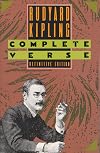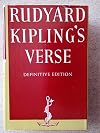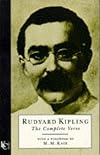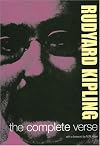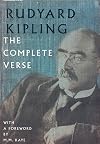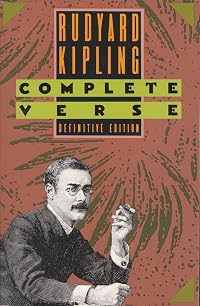
Kipling: The Complete Verse
by Rudyard Kipling 
On This Page
Description
A complete collection of Kipling's poetry.Tags
Recommendations

















Member Reviews
I get quite annoyed when I hear Rudyard Kipling being reduced to being 'the poet of manhood and masculinity'. It's so caricatural and simplistic! He wrote on so many different topics and with such a verve, range of moods, and style, that such narrowed labelling tends to get on my nerves.
Yes, for sure, as a man those political ideas were controversial (a staunch defender of the British Empire) he was obviously a jingoist, and, so, had an silly admiration for the military despite having himself never wore the uniform -let alone battled in a war as a soldier! One could therefore easily dismiss (or, at least, overlook) most of his 'barrack-room' verses as being no more than a child playing 'bang-bang-you're-dead!'. Yet, such poems are show more interesting because, funnily enough, their writing style reflects his romanticised militarism; from their powerful images to the repetitions of whole lines, reading like military parades and marches... There's is indeed something 'tough' about him. Quite admittedly, too, as a well travelled man (he had gone all around the world) his poems about boats and ships are also very 'masculine', and surprisingly creative given how limited such a topic must have been to expand upon. His portrayals are always about the rough and tough boats at war against the elements and chaotic seas, going onwards into adventures. But...
But, he also penned some cheeky and whimsy verses about the British ruling classes in India, showing him having no patience for the politicians and other pen-pushers of the British Home Office and their pettiness. His poems about India might be beautiful, but his mockeries and digs at whose administering it are certainly more delightful to read! Here's indeed another thing: whether he was laughing at the bureaucrats, praising the common soldiers, describing the common people no matter the cultures they belonged to, or, teasing with some womanising (again, he was more of a barrack-room type of poet than a troubadour...) Kipling was really good at describing the common man.
Now, of course, as a crusader for colonialism, he definitely was on the wrong side of history. 'The White Man's Burden' will always remain one of the most infamous poem ever written, and you certainly want to punch him in the face for his 'naivety' (I was about to type 'stupidity'...) at praising the likes of Cecil Rhodes! Jingoist and imperialist as he was, let's not forget, though, that he was also capable of displaying deep and heart-felt emotions; as in some of his poems about the First World War. Did grieving for his son soften him a bit?
Was he racist? Or 'merely' (well) a patronising ethnocentric?
Kipling? He may not have been a likeable man, but you cannot take away from him that he was a great poet. At the service of the wrong cause, but great nevertheless. show less
Yes, for sure, as a man those political ideas were controversial (a staunch defender of the British Empire) he was obviously a jingoist, and, so, had an silly admiration for the military despite having himself never wore the uniform -let alone battled in a war as a soldier! One could therefore easily dismiss (or, at least, overlook) most of his 'barrack-room' verses as being no more than a child playing 'bang-bang-you're-dead!'. Yet, such poems are show more interesting because, funnily enough, their writing style reflects his romanticised militarism; from their powerful images to the repetitions of whole lines, reading like military parades and marches... There's is indeed something 'tough' about him. Quite admittedly, too, as a well travelled man (he had gone all around the world) his poems about boats and ships are also very 'masculine', and surprisingly creative given how limited such a topic must have been to expand upon. His portrayals are always about the rough and tough boats at war against the elements and chaotic seas, going onwards into adventures. But...
But, he also penned some cheeky and whimsy verses about the British ruling classes in India, showing him having no patience for the politicians and other pen-pushers of the British Home Office and their pettiness. His poems about India might be beautiful, but his mockeries and digs at whose administering it are certainly more delightful to read! Here's indeed another thing: whether he was laughing at the bureaucrats, praising the common soldiers, describing the common people no matter the cultures they belonged to, or, teasing with some womanising (again, he was more of a barrack-room type of poet than a troubadour...) Kipling was really good at describing the common man.
Now, of course, as a crusader for colonialism, he definitely was on the wrong side of history. 'The White Man's Burden' will always remain one of the most infamous poem ever written, and you certainly want to punch him in the face for his 'naivety' (I was about to type 'stupidity'...) at praising the likes of Cecil Rhodes! Jingoist and imperialist as he was, let's not forget, though, that he was also capable of displaying deep and heart-felt emotions; as in some of his poems about the First World War. Did grieving for his son soften him a bit?
Was he racist? Or 'merely' (well) a patronising ethnocentric?
Kipling? He may not have been a likeable man, but you cannot take away from him that he was a great poet. At the service of the wrong cause, but great nevertheless. show less
While not everything he wrote was great --- sometimes he reminds me of Beerbohm's cartoon of Kipling on the town with his girl Britannia -- there is enough funny, moving and beautiful stuff in here to last me a lifetime.
This volume of 845 pages contains most of the poetical output of Rudyard Kipling. Many of his poems could be described as 'Jingoistic' and rightly so,but nevertheless they are still undoubtedly poems that still move the reader today. Even though the events leading to the composition of many of these pieces are long forgotten,still such poems as 'Boots' and 'The 'Eathen' will be well remembered. I love the poems ' The Glory of the Garden ' and 'Gunga Din'. Some,including this last maybe considered not to be politically correct in this day-and-age,but if read carefully,they will be seen to be full of respect for native troops ect.
Many will deride what is probably Kipling's most well-known piece 'IF----',but again if you read it carefully show more and take in his words,you will not go very far wrong,I believe. "If you can fill the unforgiving minute
With sixty seconds' worth of distance run,
Yours is the Earth and everything that's in it,
And-which is more-you'll be a man,my son! show less
Many will deride what is probably Kipling's most well-known piece 'IF----',but again if you read it carefully show more and take in his words,you will not go very far wrong,I believe. "If you can fill the unforgiving minute
With sixty seconds' worth of distance run,
Yours is the Earth and everything that's in it,
And-which is more-you'll be a man,my son! show less
I love this book I came across it in what we call a charity shop in Southgate North London where I was teaching at the time.
When I got home I scanned through the book to find on the inside page that the book belonged to a a Mr Alan Titchmarsh of the BBC London.
No idea if he lost it or threw it out, as a bibliophile and collector of books if he lost it I would give it back to him as I know the pain of losing a book I love.
My favourite Kipling poem is 'If'.
When I got home I scanned through the book to find on the inside page that the book belonged to a a Mr Alan Titchmarsh of the BBC London.
No idea if he lost it or threw it out, as a bibliophile and collector of books if he lost it I would give it back to him as I know the pain of losing a book I love.
My favourite Kipling poem is 'If'.
Magnificient, much underrated poet
storage 2025
Ratings
Members
- Recently Added By
Lists

Favourite Books
1,817 works; 316 members

CCE 1000 Good Books List
1,033 works; 12 members

Harold Bloom - The Western Canon: D. The Chaotic Age
833 works; 24 members
Author Information

2,458+ Works 90,992 Members
Kipling, who as a novelist dramatized the ambivalence of the British colonial experience, was born of English parents in Bombay and as a child knew Hindustani better than English. He spent an unhappy period of exile from his parents (and the Indian heat) with a harsh aunt in England, followed by the public schooling that inspired his "Stalky" show more stories. He returned to India at 18 to work on the staff of the Lahore Civil and Military Gazette and rapidly became a prolific writer. His mildly satirical work won him a reputation in England, and he returned there in 1889. Shortly after, his first novel, The Light That Failed (1890) was published, but it was not altogether successful. In the early 1890s, Kipling met and married Caroline Balestier and moved with her to her family's estate in Brattleboro, Vermont. While there he wrote Many Inventions (1893), The Jungle Book (1894-95), and Captains Courageous (1897). He became dissatisfied with life in America, however, and moved back to England, returning to America only when his daughter died of pneumonia. Kipling never again returned to the United States, despite his great popularity there. Short stories form the greater portion of Kipling's work and are of several distinct types. Some of his best are stories of the supernatural, the eerie and unearthly, such as "The Phantom Rickshaw," "The Brushwood Boy," and "They." His tales of gruesome horror include "The Mark of the Beast" and "The Return of Imray." "William the Conqueror" and "The Head of the District" are among his political tales of English rule in India. The "Soldiers Three" group deals with Kipling's three musketeers: an Irishman, a Cockney, and a Yorkshireman. The Anglo-Indian Tales, of social life in Simla, make up the larger part of his first four books. Kipling wrote equally well for children and adults. His best-known children's books are Just So Stories (1902), The Jungle Books (1894-95), and Kim (1901). His short stories, although their understanding of the Indian is often moving, became minor hymns to the glory of Queen Victoria's empire and the civil servants and soldiers who staffed her outposts. Kim, an Irish boy in India who becomes the companion of a Tibetan lama, at length joins the British Secret Service, without, says Wilson, any sense of the betrayal of his friend this actually meant. Nevertheless, Kipling has left a vivid panorama of the India of his day. In 1907, Kipling became England's first Nobel Prize winner in literature and the only nineteenth-century English poet to win the Prize. He won not only on the basis of his short stories, which more closely mirror the ambiguities of the declining Edwardian world than has commonly been recognized, but also on the basis of his tremendous ability as a popular poet. His reputation was first made with Barrack Room Ballads (1892), and in "Recessional" he captured a side of Queen Victoria's final jubilee that no one else dared to address. (Bowker Author Biography) show less
Rudyard Kipling has a Legacy Library. Legacy libraries are the personal libraries of famous readers, entered by LibraryThing members from the Legacy Libraries group.
Some Editions
Work Relationships
Is an expanded version of
Common Knowledge
- Canonical title
- Kipling: The Complete Verse
- First words
- Men make them fires on the hearth
Each under his roof-tree,
And the Four Winds that rule the earth
They blow the smokes to me. - Last words
- (Click to show. Warning: May contain spoilers.)But she ain't.
Classifications
Statistics
- Members
- 829
- Popularity
- 33,069
- Reviews
- 6
- Rating
- (4.22)
- Languages
- English
- Media
- Paper
- ISBNs
- 20
- ASINs
- 25