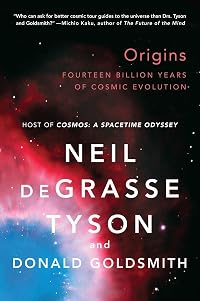
Origins: Fourteen Billion Years of Cosmic Evolution
by Neil deGrasse Tyson, Donald Goldsmith
On This Page
Description
A thrilling and accessible tour of the cosmosOur true origins are not just human, or even terrestrial, but in fact cosmic. Drawing on scientific breakthroughs and the current cross-pollination among geology, biology, astrophysics, and cosmology, Origins explains the soul-stirring leaps in our understanding of the cosmos. From the first image of a galaxy birth to Spirit rover's exploration of Mars, to the discovery of water on one of Jupiter's moons, coauthors Neil deGrasse Tyson and Donald show more Goldsmith conduct a galvanizing tour of the cosmos with clarity and exuberance. show lessTags
Recommendations


Member Reviews
Almost all of my stars on this one is for the ease for which Tyson explains the cosmos, the clarity, and the breadth of astrophysics itself.
The one star that's missing is just because it's all stuff I've read before. :) In other words, it's great if you're looking for an introductory and nearly math-less course on everything from the Big Bang to the formation of the planets to the building blocks and observed results of our search for extra-terrestrial life.
That's it. It's a great refresher, too, if that's your thing, and as for the tidbits like how we're figuring out and classifying the planets turning around other stars, there's even a great explanation for that, too. Hint: doppler shift. :)
All in all, it's very well-written and show more enjoyable if not crammed with surprises. It's meant to put our feet firmly in the science of we know well and of the others, the ones we understand more or less well, we qualify that we're always on the search for new and better questions in a game of controlled ignorance. :)
I totally recommend this for laymen and the curious. show less
The one star that's missing is just because it's all stuff I've read before. :) In other words, it's great if you're looking for an introductory and nearly math-less course on everything from the Big Bang to the formation of the planets to the building blocks and observed results of our search for extra-terrestrial life.
That's it. It's a great refresher, too, if that's your thing, and as for the tidbits like how we're figuring out and classifying the planets turning around other stars, there's even a great explanation for that, too. Hint: doppler shift. :)
All in all, it's very well-written and show more enjoyable if not crammed with surprises. It's meant to put our feet firmly in the science of we know well and of the others, the ones we understand more or less well, we qualify that we're always on the search for new and better questions in a game of controlled ignorance. :)
I totally recommend this for laymen and the curious. show less
Good as an introduction to the topics of cosmology, general astronomy, Drake's Equation and Fermi Paradox, the trouble is if you're already familiar enough to have read another introduction there's little left here to fill out an intermediary understanding. It's also presented in a fairly scattershot way and meanders into little essayist points that are familiar stomping grounds if you've listened to Tyson before.
"در آغاز فیزیک بود"
کتاب خیلی خوبی بود برای آشنایی با قسمتی از کلیات ابتدایی اخترفیزیک و پیدایش و تکامل هستی به زبان ساده، کاری که نیل دگریس تایسون معمولا خیلی خوب انجام می ده. من از شنیدنش لذت بردم گرچه قطعا خوندنش بازده بیشتری می تونست داشته باشه.
"نتیجه ای هست که چه از نظر باورمندان بشقاب پرنده ها و چه از ناباورمندان آن ها خدشه ناپذیر است. هرگاه جوامعی برون زمینی از زمین بازدید کنند باید بدانند که ما در پراکندن show more فراگیر اطلاعات و سرگرمی از توانمندی کامل برخورداریم نه در تفکیک این دو از هم" show less
کتاب خیلی خوبی بود برای آشنایی با قسمتی از کلیات ابتدایی اخترفیزیک و پیدایش و تکامل هستی به زبان ساده، کاری که نیل دگریس تایسون معمولا خیلی خوب انجام می ده. من از شنیدنش لذت بردم گرچه قطعا خوندنش بازده بیشتری می تونست داشته باشه.
"نتیجه ای هست که چه از نظر باورمندان بشقاب پرنده ها و چه از ناباورمندان آن ها خدشه ناپذیر است. هرگاه جوامعی برون زمینی از زمین بازدید کنند باید بدانند که ما در پراکندن show more فراگیر اطلاعات و سرگرمی از توانمندی کامل برخورداریم نه در تفکیک این دو از هم" show less
Arguably the most popular science communicator since Carl Sagan, Neil deGrasse Tyson, in collaboration with fellow astrophysicist Donald Goldsmith, delivers an engaging and sometimes humorous account of the origins of the universe, our solar system, our planet, and life on Earth. I read Origins shortly after watching Tyson’s Inexplicable Universe series and reading A Universe from Nothing by Lawrence M. Krauss. As such, some of the material covered in the book (as well as a few of Tyson’s jokes) was review, such as the types and nature of quarks, the expansion of the universe as demonstrated by the Doppler effect (something I learned while watching the original Cosmos as the age of nine), the formation (and naming) of the planets, show more moons, and asteroids in our solar system (learned in middle school and high school), and a tour of periodic table (it’s been a while!).
I enjoyed the refresher on topics such as the anthropic principle, ekpyrotic theory of the universe, homogeneous versus isotropic models of the universe, classifications of galaxies and of nebulae, methods for discovering exoplanets (some of which were also demonstrated in episode seven of Carl Sagan’s Cosmos series. At least some things haven’t changed!), measuring a star’s age by its depletion of lithium, the three branches of the tree of life (bacteria, archaea, and eukaryota), and much more.
Highly recommended! show less
I enjoyed the refresher on topics such as the anthropic principle, ekpyrotic theory of the universe, homogeneous versus isotropic models of the universe, classifications of galaxies and of nebulae, methods for discovering exoplanets (some of which were also demonstrated in episode seven of Carl Sagan’s Cosmos series. At least some things haven’t changed!), measuring a star’s age by its depletion of lithium, the three branches of the tree of life (bacteria, archaea, and eukaryota), and much more.
Highly recommended! show less
(posted on my blog: davenichols.net)
Astrophysicist Neil deGrasse Tyson has taken up the reins from the late Carl Sagan as the leading advocate for science education and instructional entertainment. Seen on outstanding programs such as PBS's NOVA series (which he now hosts), Tyson has Sagan's gift for expressing enthusiam for science which is infective. Origins, which Dr. Tyson wrote with astronomer Donald Goldsmith, offers the reader straightforward glimpses at some of the most fascinating processes and products in our Universe, from galactic clusters to biological evolution.
The writing in Origins is approachable by any level of science reader. There are only a couple of places where complex terms might fly over the head of a novice, show more but the authors keep the book focused on educating a reader new to the subjects without a dense recital of the math and theory behind each one.
The opening chapters deal with the early Universe, including the problems and possibilities of dark matter and dark energy, and then move on to galaxies and stars.
The authors spend a short time on planets before moving on to biological origins of life on earth and the possibilities of discovering life or the conditions which make life possible somewhere other than Earth.
While most of this information is well-known to any intermediate science reader (and likely to a great number of novice readers), the presentation is engaging and, in Tyson's unique way, enlightening even on subjects with which the reader is already familiar. The way chemistry is weaved into the discussion of star and planet formation, as well as how life depends on specific chemistries (or possibly not, as is also discussed) was very presented and added an excellent layer of insight into the astrophysical subject matter. Highly recommended for novice readers or for anyone who loves to read popular science that isn't dumbed down but also is not densely packed with high-level science jargon and data. Four stars. show less
Astrophysicist Neil deGrasse Tyson has taken up the reins from the late Carl Sagan as the leading advocate for science education and instructional entertainment. Seen on outstanding programs such as PBS's NOVA series (which he now hosts), Tyson has Sagan's gift for expressing enthusiam for science which is infective. Origins, which Dr. Tyson wrote with astronomer Donald Goldsmith, offers the reader straightforward glimpses at some of the most fascinating processes and products in our Universe, from galactic clusters to biological evolution.
The writing in Origins is approachable by any level of science reader. There are only a couple of places where complex terms might fly over the head of a novice, show more but the authors keep the book focused on educating a reader new to the subjects without a dense recital of the math and theory behind each one.
The opening chapters deal with the early Universe, including the problems and possibilities of dark matter and dark energy, and then move on to galaxies and stars.
The authors spend a short time on planets before moving on to biological origins of life on earth and the possibilities of discovering life or the conditions which make life possible somewhere other than Earth.
While most of this information is well-known to any intermediate science reader (and likely to a great number of novice readers), the presentation is engaging and, in Tyson's unique way, enlightening even on subjects with which the reader is already familiar. The way chemistry is weaved into the discussion of star and planet formation, as well as how life depends on specific chemistries (or possibly not, as is also discussed) was very presented and added an excellent layer of insight into the astrophysical subject matter. Highly recommended for novice readers or for anyone who loves to read popular science that isn't dumbed down but also is not densely packed with high-level science jargon and data. Four stars. show less
Ah... Astronomy. One my favorite subjects to read about! I love looking up at the stars and absorbing as much knowledge as I can about cosmology so it was only natural for me to pick up this book. Plus, if you've seen the show Cosmos then you should be familiar with the host and author Neil deGrasse Tyson, a very knowledgeable astrophysicist.
The book goes into detail about different parts of our universe, from the absolute colossal size of galaxies and the theory of how they formed to the infinitesimal atoms and nuetrinos. The creation of planets and stars are theories that are also touched upon. In the last chapter Neil talks about the possibility of life on other planets.
Tyson does a great job of explaining everything in Laymen's show more terms and sprinkles humor in there as well. I do recommend however that you have some knowledge of astronomy and physics because some jargon is used here. About two or three chapters get really mathematical and it made it difficult to follow so I felt I had to trudge through that information. I almost knodded off a couple of times.
There is also another version that was recently released called "Astrophysics for People in a Hurry" which is the same book but a shortened version.
I loved the book! I'll admit that there is some bias because I am a lover of science and I look up to Tyson as well as Carl Sagan! show less
The book goes into detail about different parts of our universe, from the absolute colossal size of galaxies and the theory of how they formed to the infinitesimal atoms and nuetrinos. The creation of planets and stars are theories that are also touched upon. In the last chapter Neil talks about the possibility of life on other planets.
Tyson does a great job of explaining everything in Laymen's show more terms and sprinkles humor in there as well. I do recommend however that you have some knowledge of astronomy and physics because some jargon is used here. About two or three chapters get really mathematical and it made it difficult to follow so I felt I had to trudge through that information. I almost knodded off a couple of times.
There is also another version that was recently released called "Astrophysics for People in a Hurry" which is the same book but a shortened version.
I loved the book! I'll admit that there is some bias because I am a lover of science and I look up to Tyson as well as Carl Sagan! show less
Neil deGrasse Tyson and Donald Goldsmith giving us the lowdown on what we know about the origins of--everything. The universe, the solar system, our own planet, life, and a good deal else. This book was written in 2004, so some things have already changed. For instance, Pluto and Ceres are now officially dwarf planets, and we know more about the moons of Jupiter and Saturn than we did eleven years ago. This is still a good, solid, interesting book, that will expand your knowledge of the universe we live in. It's a great read, or a great listen. I don't think I'm off base in saying that while Kevin Kenerly's voice doesn't really sound like Tyson's, he does have Tyson's speech patterns down, and for me that enhanced the listening show more experience.
Recommended. show less
Recommended. show less
Members
- Recently Added By
Lists

Physics
29 works; 3 members

Really awesome
10 works; 1 member
Author Information

59+ Works 15,673 Members
Astrophysicist Neil deGrasse Tyson was born in New York City on October 5, 1958. Interested in astronomy since he was a child, Tyson gave lectures on the topic at the age of 15. He attended the Bronx High School of Science and was the editor-in-chief for its Physical Science Journal. After earning a B.A. in Physics from Harvard in 1980, Tyson show more received an M.A. in Astronomy from the University of Texas at Austin in 1983. He earned his Ph.D. in Astrophysics from Columbia in 1991. Since 1996, Tyson has held the position of Frederick P. Rose Director of the Hayden Planetarium at Manhattan's American Museum of Natural History. In 2001, he was appointed by President George W. Bush to serve on the Commission on the Future of the United States Aerospace Industry. In 2004, Tyson joined the President's Commission on Implementation of United States Space Exploration Policy. He has hosted PBS's television show NOVA scienceNOW since 2006. Tyson can also be seen frequently as a guest on The Daily Show with Jon Stewart, The Colbert Report, and Late Night with Conan O'Brien. Tyson has written many popular books on astronomy, and he began his "Universe" column for Natural History magazine in 1995. In 2009, he published the bestselling book The Pluto Files: The Rise and Fall of America's Favorite Planet to describe the controversy over Pluto's demotion to dwarf planet. His other books include Accessory to War: The Unspoken alliance between astrophysics and the military. Tyson was recognized in 2004 with the NASA Distinguished Public Service Medal, and Time named him one of the 100 Most Influential People of 2007. (Bowker Author Biography) show less

39+ Works 1,960 Members
Awards and Honors
Distinctions
Notable Lists
Common Knowledge
- Original title
- Origins: Fourteen Billion Years of Cosmic Evolution
- Original publication date
- 2005
- Important events
- Big Bang
- Dedication
- To all those who look up,
And to all those who do not yet know
why they should - First words
- Preface
A new synthesis of scientific knowledge has emerged and continues to flourish.
Overture
Some 14 billion years ago, at the beginning of time, all the space and all the matter and all the energy of the known universe fit within a pinhead.
In the beginning, there was physics. - Last words
- (Click to show. Warning: May contain spoilers.)Let us go forth into a new dawn, ready to embrace the cosmos as it surrounds us, and as it reveals itself, shining with energy and replete with mystery.
(Click to show. Warning: May contain spoilers.)Coda
What we have discovered, the poets have known all along:
We shall not cease from exploration
And the end of all our exploring
Will be to arrive where we started
And know the place for the first time...
―T.S. Eliot, 1942
Classifications
Statistics
- Members
- 1,049
- Popularity
- 24,575
- Reviews
- 15
- Rating
- (3.91)
- Languages
- 5 — English, Italian, Polish, Portuguese, Spanish
- Media
- Paper, Audiobook, Ebook
- ISBNs
- 28
- UPCs
- 2
- ASINs
- 12