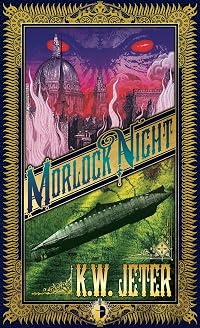
Morlock Night
by K. W. Jeter
On This Page
Description
Fantasy. Fiction. Science Fiction. Historical Fiction. HTML:JUST WHAT HAPPENED WHEN THE TIME MACHINE RETURNED? Having acquired a device for themselves, the brutish Morlocks return from the desolate far future to Victorian England to cause mayhem and disruption. But the mythical heroes of Old England have also returned, in the hour of the country's greatest need, to stand between England and her total destruction.File Under: Steampunk [ Coming Back | It’s About Time | Old Gods | Classic show more Steampunk ]. show less
Tags
Recommendations



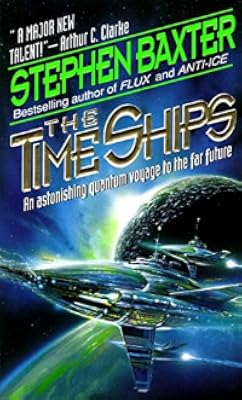













Member Recommendations
Member Reviews
from Todd:
This is one of the earliest steampunk novels (definitely the first one by an American author), and it has everything one could want. It deals with an historical London, but asks what would happen if a fixed time portal accidentally opened up between the future world discovered in H. G. Well's Time Machine and the actual historical world known to Wells in 1895 at the time he published that novel. Specifically, what if the intelligent species of that world, the Morlocks, were able to go back in time to visit Late Victorian London, and Jeter's sequel explores the key question: what would they do? The hell that breaks loose takes us through London's labyrinthine sewer system and to other points of intrigue in Europe, and even show more involves ancient guardians of the Isle of Britain. The whole quantum balance of temporal reality comes under threat, and an apocalyptic fight ensues between scientific mages representing the ideologies of chaos and order. An enjoyable crew of everyday people carries out the fight to save London...and the planet. show less
This is one of the earliest steampunk novels (definitely the first one by an American author), and it has everything one could want. It deals with an historical London, but asks what would happen if a fixed time portal accidentally opened up between the future world discovered in H. G. Well's Time Machine and the actual historical world known to Wells in 1895 at the time he published that novel. Specifically, what if the intelligent species of that world, the Morlocks, were able to go back in time to visit Late Victorian London, and Jeter's sequel explores the key question: what would they do? The hell that breaks loose takes us through London's labyrinthine sewer system and to other points of intrigue in Europe, and even show more involves ancient guardians of the Isle of Britain. The whole quantum balance of temporal reality comes under threat, and an apocalyptic fight ensues between scientific mages representing the ideologies of chaos and order. An enjoyable crew of everyday people carries out the fight to save London...and the planet. show less
I'm not sure how to rate this, because this book was hilariously hack. It was a quick, fun read in a high camp sense. I wonder if anyone has ever done a graphic novel version of this (the fact that I'm not even interested enough to look this up probably says something), because it seems like the kind of thing that would work even better with visuals, the Edwardian guy gaping at the Morlocks swarming all over London with an "OMFG!" look.
So yeah, it's a sequel to The Time Machine in which the Morlocks come back to London, and then ... you know, have to be stopped from their nefarious plans. There is also a submarine (which was confusing because where is it going to go?). It's a book where all the action just happens ... there isn't a lot show more of why involved, and what is there is delivered in goofy expositions.
But still, it was fun and moderately interesting to see some landmarks of science fiction come together -- clearly The Time Machine continues to be influential, and this book came about in the early days of steampunk so it does feel like it connects some dots if one is into that.
I also liked this quote, from the protagonist, who is one of the guys who was at the dinner in the Wells book where the inventor tells his story, and is then walking home in this book where he gets suddenly caught up in the Morlock invasion. Because who expects that, right? Anyway:
"The problem with secret knowledge, I mused bitterly, is that no one ever wants to tell you any of it." So I think it's clear that Jeter is in on the winkingness of it all. show less
So yeah, it's a sequel to The Time Machine in which the Morlocks come back to London, and then ... you know, have to be stopped from their nefarious plans. There is also a submarine (which was confusing because where is it going to go?). It's a book where all the action just happens ... there isn't a lot show more of why involved, and what is there is delivered in goofy expositions.
But still, it was fun and moderately interesting to see some landmarks of science fiction come together -- clearly The Time Machine continues to be influential, and this book came about in the early days of steampunk so it does feel like it connects some dots if one is into that.
I also liked this quote, from the protagonist, who is one of the guys who was at the dinner in the Wells book where the inventor tells his story, and is then walking home in this book where he gets suddenly caught up in the Morlock invasion. Because who expects that, right? Anyway:
"The problem with secret knowledge, I mused bitterly, is that no one ever wants to tell you any of it." So I think it's clear that Jeter is in on the winkingness of it all. show less
This is a jolly old romp, written in 1979, but it doesn’t deserve the praise heaped on it by Tim Powers in his introduction and implicitly in the intelligent backgrounder by Adam Roberts at the end.
Powers’ own ‘Anubis Gates’ (1983) is vastly superior as one of the originating texts of ‘steampunk’
‘Morlock Night’ quite simply does not stand up to scrutiny as the equivalent of, say, ‘Neuromancer’, the genuinely well written founding novel of Cyberpunk.
Roberts does, however, usefully point out the equal debt that the book pays to a very different American classic, Twain’s ‘Connecticut Yankee at the Court of King Arthur’.
In fact, the book is quite poorly written with a version of late-Imperial Britain that show more reminds one of similar American failures to capture the authentic voice of England.
I was reminded of the lamentable performance of Dick Van Dyke in ‘Mary Poppins’ which caused every Brit to cringe in their cinema seat – in this case, mangling English literature through youthful enthusiasm.
The premise is that Jeter picks up where HG Wells left off in 'The Time Machine’ but he misses the point that Wells was writing a novella of science.
'The Time Machine' was a just-on-the-edge-of-believable tale of space and time as it might be accepted by a moderately educated European of the late nineteenth century.
Eighty or so years on, Jeter’s version has no credible science in it at all, not even within the late nineteenth century context it purports to represent.
With its simple prose and hackneyed representations of the English gentleman, it has little literary merit.
It is, however, maniacally fun. The book does have an insane energy, more like a comic book or Hollywood blockbuster than a novel.
H.G. Wells’ novel, the psycho-geography of London’s sewers, Arthurian myth, the legend of Atlantis and the trope of the ‘bad Hun’ (a hint of Wewelsberg) give us a rollicking mish-mash that certainly entertains.
Once our heroes go down into the London sewers, the book becomes an extended dream sequence masquerading as a novel. Indeed, one has to suspend belief because there is nowhere else to turn.
One suspects that the opiate pleasures of Coleridge and De Quincey might well be cited as sources!
The geeky post-adolescence of it all is epitomised in the portrayal of a female side-kick. Mr. Jeter clearly had no interest in mere girls.
We are given a tight-lipped cipher, Tafe, as if the author was at a total loss as to how to give reality to some fantasy that was in his head but was unable or unwilling to have translated on to the page.
This book is thus either of historical interest to genre historians or a way to lose oneself in nonsense for a day or so but it is not really much more than that.
My recommendation, since life is short, is that, if you want to see how modern science fiction writers have taken Wells and developed his story intelligently, you should go straight to two other books.
Try Steve Baxter’s ‘The Time Ships’ or to Christopher Priest’s ‘The Space Machine’. Both are masterpieces of genre fiction.
Having said all that, I did enjoy myself reading it and so might you. Just don’t allow anyone to tell you to take it seriously.
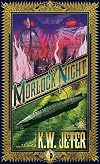
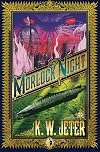
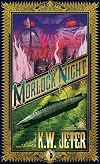
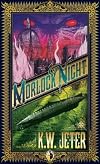
(The cover design of this edition by John Coulthart, who has an excellent blog on design called ‘{Feuilleton}’, is perfect and it certainly seduced me into the book. This will keep it in the library.) show less
Powers’ own ‘Anubis Gates’ (1983) is vastly superior as one of the originating texts of ‘steampunk’
‘Morlock Night’ quite simply does not stand up to scrutiny as the equivalent of, say, ‘Neuromancer’, the genuinely well written founding novel of Cyberpunk.
Roberts does, however, usefully point out the equal debt that the book pays to a very different American classic, Twain’s ‘Connecticut Yankee at the Court of King Arthur’.
In fact, the book is quite poorly written with a version of late-Imperial Britain that show more reminds one of similar American failures to capture the authentic voice of England.
I was reminded of the lamentable performance of Dick Van Dyke in ‘Mary Poppins’ which caused every Brit to cringe in their cinema seat – in this case, mangling English literature through youthful enthusiasm.
The premise is that Jeter picks up where HG Wells left off in 'The Time Machine’ but he misses the point that Wells was writing a novella of science.
'The Time Machine' was a just-on-the-edge-of-believable tale of space and time as it might be accepted by a moderately educated European of the late nineteenth century.
Eighty or so years on, Jeter’s version has no credible science in it at all, not even within the late nineteenth century context it purports to represent.
With its simple prose and hackneyed representations of the English gentleman, it has little literary merit.
It is, however, maniacally fun. The book does have an insane energy, more like a comic book or Hollywood blockbuster than a novel.
H.G. Wells’ novel, the psycho-geography of London’s sewers, Arthurian myth, the legend of Atlantis and the trope of the ‘bad Hun’ (a hint of Wewelsberg) give us a rollicking mish-mash that certainly entertains.
Once our heroes go down into the London sewers, the book becomes an extended dream sequence masquerading as a novel. Indeed, one has to suspend belief because there is nowhere else to turn.
One suspects that the opiate pleasures of Coleridge and De Quincey might well be cited as sources!
The geeky post-adolescence of it all is epitomised in the portrayal of a female side-kick. Mr. Jeter clearly had no interest in mere girls.
We are given a tight-lipped cipher, Tafe, as if the author was at a total loss as to how to give reality to some fantasy that was in his head but was unable or unwilling to have translated on to the page.
This book is thus either of historical interest to genre historians or a way to lose oneself in nonsense for a day or so but it is not really much more than that.
My recommendation, since life is short, is that, if you want to see how modern science fiction writers have taken Wells and developed his story intelligently, you should go straight to two other books.
Try Steve Baxter’s ‘The Time Ships’ or to Christopher Priest’s ‘The Space Machine’. Both are masterpieces of genre fiction.
Having said all that, I did enjoy myself reading it and so might you. Just don’t allow anyone to tell you to take it seriously.
(The cover design of this edition by John Coulthart, who has an excellent blog on design called ‘{Feuilleton}’, is perfect and it certainly seduced me into the book. This will keep it in the library.) show less
On the cover this is portrayed as the first Steampunk novel. That is poppycock.
What it is is an odd little semi-sequel to The Time Machine. Which starts out in the Wells area before suddenly taking a left turn into Arthurian mysticism as Merlin attempts to gather a group to defeat the Morlocks.
Towards the end it takes another abrupt shift, almost as if the author has become bored of the book and decided to wrap it up quickly. Leading to a terrible final chapter of the hero reporting on how he won.
I was hoping for a lot more from this and am really quite disappointed. Go read Stephen Baxter's Time Ships instead.
What it is is an odd little semi-sequel to The Time Machine. Which starts out in the Wells area before suddenly taking a left turn into Arthurian mysticism as Merlin attempts to gather a group to defeat the Morlocks.
Towards the end it takes another abrupt shift, almost as if the author has become bored of the book and decided to wrap it up quickly. Leading to a terrible final chapter of the hero reporting on how he won.
I was hoping for a lot more from this and am really quite disappointed. Go read Stephen Baxter's Time Ships instead.
Originally posted at FanLit.
http://www.fantasyliterature.com/reviews/morlock-night/
K.W. Jeterƒ??s Morlock Night (1979) is often cited as the first novel to be categorized at Â??steampunk.Â? In a 1987 letter to Locus magazine, Jeter coined the term in an effort to describe the types of stories that he and his friends Tim Powers and James P. Blaylock were writing:
Personally, I think Victorian fantasies are going to be the next big thing, as long as we can come up with a fitting collective term for Powers, Blaylock and myself. Something based on the appropriate technology of that era; like Â??steam-punksÂ??, perhaps.
As Tim Powers explains in his introduction to Morlock Night, Jeter wrote this book in 1976 for a British show more publisher who requested ten novels about King Arthur being reincarnated to come to EnglandÂ??s rescue at different points in that countryÂ??s history. Powers, Blaylock and Jeter agreed to write the novels. When they divvied up the history, Jeter ended up with the Victorian era.
For Morlock Night, he decided to write a steampunk �?sequel� to H.G. Well�?s The Time Machine. The premise is that the Morlocks, those brutish troglodytes who are our far-future descendants in Wells�? story, used the time machine to travel back to Victorian London where they plan to take over the city. Their use of the machine has created a channel in time that could make time collapse. Thus, it�?s not just England that�?s in danger, but the entire universe.
King Arthur, who keeps being reborn but never realizes who he is until heÂ??s needed, must come to the rescue. To do this, heÂ??ll need Excalibur which, unfortunately, has also been traveling through time and has been divided into three parts. The narrator of Morlock Night, along with an adventurous woman wearing menÂ??s clothing, must find the Excaliburs so that Arthur can get his power back. This requires various excursions into the seedy parts of London and its sewers.
I think itÂ??s important to remember the purpose of Morlock Night (a steampunk story about King Arthur) when judging the novel. As a madcap Victorian adventure fantasy, it works well enough, and is similar in many ways to JeterÂ??s Infernal Devices. The plot is quick, a bit silly, and doesnÂ??t hold up well to excessive scrutiny (e.g., Why is Arthur the only one who can beat the Morlocks? DoesnÂ??t England have an army for this?). Characterization is thin (e.g., What is the woman in menÂ??s clothing doing there? She doesnÂ??t contribute much and itÂ??s easy to forget sheÂ??s tagging along, though our narrator mentions that she makes a good companion. Is she a counterpart to Weena, the Time TravelerÂ??s female companion in The Time Machine?) Nevertheless, the setting feels genuine and the humor feels appropriately Victorian (e.g., I thought the toshing in the London sewers was hilarious).
So as a steampunk adventure, which is what it is, Morlock Night is successful. But as a �?sequel� to The Time Machine, as some (including Wikipedia) have called it, it doesn�?t work very well. The story contains many elements of, and allusions to, The Time Machine, but it�?s not meant as pastiche. The focus is definitely on wacky exploits in a foggy gas-lit London and not as a continuation of Wells�? thought-provoking warning about a possible future of human society. If you�?re expecting a sequel to The Time Machine, you�?ll be disappointed. If you�?re expecting to read the first steampunk novel, you�?ll probably be satisfied.
Thanks to Angry Robot for publishing this classic and to Brilliance Audio for putting it in audio format. Michael Page does a great job with the narration. I donÂ??t like his voice for the woman (but she doesnÂ??t speak much), but I thought he sounded just like a 19th century Englishman. show less
http://www.fantasyliterature.com/reviews/morlock-night/
K.W. Jeterƒ??s Morlock Night (1979) is often cited as the first novel to be categorized at Â??steampunk.Â? In a 1987 letter to Locus magazine, Jeter coined the term in an effort to describe the types of stories that he and his friends Tim Powers and James P. Blaylock were writing:
Personally, I think Victorian fantasies are going to be the next big thing, as long as we can come up with a fitting collective term for Powers, Blaylock and myself. Something based on the appropriate technology of that era; like Â??steam-punksÂ??, perhaps.
As Tim Powers explains in his introduction to Morlock Night, Jeter wrote this book in 1976 for a British show more publisher who requested ten novels about King Arthur being reincarnated to come to EnglandÂ??s rescue at different points in that countryÂ??s history. Powers, Blaylock and Jeter agreed to write the novels. When they divvied up the history, Jeter ended up with the Victorian era.
For Morlock Night, he decided to write a steampunk �?sequel� to H.G. Well�?s The Time Machine. The premise is that the Morlocks, those brutish troglodytes who are our far-future descendants in Wells�? story, used the time machine to travel back to Victorian London where they plan to take over the city. Their use of the machine has created a channel in time that could make time collapse. Thus, it�?s not just England that�?s in danger, but the entire universe.
King Arthur, who keeps being reborn but never realizes who he is until heÂ??s needed, must come to the rescue. To do this, heÂ??ll need Excalibur which, unfortunately, has also been traveling through time and has been divided into three parts. The narrator of Morlock Night, along with an adventurous woman wearing menÂ??s clothing, must find the Excaliburs so that Arthur can get his power back. This requires various excursions into the seedy parts of London and its sewers.
I think itÂ??s important to remember the purpose of Morlock Night (a steampunk story about King Arthur) when judging the novel. As a madcap Victorian adventure fantasy, it works well enough, and is similar in many ways to JeterÂ??s Infernal Devices. The plot is quick, a bit silly, and doesnÂ??t hold up well to excessive scrutiny (e.g., Why is Arthur the only one who can beat the Morlocks? DoesnÂ??t England have an army for this?). Characterization is thin (e.g., What is the woman in menÂ??s clothing doing there? She doesnÂ??t contribute much and itÂ??s easy to forget sheÂ??s tagging along, though our narrator mentions that she makes a good companion. Is she a counterpart to Weena, the Time TravelerÂ??s female companion in The Time Machine?) Nevertheless, the setting feels genuine and the humor feels appropriately Victorian (e.g., I thought the toshing in the London sewers was hilarious).
So as a steampunk adventure, which is what it is, Morlock Night is successful. But as a �?sequel� to The Time Machine, as some (including Wikipedia) have called it, it doesn�?t work very well. The story contains many elements of, and allusions to, The Time Machine, but it�?s not meant as pastiche. The focus is definitely on wacky exploits in a foggy gas-lit London and not as a continuation of Wells�? thought-provoking warning about a possible future of human society. If you�?re expecting a sequel to The Time Machine, you�?ll be disappointed. If you�?re expecting to read the first steampunk novel, you�?ll probably be satisfied.
Thanks to Angry Robot for publishing this classic and to Brilliance Audio for putting it in audio format. Michael Page does a great job with the narration. I donÂ??t like his voice for the woman (but she doesnÂ??t speak much), but I thought he sounded just like a 19th century Englishman. show less
OK first "steampunk" novel. Sequel to Wells' Time Machine. Brings new elements to the story.
Ratings
Members
- Recently Added By
Lists

Best Time Travel Novels
165 works; 123 members

Favourite Steampunk Books
80 works; 15 members

Readers Guide to Steampunk
65 works; 1 member

Forced Exposure
83 works; 1 member
Author Information

62+ Works 9,715 Members
Some Editions
Series
Belongs to Publisher Series
Work Relationships
Is a (non-series) sequel to
Common Knowledge
- Canonical title
- Morlock Night
- Original title
- Morlock Night
- Original publication date
- 1979
- People/Characters
- Edwin Hocker; King Arthur; Merlin/Dr. Ambrose
- Important places
- London, England, UK
- Epigraph
- '... and another - a quiet, shy man with a beard - whom I didn't know, and who, as far as my observation went, never opened his mouth all the evening' H. G. Wells,The Time Machine
- First words
- "An astonishing narrative, don't you think?"
- Last words
- (Click to show. Warning: May contain spoilers.)Only a little time had passed when the darkness folded about me like the softest and warmest of shrouds. And then, in that time and place - our Lord's year 1982 in Victoria's England - I saw no more.
- Original language
- English
- Canonical DDC/MDS
- 813.087627
Classifications
- Genres
- Science Fiction, Fiction and Literature
- DDC/MDS
- 813.087627 — Literature & rhetoric American literature in English American fiction in English By type Genre fiction Adventure fiction Speculative fiction Science fiction Steampunk
- LCC
- PS3560 .E85 — Language and Literature American literature American literature Individual authors 1961-
- BISAC
Statistics
- Members
- 340
- Popularity
- 93,064
- Reviews
- 6
- Rating
- (3.10)
- Languages
- English, German, Italian
- Media
- Paper, Ebook
- ISBNs
- 12
- ASINs
- 4