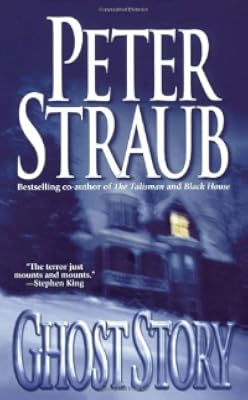
Ghost Story
by Peter Straub
On This Page
Description
#1 New York Times bestselling author Peter Straub's classic tale of horror, secrets, and the dangerous ghosts of the past... What was the worst thing you've ever done? In the sleepy town of Milburn, New York, four old men gather to tell each other stories--some true, some made-up, all of them frightening. A simple pastime to divert themselves from their quiet lives. But one story is coming back to haunt them and their small town. A tale of something they did long ago. A wicked mistake. A show more horrifying accident. And they are about to learn that no one can bury the past forever... show lessTags
Recommendations











Member Recommendations
Member Reviews
Ghost Story was Peter Straub's breakout novel in 1979, and I remember seeing it in the "new" section of my local public library at the time. The publisher flogged it as a supernatural horror book with literary merit, and it was a fair boast. Straub was an admirable prose stylist, and his monsters have come a long way from their folklore and pulp origins. I found precursor comparanda in some of Seabury Quinn's semi-traditional creatures and most especially Jack Williamson's Darker Than You Think. Straub, who would eventually edit the two-volume American Fantastic Tales: Terror and the Uncanny for Library of America, consciously adverts to his more literary antecedents Nathaniel Hawthorne and Henry James, even going so far as to name two show more central characters Ricky Hawthorne and Sears James.
It's a big book, with the storytelling heft of, say, a full season of the Stranger Things television horror drama. Like that show, it is multigenerational in scope, although Straub's key ensemble is geriatric rather than adolescent. And Straub's imagined town of Milburn, New York provides the Hawthorne-to-HPL New England sense of a lost frontier buried deep in the unconscious, rather than the vulnerable bucolic Midwestern sensibility of Hawkins, Indiana. All sorts of characters are powerfully drawn, with relationship tensions extending in every direction.
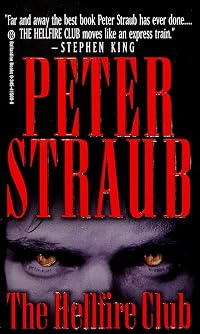
The body of the book provides several layers of background for the frame story focused on the horror novelist Don Wanderly. There is naturally some metafictional positioning that results, both from Wanderly's metier and from the ghost-storytelling preoccupation of the Chowder Society, the clique of old friends around whom most of the novel is constructed. The climax takes place in late December, thus attaching the book to the English tradition of the Christmas ghost story, for which those of M.R. James are paragons. While there was less metafictional meat here than in Straub's later book The Hellfire Club (i.e. Wanderly's The Nightwatcher is neither so well-developed nor so pivotal to the story as Hugo Driver's Night Journey), it still put a shine on the writing.
I have not yet seen the 1981 movie which was "loosely based" on the novel, but the book itself gives more than a little attention to cinema. Attorney Ricky Hawthorne is a movie aficionado given to describing people in terms of old screen icons, and he is friends with the proprietor of the local picture show. A key background character Eva Galli was a film actress, having appeared in a single silent film China Pearl (1925), and there is also important business involving a more recent actress Ann-Veronica Moore. The film of Ghost Story turned out to be the final screen appearance of Fred Astaire (in the role of Ricky Hawthorne), and Astaire is actually name-checked in the novel: "... Clark Gable in a bush jacket turning into Dan Duryea in a gangster's nipped-in-suit turning into graceful, winning Fred Astaire in a Chowder Society tuxedo" (465).
My copy of this book is the first edition, which has a feature of interest extirpated from later re-issues. The chapter "Alma" (181-221) details Wanderly's previous marital engagement during a brief university gig in Berkeley, California. By way of making the Alma character mysterious and creepy, Straub associated her with something presented as more dreadful than "California lunacy at its worst," to wit: "O.T.O. ... Ordo Templi Orientis ... raw material for nightmares" (194-5). Some incidental details demonstrate that Straub's awareness of O.T.O. was almost certainly based on press coverage of the Solar Lodge pretender organization. In any case, he never presents any specific characters or activities as being part of O.T.O., he just uses the allusion for nebulous menace. Since the actual O.T.O. was operating in Berkeley in 1979, they felt a bit slandered and reached out to Straub, who graciously apologized and made an edit for later printings to change the name to an occult order of his own invention: Xala Xalior Xiati.
The rich character development in this book is the feature that makes it most effective as supernatural horror, in my opinion. You can't be very afraid for people you don't care about. On the other hand, there are doubtless adrenaline junkies for whom the pace of this novel with its nested retrospection is just too slow to keep them engaged. (I've certainly read complaints to that effect online.) It continues to find a place in "best of" horror indices, and it deserves one. show less
It's a big book, with the storytelling heft of, say, a full season of the Stranger Things television horror drama. Like that show, it is multigenerational in scope, although Straub's key ensemble is geriatric rather than adolescent. And Straub's imagined town of Milburn, New York provides the Hawthorne-to-HPL New England sense of a lost frontier buried deep in the unconscious, rather than the vulnerable bucolic Midwestern sensibility of Hawkins, Indiana. All sorts of characters are powerfully drawn, with relationship tensions extending in every direction.
The body of the book provides several layers of background for the frame story focused on the horror novelist Don Wanderly. There is naturally some metafictional positioning that results, both from Wanderly's metier and from the ghost-storytelling preoccupation of the Chowder Society, the clique of old friends around whom most of the novel is constructed. The climax takes place in late December, thus attaching the book to the English tradition of the Christmas ghost story, for which those of M.R. James are paragons. While there was less metafictional meat here than in Straub's later book The Hellfire Club (i.e. Wanderly's The Nightwatcher is neither so well-developed nor so pivotal to the story as Hugo Driver's Night Journey), it still put a shine on the writing.
I have not yet seen the 1981 movie which was "loosely based" on the novel, but the book itself gives more than a little attention to cinema. Attorney Ricky Hawthorne is a movie aficionado given to describing people in terms of old screen icons, and he is friends with the proprietor of the local picture show. A key background character Eva Galli was a film actress, having appeared in a single silent film China Pearl (1925), and there is also important business involving a more recent actress Ann-Veronica Moore. The film of Ghost Story turned out to be the final screen appearance of Fred Astaire (in the role of Ricky Hawthorne), and Astaire is actually name-checked in the novel: "... Clark Gable in a bush jacket turning into Dan Duryea in a gangster's nipped-in-suit turning into graceful, winning Fred Astaire in a Chowder Society tuxedo" (465).
My copy of this book is the first edition, which has a feature of interest extirpated from later re-issues. The chapter "Alma" (181-221) details Wanderly's previous marital engagement during a brief university gig in Berkeley, California. By way of making the Alma character mysterious and creepy, Straub associated her with something presented as more dreadful than "California lunacy at its worst," to wit: "O.T.O. ... Ordo Templi Orientis ... raw material for nightmares" (194-5). Some incidental details demonstrate that Straub's awareness of O.T.O. was almost certainly based on press coverage of the Solar Lodge pretender organization. In any case, he never presents any specific characters or activities as being part of O.T.O., he just uses the allusion for nebulous menace. Since the actual O.T.O. was operating in Berkeley in 1979, they felt a bit slandered and reached out to Straub, who graciously apologized and made an edit for later printings to change the name to an occult order of his own invention: Xala Xalior Xiati.
The rich character development in this book is the feature that makes it most effective as supernatural horror, in my opinion. You can't be very afraid for people you don't care about. On the other hand, there are doubtless adrenaline junkies for whom the pace of this novel with its nested retrospection is just too slow to keep them engaged. (I've certainly read complaints to that effect online.) It continues to find a place in "best of" horror indices, and it deserves one. show less
I always had a bit of a preference for Peter Straub over Stephen King. Both superb writers, Straub did not have King's tendency to clown around with his writing, to splurge words all over the page. I realised, rereading this, that the difference beteween Straub and King is like the difference between classic ghost stories and pulp horror. It's clear from this that Straub reveres the old-school styilings of Hawthorne, James and James. It's centred around a group of old men who sit around in formal evening wer telling each other ghost stories for God's sake, and the example we get is an homage to The Turn Of The Screw. Straub is conservative, intellectual, formal, and it shows through in his writing and his structure, but at the end of show more the day it's still a massive town-besieged-by-evil story that became the mainstay of eighties doorstop horror.
It opens, of course, with that eerie, unsettling image - a man driving somewhere with a child he has just taken. The air of mystery and dread surrounding this is unmatched in anything else I've ever read. The rest of the book delivers on the promise of this opening, but I will say there's one part set on a college campus that made me want to punch the character when he started interrogating a young woman he had only just met about her love life - we may have dodged a bullet in not losing Straub to what I think they call The College Novel, or maybe he just exorcised that literary inclination here. Yuk. Maybe it was the Evil Influence Of Evil (because she turns out to be Evil), or maybe men talked to women like that in the 70s?
Anyway, classic, brilliant horror novel, full of heart and atmosphere and occasional splatters of blood. show less
It opens, of course, with that eerie, unsettling image - a man driving somewhere with a child he has just taken. The air of mystery and dread surrounding this is unmatched in anything else I've ever read. The rest of the book delivers on the promise of this opening, but I will say there's one part set on a college campus that made me want to punch the character when he started interrogating a young woman he had only just met about her love life - we may have dodged a bullet in not losing Straub to what I think they call The College Novel, or maybe he just exorcised that literary inclination here. Yuk. Maybe it was the Evil Influence Of Evil (because she turns out to be Evil), or maybe men talked to women like that in the 70s?
Anyway, classic, brilliant horror novel, full of heart and atmosphere and occasional splatters of blood. show less
This is another one of those horror classics that I've owned for years, but have only just read....I, a horror buff....I know, I know......trust me, I hang my head in shame.
Written in typical Straub fashion, this story was darkly beautiful.....with a moody atmosphere and literary precision. A wonderful journey that encompasses more than just terrifying creatures, but also friendship and life. With great characters, and character development, its a story you consume quickly, eager to learn the fate of everyone......but, soon regret that you're almost to the end.
I loved this from start to finish! A definite must read for every horror fan!
Written in typical Straub fashion, this story was darkly beautiful.....with a moody atmosphere and literary precision. A wonderful journey that encompasses more than just terrifying creatures, but also friendship and life. With great characters, and character development, its a story you consume quickly, eager to learn the fate of everyone......but, soon regret that you're almost to the end.
I loved this from start to finish! A definite must read for every horror fan!
*SPOILERS AHEAD*
I. "Panama City? Panama City, Florida? What was he doing there?"
What, indeed? I've read Ghost Story at least eight times during the past three decades, and was always curious about why Peter Straub set the prologue and epilogue of the novel in my family's old vacation spot. The answer lay hidden in plain sight in another of my favorite books, a work of nonfiction, but I'll get to that in a moment. For now, a word about the quality of Straub's writing: Ghost Story is unquestionably a masterpiece, and arguably the greatest horror novel ever published. The scenes intended to frighten the reader actually are frightening, and the characters are subtly, realistically rendered. (Not just the members of the Chowder Society, show more either; Straub makes Stella Hawthorne fascinatingly repellent but avoids coming right out and saying that she's a terrible person, while Sheriff Hardesty immediately recognizes that something unnatural is happening in Milburn, despite being held in universally low regard by the townspeople.)
But it's not purely fiction.
II. "They're playful. Think of those initials. Anna Mostyn, Alma Mobley, Ann-Veronica Moore. That was playfulness: she wanted us to notice the similarity. They love to flaunt themselves."
Readers who recognized Straub's "Xala Xalior Xiati" as the Process Church of the Final Judgment probably have also deduced the significance of the initials A.M.: reversed, they are the initials of Process co-founder Mary Ann MacLean. This is not the novel's sole reference to the Process and its associates, however. The town of Milburn is based in large part on Yonkers, New York, where Son of Sam shooter David Berkowitz lived and was arrested in 1977. Though Berkowitz confessed to all the attacks, there was abundant evidence that he had accomplices...and that the late John Carr, one of the two real-life sons of Sam (Sam Carr, Berkowitz's neighbor in Yonkers), was among them. A mechanic in the U.S. Air Force, John was at one time stationed in Panama City, Florida. (The Ann-Veronica Moore character was based on a real person, a Yonkers local and long-time regional occult figure who knew the Carrs and Berkowitz. Like Ann-Veronica, her real-life counterpart appeared in a play and then abruptly left town. Real people named Don and Eva were associated with this play, and Straub used their names for the characters Don Wanderley and Eva Galli.)
III. "And for Don Wanderley, when he would see it, the mystery would lead to Panama City, Florida, and a little girl who said, 'I am you.'"
In The Ultimate Evil, investigative journalist Maury Terry convincingly argued that Berkowitz and the Carr brothers belonged to a Yonkers cult with links to both organized crime and the Process Church. The second of two letters penned by the (alleged) lone Son of Sam killer identified John Carr as "John 'Wheaties' - Rapist and Suffocator of Young Girls," and former cult member Paul Ranieri told Terry that, according to Carr, "some kids nobody would ever miss were taken from an orphanage and killed in rituals." This places in an especially ghastly light Don Wanderley's long drive from Milburn to Panama City (with Angie Maule, the orphaned girl he has abducted) in the novel.
And there's another odd little item to be addressed...one which seems to have been eerily predictive of a future event. In Ghost Story, the vengeful shapeshifter A.M. takes animal victims before moving on to her human targets; sheep, cattle and hapless insurance salesman Freddy Robinson are all found dead, the blood completely drained from their bodies. Straub's novel was published in April 1979. In December of that year, a Brooklyn couple named Howard Green and Carol Marron were stabbed and beaten to death. Their bodies (found in West Paterson, New Jersey) had been drained of blood, possibly with a veterinary syringe. Police said the couple appeared to have been killed "in a satanic rite" and that the man being sought for questioning "was last seen in Oklahoma near the scene of where several cows were found dead and drained of blood." (See "Blood drained from victims," Tonawanda News, February 23, 1980.) The double murder remains unsolved.
Coincidence? Perhaps, but how many coincidences add up to a disturbing pattern? The reader who has made it this far is invited to note the names of the two individuals (Valli Shaio and Gregorio Kohon) to whom Ghost Story is dedicated. show less
I. "Panama City? Panama City, Florida? What was he doing there?"
What, indeed? I've read Ghost Story at least eight times during the past three decades, and was always curious about why Peter Straub set the prologue and epilogue of the novel in my family's old vacation spot. The answer lay hidden in plain sight in another of my favorite books, a work of nonfiction, but I'll get to that in a moment. For now, a word about the quality of Straub's writing: Ghost Story is unquestionably a masterpiece, and arguably the greatest horror novel ever published. The scenes intended to frighten the reader actually are frightening, and the characters are subtly, realistically rendered. (Not just the members of the Chowder Society, show more either; Straub makes Stella Hawthorne fascinatingly repellent but avoids coming right out and saying that she's a terrible person, while Sheriff Hardesty immediately recognizes that something unnatural is happening in Milburn, despite being held in universally low regard by the townspeople.)
But it's not purely fiction.
II. "They're playful. Think of those initials. Anna Mostyn, Alma Mobley, Ann-Veronica Moore. That was playfulness: she wanted us to notice the similarity. They love to flaunt themselves."
Readers who recognized Straub's "Xala Xalior Xiati" as the Process Church of the Final Judgment probably have also deduced the significance of the initials A.M.: reversed, they are the initials of Process co-founder Mary Ann MacLean. This is not the novel's sole reference to the Process and its associates, however. The town of Milburn is based in large part on Yonkers, New York, where Son of Sam shooter David Berkowitz lived and was arrested in 1977. Though Berkowitz confessed to all the attacks, there was abundant evidence that he had accomplices...and that the late John Carr, one of the two real-life sons of Sam (Sam Carr, Berkowitz's neighbor in Yonkers), was among them. A mechanic in the U.S. Air Force, John was at one time stationed in Panama City, Florida. (The Ann-Veronica Moore character was based on a real person, a Yonkers local and long-time regional occult figure who knew the Carrs and Berkowitz. Like Ann-Veronica, her real-life counterpart appeared in a play and then abruptly left town. Real people named Don and Eva were associated with this play, and Straub used their names for the characters Don Wanderley and Eva Galli.)
III. "And for Don Wanderley, when he would see it, the mystery would lead to Panama City, Florida, and a little girl who said, 'I am you.'"
In The Ultimate Evil, investigative journalist Maury Terry convincingly argued that Berkowitz and the Carr brothers belonged to a Yonkers cult with links to both organized crime and the Process Church. The second of two letters penned by the (alleged) lone Son of Sam killer identified John Carr as "John 'Wheaties' - Rapist and Suffocator of Young Girls," and former cult member Paul Ranieri told Terry that, according to Carr, "some kids nobody would ever miss were taken from an orphanage and killed in rituals." This places in an especially ghastly light Don Wanderley's long drive from Milburn to Panama City (with Angie Maule, the orphaned girl he has abducted) in the novel.
And there's another odd little item to be addressed...one which seems to have been eerily predictive of a future event. In Ghost Story, the vengeful shapeshifter A.M. takes animal victims before moving on to her human targets; sheep, cattle and hapless insurance salesman Freddy Robinson are all found dead, the blood completely drained from their bodies. Straub's novel was published in April 1979. In December of that year, a Brooklyn couple named Howard Green and Carol Marron were stabbed and beaten to death. Their bodies (found in West Paterson, New Jersey) had been drained of blood, possibly with a veterinary syringe. Police said the couple appeared to have been killed "in a satanic rite" and that the man being sought for questioning "was last seen in Oklahoma near the scene of where several cows were found dead and drained of blood." (See "Blood drained from victims," Tonawanda News, February 23, 1980.) The double murder remains unsolved.
Coincidence? Perhaps, but how many coincidences add up to a disturbing pattern? The reader who has made it this far is invited to note the names of the two individuals (Valli Shaio and Gregorio Kohon) to whom Ghost Story is dedicated. show less
A group of old friends, "The Chowder Society" meet regularly to swap spooky stories and talk about old times. As group members start dying off, the men realise that they need to confront the sins of their past. This is a slow burn psychological thriller that draws you in and takes you on one hell of a ride. The first thing that struck me about this story, was how well written it is. It's full of beautiful descriptions, intense scenery and believable characters. The point of view switches regularly, but the story doesn't lose continuity. I must admit that when I started reading the book (the first Straub novel I have read), I realised that I had seen the film version of this sometime in the early 90s. It was a creepy film too. A must for show more genre fans. I enjoyed this more than I thought I would. show less
I enjoyed this, both on a plot level and on the symbolic. There's a LOT going on inside of this book. For me, though, the principal joys of the book are the characters from Milburn. Straub does a wonderful job with these: even the passing characters are sketched in with great care and have a sustainable life of their own. I was never comfortable with Don Wanderley. If fact, the parts of the story narrated through his voice are the weakest. Perhaps this was because Straub wrote that section using Wanderley's literary voice -- something I quickly grew to loathe.
Straub's gives certain mythic types a modern spin, almost a meta-fiction angle, that I liked.
For me, besides the Wanderley section, the weakest part of the novel is the ending. It show more feels tacked on and abrupt, looses much of the majesty of the remainder of the book. show less
Straub's gives certain mythic types a modern spin, almost a meta-fiction angle, that I liked.
For me, besides the Wanderley section, the weakest part of the novel is the ending. It show more feels tacked on and abrupt, looses much of the majesty of the remainder of the book. show less
I am SO glad that I finally re-read this book! I was afraid that it wouldn't hold up to my memory of it. I worried about that for decades. Silly me-I needn't have worried-it was even better than I remembered!
This beautifully written story of evil in a small town has a lot in common with Stephen King's IT as far as the small town portion goes. Derry and Milburn are similar in a lot of ways. Despite the title, this book isn't really a ghost story. Just like in IT, IT isn't really a clown.
Ghost Story is about a small group of men who made a mistake in their youth and rather than face up to it, they went about hiding it instead. This leads to consequences none of them could have possibly foreseen. But WE can see those consequences, and show more unfortunately, they are often deadly.
GHOST STORY was my favorite novel for many years-mostly because of the intricacy of it. The stories of these men, the stories about the relatives of these men, and the stories about the town itself, wind around and through each other-to me it's like a beautifully woven tapestry of art. I have to think that the author had it all planned out from the very beginning, otherwise how could it have been so wonderfully done?
This book isn't for everyone, and I get that. (It wasn't even for me at one time, it took me three tries to get into it back in the day.) For those people that it DOES work for? They will sit back when they're done, just like I did, and marvel at the skill on display here.
My highest recommendation!
*I've purchased this book 3 times so far, (my original copy was lost), then I bought a paperback copy, but the print was too small, so I purchased a Kindle copy. I'd buy it again, if I had to!* show less
This beautifully written story of evil in a small town has a lot in common with Stephen King's IT as far as the small town portion goes. Derry and Milburn are similar in a lot of ways. Despite the title, this book isn't really a ghost story. Just like in IT, IT isn't really a clown.
Ghost Story is about a small group of men who made a mistake in their youth and rather than face up to it, they went about hiding it instead. This leads to consequences none of them could have possibly foreseen. But WE can see those consequences, and show more unfortunately, they are often deadly.
GHOST STORY was my favorite novel for many years-mostly because of the intricacy of it. The stories of these men, the stories about the relatives of these men, and the stories about the town itself, wind around and through each other-to me it's like a beautifully woven tapestry of art. I have to think that the author had it all planned out from the very beginning, otherwise how could it have been so wonderfully done?
This book isn't for everyone, and I get that. (It wasn't even for me at one time, it took me three tries to get into it back in the day.) For those people that it DOES work for? They will sit back when they're done, just like I did, and marvel at the skill on display here.
My highest recommendation!
*I've purchased this book 3 times so far, (my original copy was lost), then I bought a paperback copy, but the print was too small, so I purchased a Kindle copy. I'd buy it again, if I had to!* show less
Members
- Recently Added By
Lists

Best Horror Books
281 works; 84 members

Read the book and saw the movie
1,170 works; 193 members

Best Gothic Fiction
110 works; 30 members
Scary Stories for the Season
160 works; 94 members

Scary ghost stories - no zombies, vampires or werewolves, please
53 works; 19 members

1970s
657 works; 23 members

Writers as Characters in Fiction
120 works; 19 members

Stephen King's 'Danse Macabre' reading list
111 works; 25 members
Horror: Top 10
10 works; 2 members
1970s Horror
28 works; 8 members

Reader's Digest 50 Best Horror Books to Read
50 works; 3 members

Stephen King's Biggest Influences
46 works; 3 members
Paste's 50 Best Horror Novels of All time
50 works; 6 members

New York
8 works; 2 members

Books Set in Small Towns and Villages
278 works; 16 members

Ghosts
278 works; 18 members
Haunted Places and Ghost Stories Reading List
99 works; 4 members

100 Hemskaste
81 works; 1 member

Best Horror Mega-List
342 works; 6 members
Stephen King's Danse Macabre Full Appendix List
110 works; 2 members
Kate & Cheyanne's Horror Extravaganza
144 works; 6 members
Ghost Stories That Thrill Us
256 works; 115 members
Stephen King Danse Macabre Appendix Starred List
53 works; 1 member

Is the book too misogynist to read/recommend?
40 works; 9 members

Books Read in 2019
4,052 works; 110 members

Small-Town Horror Reading List
25 works; 3 members

Books Read in 2021
5,361 works; 113 members
Reedsydiscovery 100 Best Horror Books of All Time
100 works; 5 members

to get
244 works; 2 members

Swinging Seventies
255 works; 18 members
BlackDog's Complete Paperbacks From Hell List
639 works; 3 members
Nightmare Magazine's Top 100 Horror Books
100 works; 7 members

Jones and Newman's Horror: The 100 Best Books
100 works; 4 members
Author Information

Author Peter Straub was born in Milwaukee, Wisconsin in 1943. He earned degrees in English from the University of Wisconsin and Columbia University. He taught English at his former high school for three years and worked for a time on his doctorate in Ireland. He began writing in 1969 and published two books of poetry in 1972. His novel Julia show more (1975) was an attempt to find a successful genre in which to work, after his first novel, Marriages (1973), did not sell well. He found that he had a talent for writing horror thrillers in the Gothic tradition. His stories are complex and well paced, with authentic settings that add to the believability of the plot. He is particularly good at creating grotesque characters and gruesome situations; the eeriness of his work is captivating. He has won numerous awards including the British Fantasy Award, the Bram Stoker Award, and the World Fantasy Award. (Bowker Author Biography) show less
Some Editions
Awards and Honors
Awards
Distinctions
Series
Belongs to Publisher Series
Goldmann Magische Literatur (8541)
Pocket (9033)
Work Relationships
Has the adaptation
Common Knowledge
- Canonical title*
- Het Kwaad
- Original title
- Ghost Story
- Alternate titles*
- Ghost Story
- Original publication date
- 1979
- People/Characters
- Ricky Hawthorne; Sears James; Lewis Benedikt; John Jaffrey; Donald Wanderley; Stella Hawthorne (show all 11); Eva Galli; Fenny Bate; Gregory Bate; Peter Barnes; Christina Barnes
- Important places
- Milburn, New York, USA; Valdosta, Georgia, USA; Panama City, Florida, USA; New York, USA; Florida, USA; Georgia, USA (show all 7); New York, USA
- Related movies
- Ghost Story (1981 | IMDb)
- Epigraph
- The chasm was merely one of the orifices of that pit of blackness that lies beneath us, everywhere. -- The Marble Faun, Nathaniel Hawthorne
Ghosts are always hungry. -- R.D. Jameson - Dedication
- For Valli Shaio and Gregorio Kohon
- First words
- What was the worst thing you've ever done?
- Last words
- (Click to show. Warning: May contain spoilers.)"Yes," Don answered. "Yes I am. Don't ask me to explain it."
- Blurbers
- King, Stephen
- Original language*
- Inglés
- Canonical DDC/MDS
- 813.54
- Canonical LCC
- PS3569.T6914
*Some information comes from Common Knowledge in other languages. Click "Edit" for more information.
Classifications
Statistics
- Members
- 4,425
- Popularity
- 3,384
- Reviews
- 117
- Rating
- (3.79)
- Languages
- 15 — Czech, Danish, Dutch, English, Finnish, French, German, Greek, Hungarian, Italian, Polish, Portuguese, Spanish, Swedish, Turkish
- Media
- Paper, Audiobook, Ebook
- ISBNs
- 68
- ASINs
- 29