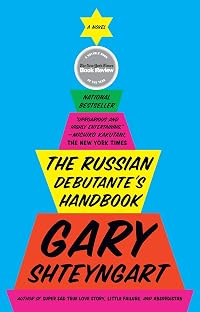
The Russian Debutante's Handbook
by Gary Shteyngart
On This Page
Description
Best-selling author Gary Shteyngart's exquisite fiction is met with a level of critical acclaim reserved for the very best in the field. In this startlingly provocative work, Russian immigrant Vladimir Girshkin searches for love and self-identity while interacting with a quirky set of acquaintances.Tags
Recommendations





























Member Recommendations


by jacr
Member Reviews
This is one of the few books that really lives up to all the reviewer hype. It is really hilarious. I found myself laughing out loud on every other page. Vladimir, the main character is sort of pathetic and lovable, you want him to do well, but also to grab him by the shoulders and shake him a bit while yelling 'grow up'! Although half way through the book, the story takes a turn for the really bizzar, Shteyngart manages to pull it off. Anyone from an immigrant family will appreciate this book. Or anyone with a Jewish mama... or anyone with a sense of humor in general!
This book tells the story of a young man, born in Russia, living in New York City who ends up moving to Eastern Europe and running a pyramid scheme. It is clever, witty, and entertaining and combined several things I love....immigrant life, making fun of hipsters, and good writing. I'd be hesitant to recommend it to everyone, but I really loved it. I will definitely read more by Gary Shteyngart.
In his usual wry fashion, Gary Shteyngart delivers a captivating transcontinental adventure filled to the brim with his unique blend of sardonic and self-deprecating wit. Giving a detailed and often hilarious depiction of immigrants and expatriates, with a few solid jabs at privileged Americans, Shteyngart is at the height of his powers as postmodern provocateur.
http://wineandabook.com/2011/07/23/review-the-russian-debutantes-handbook-by-gar...
One of two things must be true:
a) either Gary Shteyngart was channeling one of my ex-boyfriends (a Bukharian Jew from Uzbekistan) when he created Vladimir Girshkin
OR
b) Shteyngart is a supremely talented architect of character.
And unless Shteyngart also has a time machine, I'm going to put my money on the latter rather than the former.
In Vladimir, Shteyngart balances almost paradoxical levels of swagger and self-deprecation; throughout the novel, Vladimir manages to sell himself short one moment, then brazenly shoot the moon the next, and I was with him every step of the way. Even if I hadn't dated someone with the exact same extremes in their show more personality, Girshkin would never have read as inconsistent because Shteyngart's craft is that good and his characterizations, no matter how bizarre, are that honest (more on that in a bit). It's a fascinating balance of traits to watch in a person, and likewise makes for a compelling character to follow, especially when combined with Vladimir's intellect and propensity towards personal analysis.
In Vladimir Girshkin's journey over the course of the novel, Shteyngart's takes a fairly familiar story line and turns it on its head:
boy comes to America from a conflict-ridden country
boy struggles to please both his new American peers and his old-country parents/relatives
Here's the part, where, if Shteyngart were another popular writer pontificating on the perils and complexities of The Immigrant Experience like, say, Amy Tan, the story would continue on as the boy, through the experience of his parents/relatives, is able to find his "unique" self, which usually means the boy becomes a bit more comfortable code-switching and balancing the old-country traditions and new American expectations. (ex: see anything written by Tan. Really. Anything. She's RIDICULOUSLY consistent in her use of this structure, just swap "boy" for "girl" and "old country" for "China." Formulaic, but it works for her.) Instead of Vladimir learning how to be both a Russian Jew and an American (two states he sees as incredibly disparate), through the experience of others, Shteyngart allows Vladimir to venture to the city of Prava (Prague), "the Paris of the 90s", where he embarks on a journey of both deception and self-discovery as he learns to relegate his Russian Jewish childhood, his American adolescence, his Eastern European present and his uncertain future.
The narrative is rife with the bizarre personalities whose influence shapes Vladimir along the way: Challah, his ex-girlfriend, whom he not quite loves, who works in a sex dungeon; the Groudhog, the cut throat yet gregarious Russian mafioso determined to exploit the expat community of Prava who likes to be whipped while in the sauna; the Fan Man, father of the Groundhog, dead set on earning his American citizenship, and whose best friend is a small electric fan to whom he has given imaginary anthropomorphic qualities.
My favorite scene in the novel, which I can share without spoiling the plot, takes place in Prava and highlights not only Shteyngart's unique narrative voice but the East/West motif that underscores the text. Here, Vladimir and the poet Fish are on the balcony of a nightclub and both have just snorted horse tranquilizer (It was the the 90s). From the balcony, Vladimir is watching buses arrive and depart from Prava from the bus station below:
"But Vladimir's examination of this unhappy dichotomy, a dichotomy which was in some ways the story of his life, which brought on feelings of both elation and remorse--the elation of having a special, privileged knowledge of both East and West, the remorse of fitting finally into neither--was interrupted by the stinging, crystal-edged horse powder which the poet Fish administered to him nasally and then
not
much
happened.
Perhaps that's an exaggeration. Something, of course, happened, even while Vladimir withdrew into the upper stories of his brain where the thin mountain air was not conducive to the cognitive process. The buses kept arriving and departing but now they were just buses (buses, you know, transport, point A to point B) and Fish rolling up and down the balcony naked, howling, and waving his tiny purple penis at the moon was just a young man with his purple penis howling. Nothing much was happening in a big way. In fact, nonexistence was no longer so unfathomable (and how many times had he, as a morose child, shut his eyes and plugged his ears with cotton, trying to imagine The Void), but rather a fairly natural progression of this goofy happiness. The floating, bottomless joy of anesthesia.
And then the fifteen minutes were up and, like clockwork, Vladimir was noiselessly airlifted info his body; Fish was putting on his clothes." (p. 306).
Rubric rating: 8. Absurdistan and Super Sad True Love Story are on my holds list at the library and I'm absolutely looking forward to reading more of Shteyngart's unique voice.
All in all, Shteyngart's piece was almost good enough to make me nostalgic for my ex...almost.
For more reviews, check out wineandabook.com! show less
One of two things must be true:
a) either Gary Shteyngart was channeling one of my ex-boyfriends (a Bukharian Jew from Uzbekistan) when he created Vladimir Girshkin
OR
b) Shteyngart is a supremely talented architect of character.
And unless Shteyngart also has a time machine, I'm going to put my money on the latter rather than the former.
In Vladimir, Shteyngart balances almost paradoxical levels of swagger and self-deprecation; throughout the novel, Vladimir manages to sell himself short one moment, then brazenly shoot the moon the next, and I was with him every step of the way. Even if I hadn't dated someone with the exact same extremes in their show more personality, Girshkin would never have read as inconsistent because Shteyngart's craft is that good and his characterizations, no matter how bizarre, are that honest (more on that in a bit). It's a fascinating balance of traits to watch in a person, and likewise makes for a compelling character to follow, especially when combined with Vladimir's intellect and propensity towards personal analysis.
In Vladimir Girshkin's journey over the course of the novel, Shteyngart's takes a fairly familiar story line and turns it on its head:
boy comes to America from a conflict-ridden country
boy struggles to please both his new American peers and his old-country parents/relatives
Here's the part, where, if Shteyngart were another popular writer pontificating on the perils and complexities of The Immigrant Experience like, say, Amy Tan, the story would continue on as the boy, through the experience of his parents/relatives, is able to find his "unique" self, which usually means the boy becomes a bit more comfortable code-switching and balancing the old-country traditions and new American expectations. (ex: see anything written by Tan. Really. Anything. She's RIDICULOUSLY consistent in her use of this structure, just swap "boy" for "girl" and "old country" for "China." Formulaic, but it works for her.) Instead of Vladimir learning how to be both a Russian Jew and an American (two states he sees as incredibly disparate), through the experience of others, Shteyngart allows Vladimir to venture to the city of Prava (Prague), "the Paris of the 90s", where he embarks on a journey of both deception and self-discovery as he learns to relegate his Russian Jewish childhood, his American adolescence, his Eastern European present and his uncertain future.
The narrative is rife with the bizarre personalities whose influence shapes Vladimir along the way: Challah, his ex-girlfriend, whom he not quite loves, who works in a sex dungeon; the Groudhog, the cut throat yet gregarious Russian mafioso determined to exploit the expat community of Prava who likes to be whipped while in the sauna; the Fan Man, father of the Groundhog, dead set on earning his American citizenship, and whose best friend is a small electric fan to whom he has given imaginary anthropomorphic qualities.
My favorite scene in the novel, which I can share without spoiling the plot, takes place in Prava and highlights not only Shteyngart's unique narrative voice but the East/West motif that underscores the text. Here, Vladimir and the poet Fish are on the balcony of a nightclub and both have just snorted horse tranquilizer (It was the the 90s). From the balcony, Vladimir is watching buses arrive and depart from Prava from the bus station below:
"But Vladimir's examination of this unhappy dichotomy, a dichotomy which was in some ways the story of his life, which brought on feelings of both elation and remorse--the elation of having a special, privileged knowledge of both East and West, the remorse of fitting finally into neither--was interrupted by the stinging, crystal-edged horse powder which the poet Fish administered to him nasally and then
not
much
happened.
Perhaps that's an exaggeration. Something, of course, happened, even while Vladimir withdrew into the upper stories of his brain where the thin mountain air was not conducive to the cognitive process. The buses kept arriving and departing but now they were just buses (buses, you know, transport, point A to point B) and Fish rolling up and down the balcony naked, howling, and waving his tiny purple penis at the moon was just a young man with his purple penis howling. Nothing much was happening in a big way. In fact, nonexistence was no longer so unfathomable (and how many times had he, as a morose child, shut his eyes and plugged his ears with cotton, trying to imagine The Void), but rather a fairly natural progression of this goofy happiness. The floating, bottomless joy of anesthesia.
And then the fifteen minutes were up and, like clockwork, Vladimir was noiselessly airlifted info his body; Fish was putting on his clothes." (p. 306).
Rubric rating: 8. Absurdistan and Super Sad True Love Story are on my holds list at the library and I'm absolutely looking forward to reading more of Shteyngart's unique voice.
All in all, Shteyngart's piece was almost good enough to make me nostalgic for my ex...almost.
For more reviews, check out wineandabook.com! show less
Despite the unlikeable main character, I kept reading this to find out what would happen to the idiot Vladimir Girshkin next. This unusual coming-of-age tale follows our anti-hero from his underachieving life as a hipster wannabe in New York City to his try at a Ponzi scheme mastermind in Prava. He careens from one drunken encounter to the next, always trying to score with the prom queen, and the sexual scenes are decidedly not erotic. Shteyngart is a gifted writer and I frequently laughed out loud, but the story seemed bloated and repetitive, as the focus blurred in Prava, so did my attention.
Gary Shteyngart's first novel, and it shows. While it has the Shteyngartian charm and language, the plot meanders, the philosophy is confused, and the characters listless. Compared to the uproarious mania of Absurdistan, or the "so true it hurts" melodrama of Super Sad True Love Story, this is clearly a lesser novel. Still worth it, if you like his other stuff, but not his best.
Having been born in Russia, and have come to the U.S. at the age of 13, and now living in Los Angeles' 'Little Russia' this book was so spot-on and hilarious with descriptions of Russians and Russian Americans and the whole experience of growing up Russian in America. It was like recognizing many characters in my life on the pages of this book. Wickedly funny.
Members
- Recently Added By
Published Reviews
ThingScore 50
added by booksaplenty1949
Lists

The Atlantic's The Great American Novel
136 works; 12 members

Books Read in 2024
4,727 works; 128 members
Author Information

10+ Works 9,798 Members
Gary Shteyngart was born in Leningrad, which is now St. Petersburg, Russia, in 1972. He moved to the United States seven years later with his family. He received a bachelor's degree in politics from Oberlin College in Ohio and an MFA in creative writing from City University of New York. His debut novel, The Russian Debutante's Handbook, won the show more Stephen Crane Award for First Fiction and the National Jewish Book Award for Fiction. His other works include Absurdistan, Super Sad True Love Story, which won the Bollinger Everyman Wodehouse Prize, and Little Failure: A Memoir. He has taught writing at Hunter College, Columbia University, and Princeton University. (Bowker Author Biography) show less
Some Editions
Awards and Honors
Awards
Distinctions
Series
Belongs to Publisher Series
rororo (29048)
Work Relationships
Common Knowledge
- Canonical title
- The Russian Debutante's Handbook
- Original title
- The Russian Debutante's Handbook
- Original publication date
- 2002
- People/Characters
- Vladimir Girshkin; Challa; Francesca
- Important places
- New York, New York, USA
- Dedication*
- A mes parents
- First words
- The story of Vladimir Girshkin—part P.T. Barnum, part V.I. Lenin, the man who could conquer half of Europe (albeit the wrong half)—begins the way so many things begin. On a Monday morning. In an office. With the first cup... (show all) of instant coffee curling to life in the common lounge. -Capter 1, The Story of Vladimir Girshkin
- Original language*
- Anglais (Etats-Unis) (Etats-Unis)
- Canonical DDC/MDS
- 813.6
- Canonical LCC
- PS3619 .H79 .R87
*Some information comes from Common Knowledge in other languages. Click "Edit" for more information.
Classifications
Statistics
- Members
- 1,649
- Popularity
- 13,674
- Reviews
- 32
- Rating
- (3.44)
- Languages
- 9 — Czech, Dutch, English, French, German, Hungarian, Italian, Spanish, Swedish
- Media
- Paper, Audiobook, Ebook
- ISBNs
- 29
- ASINs
- 10