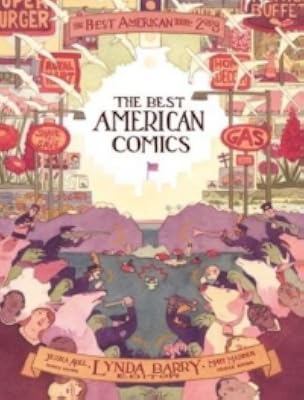
The Best American Comics 2008
by Lynda Barry (Editor), Jessica Abel (Series editor), Matt Madden (Series editor)
The Best American Comics (2008), Best American (2008)
On This Page
Description
Features excerpts from graphic novels, pamphlet comics, newspapers, magazines, mini-comics, and the Web, from Chris Ware, Seth, Alison Bechdel, and Matt Groening, among others.Tags
Recommendations





Member Reviews
I'm not 100% sure this is 5-star material--it does have a couple of duds in it, as any anthology will--but dude, it's an anthology of comics that features Alison Bechdel, Chris Ware, Gene Yang, and Seth, so as far as I'm concerned the rest of it could completely blow before I'd not find something to love in here.
I admit I skipped last year's, since I heard nothing but negatives about it. This year's, though? Excellent.
I admit I skipped last year's, since I heard nothing but negatives about it. This year's, though? Excellent.
I have this problem with Summer Reading lists that are doled out by schools. Basically, they suck. They suck the joy of reading right down to the marrow and attempt to equate vacation time with extended education. Either schools should go year-round and quit the pretense or Summer Reading lists need to lighten up. Spend the Summer returning fun the the reading quotient, there'll be plenty of time starting in September for reading the Serious, the Dry, the Meaningful to be analyzed within inches of their pulpy lives.
I've got plenty of suggestions for alternate Summer Reading but today I want to talk about comics, and specifically The Best American Comics of 2008. I've actually wanted to talk about this for months but teetered on the edge show more of deciding whether or not the collection is appropriate. It's that whole chicken v. egg thing of whether or not some graphic imagery and story elements are appropriate for teens or if they're already seeing them in other places (like movies and TV) and there's little harm involved in comics that do the same thing.
Murder, sex, and drugs are involved, but these are topics often touched on in Young Adult literature. The difference is that when they appear in comics there's this feeling that somehow minors are being corrupted, that "comics" equals "funny" or "humorous" and that anything more is some grand betrayal of morals.
Editor Lynda Berry mentions in her introduction that "If this book had been in my house when I was a kid, I would have found a way to read it in secret." This is exactly what I would have done as a kid, and it got me wondering if that still isn't the best way to discover a world of comics beyond superheroes and other ridiculous over-muscled, tights-wearing vigilantes. On the other hand, shouldn't we have evolved in our thinking that kids shouldn't have to discover these things in secret? Sure, the thrill of doing something forbidden is lost, as is the wonderment that comes with discovery, but comics already have a hard enough time (though it's getting better) with acceptance that maybe that secret reading should be secret no longer.
For anyone who grew up, as I did, looking forward to the comics in the alternative weekly papers, and those who have kept tabs with small press and alternative comics, there are few surprises here. Matt Groening, Nick Bertozzi, Kaz, Jaime Hernandez, Seth, Alison Bechdel, Rick Geary, Chris Ware, Derf... the line-up reads like a brief history of 80s and 90s comics history, and the fact that these folks are still around (and perhaps to some extent largely unknown) may make a larger point about comics history in America. The fact that one "mainstream" comic was chosen - a Batman: Year 100 excerpt was chosen and pulled at the last minute by its publisher makes another point about this collection: there's still a Wild West frontier in comics.
With a wide range of styles and subject matter, the comics Barry has chosen are incredibly strong. Usually with collections like this the pieces I like are outweighed by the number I don't, but here I found only two duds and a couple of marginal pieces and the rest were solid. Subjects cover everything from the opening comic where fratricide is played as a casual punchline to the horrors of the war in Iraq from a journalist to kids playing war and discovering girlie magazines while "invading" a homeless encampment. The four panel strip format flips it's wig with surreality, the Tortoise and the Hare becomes a battle between a rock-steady drummer on the one hand and a party-hearty type on the other, a pair of nocturnal ragamuffins spending the night building a tower of boxes to play hopscotch on, young woman tries to help a drug addict, a man is sanguine about losing his love to a suicidal cult, Cupid's assistant takes over for a day and has cats mating with dogs (literally) in no time... there's something for (and possibly to offend) every sensibility, though that isn't it's purpose.
To those who have felt the short story is dead, I propose that the short story is alive and well in the form of comics. Even as stand-alone excepts from larger works, these stories deliver – not so much a punchline but a promise of a satisfying resolution.
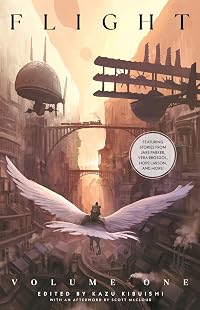
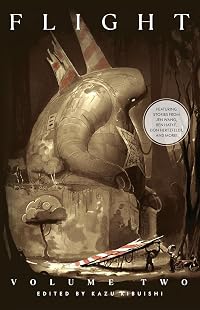
There is always that danger that one person's "best" is another person's worst, but omnibus collections like The Best American Comics series (previous editions edited by Harvey Pekar and Chris Ware) and Flight (now in it's fifth volume, edited by Kazu Kibuishi) are a great ways to sample what's out there and explore the possibilities of storytelling that don't involve nefarious villains plotting to take over the world.
Lynda Barry's advice for how to approach the book is one I wish more adults would encourage in collections. She suggests opening the book to find something of interest – as a kid she would have tried to zoom in on swear words or crazy pictures – and start reading from there. Jump around, find what interests, read in pieces, not all at once. Linear is highly overrated and constricting, not unlike a lot of educational thinking about Summer Reading.
Lighten up and enjoy the experience. show less
I've got plenty of suggestions for alternate Summer Reading but today I want to talk about comics, and specifically The Best American Comics of 2008. I've actually wanted to talk about this for months but teetered on the edge show more of deciding whether or not the collection is appropriate. It's that whole chicken v. egg thing of whether or not some graphic imagery and story elements are appropriate for teens or if they're already seeing them in other places (like movies and TV) and there's little harm involved in comics that do the same thing.
Murder, sex, and drugs are involved, but these are topics often touched on in Young Adult literature. The difference is that when they appear in comics there's this feeling that somehow minors are being corrupted, that "comics" equals "funny" or "humorous" and that anything more is some grand betrayal of morals.
Editor Lynda Berry mentions in her introduction that "If this book had been in my house when I was a kid, I would have found a way to read it in secret." This is exactly what I would have done as a kid, and it got me wondering if that still isn't the best way to discover a world of comics beyond superheroes and other ridiculous over-muscled, tights-wearing vigilantes. On the other hand, shouldn't we have evolved in our thinking that kids shouldn't have to discover these things in secret? Sure, the thrill of doing something forbidden is lost, as is the wonderment that comes with discovery, but comics already have a hard enough time (though it's getting better) with acceptance that maybe that secret reading should be secret no longer.
For anyone who grew up, as I did, looking forward to the comics in the alternative weekly papers, and those who have kept tabs with small press and alternative comics, there are few surprises here. Matt Groening, Nick Bertozzi, Kaz, Jaime Hernandez, Seth, Alison Bechdel, Rick Geary, Chris Ware, Derf... the line-up reads like a brief history of 80s and 90s comics history, and the fact that these folks are still around (and perhaps to some extent largely unknown) may make a larger point about comics history in America. The fact that one "mainstream" comic was chosen - a Batman: Year 100 excerpt was chosen and pulled at the last minute by its publisher makes another point about this collection: there's still a Wild West frontier in comics.
With a wide range of styles and subject matter, the comics Barry has chosen are incredibly strong. Usually with collections like this the pieces I like are outweighed by the number I don't, but here I found only two duds and a couple of marginal pieces and the rest were solid. Subjects cover everything from the opening comic where fratricide is played as a casual punchline to the horrors of the war in Iraq from a journalist to kids playing war and discovering girlie magazines while "invading" a homeless encampment. The four panel strip format flips it's wig with surreality, the Tortoise and the Hare becomes a battle between a rock-steady drummer on the one hand and a party-hearty type on the other, a pair of nocturnal ragamuffins spending the night building a tower of boxes to play hopscotch on, young woman tries to help a drug addict, a man is sanguine about losing his love to a suicidal cult, Cupid's assistant takes over for a day and has cats mating with dogs (literally) in no time... there's something for (and possibly to offend) every sensibility, though that isn't it's purpose.
To those who have felt the short story is dead, I propose that the short story is alive and well in the form of comics. Even as stand-alone excepts from larger works, these stories deliver – not so much a punchline but a promise of a satisfying resolution.
There is always that danger that one person's "best" is another person's worst, but omnibus collections like The Best American Comics series (previous editions edited by Harvey Pekar and Chris Ware) and Flight (now in it's fifth volume, edited by Kazu Kibuishi) are a great ways to sample what's out there and explore the possibilities of storytelling that don't involve nefarious villains plotting to take over the world.
Lynda Barry's advice for how to approach the book is one I wish more adults would encourage in collections. She suggests opening the book to find something of interest – as a kid she would have tried to zoom in on swear words or crazy pictures – and start reading from there. Jump around, find what interests, read in pieces, not all at once. Linear is highly overrated and constricting, not unlike a lot of educational thinking about Summer Reading.
Lighten up and enjoy the experience. show less
Although I've collected (and sometimes read) a number of items from the Best American Short Stories and Best American Mystery Stories, only recently did I learn of the Best American Comics series. To try out out, I selected the 2008 volume, because it was edited by a cartoonist for whom I've long had a certain affection, Lynda Barry. As one might expect from such a collection,it is a mixed experience. The range is extraordinary, from amusing to perplexing to obscure to violent and disturbing. These are not (with a couple of exceptions) the sorts of comics that would make it into your family newspaper (for anyone old enough to remember when daily newspapers existed). They are more likely to be featured in alternative weeklies (as found show more in progressive cities and towns) and in head comics (which gained their name from being sold in "head shops").
The 2008 volume includes works by 26 artists. I found few of them to my tastes, and many to be somewhat too obscure for comprehension. My favorite set was the contribution from Matt Groening -- of his Will and Abe series. I also enjoyed Eric Haven's "Mammalogy", Jaime Hernandez's "Gold Diggers of 1969", and Rick Geary's "The Bloody Benders". Jason Lute's "Berlin" (an excerpt of a larger work) I thought to be notable for the quality of the art and the power of his characterizations. Based on my experience, I'm not very inclined to seek out other volumes in the series. However, I'm glad to see that due to the creativity and imaginations of a new generation of artists that the comics genre is alive and well. show less
The 2008 volume includes works by 26 artists. I found few of them to my tastes, and many to be somewhat too obscure for comprehension. My favorite set was the contribution from Matt Groening -- of his Will and Abe series. I also enjoyed Eric Haven's "Mammalogy", Jaime Hernandez's "Gold Diggers of 1969", and Rick Geary's "The Bloody Benders". Jason Lute's "Berlin" (an excerpt of a larger work) I thought to be notable for the quality of the art and the power of his characterizations. Based on my experience, I'm not very inclined to seek out other volumes in the series. However, I'm glad to see that due to the creativity and imaginations of a new generation of artists that the comics genre is alive and well. show less
As with the other volume of this series that I've read, the anthology brings together a nice mix of familiar names (Ware, Barry, Geary, Bechdel, Groening, Derf), and a sprinkling of enjoyable new artists. Barry, true to form, presents her introduction as a comic where she leads us through her changing relationship with comics and art and the importance of the much-maligned comic strip in the world of "Graphic Novels" (especially for the children of today who will become the artists and readers of the future).
[full review here: http://spacebeer.blogspot.com/2015/06/the-best-american-comics-2008-edited-by.ht... ]
[full review here: http://spacebeer.blogspot.com/2015/06/the-best-american-comics-2008-edited-by.ht... ]
The Best American Comics 2008 is a great primer to what's currently being written and drawn in the graphic novel realm. 25 or so artists are featured with short, but fulfilling, excerpts of their work collected in this anthology. The work is long enough to give the reader an idea of what they are about and how good their work is, yet still easy to sample and leave yearning for more. The only real problem with the collection is the sometimes small size of the lettering, which can be difficult to read.
Overall, this is an excellent volume of comics that highlight the creativity and explorations done in the realm of graphic novels. My favorite of the book was Alison Bechdel, of course, although her work is not easily excerpted. Gene Luen show more Yang's American Born Chinese excerpt was also excellent, leaving me looking forward to reading the longer work. No one was really disappointing, however, and everyone is worthy of further investigation. show less
Overall, this is an excellent volume of comics that highlight the creativity and explorations done in the realm of graphic novels. My favorite of the book was Alison Bechdel, of course, although her work is not easily excerpted. Gene Luen show more Yang's American Born Chinese excerpt was also excellent, leaving me looking forward to reading the longer work. No one was really disappointing, however, and everyone is worthy of further investigation. show less
This is a beautiful book. I was expecting every comic to blow my shit away, but you know. A few did.
But I was glad to see Alison Bechdel in there. And I'm definitely going to check out more of Oleskek.
But I was glad to see Alison Bechdel in there. And I'm definitely going to check out more of Oleskek.
This is a beautiful book. I was expecting every comic to blow my shit away, but you know. A few did.
But I was glad to see Alison Bechdel in there. And I'm definitely going to check out more of Oleskek.
But I was glad to see Alison Bechdel in there. And I'm definitely going to check out more of Oleskek.
Members
- Recently Added By
Author Information


All Editions
Awards and Honors
Awards
Series


Common Knowledge
- Canonical title
- The Best American Comics 2008
- Original publication date
- 2008-10-08
- Original language
- English
Classifications
- Genre
- Graphic Novels & Comics
- DDC/MDS
- 741.56973 — Arts & recreation Drawing & decorative arts Drawing Comic books, graphic novels, fotonovelas, cartoons, caricatures, comic strips Cartoons, Caricatures, Comic Strips History, geographic treatment, biography North American United States
- LCC
- PN6726 .B47 — Language and Literature Literature (General) Literature (General) Collections of general literature Comic books, strips, etc.
- BISAC
Statistics
- Members
- 321
- Popularity
- 99,491
- Reviews
- 15
- Rating
- (3.39)
- Languages
- English
- Media
- Paper
- ISBNs
- 1
- ASINs
- 1