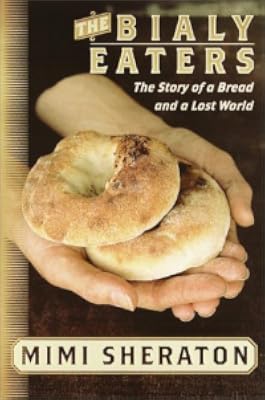
The Bialy Eaters: The Story of a Bread and a Lost World
by Mimi Sheraton
Mimi Sheraton's Food Books (5)
On This Page
Description
The acclaimed restaurant critic and food authority journeys to the Polish town of Bialystok to uncover the history of the staple Jewish bread, the bialy, only to find a region devastated by ethnic cleansing and the Holocaust, and embarks on a worldwide search for the scattered inhabitants of the towTags
Recommendations











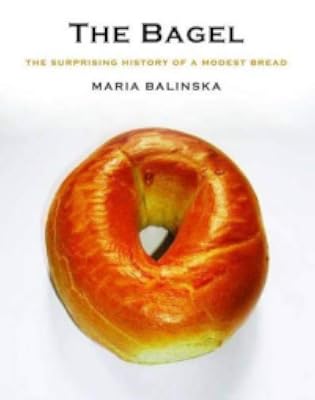



Member Reviews
I grew up with bialys in New York City. Places that sold bagels sold bialys. When you got bored of bagels, you had a bialy. But fast forward several decades, and I can barely remember them. They were never popular outside of New York, and though a quintessentially Jewish food, they were nowhere to be found in Israel. Eventually, I started making my own. And when I read about Mimi Sheraton’s book — knowing that she was the New York Times’ food writer, my expectations were high. But I was disappointed. This book is less about the bialys than it is about Mimi Sheraton’s “journey”. Though the book was researched and written at a time when the Internet was taking off, it is very Old School about research. She finds out show more someone’s name and tries to phone them and then someone answers in a foreign language, and of course she doesn’t speak any of the languages essential for this book (Yiddish, Polish, Hebrew, etc). She describes in some detail getting the address of someone who might know something, and knocking on the door and finding out that it is not the right address. This was starting to feel like a book that desperately wanted to be a magazine article. The book ends with a bialy recipe that goes on for pages and pages. The one I use is a couple of paragraphs long. Oh, and Mimi Sheraton learned from some Esperanto speakers in Israel (because Bialystok is the birthplace of both the bialy and the international language Esperanto) what the word for bialy is in that language. “Kuko”, she was told. And even that was wrong — kuko is Esperanto for “cake”, any cake at all. show less
The author clearly felt a need to mention everyone she ever interviewed, whether or not they has anything to say except "you just can't get 'em any more."
They history of the diaspora of the citizens of Bialystok is random and spotty. And the bread just doesn't exist any more.
I tried for 2 days and I just can't do it any more.
Some of the stuff I read is the literary equivalent of a cream horn. All fluff, no substance, but fun. This thing is a soda cracker with no peanut butter.
They history of the diaspora of the citizens of Bialystok is random and spotty. And the bread just doesn't exist any more.
I tried for 2 days and I just can't do it any more.
Some of the stuff I read is the literary equivalent of a cream horn. All fluff, no substance, but fun. This thing is a soda cracker with no peanut butter.
The author clearly felt a need to mention everyone she ever interviewed, whether or not they has anything to say except "you just can't get 'em any more."
They history of the diaspora of the citizens of Bialystok is random and spotty. And the bread just doesn't exist any more.
I tried for 2 days and I just can't do it any more.
Some of the stuff I read is the literary equivalent of a cream horn. All fluff, no substance, but fun. This thing is a soda cracker with no peanut butter.
They history of the diaspora of the citizens of Bialystok is random and spotty. And the bread just doesn't exist any more.
I tried for 2 days and I just can't do it any more.
Some of the stuff I read is the literary equivalent of a cream horn. All fluff, no substance, but fun. This thing is a soda cracker with no peanut butter.
A food writer sets off to find the origins of the bialy, which is sort of like a bagel, but not exactly. I remember good ones from a Jewish deli in NE Phila, but like the writer finds, they aren't found everywhere, and when they are found, they may not be true to the believed origins in Bialystok, Poland
A wonderful history and fun to read. The bialy is infinitely better than the bagel but not as widely available, unfortunately. Includes a recipe, but the best recommendation is simply to go to Kossars www.kossarsbialys.com/
Ratings
Members
- Recently Added By
Author Information

15+ Works 1,247 Members
Mimi Sheraton is a former New York Times restaurant critic who now free-lances for The New York Times, Travel & Leisure, and other magazines. Her cookbook The Whole World Loves chicken Soup won both the IACP Julia Child Award and the James Beard Award. She lives in New York City. (Bowker Author Biography)
Series

Work Relationships
Common Knowledge
- Canonical title
- The Bialy Eaters: The Story of a Bread and a Lost World
- Original publication date
- 2000
- Important places
- Bialystok, Poland; New York, USA
- First words
- On a gray and rainy day in November, 1992, I stood on Rynek Kosciuszko, the deserted town square of Bialystok, Poland, and was suddenly overcome by the same shadowy sense of loss that I had felt in the old Jewish quarters of ... (show all)Kazimierz in Cracow and Mikulov in Moravia.
- Last words
- (Click to show. Warning: May contain spoilers.)All are high-gluten.
Classifications
- Genres
- Nonfiction, Food & Cooking, General Nonfiction, History
- DDC/MDS
- 641.8 — Applied science & technology Home economics & family management Food, Cooking & Recipes / Meals, Picnics Cooking specific kinds of dishes and preparing beverages
- LCC
- TX769 .S413 — Technology Home economics Home economics Cooking
- BISAC
Statistics
- Members
- 137
- Popularity
- 237,943
- Reviews
- 6
- Rating
- (3.28)
- Languages
- English
- Media
- Paper, Ebook
- ISBNs
- 2
- ASINs
- 1