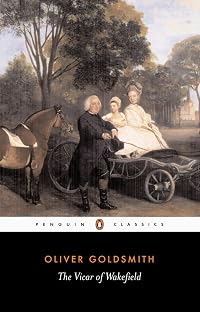
The Vicar of Wakefield
by Oliver Goldsmith
On This Page
Description
The Vicar of Wakefield follows the life of a wealthy vicar and his family who lie an idyllic life in their country parish thanks to the vicar's clever investments. The evening that his son is to marry an heiress, the vicar discovers that his merchant investor has lost all his money in bankruptcy.Written by Irish author Oliver Goldsmith in the late 18th century.
.
Tags
Recommendations














Member Recommendations

Morryman84 Scott and Dickens two of my favorite writers
Member Reviews
Summary: The “memoir” of the vicar, who experiences a series of financial and family disasters, ending up in prison, and how matters resolved themselves.
It was one of the most popular novels of the eighteenth century, and were it not for the poverty of Oliver Goldsmith and the efforts of his friend, Samuel Johnson, it might not have seen the light of day:
“I received one morning a message from poor Goldsmith that he was in great distress, and, as it was not in his power to come to me, begging that I would come to him as soon as possible. I sent him a guinea, and promised to come to him directly. I accordingly went as soon as I was dressed, and found that his landlady had arrested him for his rent, at which he was in a violent show more passion: I perceived that he had already changed my guinea, and had a bottle of Madeira and a glass before him. I put the cork into the bottle, desired he would be calm, and began to talk to him of the means by which he might be extricated. He then told me he had a novel ready for the press, which he produced to me. I looked into it and saw its merit; told the landlady I should soon return; and, having gone to a bookseller, sold it for sixty pounds. I brought Goldsmith the money, and he discharged his rent, not without rating his landlady in a high tone for having used him so ill.”
SAMUEL JOHNSON
The story centers around the memoirs of Dr. Charles Primrose, the vicar of a rural parish, who was well-off due to an invested inheritance, enabling him to donate his “living.” On the eve of his son George’s wedding to wealthy Arabella Wilmot, he receives word that his investor has gone bankrupt and skipped town, leaving the Primroses in poverty. The change in status as well as a theological dispute with the bride’s father result in a breaking of the engagement. Things go from bad to worse. They take refuge on the estate of Squire Thornhill, a notorious womanizer. They turn a thatch roofed home into a comfortable refuge while George seeks to support himself in the city, succeeding as an actor. Both son and father are swindled by a smooth-talking “sharp” losing their remaining animals. The family’s hope turns on securing good husbands for the daughters. Squire Thornhill visit and is drawn to Olivia. Then a mysterious gentleman, Mr. Burchell visits, and rescues Sophia from drowning, but Dr. Primrose is reluctant to trust him.
Thornhill heads off any possibility of George and Arabella getting together by arranging a commission to the West Indies, with Goldsmith agreeing to a note to fund George. Meanwhile, Olivia has been abducted, it being thought, by Mr. Burchell, when in fact it was Thornhill, who arranged a fictitious marriage, a tactic he apparently used with several women. Olivia is rescued by Primrose, but shortly after returning home, the house burns, with Primrose being badly burned on the arm, Thornhill calls the note which Primrose cannot pay, and is thrown into jail, while the violated Olivia grows more and more ill and dies.
This is one of those “sentimental” stories where in the end, all things are righted. I won’t say how but I will tell you that even Olivia lives and a succession of weddings and a restoration of Primrose’s fortunes occurs.
It is kind of like the book of Job without Job’s agonizings. Primrose continues to trust to God’s providence and act with rectitude. While wanting to recover what was lost, he is able to be content with little. Even in jail, he embraces his pitiful surroundings and sets about evangelizing the prisoners.
The other feature of this story is its lightning fast reversals–dramatic changes in a sentence or a paragraph. Goldsmith doesn’t let moss grow under his plot. In the end, things turn out as one might hope, but the series of disasters it takes to get there and the seeming impossibility of undoing them might stretch credulity at points.
This was the only novel Goldsmith wrote but it was a good one. After all, don’t we all like a story where good prevails and all who should, live happily ever after? Life isn’t always like this, perhaps one of the reasons for the timelessness of stories like this. show less
It was one of the most popular novels of the eighteenth century, and were it not for the poverty of Oliver Goldsmith and the efforts of his friend, Samuel Johnson, it might not have seen the light of day:
“I received one morning a message from poor Goldsmith that he was in great distress, and, as it was not in his power to come to me, begging that I would come to him as soon as possible. I sent him a guinea, and promised to come to him directly. I accordingly went as soon as I was dressed, and found that his landlady had arrested him for his rent, at which he was in a violent show more passion: I perceived that he had already changed my guinea, and had a bottle of Madeira and a glass before him. I put the cork into the bottle, desired he would be calm, and began to talk to him of the means by which he might be extricated. He then told me he had a novel ready for the press, which he produced to me. I looked into it and saw its merit; told the landlady I should soon return; and, having gone to a bookseller, sold it for sixty pounds. I brought Goldsmith the money, and he discharged his rent, not without rating his landlady in a high tone for having used him so ill.”
SAMUEL JOHNSON
The story centers around the memoirs of Dr. Charles Primrose, the vicar of a rural parish, who was well-off due to an invested inheritance, enabling him to donate his “living.” On the eve of his son George’s wedding to wealthy Arabella Wilmot, he receives word that his investor has gone bankrupt and skipped town, leaving the Primroses in poverty. The change in status as well as a theological dispute with the bride’s father result in a breaking of the engagement. Things go from bad to worse. They take refuge on the estate of Squire Thornhill, a notorious womanizer. They turn a thatch roofed home into a comfortable refuge while George seeks to support himself in the city, succeeding as an actor. Both son and father are swindled by a smooth-talking “sharp” losing their remaining animals. The family’s hope turns on securing good husbands for the daughters. Squire Thornhill visit and is drawn to Olivia. Then a mysterious gentleman, Mr. Burchell visits, and rescues Sophia from drowning, but Dr. Primrose is reluctant to trust him.
Thornhill heads off any possibility of George and Arabella getting together by arranging a commission to the West Indies, with Goldsmith agreeing to a note to fund George. Meanwhile, Olivia has been abducted, it being thought, by Mr. Burchell, when in fact it was Thornhill, who arranged a fictitious marriage, a tactic he apparently used with several women. Olivia is rescued by Primrose, but shortly after returning home, the house burns, with Primrose being badly burned on the arm, Thornhill calls the note which Primrose cannot pay, and is thrown into jail, while the violated Olivia grows more and more ill and dies.
This is one of those “sentimental” stories where in the end, all things are righted. I won’t say how but I will tell you that even Olivia lives and a succession of weddings and a restoration of Primrose’s fortunes occurs.
It is kind of like the book of Job without Job’s agonizings. Primrose continues to trust to God’s providence and act with rectitude. While wanting to recover what was lost, he is able to be content with little. Even in jail, he embraces his pitiful surroundings and sets about evangelizing the prisoners.
The other feature of this story is its lightning fast reversals–dramatic changes in a sentence or a paragraph. Goldsmith doesn’t let moss grow under his plot. In the end, things turn out as one might hope, but the series of disasters it takes to get there and the seeming impossibility of undoing them might stretch credulity at points.
This was the only novel Goldsmith wrote but it was a good one. After all, don’t we all like a story where good prevails and all who should, live happily ever after? Life isn’t always like this, perhaps one of the reasons for the timelessness of stories like this. show less
I literally only wanted to read this because of a passing reference (or two) in Jane Austen's Emma! (Harriet gives a copy to Robert Martin, and Mrs Elton misquotes the verse about woman stooping to folly, I think!) I found an old library copy and couldn't resist. But, having suffered through Evelina and the like in the past, I had to brace myself. Goldsmith is slightly more witty than Burney, but still dedicates whole chapters to random subjects.
The story, even in such a short book, is bonkers. Talk about melodrama! The vicar of the title lives an idyllic life with his loving wife and large family of two daughters and four sons until the proverbial hits the fan. He loses all his money, they have to move to another parish miles away show more belonging to a dodgy landowner who puts Willoughby and Wickham in the shade, his eldest daughter elopes but nobody is sure who with, the family house burns down, he's thrown in jail for not paying his rent, where he finds his son, sent away to earn his fortune, who has killed someone in a duel. I think!
Mental, densely packed, but still just about readable! show less
The story, even in such a short book, is bonkers. Talk about melodrama! The vicar of the title lives an idyllic life with his loving wife and large family of two daughters and four sons until the proverbial hits the fan. He loses all his money, they have to move to another parish miles away show more belonging to a dodgy landowner who puts Willoughby and Wickham in the shade, his eldest daughter elopes but nobody is sure who with, the family house burns down, he's thrown in jail for not paying his rent, where he finds his son, sent away to earn his fortune, who has killed someone in a duel. I think!
Mental, densely packed, but still just about readable! show less
The story opens in the country parsonage of Dr Primrose, a kindly man who has a good heart, a good family and a good income, some of which he gives away to his poorer parishioners. Suddenly, his idyllic life is devastated by a series of misfortunes and he ends up in debtors gaol. Yet, despite all this calamity and injustice, the vicar never loses sight of Christian morality, and while his convictions lends him a certain moral nobility, in the end it also brings justice and restoration.
Through a simple, almost fairy-tale plot; people go through much of the book, disguised as to their real identity, there are unbelievable coincidences and the ending is so improbable that, in a sense, seems at variance with what came before, Goldsmith show more provides a charming satire on the dangers of undeserved wealth and the immense power that it can exert on those less fortunate. It is also an artful send-up of many of the literary conventions of his day, in particular the stoic bravery of the hero.
This isn't an easy read. Alongside its vivid and very realistic seeming window in to many aspects of life in the England of the 1700’s, even down to its parlour games, there are some liberal bouts of sermonising; the Vicar himself, loves to preach and pontificate on the proper morality of life. In one eloquent passage he argues that widowed vicars should never remarry and for prison reform, noting that compared to the rest of Europe, English punishment is too harsh and indiscriminate. But what makes this book readable is the fact that he also has an enjoyably sly sense of humour coupled with an amusing naivete.
"I … chose my wife, as she did her wedding-gown, not for a fine glossy surface, but such qualities as would wear well."
This book was published in 1766 and although I had a few issues with it, mainly it seemed to be over-reliant on coincidences to drive the plot rather than real storytelling, but that said it it amused more than several other 18th-century English novels, namely Defoe's 'Robinson Crusoe' and Swift's 'Gulliver’s Travels' that I've read, and as such was pleased that I made the effort. show less
Through a simple, almost fairy-tale plot; people go through much of the book, disguised as to their real identity, there are unbelievable coincidences and the ending is so improbable that, in a sense, seems at variance with what came before, Goldsmith show more provides a charming satire on the dangers of undeserved wealth and the immense power that it can exert on those less fortunate. It is also an artful send-up of many of the literary conventions of his day, in particular the stoic bravery of the hero.
This isn't an easy read. Alongside its vivid and very realistic seeming window in to many aspects of life in the England of the 1700’s, even down to its parlour games, there are some liberal bouts of sermonising; the Vicar himself, loves to preach and pontificate on the proper morality of life. In one eloquent passage he argues that widowed vicars should never remarry and for prison reform, noting that compared to the rest of Europe, English punishment is too harsh and indiscriminate. But what makes this book readable is the fact that he also has an enjoyably sly sense of humour coupled with an amusing naivete.
"I … chose my wife, as she did her wedding-gown, not for a fine glossy surface, but such qualities as would wear well."
This book was published in 1766 and although I had a few issues with it, mainly it seemed to be over-reliant on coincidences to drive the plot rather than real storytelling, but that said it it amused more than several other 18th-century English novels, namely Defoe's 'Robinson Crusoe' and Swift's 'Gulliver’s Travels' that I've read, and as such was pleased that I made the effort. show less
It’s probably best to go into this one with the same mindset as a stage comedy. Things just happen. Coincidences abound. The vicar almost gets his son married—but then a merchant runs off with his savings! He successfully sells his horse at market—to a conman! And so on and so forth. Which is not to say that I found any of that annoying, being used to novels where plot and theme are a bit tighter and more believable, because this is a satire, a comedy, and a 250-year-old novel, so my expectations were about on par. I didn’t even mind the wordiness or the fact that, when the vicar really gets going, I had to reread a page to figure out what he was saying. Also, the characters are more rounded than I thought they’d be!
I had fun show more reading this, in other words, though it’s not the best bit of 18th-century writing I’ve read. There’s a lot of parody and satire in it, from the small and domestic misfortunes that are treated as the end of the world to the vicar’s stubborn insistence on being kind and forgiving to everyone (including the aforementioned conman) to his views on marriage to the bit near the end where he’s sure he’s converting an entire jail but they’re making fun of him the whole time. I suspect there’s also a bit of parody in how quickly and randomly tragedy strikes, but I haven’t read any other sentimental novels so I can’t comment.
And yes, if you couldn’t tell from my summary, there are Austen vibes. (She must’ve read this. It was a bestseller and, well, let’s just say there are mistaken identities and a rake who’s taken for an honest man and the vicar reminded me a lot of Mr. Bennett at times.) That alone would make this worth reading, but it was enjoyable apart from that and I’m glad to have read it, and read it when I did so I could appreciate what Goldsmith was doing. I can totally picture it being read aloud in social settings with people tittering behind their fans and then debating the satire over sherry or embroidery.
Recced, but not fannishly. ‘Twas good and holds up, but is also not the best novel in the world.
Warnings: Period sexism. One scene with the g-slur describing a fortune teller. Several reports of comedic abduction.
7/10 show less
I had fun show more reading this, in other words, though it’s not the best bit of 18th-century writing I’ve read. There’s a lot of parody and satire in it, from the small and domestic misfortunes that are treated as the end of the world to the vicar’s stubborn insistence on being kind and forgiving to everyone (including the aforementioned conman) to his views on marriage to the bit near the end where he’s sure he’s converting an entire jail but they’re making fun of him the whole time. I suspect there’s also a bit of parody in how quickly and randomly tragedy strikes, but I haven’t read any other sentimental novels so I can’t comment.
And yes, if you couldn’t tell from my summary, there are Austen vibes. (She must’ve read this. It was a bestseller and, well, let’s just say there are mistaken identities and a rake who’s taken for an honest man and the vicar reminded me a lot of Mr. Bennett at times.) That alone would make this worth reading, but it was enjoyable apart from that and I’m glad to have read it, and read it when I did so I could appreciate what Goldsmith was doing. I can totally picture it being read aloud in social settings with people tittering behind their fans and then debating the satire over sherry or embroidery.
Recced, but not fannishly. ‘Twas good and holds up, but is also not the best novel in the world.
Warnings: Period sexism. One scene with the g-slur describing a fortune teller. Several reports of comedic abduction.
7/10 show less
There is an ongoing debate about whether The Vicar of Wakefield is serious or a satire. I tend toward the former opinion, for while the utter hypocrisy of the characters and the unbelievable serendipity of its plot have all the stuff of satire, I think this is just a coincidence. Goldsmith is not a satirist in the manner of Swift or Haywood: the absurdities of his novel are almost certainly a result of incompetence rather than biting social humor.
The novel itself is an exercise in cognitive dissonance. There is a debate about politics, for instance, in which the protagonist, Charles Primrose, ties himself up in knots trying to explain the importance of liberty, only to end up by affirming that the highest expression of liberty is show more actually monarchy.
"What they may then expect, may be seen by turning our eyes to Holland, Genoa, or Venice, where the laws govern the poor, and the rich govern the law. I am then for, and would die for, monarchy, sacred monarchy; for if there be any thing sacred amongst men, it must be the anointed sovereign of his people, and every diminution of his power in war, or in peace, is an infringement upon the real liberties of the subject."
We must treasure liberty - by cultivating monarchy. We must value the misery of poverty - by aspiring to riches. We must be honest - but it is okay to lie and deceive to cultivate "virtue." These recurrent hypocrisies run throughout The Vicar of Wakefield in a way that makes the characters seem like a bunch of social climbers of the most cynical kind. There is no sense of actual virtue, love, or kindness in the social relations on display here: everything is a performance designed to raise social status.
Of course, The Vicar of Wakefield, for the sheer extent of its influence, is a necessary text to read in a historical sense. But let's be honest: it is an awful book, lacking in plot or entertainment, full of hypocrisy, with a narrative that at times borders on the territory of an eighteenth-century American Psycho in its sheer lack of conscience or restraint. show less
The novel itself is an exercise in cognitive dissonance. There is a debate about politics, for instance, in which the protagonist, Charles Primrose, ties himself up in knots trying to explain the importance of liberty, only to end up by affirming that the highest expression of liberty is show more actually monarchy.
"What they may then expect, may be seen by turning our eyes to Holland, Genoa, or Venice, where the laws govern the poor, and the rich govern the law. I am then for, and would die for, monarchy, sacred monarchy; for if there be any thing sacred amongst men, it must be the anointed sovereign of his people, and every diminution of his power in war, or in peace, is an infringement upon the real liberties of the subject."
We must treasure liberty - by cultivating monarchy. We must value the misery of poverty - by aspiring to riches. We must be honest - but it is okay to lie and deceive to cultivate "virtue." These recurrent hypocrisies run throughout The Vicar of Wakefield in a way that makes the characters seem like a bunch of social climbers of the most cynical kind. There is no sense of actual virtue, love, or kindness in the social relations on display here: everything is a performance designed to raise social status.
Of course, The Vicar of Wakefield, for the sheer extent of its influence, is a necessary text to read in a historical sense. But let's be honest: it is an awful book, lacking in plot or entertainment, full of hypocrisy, with a narrative that at times borders on the territory of an eighteenth-century American Psycho in its sheer lack of conscience or restraint. show less
Curiosity satisfied, but not really worth it. Written in the 1760s, here is the tale of a countryside vicar who falls upon hard times in the footsteps of Job and ... no, that's pretty much it. You've heard the Job story, so you know this one. It's also a satire of its times, so living in the 18th century is strongly recommended for a full appreciation.
The Vicar of Wakefield gets a mention in a ton of 19th century classics so I presumed it was something worth reading. It is, for the sake of sampling some English literature history - if you can tolerate a well-disguised climax that occurs halfway through, a whole lot of sermons, and such an avalanche of coincidences that even Dickens would say yeah, that's too much. There were a couple of show more funny bits, but today's newspaper probably rates the same amount. I still love the classics but I didn't love this. show less
The Vicar of Wakefield gets a mention in a ton of 19th century classics so I presumed it was something worth reading. It is, for the sake of sampling some English literature history - if you can tolerate a well-disguised climax that occurs halfway through, a whole lot of sermons, and such an avalanche of coincidences that even Dickens would say yeah, that's too much. There were a couple of show more funny bits, but today's newspaper probably rates the same amount. I still love the classics but I didn't love this. show less
Every now and then there's nothing like a good classic. (Groucho Marx voice:) And this is nothing like a good classic!
It's wild and crazy. Fortunes are lost, houses burn down, reputations are ruined, ruffians roughhouse, people come back from the dead, and digressions digress a la galore. The vicar has six lovely children, two of them marriageable daughters. At heart, it is a classic Marriage Plot; and that's OK by me.
It's wild and crazy. Fortunes are lost, houses burn down, reputations are ruined, ruffians roughhouse, people come back from the dead, and digressions digress a la galore. The vicar has six lovely children, two of them marriageable daughters. At heart, it is a classic Marriage Plot; and that's OK by me.
Members
- Recently Added By
Lists

1001 Books You Must Read Before You Die
1,448 works; 1,134 members

The Guardian's 1000 Novels Everyone Must Read
1,005 works; 547 members

1898 C.K. Shorter List of Best 100 Novels
100 works; 34 members
501 Must-Read Books
529 works; 72 members

100 Books to Read in a Lifetime (That Are Older Than 200 Years)
415 works; 174 members
Philip Ward's Lifetime Reading Plan
592 works; 22 members

Harold Bloom - The Western Canon: B. The Aristocratic Age
231 works; 13 members

Publisher's Weekly Bestsellers Prior to 1895 in Chronological Order
95 works; 6 members

1,001 BYMRBYD Concensus
723 works; 27 members

100
56 works; 1 member

Books Read in 2022
5,166 works; 112 members

CCE 1000 Good Books List
1,033 works; 12 members
Trinity College Booklist (1951): Class Ten, English Literature
358 works; 5 members
F. B. Perkins' List of 100 Best Fiction
100 works; 5 members

My TBR
371 works; 3 members

Merrill's English Texts
59 works; 3 members

1964 College Preparatory Reading List
202 works; 8 members
150 Best Novels Selected by Brander Matthews (1883)
150 works; 7 members

Greatest Books, allegedly
484 works; 9 members

AP Lit
363 works; 6 members

Book Titles Mentioned In Newberry Medal And Honor Books
884 works; 3 members

Recommended Reading : 600 Classics Reviewed, Editors of Salem Press, 2015
634 works; 6 members

DigitalDreamDoor top 300
300 works; 4 members

.
396 works; 1 member
Talk Discussions
Past Discussions
Folio Archives 343: The Vicar of Wakefield by Oliver Goldsmith 1971 in Folio Society Devotees (October 2023)
Author Information

As Samuel Johnson said in his famous epitaph on his Irish-born and educated friend, Goldsmith ornamented whatever he touched with his pen. A professional writer who died in his prime, Goldsmith wrote the best comedy of his day, She Stoops to Conquer (1773). Amongst a plethora of other fine works, he also wrote The Vicar of Wakefield (1766), which, show more despite major plot inconsistencies and the intrusion of poems, essays, tales, and lectures apparently foreign to its central concerns, remains one of the most engaging fictional works in English. One reason for its appeal is the character of the narrator, Dr. Primrose, who is at once a slightly absurd pedant, an impatient traditional father of teenagers, a Job-like figure heroically facing life's blows, and an alertly curious, helpful, loving person. Another reason is Goldsmith's own mixture of delight and amused condescension (analogous to, though not identical with, Laurence Sterne's in Tristram Shandy and Johnson's in Rasselas, both contemporaneous) as he looks at the vicar and his domestic group, fit representatives of a ludicrous but workable world. Never married and always facing financial problems, he died in London and was buried in Temple Churchyard. (Bowker Author Biography) show less
Some Editions
Awards and Honors
Notable Lists
Series
Belongs to Publisher Series
World's Greatest Literature (Volume 9)
Sammlung Dieterich (112)
Oxford English Novels (1766)
Doubleday Dolphin (C20)
Crisol (181)
Airmont Classics (52)
The Pocket Library (PL-54)
Amstelboeken (115-116)
Zephyr Books (69)
Everyman's Library (295)
Work Relationships
Is contained in
Is abridged in
Common Knowledge
- Canonical title
- The Vicar of Wakefield
- Original title
- The Vicar of Wakefield
- Alternate titles*
- De predikant van Wakefield
- Original publication date
- 1766
- Important places
- Wakefield, Yorkshire, England, UK; England, UK
- Epigraph
- Sperate miseri, cavete faelices
[Hope, ye wretched, beware, ye prosperous] - First words
- I was ever of opinion that the honest man, who married and brought up a large family, did more service than he who continued single, and only talked of population.
Sir Joshua Reynolds told how he once visited Goldsmith and found the poet kicking a masquerade costume round the floor. (Introduction)
There are an hundred faults in this Thing, and an hundred things that might be said to prove them beauties. (Advertisement) - Quotations
- The jewels of truth have been so imported by others, that nothing was left for me to import but some splendid things that, at a distance, looked every bit as well.
That virtue which requires to be ever guarded is scarce worth the sentinel.
However, when any one of our relations was found to be a person of very bad character, a troublesome guest, or one we desired to get rid of, upon his leaving my house, I ever took care to lend him a riding coat, or a pair of ... (show all)boots, or sometimes a horse of small value, and I always had the satisfaction of finding he never came back to return them.
The pain which conscience gives the man who has already done wrong is soon got over. Conscience is a coward; and those faults it has not strength enough to prevent, it seldom has justice enough to accuse. - Last words
- (Click to show. Warning: May contain spoilers.)It now only remained, that my good fortune should exceed my former submission in adversity.
(Click to show. Warning: May contain spoilers.)His view is not that of Bunyan's hero, a view of a celestial city and a wife still to be redeemed; rather, as a wiser man than before (though still something of a prig) he sits informally with his family at a meal, his world integrated and himself happy in a way that Goldsmith had long since left behind him in Ireland. (Introduction)
(Click to show. Warning: May contain spoilers.)Such as mistake ribaldry for humour, will find no wit in his harmless conversation; and such as have been taught to deride religion, will laugh at one who chief stories of comfort are drawn from futurity. (Advertisement)
(Click to show. Warning: May contain spoilers.)It now only remained that my gratitude in good fortune should exceed my former submission in adversity. - Blurbers*
- Scott, Sir Walter
- Original language
- English
*Some information comes from Common Knowledge in other languages. Click "Edit" for more information.
Classifications
Statistics
- Members
- 3,505
- Popularity
- 4,702
- Reviews
- 63
- Rating
- (3.32)
- Languages
- 12 — Catalan, Chinese, Danish, Dutch, English, Finnish, French, German, Italian, Spanish, Swedish, Welsh
- Media
- Paper, Audiobook, Ebook
- ISBNs
- 219
- UPCs
- 2
- ASINs
- 206