
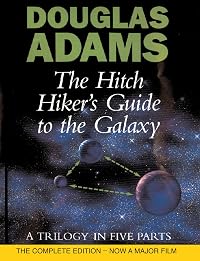
The Hitchhiker's Guide to the Galaxy: A Trilogy in Five Parts
by Douglas Adams
The Hitchhiker's Guide to the Galaxy (Collections and Selections — 1-5)
On This Page
Description
Collected together in the Hitchhiker's Guide Trilogy are the five titles that comprise Douglas Adams' wildly popular and wholly remarkable comedy science fiction series. The edition comes complete with an unhelpful introduction from the author, a bonus short story, Young Zaphod Plays It Safe, and a special undeleted scene. "The Hitchhiker's Guide to the Galaxy": One Thursday lunchtime the Earth gets unexpectedly demolished to make way for a new hyperspace bypass. For Arthur Dent, who has show more only just had his house demolished that morning, this seems already to be rather a lot to cope with. Sadly, however, the weekend has only just begun. The Galaxy may offer a mind-boggling variety of ways to be blown up and/or insulted, but it's very hard to get a cup of tea. "The Restaurant at the End of the Universe": When all questions of space, time, matter and the nature of being have been resolved, only one question remains - 'Where shall we have dinner?' "Life, the Universe and Everything": Following a number of stunning catastrophes, Arthur Dent is surprised to find himself living in a hideously miserable cave on prehistoric Earth. However, just as he thinks that things cannot get possibly worse, they suddenly do. An eddy in the space-time continuum lands him, Ford Prefect, and their flying sofa in the middle of the cricket ground at Lord's, just two days before the world is due to be destroyed by the Vogons. Escaping the end of the world for a second time, Arthur, Ford, and their old friend Slartibartfast embark (reluctantly) on a mission to save the whole galaxy from fanatical robots. Not bad for a man in his dressing gown. "So Long, and Thanks for All the Fish": There is a knack to flying. The knack lies in learning how to throw yourself at the ground and miss. It's not an easy thing to do, and Arthur Dent thinks he's the only human who's been able to master this nifty little trick - until he meets Fenchurch, the woman of his dreams. Fenchurch once realised how the world could be made a good and happy place. Unfortunately, she's forgotten. Convinced that the secret lies within God's Final Message to His Creation, they go in search of it. And, in a dramatic break with tradition, actually find it... "Mostly Harmless": Arthur Dent has settled down on the small planet Lamuella and has embraced his role as a Sandwich Maker. However, his plans for a quiet life are thrown awry by the unexpected arrival of his daughter. There's nothing worse than a frustrated teenager with a copy of the Hitchhiker's Guide to the Galaxy in their hands. When she runs away, Arthur goes after her determined to save her from the horrors of the universe. After all - he's encountered most of them before. show lessTags
Recommendations
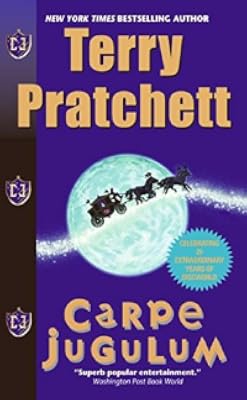
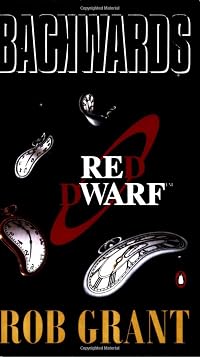
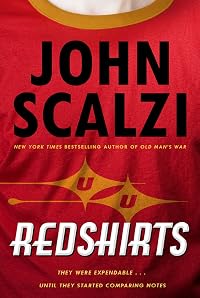

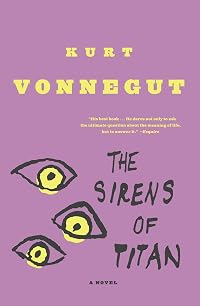

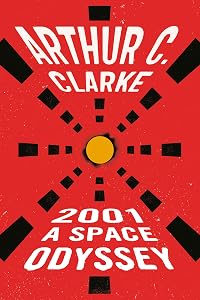

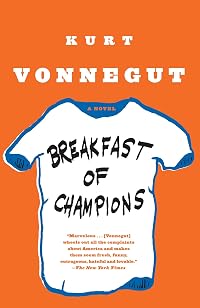
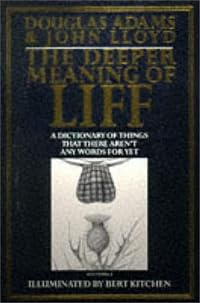
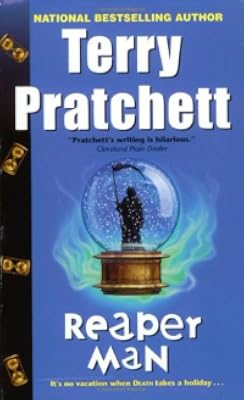





Member Recommendations
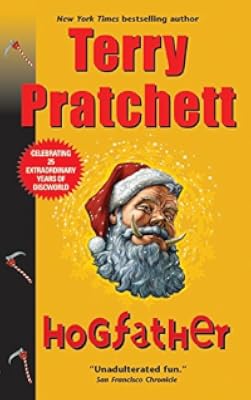
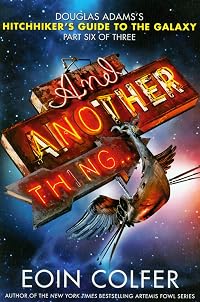
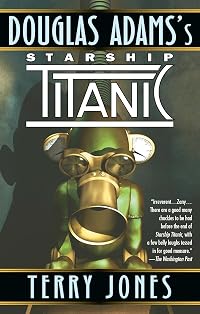
jabberwockiness Published posthumously - drabbles from Douglas Adams himself. Enjoy!
60
antihero This is a great book about the life of Douglas Adams, with a focus on all things Hitchhiker.
20
PghDragonMan Improbable road trips while dealing with the End of Everything.
20

andejons Similarly absurd stories set in space, even if Niemi has more grime.

Wilt by Tom Sharpe
by kullfarr

Smith by Mike Devlin
tottman Both have a wacky, offbeat sense of humor and adventure. They tell tales of fish-out-of-water earthmen on hilarious romps across the universe.

rretzler Science fiction with a dry wit.

pratchettfan Dimension of Miracles of Miracles and Hitchhiker's Guide to the Galaxy share the same mindset of strange, intelligent and witty sci-fi. If you loved one of them you'll love the other too!
Member Reviews
The way I (probably mistakenly) see it, the answer 42 represents a view of cheery perfection. It's almost as though it is trying to be as divisible as possible simply to be helpful. Even its name is annoyingly perky. It is the number which represents what the established order (notably religion) has told us represents the universe. It is the number of order, sense and reason. Neither 6 nor 9 nor 54 are particularly welcoming numbers. Douglas Adams seems to like this view of the world. Just like Sirius Cybernetics, we're sold the idea of something being perfect and flawless whereas we all know (even if we are reluctant to truly accept it) that the reality does not match it.
I also wrote the “perfect sonnet”:
Sonnet 42
That thou hast show more her, it is not all my grief,
And yet it may be said I loved her dearly;
That she hath thee, is of my wailing chief,
A loss in love that touches me more nearly.
Loving offenders, thus I will excuse ye:
Thou dost love her, because thou knowst I love her;
And for my sake even so doth she abuse me,
Suffering my friend for my sake to approve her.
If I lose thee, my loss is my love's gain,
And losing her, my friend hath found that loss;
Both find each other, and I lose both twain,
And both for my sake lay on me this cross:
But here's the joy; my friend and I are one;
Sweet flattery! Then she loves but me alone.
By MySelfie, the Flatulent Shakespeare
(Bought in 1994)
NB: At the risk of being jumped on and beaten up by everyone who hates such things being mentioned, there is another lovely coincidence here to do with the number 42, and that is that in cultures all over the world 42 is the number of Creation. The Jews believe 42 is the number of permutations of the letters of the name of God with which the Universe was brought into being and in China, both the Tao Te Ching and the I Ching discuss the creation of the Universe in their 42nd chapters. In ancient Egypt, 42 was the number linked to the Goddess Maat (Wisdom) who was the personification of the idea of balance and harmony the Egyptians thought upheld the Cosmos. I offer this up as a piece of anthropological information which makes a nice coincidence for Douglas Adams, whose books I have loved since a child, and not as something which suggests we should all bow to the Pope, become orthodox Jews or take up Taoism, in case anyone starts frothing at the mouth. I just thought it was fun that Adams, in thinking he had come up with a joke comment on the futility of trying to come up with an answer to the question of the meaning of the Universe landed upon the one number which traditionally has been all about the meaning of the Universe! I had always believed that Douglas Adams chose "42" since it was (but no longer is) the Hubble constant. If the number was below 42 then the universe ends in big crunch, greater than 42 we expand into infinite nothingness, but at 42 the universe will reach a state of equilibrium. However the number has been subject to revision and is steadily crawling closer to 43 which (imho) is the ultimate number .... show less
I also wrote the “perfect sonnet”:
Sonnet 42
That thou hast show more her, it is not all my grief,
And yet it may be said I loved her dearly;
That she hath thee, is of my wailing chief,
A loss in love that touches me more nearly.
Loving offenders, thus I will excuse ye:
Thou dost love her, because thou knowst I love her;
And for my sake even so doth she abuse me,
Suffering my friend for my sake to approve her.
If I lose thee, my loss is my love's gain,
And losing her, my friend hath found that loss;
Both find each other, and I lose both twain,
And both for my sake lay on me this cross:
But here's the joy; my friend and I are one;
Sweet flattery! Then she loves but me alone.
By MySelfie, the Flatulent Shakespeare
(Bought in 1994)
NB: At the risk of being jumped on and beaten up by everyone who hates such things being mentioned, there is another lovely coincidence here to do with the number 42, and that is that in cultures all over the world 42 is the number of Creation. The Jews believe 42 is the number of permutations of the letters of the name of God with which the Universe was brought into being and in China, both the Tao Te Ching and the I Ching discuss the creation of the Universe in their 42nd chapters. In ancient Egypt, 42 was the number linked to the Goddess Maat (Wisdom) who was the personification of the idea of balance and harmony the Egyptians thought upheld the Cosmos. I offer this up as a piece of anthropological information which makes a nice coincidence for Douglas Adams, whose books I have loved since a child, and not as something which suggests we should all bow to the Pope, become orthodox Jews or take up Taoism, in case anyone starts frothing at the mouth. I just thought it was fun that Adams, in thinking he had come up with a joke comment on the futility of trying to come up with an answer to the question of the meaning of the Universe landed upon the one number which traditionally has been all about the meaning of the Universe! I had always believed that Douglas Adams chose "42" since it was (but no longer is) the Hubble constant. If the number was below 42 then the universe ends in big crunch, greater than 42 we expand into infinite nothingness, but at 42 the universe will reach a state of equilibrium. However the number has been subject to revision and is steadily crawling closer to 43 which (imho) is the ultimate number .... show less
In a way, I wish I could have read these novels separately rather than in one big omnibus-mush so I could rate them individually. Clearly the first novel is a 4-star book, despite the issues I had with it (to be revealed later in this review) but I'm not sure if any of the sequels reached that level. Oddly enough though, the stories haven't all merged into one big unidentifiable story in my head, despite reading them in quick succession, because they are all totally different in style. I mean, obviously still Adams, but very much each bringing a different type of story to the table.
So first of all we have The Hitch Hiker's Guide To The Galaxy, which is something like the spray cream equivalent of a novel. Lots of fun, light and fluffy show more to digest, with no substance at all and it dissolves before you're done with it. Well actually, Adams often puts in a lot of weird SF ideas and pseudo scientific or mathematic concepts that completely go over my head, so I feel like I am missing out on about a fifth of each book because I don't understand a word he is saying. But that aside, the first book is motivated not by plot or character, like every other novel I have ever read, but by comedy. The characters have almost no depth at all, Arthur is confused, Ford is a jerk, Zaphod is a cad with a weird brain thing, Trillian is deadpan and smart and Marvin is unbearable. There's barely a plot, and Adams purposely removes all instances of drama to insert more laughs. It's fun and well written, but it's all pudding and nothing to get your teeth into. There are two interesting concepts, that everything that happens is because Zaphod is being motivated subconsciously by a part of his brain he can't access and was sealed off from him by his earlier self, and that part of this plan involves him using a spaceship that is powered by improbability which means that the random coincidences happening are all meant to happen and a part of this plot. Also there are the two questions - the meaning of life and the ruler of the universe - which at least hint at more to come. Because this book just stops part way along.
I liked The Restaurant At The End Of The Universe a lot more, to start with. Zaphod was by far the most interesting character with the only plot going in the first book, so his (and Marvin's) adventures, actually featuring real drama and thrills, were an absolute relief for me. Shame that the other characters literally sit around doing nothing during this. However, this came to an abrupt halt. Suddenly they all go to the actual restaurant at the end of the universe for no reason and nothing of interest happens here. For some reason this whole sequence is the part I remember most from the TV show, so it was particularly uninteresting to read about. Then we get all that rather disheartening stuff with Arthur and Ford (neither of whom I particularly like) on prehistoric Earth. The intrigue of those two questions set up in the first book are both deliberately flushed down the toilet towards the end of this one, which means that everything that was interesting about this series is completely over now. Also Trillian does absolutely nothing in this book.
Life, The Universe And Everything is the real odd one out in the series because it has almost nothing to do with the characters. Slartibartfast (and there is no reason it is this random character from book 1) is trying to stop some aliens getting hold of five artefacts (yes this does feel like a computer game plot) that will allow them to destroy the universe. For no reason at all (I genuinely assumed this was plot-relevant, but none of the characters even notice it happening) 4 of the 5 artefacts are in the direct vicinity of our five heroes. The fifth one we only find out about in an epilogue. So that's frustrating and disappointing, but far worse than that is the fact that the characters do nothing for almost all the book. Arthur and Ford have joined up with Slartibartfast kind of against their will, and Ford, who has always been an apathetic selfish jerk, is worse than ever and has zero interest in saving the universe. So our three leads just stand around, arriving too late and doing nothing at each scene. Literally the plot could continue perfectly well whether they were there or not. Meanwhile, Trillian is reduced to being unsympathetic, Zaphod remains by far the best thing in it for the two scenes or so that he gets, and Marvin shows up again, being surprisingly nice. Trillian, who has barely been in it, randomly solves the problem right at the end in a very poorly set-up manner and we move on with our lives.
Book 4, So Long, And Thanks For All The Fish, is different. When I listened to this as the radio version back when I was at uni (and it was newly adapted) I actually liked it the best because it was the least SF so I was able to almost follow what the hell was going on for once. But 15 years later, clearly my tastes have changed. Because this one is boring. It's entirely about Arthur having one of those impulsive instant love affairs with a woman called Fenchurch and I really hate that kind of love story. Also Ford is in the book, doing some gibberish I wasn't able to follow at all. Marvin gets a cameo, but Zaphod and Trillian don't feature at all, getting a brief mention from Ford that they settled down and had kids. It's probably the nicest of the books. The Earth is restored and Arthur is happy. Ahhh.
Book 5, Mostly Harmless, seems only to exist to take a big poop on book 4. So some of you liked all that niceness, did you? You liked that the story had ended, did you? Let me ruin it for you! This book focuses on parallel universes, except not, and I was absolutely, completely never sure what was going on because of that. It also directly contradicts a few things already established, although occasionally sort of pooh-poohs the ideas, as if ol' book 5 knows better than all that stuff that came before. Arthur has never, NEVER, been an interesting lead. A character whose only trait is that he never knows what is going on is not a motivating lead. Book 4 and 5 have focused more on him as a person, but following on from three books of him being nothing, it's a bit late, and the fact that he has given up on Fenchurch in this one and is only obsessed with Earth is really jarring, although I liked that he cared about poor psychologically-damaged Random, although she never gets a chance to be anything more than a catalyst for the ending. Ford has the exact same role as he had in book 4, that is that we cut to him doing some exciting harebrained schemes that are totally out of character for this apathetic jerk and are clearly the realm of Zaphod in books 2 and 3. Trillian is absolutely ruined forever, and is a heartless awful person, plus there is a random other version of her now; one regrets leaving with Zaphod and the other regrets not leaving with Zaphod. Zaphod himself is nowhere to be seen. Neither is Marvin but that's because that's one piece of continuity from book 4 we are keeping. Anyway, everything that happens escalates to the climax, in which you discover that once again forces beyond the characters' control have been controlling themand they are all brought together in order to be annihilated. Yes, that's right, book 5 brings us full circle back to the start of book 1 and then murders all of the main characters and just abruptly ends there. It is chilling. Hard to find a more disheartening way to end the book. And yet it is annoyingly 'neat' and 'ties in'. Clever and utterly horrible. I really wish I had not read book 5 because it offers nothing but a series of adventures that turn out to only exist to kick you in the gut.
The good news for me is that my favourite character is the only one to survive the series!
Although he does this by simply not being in the last two books.
Also, a kind of nasty or sad note to these books is that it doesn't seem to value friendship at all. It is never explained why Ford saves Arthur from the destruction of the Earth. Neither particularly like each other (or anyone) and by book 5, they actively despise each other. Arthur repeatedly chooses to live alone, with no contact with the other characters between books. When he loses the woman he loves, he doesn't even try to seek out the only people he knows in the universe. The five heroes of the original book simply don't like each other and only seem to spend any time together because of the outside forces driving them. The only times you get any hint of warmth from characters is that Zaphod likes Trillian and Arthur and Fenchurch love each other, but these are romantic relationships - friendship doesn't exist in this universe.
So, overall, the SF humour of these books pretty much completely bypasses my brain. Oddly the very particular humour of the first book is notably absent from the others. The plots (infuriatingly deliberately) don't go anywhere, end in anti-climaxes and are propelled by seemingly relevant coincidences that are hardly ever explained. And the characters are shallow and unlikeable. Except for Zaphod, who I love. And ultimately each book (not including 3 which really doesn't fit with the rest of it) is slightly more depressing than the last (okay book 4 was happier, but less eventful, so it still had a downer feel to it), finally ending in utter misery. The first book is fun but too insubstantial on its own, unfortunately nothing it sets up goes anywhere satisfactory in the later books. The only part of the omnibus that I really enjoyed was the first third of book 2. And when you read an entire series waiting for 'The Adventures Of Zaphod Show' to come back and then he's not even in the last two books... I guess I'm just not the intended audience here. show less
So first of all we have The Hitch Hiker's Guide To The Galaxy, which is something like the spray cream equivalent of a novel. Lots of fun, light and fluffy show more to digest, with no substance at all and it dissolves before you're done with it. Well actually, Adams often puts in a lot of weird SF ideas and pseudo scientific or mathematic concepts that completely go over my head, so I feel like I am missing out on about a fifth of each book because I don't understand a word he is saying. But that aside, the first book is motivated not by plot or character, like every other novel I have ever read, but by comedy. The characters have almost no depth at all, Arthur is confused, Ford is a jerk, Zaphod is a cad with a weird brain thing, Trillian is deadpan and smart and Marvin is unbearable. There's barely a plot, and Adams purposely removes all instances of drama to insert more laughs. It's fun and well written, but it's all pudding and nothing to get your teeth into. There are two interesting concepts, that everything that happens is because Zaphod is being motivated subconsciously by a part of his brain he can't access and was sealed off from him by his earlier self, and that part of this plan involves him using a spaceship that is powered by improbability which means that the random coincidences happening are all meant to happen and a part of this plot. Also there are the two questions - the meaning of life and the ruler of the universe - which at least hint at more to come. Because this book just stops part way along.
I liked The Restaurant At The End Of The Universe a lot more, to start with. Zaphod was by far the most interesting character with the only plot going in the first book, so his (and Marvin's) adventures, actually featuring real drama and thrills, were an absolute relief for me. Shame that the other characters literally sit around doing nothing during this. However, this came to an abrupt halt. Suddenly they all go to the actual restaurant at the end of the universe for no reason and nothing of interest happens here. For some reason this whole sequence is the part I remember most from the TV show, so it was particularly uninteresting to read about. Then we get all that rather disheartening stuff with Arthur and Ford (neither of whom I particularly like) on prehistoric Earth. The intrigue of those two questions set up in the first book are both deliberately flushed down the toilet towards the end of this one, which means that everything that was interesting about this series is completely over now. Also Trillian does absolutely nothing in this book.
Life, The Universe And Everything is the real odd one out in the series because it has almost nothing to do with the characters. Slartibartfast (and there is no reason it is this random character from book 1) is trying to stop some aliens getting hold of five artefacts (yes this does feel like a computer game plot) that will allow them to destroy the universe. For no reason at all (I genuinely assumed this was plot-relevant, but none of the characters even notice it happening) 4 of the 5 artefacts are in the direct vicinity of our five heroes. The fifth one we only find out about in an epilogue. So that's frustrating and disappointing, but far worse than that is the fact that the characters do nothing for almost all the book. Arthur and Ford have joined up with Slartibartfast kind of against their will, and Ford, who has always been an apathetic selfish jerk, is worse than ever and has zero interest in saving the universe. So our three leads just stand around, arriving too late and doing nothing at each scene. Literally the plot could continue perfectly well whether they were there or not. Meanwhile, Trillian is reduced to being unsympathetic, Zaphod remains by far the best thing in it for the two scenes or so that he gets, and Marvin shows up again, being surprisingly nice. Trillian, who has barely been in it, randomly solves the problem right at the end in a very poorly set-up manner and we move on with our lives.
Book 4, So Long, And Thanks For All The Fish, is different. When I listened to this as the radio version back when I was at uni (and it was newly adapted) I actually liked it the best because it was the least SF so I was able to almost follow what the hell was going on for once. But 15 years later, clearly my tastes have changed. Because this one is boring. It's entirely about Arthur having one of those impulsive instant love affairs with a woman called Fenchurch and I really hate that kind of love story. Also Ford is in the book, doing some gibberish I wasn't able to follow at all. Marvin gets a cameo, but Zaphod and Trillian don't feature at all, getting a brief mention from Ford that they settled down and had kids. It's probably the nicest of the books. The Earth is restored and Arthur is happy. Ahhh.
Book 5, Mostly Harmless, seems only to exist to take a big poop on book 4. So some of you liked all that niceness, did you? You liked that the story had ended, did you? Let me ruin it for you! This book focuses on parallel universes, except not, and I was absolutely, completely never sure what was going on because of that. It also directly contradicts a few things already established, although occasionally sort of pooh-poohs the ideas, as if ol' book 5 knows better than all that stuff that came before. Arthur has never, NEVER, been an interesting lead. A character whose only trait is that he never knows what is going on is not a motivating lead. Book 4 and 5 have focused more on him as a person, but following on from three books of him being nothing, it's a bit late, and the fact that he has given up on Fenchurch in this one and is only obsessed with Earth is really jarring, although I liked that he cared about poor psychologically-damaged Random, although she never gets a chance to be anything more than a catalyst for the ending. Ford has the exact same role as he had in book 4, that is that we cut to him doing some exciting harebrained schemes that are totally out of character for this apathetic jerk and are clearly the realm of Zaphod in books 2 and 3. Trillian is absolutely ruined forever, and is a heartless awful person, plus there is a random other version of her now; one regrets leaving with Zaphod and the other regrets not leaving with Zaphod. Zaphod himself is nowhere to be seen. Neither is Marvin but that's because that's one piece of continuity from book 4 we are keeping. Anyway, everything that happens escalates to the climax, in which you discover that once again forces beyond the characters' control have been controlling them
Although he does this by simply not being in the last two books.
Also, a kind of nasty or sad note to these books is that it doesn't seem to value friendship at all. It is never explained why Ford saves Arthur from the destruction of the Earth. Neither particularly like each other (or anyone) and by book 5, they actively despise each other. Arthur repeatedly chooses to live alone, with no contact with the other characters between books. When he loses the woman he loves, he doesn't even try to seek out the only people he knows in the universe. The five heroes of the original book simply don't like each other and only seem to spend any time together because of the outside forces driving them. The only times you get any hint of warmth from characters is that Zaphod likes Trillian and Arthur and Fenchurch love each other, but these are romantic relationships - friendship doesn't exist in this universe.
So, overall, the SF humour of these books pretty much completely bypasses my brain. Oddly the very particular humour of the first book is notably absent from the others. The plots (infuriatingly deliberately) don't go anywhere, end in anti-climaxes and are propelled by seemingly relevant coincidences that are hardly ever explained. And the characters are shallow and unlikeable. Except for Zaphod, who I love. And ultimately each book (not including 3 which really doesn't fit with the rest of it) is slightly more depressing than the last (okay book 4 was happier, but less eventful, so it still had a downer feel to it), finally ending in utter misery. The first book is fun but too insubstantial on its own, unfortunately nothing it sets up goes anywhere satisfactory in the later books. The only part of the omnibus that I really enjoyed was the first third of book 2. And when you read an entire series waiting for 'The Adventures Of Zaphod Show' to come back and then he's not even in the last two books... I guess I'm just not the intended audience here. show less
Det är en helt vanlig morgon för Arthur Dent; inte alls olik andra morgnar. Åtminstone inte förrän han inser att det står en bulldozer och massor av arbetare utanför hans fönster. Det visar sig nämligen att hans hus måste rivas då en ny genomfartsled ska byggas och hans hus råkar stå precis i vägen. Men när han ligger där i gyttan i bara badrocken dyker hans vän Ford förbi. Han har nyheter som kräver att protesten ligger på is bara en liten stund.
Själva Jorden är nämligen på väg att sprängas för att ge plats åt en intergalatisk genomfartsled. Ford vet detta för han själv är utomjording; han hamnade på Jorden på grund av studier för det digitala uppslagsverket Liftarens guide till galaxen. Men nu ser han show more sin chans att återvända hem, denna gång med Arthur eftersom Jorden ändå ska förintas. I sista sekund lyckas de lifta med ett av skeppen i Vogonflottan vars uppgift är att röja Jorden ur vägen.
Ungefär samtidigt stjäl Fords halvkusin Zaphod Beeblebrox stjäl det nya rymdskeppet Hjärtat av Guld från dess premiärvisning. Det är ett skepp som drivs med hjälp av en oändlig osannolikhet. Hjärtat av Guld är nämligen det enda skeppet i universum som kan hjälpa honom på traven med de planer han smider. Problemet är bara att inte riktigt vet vad dessa planer är...
Det är en osannolik bok där allt och inget kan hända. Hela boken känns som ett enda citat; det är svårt att välja de bästa delarna; man skulle bli tvungen att inkludera hela boken. Samtidigt som den är full av klockrena och ironiska repliker och beskrivningar så är den även fascinerande djup. På ett sådant där jobbigt sätt som man helst ignorerar fast man vet att det är omöjligt. show less
Själva Jorden är nämligen på väg att sprängas för att ge plats åt en intergalatisk genomfartsled. Ford vet detta för han själv är utomjording; han hamnade på Jorden på grund av studier för det digitala uppslagsverket Liftarens guide till galaxen. Men nu ser han show more sin chans att återvända hem, denna gång med Arthur eftersom Jorden ändå ska förintas. I sista sekund lyckas de lifta med ett av skeppen i Vogonflottan vars uppgift är att röja Jorden ur vägen.
Ungefär samtidigt stjäl Fords halvkusin Zaphod Beeblebrox stjäl det nya rymdskeppet Hjärtat av Guld från dess premiärvisning. Det är ett skepp som drivs med hjälp av en oändlig osannolikhet. Hjärtat av Guld är nämligen det enda skeppet i universum som kan hjälpa honom på traven med de planer han smider. Problemet är bara att inte riktigt vet vad dessa planer är...
Det är en osannolik bok där allt och inget kan hända. Hela boken känns som ett enda citat; det är svårt att välja de bästa delarna; man skulle bli tvungen att inkludera hela boken. Samtidigt som den är full av klockrena och ironiska repliker och beskrivningar så är den även fascinerande djup. På ett sådant där jobbigt sätt som man helst ignorerar fast man vet att det är omöjligt. show less
The Hitchhiker's Guide to the Galaxy was a life-changing read for me in high school. It would affect how I looked at writing for the next 22 years and will probably continue to do so for the rest of my life. The book was incredibly funny, the dialogue was great and it was all absolutely ridiculous. However, it was never a parody of itself and Adams made sure you cared about what happened to the characters and the story.
Great book. A must-read for any sci-fi fan.
Oh, and the rest of the books are pretty darn excellent, as well. :)
Great book. A must-read for any sci-fi fan.
Oh, and the rest of the books are pretty darn excellent, as well. :)
Douglas Adams' Hitchhiker series will, for certain readers, represent an epiphany of the sort caused elsewhere (but in the same sorts of people) only by Monty Python and Pink Floyd. Generally speaking, if you know all the lyrics to Animals, can quote the dead parrot sketch and can hum David Gilmour's guitar solos, you will be able to recite the titles of all Oolon Colluphid's groundbreaking metaphysical tracts about God, too. Yes, you. You know who you are.
I have a few complaints about the way it all ends up, but I better get in the bouquets while the going is good: all my quibbling below is not to detract from the fact that the original instalment, The Hitch-Hiker's Guide To The Galaxy, is one of the wittiest books ever written - the show more combination of a solid science fiction grounding (Adams scriptwrote for Doctor Who) and dead-eye observations about the collision of the British way of life with the Nineteen Seventies, make this little book one of the genuine cultural artefacts of the past century.
Nevertheless, and rather as it has for Floyd and Python, universal admiration for Adams (recently deceased) and the first book has tended to cloud the collective judgment as far as the rest of the series is concerned. While Adams is clearly a master of the dead-ball, the entire package is a pretty tiring affair, as if it were a good idea which ran out of steam about halfway through. Which, according to Adams himself, it was.
If you read even the first three stories back to back a few things begin to emerge. Firstly, the original (and undeniably brilliant) premise has completely evaporated by the end of the second book. Until this point the story drifts from set piece to set piece, but is guided fairly firmly by the central quest. When this runs out of gas, the linear narrative disappears, and the characters drift pointlessly between scenes with no apparent connection. What starts out as a clever concept album ends up as a sketch show. As long as the sketches are funny this is ok, if not necessarily ideal. But they too begin to run out of steam.
Whenever Adams needs to restore a semblance of continuity, he reintroduces Marvin the Paranoid Android, who turns up having been stuck somewhere for millions of years (waiting to save the author's bacon?): no bad thing, as Marvin is the most enjoyable character of the lot. Adams obviously realised the mess he'd created by the end of Life, The Universe and Everything: So Long and Thanks For All The Fish is an attempt to pull everything back together. Alas, it's wholly unsuccessful. So unsuccessful, in fact, that Adams felt obliged to have another go at the same job in Mostly Harmless, and was equally unsuccessful second time round.
After a time you also begin to realise that Adams' famously brilliant writing style consists largely of taking figures of speech and deliberately subverting them - a technique which after a while, to paraphrase it, more or less exactly fails to please the eye. By So Long..., Adams is rather arch about the whole affair - consciously introducing "the chronicler" into proceedings and on one occasion (not a little arrogantly) telling readers to re-read a seemingly incomprehensible sentence, until it is understood.
The series certainly gave him the chance to work on his storytelling, and the results are plain to see from Dirk Gently's Holistic Detective Agency, which is a superbly plotted, focussed and realised story. But, rather like his characters, for the most part in this Series Adams flounders around with the Answer, but never really gets to grips with the Question.
Mostly Harmless. show less
I have a few complaints about the way it all ends up, but I better get in the bouquets while the going is good: all my quibbling below is not to detract from the fact that the original instalment, The Hitch-Hiker's Guide To The Galaxy, is one of the wittiest books ever written - the show more combination of a solid science fiction grounding (Adams scriptwrote for Doctor Who) and dead-eye observations about the collision of the British way of life with the Nineteen Seventies, make this little book one of the genuine cultural artefacts of the past century.
Nevertheless, and rather as it has for Floyd and Python, universal admiration for Adams (recently deceased) and the first book has tended to cloud the collective judgment as far as the rest of the series is concerned. While Adams is clearly a master of the dead-ball, the entire package is a pretty tiring affair, as if it were a good idea which ran out of steam about halfway through. Which, according to Adams himself, it was.
If you read even the first three stories back to back a few things begin to emerge. Firstly, the original (and undeniably brilliant) premise has completely evaporated by the end of the second book. Until this point the story drifts from set piece to set piece, but is guided fairly firmly by the central quest. When this runs out of gas, the linear narrative disappears, and the characters drift pointlessly between scenes with no apparent connection. What starts out as a clever concept album ends up as a sketch show. As long as the sketches are funny this is ok, if not necessarily ideal. But they too begin to run out of steam.
Whenever Adams needs to restore a semblance of continuity, he reintroduces Marvin the Paranoid Android, who turns up having been stuck somewhere for millions of years (waiting to save the author's bacon?): no bad thing, as Marvin is the most enjoyable character of the lot. Adams obviously realised the mess he'd created by the end of Life, The Universe and Everything: So Long and Thanks For All The Fish is an attempt to pull everything back together. Alas, it's wholly unsuccessful. So unsuccessful, in fact, that Adams felt obliged to have another go at the same job in Mostly Harmless, and was equally unsuccessful second time round.
After a time you also begin to realise that Adams' famously brilliant writing style consists largely of taking figures of speech and deliberately subverting them - a technique which after a while, to paraphrase it, more or less exactly fails to please the eye. By So Long..., Adams is rather arch about the whole affair - consciously introducing "the chronicler" into proceedings and on one occasion (not a little arrogantly) telling readers to re-read a seemingly incomprehensible sentence, until it is understood.
The series certainly gave him the chance to work on his storytelling, and the results are plain to see from Dirk Gently's Holistic Detective Agency, which is a superbly plotted, focussed and realised story. But, rather like his characters, for the most part in this Series Adams flounders around with the Answer, but never really gets to grips with the Question.
Mostly Harmless. show less
I first discovered the Hitchhiker series through BBC radio 4, and I never looked back. The books are hilarious and completely off the wall. Ships which travel using "improbability drives" and cause improbable things to happen (naturally), like picking up 2 humanoids from deep space and certain death. To be a hitch hiker in the universe all you need is a towel, an electronic thumb and the eponymous guide. Read it, and you will discover, amongst other things, the rudest word in the universe, the answer to life the universe and everything (but not the question), and that mobile phone ringtones are not as cool as homo sapiens seems to think... a great antidote to modern life.
Very funny. The story is very honest view of how governments work. Like a long public works poem. Very clever and never what you would expect. So long and thanks for all the fish.
Members
- Recently Added By
Lists

1001 Books You Must Read Before You Die
1,448 works; 1,132 members

Stories About Other Worlds
145 works; 13 members

Best Books About Journeys and Quests
117 works; 30 members

Banned Books Week 2014
268 works; 63 members

20th Century Literature
1,161 works; 55 members

Nonhuman Protagonists
235 works; 34 members
Favourite Books
1,817 works; 316 members

Carole's List
445 works; 13 members

A Novel Cure
742 works; 23 members

BBC Radio 4 Bookclub
340 works; 13 members

Books to Read in 2015
13 works; 1 member
Banned or Challenged Books
400 works; 41 members

Our Favorite Comfort Reads
334 works; 200 members
Talk Discussions
Past Discussions
Hitchhiker's Guide to the Galaxy LE 2023 in Folio Society Devotees (November 2023)
Author Information

91+ Works 190,662 Members
Douglas Noel Adams (sometimes referred to Bop Ad because of his distinctive signature) was born in Cambridge, England, on March 11, 1952 and educated at St. John's College at Cambridge University. He graduated with honors in English Literature in 1974. In addition to being a writer/editor for radio, television, and stage, Adams has worked as a show more hospital reporter, barn builder, and radio producer. The Hitchhiker's Guide to the Galaxy, 1979, one of his bestselling humor and science fiction novels, was originally a radio series. It was the first in a four-book series that includes The Restaurant at the End of the Universe; Life, the Universe, and Everything, and So Long, and Thanks for All the Fish. He once stated that the idea for his first novel came while he was "lying drunk in a field in Innsbruck and gazing at the stars." He pokes fun at humanity by mixing science fiction with humor. Adams's additional books include The Meaning of Liff; The Deeper Meaning of Liff; Dirk Gently's Holistic Detective Agency; The Long Dark Tea-time of the Soul; and Mostly Harmless. He has also co-authored the book Last Chance to See, about endangered species. Douglas Adams died May 11, 2001 of a heart attack in Santa Barbara, California at the age of 49. (Bowker Author Biography) show less
Some Editions
Awards and Honors
Distinctions
Series

Work Relationships
Contains
Is an expanded version of
Is expanded in
Common Knowledge
- Canonical title
- The Hitchhiker's Guide to the Galaxy: A Trilogy in Five Parts
- Original title
- The Hitchhiker's Guide to the Galaxy
- Original publication date
- 1992
- People/Characters
- Zaphod Beeblebrox; Ford Prefect; Arthur Dent; Tricia "Trillian" McMillan; Marvin, the Paranoid Android; Agrajag (show all 23); Slartibartfast; Deep Thought; Frankie Mouse; Benjy Mouse; Zaphod Beeblebrox the Fourth; Zarniwoop; Roosta; Gargravarr; The Ruler of the Universe; Judiciary Pag; Hactar; Russell; Fenchurch; Wonko the Sane (John Watson); Random Dent; Guide 2.0; Ronald Reagan
- Important places
- London, England, UK; Earth; Betelgeuse; Magrathea; Milliways; Ursa Minor Beta (show all 13); Lord's Cricket Ground; Krikkit; Stavromula Beta; California, USA; Lamuella; Rupert; Galactic Sector ZZ9 Plural Z Alpha
- Related movies
- The Hitch Hikers Guide to the Galaxy (1981 | IMDb); The Hitchhiker's Guide to the Galaxy (2005 | IMDb)
- Epigraph*
- "Ta det lugnt", 42
- Dedication
- For Jonny Brock and Clare Gorst
and all other Arlingtonians
for tea, sympathy, and a sofa - First words
- Far out in the uncharted backwaters of the unfashionable end of the Western Spiral arm of the Galaxy lies a small unregarded yellow sun.
- Last words
- (Click to show. Warning: May contain spoilers.)He put on a little light music instead.
- Canonical DDC/MDS
- 823.914
- Disambiguation notice
- Collected Books 1-5 Only. This omnibus does NOT include the short story "Young Zaphod Plays it Safe". This is NOT the Ultimate Hitchhiker's Guide.
*Some information comes from Common Knowledge in other languages. Click "Edit" for more information.
Classifications
Statistics
- Members
- 4,620
- Popularity
- 3,126
- Reviews
- 47
- Rating
- (4.38)
- Languages
- 16 — Danish, English, Finnish, French, German, Hungarian, Italian, Korean, Norwegian (Bokmål), Norwegian, Polish, Portuguese, Serbian, Slovak, Swedish, Turkish
- Media
- Paper, Audiobook, Ebook
- ISBNs
- 55
- UPCs
- 1
- ASINs
- 17