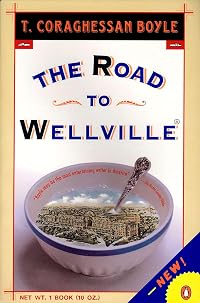
The Road to Wellville
by T. Coraghessan Boyle
On This Page
Description
Will Lightbody is a man with a stomach ailment whose only sin is loving his wife, Eleanor, too much. Eleanor is a health nut of the first stripe, and when in 1907 she journeys to Dr. John Harvey Kellogg's infamous Battle Creek Spa to live out the vegetarian ethos, poor Will goes too. So begins T. Coraghessan Boyle's wickedly comic look at turn-of-the-century fanatics in search of the magic pill to prolong their lives--or the profit to be had from manufacturing it. Brimming with a Dickensian show more cast of characters and laced with wildly wonderful plot twists, Jane Smiley in the New York Times Book Review called The Road to Wellville "A marvel, enjoyable from beginning to end. show lessTags
Recommendations


















Member Recommendations

2wonderY You've got to hear from the horse's mouth, eh?
Member Reviews
The opening scene is cinematic in its grandeur. Great hook and something Boyle does so well. Kellogg as the ultimate shyster; part preacher, part side-show hustler. He was fabulously crazy in the most successful way you can be crazy; selling the crazy to the desperate. Like many diets today and of yesteryear, it’s almost Puritanical in its denial of things we love; food for pleasure is the sin. No matter how much worse an inmate at ‘The San’ gets, they ignore it and double down. If one dies, they must have been doing it wrong, or not doing it enough. Will baffled me the most since he didn’t want to be there in the first place. As he got worse, why didn’t he just leave? After a while I started skipping Kellogg’s show more self-aggrandizing, anti-meat speeches. It was fun, but so over-the-top and prolonged that I was glad for the sub-plot involving Bender and Ossining; boss and bagman, con and dupe. I won’t tell you how that one ends, but it surprised me. Boyle does a great job when wrapping a fiction around a historical event, but this one could have been tighter. Losing about 100 pages would have been a good idea; maybe he needs to send the book to The San. show less
During a recent class trip to my university's special collections, my pal Mark the librarian brought out a copy of John Harvey Kellogg's 1877 tome "Plain Facts for Old and Young" (Mark always seems to know which weird book I will like). My students had a grand time looking through it and laughing at some of Kellogg's pronouncements (especially the ones about sex and "self-abuse"--they are college students after all…). Then I thought, "hey, there's that copy of The Road to Wellville that's sitting on my shelf at home…maybe now's the time." It was. And it was pretty awesome.
The novel features the interwoven stories of Dr. Kellogg, director of a health sanitarium in turn-of-the-century Michigan; Will and Eleanor Lightbody, upper crust show more patients from New York; and Charlie Ossining, a lovable and well-meaning conman. All is not as serene and eudaemonic as it appears at "the San": Kellogg has some familial and administrative problems that threaten his vision for a vegetarian utopia.
Boyle has a unique ability to make the repulsive funny. I like humor but I don't always like "funny" writers because they feel like they're trying too hard. Boyle never really feels that way; he has this great talent to probe visceral human emotions and poke at them and mock them and finally to make us laugh at ourselves. There are a lot of enemas in this book, and some of them are pretty funny enemas. But there are also tender enemas and harrowing enemas and enemas filled with ennui. And if you don't think you would laugh at an enema, then maybe you would titter at a vegetarian wolf, an earnest conman, a German "womb manipulator," or a healthful cure based on the inhalation of radium vapors?
Hidden under all this is a satire probably even more relevant today than when the book first came out c. 20 years ago about our ability to fool ourselves, especially when it comes to our self image and physical health. The novel does go on a bit longer than it needed to--there's a section about 3/4 of the way through where I felt it started to get repetitive--but the climaxes revive the breakneck energy promised in the opening chapters. show less
The novel features the interwoven stories of Dr. Kellogg, director of a health sanitarium in turn-of-the-century Michigan; Will and Eleanor Lightbody, upper crust show more patients from New York; and Charlie Ossining, a lovable and well-meaning conman. All is not as serene and eudaemonic as it appears at "the San": Kellogg has some familial and administrative problems that threaten his vision for a vegetarian utopia.
Boyle has a unique ability to make the repulsive funny. I like humor but I don't always like "funny" writers because they feel like they're trying too hard. Boyle never really feels that way; he has this great talent to probe visceral human emotions and poke at them and mock them and finally to make us laugh at ourselves. There are a lot of enemas in this book, and some of them are pretty funny enemas. But there are also tender enemas and harrowing enemas and enemas filled with ennui. And if you don't think you would laugh at an enema, then maybe you would titter at a vegetarian wolf, an earnest conman, a German "womb manipulator," or a healthful cure based on the inhalation of radium vapors?
Hidden under all this is a satire probably even more relevant today than when the book first came out c. 20 years ago about our ability to fool ourselves, especially when it comes to our self image and physical health. The novel does go on a bit longer than it needed to--there's a section about 3/4 of the way through where I felt it started to get repetitive--but the climaxes revive the breakneck energy promised in the opening chapters. show less
I am a superfan of T.C. Boyle's writing yet this one might be a Big Ask for the reader. It's a very long historical novel on the wellness fad back in the day, around 1907. Oh and it's satire, of course. Luckily with alternating chapters split between three characters, Dr. Kellogg himself, the master of multitasking and overachieving, Charlie Ossining, a man starting his own competing breakfast foods business, Will Lightbody, a patient at Dr. Kellogg's Battle Creek Sanitarium (oh and his wife Eleanor gets one chapter too.) Surprisingly, Post doesn't make much of an appearance, though Kellogg considers him a nemesis. But Dr. Kellogg has many other enemies closer to home. Really, any book written about Kellogg could have went in many show more different tangents, and really doesn't feature in most of this book anyway. But a book this long -- the three (four, really) main characters are the perfect balance, to really encompass the variety of people living during this time. But that satire! You have to forgive Boyle for loving the written word this much. He has fun. The satire in every sentence is like a slab of sheet cake with more and more layers of icing. I can take it for this many pages, but can many other readers? I enjoyed it anyway! The film is also a hoot, though makes some changes that (obviously) makes the book better. show less
This fat, picaresque novel focuses on the elite but quackish sanitarium run by Dr JH Kellogg in Battle Creek, Michigan, in the early days of breakfast cereals. Kellogg was a powerful orator, a staunch vegetarian and a proponent of the kind of health fads that we'd nowadays class as alternative medicine; he also had some morbidly puritanical ideas about sex (cornflakes, famously, were originally intended to stop people masturbating – on what principle, I'm not sure, unless he planned to scatter them in people's beds).
The closed world of the sanitarium is a promisingly insular setting for the kind of comic novel that TC Boyle likes to write, and he manages to take in everything here from yogurt enemas, through insane diets (‘protose show more patties with gluten mush’, anyone?), budding entrepreneurs, down-and-outs, tycoons, alcoholism, opioid addiction, animal experimentation and the nascent nudist movement, all the way to the infamous ‘womb massage’ treatment for hysteria.
In a novel of two hundred pages, all this would have been a riot; at just shy of five hundred, I found it ultimately exhausting. Boyle's sense of humour does not quite agree with me: his main technique involves setting his characters up for great success, allowing them to reach the brink of attaining something wonderful, and then making sure that they fail in the most humiliating and unpleasant way possible at the last minute. I think this is supposed to be comic, but the effect on me was draining. (I vaguely remember feeling something similar during the last TC Boyle book I read, Water Music, too.) In this case, the endingturned out to be quite a happy one, which, unusually for me, actually made up for a lot .
It's almost worth dipping into The Road to Wellville just to sample the mood of this strange time and place, which really is fascinating. But overall, it's not so much Gr-r-reat! as Aver-r-rage!No I'm not proud of it.
Edit: Last night we watched the film version from 1994, directed by Alan Parker. It's great fun, and solves a lot of the problems with the book's plot – and it only requires an investment of two hours. So on balance, I'd recommend that instead. show less
The closed world of the sanitarium is a promisingly insular setting for the kind of comic novel that TC Boyle likes to write, and he manages to take in everything here from yogurt enemas, through insane diets (‘protose show more patties with gluten mush’, anyone?), budding entrepreneurs, down-and-outs, tycoons, alcoholism, opioid addiction, animal experimentation and the nascent nudist movement, all the way to the infamous ‘womb massage’ treatment for hysteria.
In a novel of two hundred pages, all this would have been a riot; at just shy of five hundred, I found it ultimately exhausting. Boyle's sense of humour does not quite agree with me: his main technique involves setting his characters up for great success, allowing them to reach the brink of attaining something wonderful, and then making sure that they fail in the most humiliating and unpleasant way possible at the last minute. I think this is supposed to be comic, but the effect on me was draining. (I vaguely remember feeling something similar during the last TC Boyle book I read, Water Music, too.) In this case, the ending
It's almost worth dipping into The Road to Wellville just to sample the mood of this strange time and place, which really is fascinating. But overall, it's not so much Gr-r-reat! as Aver-r-rage!
Edit: Last night we watched the film version from 1994, directed by Alan Parker. It's great fun, and solves a lot of the problems with the book's plot – and it only requires an investment of two hours. So on balance, I'd recommend that instead. show less
She was even then undergoing one of Dr. Kellogg's newest and - if you believed his self-puffery - most efficacious cures for chlorosis and a host of other conditions, from erysipelas and obesity to ingrown toenails: inhaling radium emanations. Radium, as Will understood it, was some sort of stone that gave off healing rays or vibrations. The Curies has discovered it, along with polonium, and won the 1903 Nobel Prize in Physics in acknowledgment of their achievement in isolating this miraculous substance. Dr. Kellogg had picked right up on it. A stone. A healing stone. It almost sounded pagan.
This book is set in Battle Creek, Michigan in 1907 and comprises three entwined stories. Dr. John Harvey Kellogg subjects the wealthy patients at show more the famed Battle Creek Sanatorium to a strict vegetarian diet and exercise regime, along with a wide variety of treatments, some of which, like poor Ida Muntz's radium therapy, could be doing them more harm than good. Although he is revered by most of his staff and patients Dr. Kellogg has an altogether more difficult relationship with his adopted son George who hates him and everything he stands for.
Charles Ossining comes to town intending to set up a breakfast cereal company, only to discover that every man and his dog has had the same idea. Charles and his business partner, a conman named Bender, join forces with George so that they can use the famous Kellogg name on their new breakfast cereal, while George is only to happy to be involved in a scheme that will embarrass his father.
On the train into Battle Creek, Charles meets Will and Eleanor Lightbody, who are planning a long stay at the sanatorium. Will is immediately put on a regime of enemas and a very restricted diet to treat his 'autointoxication' and sort out his terrible stomach problems, and is upset to find out that he and Eleanor are in separate rooms on different floors. Dr. Kellogg is strongly against the debilitating effects of sexual intercourse and prefers to keep married couples apart as much as possible, so they are not even seated together in the dining room. Eleanor, who has stayed at the sanatorium before, is much happier with this arrangement and starts to spend a lot of time with her handsome doctor.
An amusing and enjoyable story set at a fascinating time and place in American history. show less
This book is set in Battle Creek, Michigan in 1907 and comprises three entwined stories. Dr. John Harvey Kellogg subjects the wealthy patients at show more the famed Battle Creek Sanatorium to a strict vegetarian diet and exercise regime, along with a wide variety of treatments, some of which, like poor Ida Muntz's radium therapy, could be doing them more harm than good. Although he is revered by most of his staff and patients Dr. Kellogg has an altogether more difficult relationship with his adopted son George who hates him and everything he stands for.
Charles Ossining comes to town intending to set up a breakfast cereal company, only to discover that every man and his dog has had the same idea. Charles and his business partner, a conman named Bender, join forces with George so that they can use the famous Kellogg name on their new breakfast cereal, while George is only to happy to be involved in a scheme that will embarrass his father.
On the train into Battle Creek, Charles meets Will and Eleanor Lightbody, who are planning a long stay at the sanatorium. Will is immediately put on a regime of enemas and a very restricted diet to treat his 'autointoxication' and sort out his terrible stomach problems, and is upset to find out that he and Eleanor are in separate rooms on different floors. Dr. Kellogg is strongly against the debilitating effects of sexual intercourse and prefers to keep married couples apart as much as possible, so they are not even seated together in the dining room. Eleanor, who has stayed at the sanatorium before, is much happier with this arrangement and starts to spend a lot of time with her handsome doctor.
An amusing and enjoyable story set at a fascinating time and place in American history. show less
An outstanding novel. Boyle really outdid himself with this creative treatment of the Kellogg sanitarium and the breakfast food boom centered around Battle Creek Michigan in the early twentieth century.
The novel’s dark humor is its most striking aspect. The descriptions of the medical treatments, the enemas, the food at the sanitarium, the lectures by Kellogg, the odd characters who were drawn to the treatments, read like an odd mixture of Faulkner and Dickens. And it has plot! We follow the Will Lightbody and his wife Eleanor on the road to Wellville, along with an assortment of minor characters and subplots. Highly inventive and a great read.
The novel’s dark humor is its most striking aspect. The descriptions of the medical treatments, the enemas, the food at the sanitarium, the lectures by Kellogg, the odd characters who were drawn to the treatments, read like an odd mixture of Faulkner and Dickens. And it has plot! We follow the Will Lightbody and his wife Eleanor on the road to Wellville, along with an assortment of minor characters and subplots. Highly inventive and a great read.
This novel is set in Battle Creek, Michigan, the breakfast-food capital of the world, in the early days on the 20th century. It features a slick, unscrupulous businessman trying to make it in the cereal biz; patients at John Harvey Kellog's Sanitarium, home to daily enemas and bizarre health foods; and the great health quack Kellog himself. (The still-extant cereal company, by the way, was actually not his, but his brother's, and was a source of great conflict between them.)
It's a fairly entertaining look at a quirky little corner of history -- and one that highlights how depressingly little pseudoscientific health fads have changed since then. The back cover blurbs on my copy bill it as a hilarious satire, but while it is somewhat show more satirical, it's not really laugh-out-loud funny. Mostly, it just lets the (often tragic) absurdity of the whole thing speak for itself.
Unfortunately, the characters and the story, such as it is, aren't nearly as interesting as the setting, and while quirkiness and historical interest carry the novel pretty far, they're not quite enough to sustain 475 pages , and by the end I was beginning to lose interest a bit. It does at least pull off a dramatic (indeed, perhaps somewhat over-the-top) climax, but that doesn't change the fact that it was still maybe about 100 pages too long. show less
It's a fairly entertaining look at a quirky little corner of history -- and one that highlights how depressingly little pseudoscientific health fads have changed since then. The back cover blurbs on my copy bill it as a hilarious satire, but while it is somewhat show more satirical, it's not really laugh-out-loud funny. Mostly, it just lets the (often tragic) absurdity of the whole thing speak for itself.
Unfortunately, the characters and the story, such as it is, aren't nearly as interesting as the setting, and while quirkiness and historical interest carry the novel pretty far, they're not quite enough to sustain 475 pages , and by the end I was beginning to lose interest a bit. It does at least pull off a dramatic (indeed, perhaps somewhat over-the-top) climax, but that doesn't change the fact that it was still maybe about 100 pages too long. show less
Members
- Recently Added By
Published Reviews
ThingScore 100
Any raggedness is more than compensated for by Boyle's Dickensian eye for the grotesque and his formidable narrative power; most fittingly, for a book about the body, Boyle is one of those gloriously physical writers who can describe a simple walk on a cold night in a way that makes your blood tingle. Big, smart, exciting, and often wildly funny.
added by Richardrobert
Lists

Watched the Movie, Probably Won't Read the Book
185 works; 34 members

Historical Fiction Lovers
88 works; 4 members

Books Read in 2016
4,666 works; 199 members

Authors from the United States
245 works; 3 members

BingoDOG - Scientists in Fiction
111 works; 17 members

Florida
366 works; 3 members
Author Information

103+ Works 28,021 Members
T. C. Boyle was born Thomas John Boyle in Peekskill, New York on December 2, 1948. He received a B.A. in English and history from SUNY Potsdam in 1968, a MFA from the University of Iowa Writers' Workshop in 1974, and a Ph.D. degree in nineteenth century British literature from the University of Iowa in 1977. He has been a member of the English show more department at the University of Southern California since 1978. He has written over 20 books including After the Plague, Drop City, The Inner Circle, Tooth and Claw, The Human Fly, Talk Talk, The Women, Wild Child, and When the Killing's Done. He has received numerous awards including the PEN/Faulkner Award for best novel of the year for World's End; the PEN/Malamud Prize in the short story for T. C. Boyle Stories; and the Prix Médicis Étranger for best foreign novel in France for The Tortilla Curtain. His title's Sam Miguel and The Harder They Caome made The New York Times Best Seller List. (Bowker Author Biography) T. Coraghessan Boyle is the best-selling author of "T.C. Boyle Stories," "Riven Rock," "The Tortilla Curtain," "Without a Hero," "The Road to Wellville," "East Is East," "If the River Was Whiskey," "World's End" (winner of the PEN/Faulkner Award), "Greasy Lake," "Budding Prospects," "Water Music," & "Descent of Man" (all available from Penguin). His fiction regularly appears in major American magazines, including "The New Yorker," "GQ," "The Paris Review," "Playboy," & "Esquire." He lives in Santa Barbara, California. (Publisher Provided) show less
Some Editions
Awards and Honors
Notable Lists
Work Relationships
Has the adaptation
Common Knowledge
- Canonical title
- The Road to Wellville
- Original title
- The Road to Wellville
- Original publication date
- 1993-05-01
- People/Characters
- John Harvey Kellogg; Frank Linniman; George Kellogg; Charles Peter McGahee aka Charle Ossining; Will Lightbody; Eleanor Lightbody (show all 13); Goodloe Bender; Amelia Hookstratten; Nurse Irene Graves; Lionel Badger; Ida Muntz; Virginia Cranehill; Bartholomew Bookbinder
- Important places
- Battle Creek Sanitarium, Battle Creek, Michigan, USA; Michigan, USA
- Related movies
- The Road to Wellville (1994 | IMDb)
- Epigraph
- "Life is a temporary victory over the causes which induce death." - Sylvester Graham, A Lecture on Epidemic Diseases
- Dedication
- Rosemary Post 1923 - 1981
- First words
- Dr. John Harvey Kellogg, inventor of the corn flake and peanut butter, not to mention caramel-cereal coffee, Bromose, Nuttolene and some other seventy-five other gastrically correct foods, paused to level his gaze on the heav... (show all)yset woman in the front row. As was the audience, judging from the gasp that arose after she's raised her hand, stood shakily and demanded to know what was so sinful about a good porterhouse steak-it had done for the pioneers, hadn't it? And for her father and his father before him?
- Quotations
- "The Battle Creek Sanitarium: Organized Rest Without Ennui."
- Last words
- (Click to show. Warning: May contain spoilers.)He did die, yes. But could anyone ask for more?
Classifications
Statistics
- Members
- 1,772
- Popularity
- 12,368
- Reviews
- 35
- Rating
- (3.68)
- Languages
- 10 — Danish, Dutch, English, French, German, Italian, Japanese, Portuguese, Spanish, Swedish
- Media
- Paper, Audiobook, Ebook
- ISBNs
- 30
- ASINs
- 16