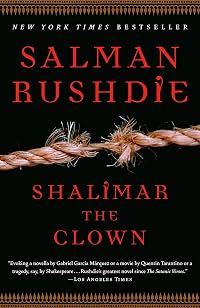
Shalimar the Clown
by Salman Rushdie
On This Page
Description
In 1991, Ambassador Maximilian Ophuls--ex-ambassador to India, and America's counterterrorism chief--is murdered on the Los Angeles doorstep of his illegitimate daughter's home by his Kashmiri Muslim driver, who calls himself Shalimar the Clown.Tags
Recommendations


Member Reviews
“For the rest of his life Max Ophuls would remember that instant during which the shape of the conflict in Kashmir had seemed too great and alien for his Western mind to understand, and the sense of urgent need with which he had drawn his own experience around him, like a shawl. Had he been trying to understand, or to blind himself to his failure to do so?”
This book begins with the murder of Max Ophuls, former U.S. Ambassador to India and later chief of counterterrorism, by Shalimar the Clown, while Max is visiting his illegitimate daughter, India, in California. The book then flashes back to provide the family members’ backstories. As we learn about the characters, we also learn about the culture and history of Kashmir. show more Initially, Kashmir is an area of peaceful coexistence among a diverse population. Over the course of the novel, it devolves into an area of violent conflict. In a similar manner, the characters are initially content, but end up embroiled in gruesome tale of revenge.
“The murderous rage of Shalimar the clown, his possession by the devil, burned fiercely in him and carried him forward, but in the murmurous night it was just one of many stories, one small particular untold tale in a crowd of such tales, one minuscule portion of the unwritten history of Kashmir.”
This is a literary work. Rushdie’s writing is dense and complex. He weaves a compelling storyline, set against a backdrop of Kashmir’s history. He expects the reader to do some heavy lifting. I looked up quite a bit of Kashmiri history to supplement the information provided in the novel. It also includes a number of local myths and legends. Suffice it to say this is not a quick and easy read, but I found it fascinating.
A few of the political, historical, and cultural topics include foreign interference, imperialism, colonialism, corruption, terrorism, and religious differences. I am not going to claim to completely understand all the interconnected elements of this book, but I definitely get the sense that this is a book about the corruption of a paradise. Rushdie is a brilliant writer.
“What happened that day in Pachigam need not be set down here in full detail, because brutality is brutality and excess is excess and that’s all there is to it. There are things that must be looked at indirectly because they would blind you if you looked them in the face, like the fire of the sun.” show less
This book begins with the murder of Max Ophuls, former U.S. Ambassador to India and later chief of counterterrorism, by Shalimar the Clown, while Max is visiting his illegitimate daughter, India, in California. The book then flashes back to provide the family members’ backstories. As we learn about the characters, we also learn about the culture and history of Kashmir. show more Initially, Kashmir is an area of peaceful coexistence among a diverse population. Over the course of the novel, it devolves into an area of violent conflict. In a similar manner, the characters are initially content, but end up embroiled in gruesome tale of revenge.
“The murderous rage of Shalimar the clown, his possession by the devil, burned fiercely in him and carried him forward, but in the murmurous night it was just one of many stories, one small particular untold tale in a crowd of such tales, one minuscule portion of the unwritten history of Kashmir.”
This is a literary work. Rushdie’s writing is dense and complex. He weaves a compelling storyline, set against a backdrop of Kashmir’s history. He expects the reader to do some heavy lifting. I looked up quite a bit of Kashmiri history to supplement the information provided in the novel. It also includes a number of local myths and legends. Suffice it to say this is not a quick and easy read, but I found it fascinating.
A few of the political, historical, and cultural topics include foreign interference, imperialism, colonialism, corruption, terrorism, and religious differences. I am not going to claim to completely understand all the interconnected elements of this book, but I definitely get the sense that this is a book about the corruption of a paradise. Rushdie is a brilliant writer.
“What happened that day in Pachigam need not be set down here in full detail, because brutality is brutality and excess is excess and that’s all there is to it. There are things that must be looked at indirectly because they would blind you if you looked them in the face, like the fire of the sun.” show less
This is a love story between the Hindu Boonyi and the Muslim Shalimar, set in a magical Kashmiri mountain village. But a careless American (with European roots) and an evil English stepmother destroy the relationship, and with it centuries of relatively peaceful coexistence in the disputed mountains between India and Pakistan.
Often told in mythic, poetic language, the story stands in for the poisoned relationship between India and Pakistan, and illustrates how colonialism at many levels has affected the modern history of the two countries, particularly in the senseless, brutal violence in the valleys of Kashmir. Or at least, that’s how Rushdie sees it, although I’m sure there are different interpretations of the history.
Rushdie show more makes explicit parallels with the Nazi occupation of the Franco-German town of Strasbourg and with the urban riots in the USA. (We Westerners can’t claim any political or moral superiority on this.) And his depiction of the Muslim terrorists in Pakistan and the Philippines has an implicit parallel with his own persecution by religious fanatics intent on assassinating him.
Interestingly, these sections are written in a flat, almost neutral tone that contrasts with the mythic tone of the traditional village life and love story. Rushdie seems to be deliberately making the modern parts of the story into a black and white cartoon comic book in contrast to the richness of the traditional story. It’s a little disappointing, though, that the child at the centre of the story, named Kashmiri by her mother and India by her stepmother, is mainly described in the flatter style. By the end of the novel, however, her story becomes joined with Greek mythology that represents either a unity of Western and Eastern stories or an overcoming of the East by the West. (This is left unresolved.)
I liked the story of the politics, which makes the Kashmir dispute very concrete without going into the details of the history. Rushdie’s view of the brutality of both sides – the responsibility of the Indian government and army on the one side and the Muslim fighters supported by Pakistan on the other – is unforgettably clear. Even more, I liked Rushdie’s telling of the village history, the characters of Boonyi and Shalimar how they become caught in the events. The destruction of their relationship and its outcome become an evil inverse of their love. Rushdie reflects this in the references to twin planets that both exist and do not exist, and to the combined creation and destruction in Indian cosmology.
In fact, Rushdie’s story and his writing are so complex that it takes a while to process. He brings so much into it, history, myth, personalities, magic and very playful word work, that I find it hard to assess. Many sections feel very thin, and many characterizations are cartoonish stereotypes. But in spite of being a little mystified by these choices, I very much enjoy reading him. His writing is so creative that it’s a pleasure to spend time in his imagination. What I’ve read of his other novels seems to capture people at their worst and blackest periods, but nevertheless leads to an outcome that is if not quite positive at least hopeful.
I’m not sure that this is Rushdie’s best book. The neutral style of some of the prose left me less engaged than his more playful writing, although his depiction of modern Kashmir certainly has impact. But in spite of my hesitation, this is the only book in many years that I’ve read twice, so clearly I’m willing to spend my time with it. It’s complexity and unsettling character are what drew me back for a second and more thoughtful read. To use the metaphor of the dual planets, it both is and isn’t satisfying and that makes it really interesting. show less
Often told in mythic, poetic language, the story stands in for the poisoned relationship between India and Pakistan, and illustrates how colonialism at many levels has affected the modern history of the two countries, particularly in the senseless, brutal violence in the valleys of Kashmir. Or at least, that’s how Rushdie sees it, although I’m sure there are different interpretations of the history.
Rushdie show more makes explicit parallels with the Nazi occupation of the Franco-German town of Strasbourg and with the urban riots in the USA. (We Westerners can’t claim any political or moral superiority on this.) And his depiction of the Muslim terrorists in Pakistan and the Philippines has an implicit parallel with his own persecution by religious fanatics intent on assassinating him.
Interestingly, these sections are written in a flat, almost neutral tone that contrasts with the mythic tone of the traditional village life and love story. Rushdie seems to be deliberately making the modern parts of the story into a black and white cartoon comic book in contrast to the richness of the traditional story. It’s a little disappointing, though, that the child at the centre of the story, named Kashmiri by her mother and India by her stepmother, is mainly described in the flatter style. By the end of the novel, however, her story becomes joined with Greek mythology that represents either a unity of Western and Eastern stories or an overcoming of the East by the West. (This is left unresolved.)
I liked the story of the politics, which makes the Kashmir dispute very concrete without going into the details of the history. Rushdie’s view of the brutality of both sides – the responsibility of the Indian government and army on the one side and the Muslim fighters supported by Pakistan on the other – is unforgettably clear. Even more, I liked Rushdie’s telling of the village history, the characters of Boonyi and Shalimar how they become caught in the events. The destruction of their relationship and its outcome become an evil inverse of their love. Rushdie reflects this in the references to twin planets that both exist and do not exist, and to the combined creation and destruction in Indian cosmology.
In fact, Rushdie’s story and his writing are so complex that it takes a while to process. He brings so much into it, history, myth, personalities, magic and very playful word work, that I find it hard to assess. Many sections feel very thin, and many characterizations are cartoonish stereotypes. But in spite of being a little mystified by these choices, I very much enjoy reading him. His writing is so creative that it’s a pleasure to spend time in his imagination. What I’ve read of his other novels seems to capture people at their worst and blackest periods, but nevertheless leads to an outcome that is if not quite positive at least hopeful.
I’m not sure that this is Rushdie’s best book. The neutral style of some of the prose left me less engaged than his more playful writing, although his depiction of modern Kashmir certainly has impact. But in spite of my hesitation, this is the only book in many years that I’ve read twice, so clearly I’m willing to spend my time with it. It’s complexity and unsettling character are what drew me back for a second and more thoughtful read. To use the metaphor of the dual planets, it both is and isn’t satisfying and that makes it really interesting. show less
The very simple plot--man betrayed by wife, seeks revenge--is completely surrounded by Rushdie's beautiful language, which he uses to discuss, among other things: the history of Kashmir; the complex relationship of India and Pakistan; terrorism, its origins, effects, and perpetrators; the nature of love; folk tales and magic; and the interactions between religions, particularly Islam and Buddhism. Violence and the separation of peoples into religious, cultural, and natural groups which can be manipulated into hatred ot the "other" is explored in depth.
One obstacle to easy reading is the names of the characters, which are hard for the western reader to keep straight. Another is the background cultural information used throughout the show more book. Certainly this is a complicated work and one that requires effort on the part of the reader, but one which will repay the careful reader for a long time.
Note: The first two thirds or so of this proceed at a leisurely pace. The last third picks up that pace and the reading experience is accelerated almost unbelievably. A very clever effect.
Highly recommended. show less
One obstacle to easy reading is the names of the characters, which are hard for the western reader to keep straight. Another is the background cultural information used throughout the show more book. Certainly this is a complicated work and one that requires effort on the part of the reader, but one which will repay the careful reader for a long time.
Note: The first two thirds or so of this proceed at a leisurely pace. The last third picks up that pace and the reading experience is accelerated almost unbelievably. A very clever effect.
Highly recommended. show less
I was impressed at how Rushdie managed to create such a vast historical and geopolitical context and then set his diverse characters in it in such a way as to illuminate both the political context and its effect on individuals, while the individuals can also be interpreted almost allegorically. I rather disliked the character India at the beginning of the novel, and I found it hard to get into at first, but after a few chapters, it became engrossing.
Joy keeps lending me books that I dislike in interesting ways.
There is no doubt that this is a collection of beautiful sentences. The writing is vivid, lyrical, and evocative. Unfortunately it's mostly evocative of horror. The sections all pretty much start out "Here are some people. Horrible things happened to them. Let's examine their lives leading up to the horrible things." The Kashmir sections are the loveliest, I think, but that just makes the torture, rape, and systematic murder in them all the more gruesome.
My other main objection is the Max Ophuls section. If I never read another book about a brilliant, multitalented Renaissance man who gets all the girls, treats all of them like commodities, behaves in general like a raging show more narcissist that nevertheless knows his lines and is still supposed to be a sympathetic figure it will be too soon. It made me even angrier that he was supposed to be worthy of pity because he got his throat slit in the first section. (This isn't a spoiler since it's mentioned with increasingly tedious foreshadowing every fifth sentence from the second page on.)
So yeah, women are treated like dirt, minorities are treated like dirt, people in regions the possession of which is disputed by major powers are treated like dirt, and being treated like dirt makes people crazy. That's the takeaway. The presence of a bow- and gun-shooting, boxing, martial-artist hot female instrument of revenge in the last 75 pages doesn't balance the rest of it, really.
Shalimar the Clown is a book filled with richly detailed pictures. They're just not pictures I want in my head. show less
There is no doubt that this is a collection of beautiful sentences. The writing is vivid, lyrical, and evocative. Unfortunately it's mostly evocative of horror. The sections all pretty much start out "Here are some people. Horrible things happened to them. Let's examine their lives leading up to the horrible things." The Kashmir sections are the loveliest, I think, but that just makes the torture, rape, and systematic murder in them all the more gruesome.
My other main objection is the Max Ophuls section. If I never read another book about a brilliant, multitalented Renaissance man who gets all the girls, treats all of them like commodities, behaves in general like a raging show more narcissist that nevertheless knows his lines and is still supposed to be a sympathetic figure it will be too soon. It made me even angrier that he was supposed to be worthy of pity because he got his throat slit in the first section. (This isn't a spoiler since it's mentioned with increasingly tedious foreshadowing every fifth sentence from the second page on.)
So yeah, women are treated like dirt, minorities are treated like dirt, people in regions the possession of which is disputed by major powers are treated like dirt, and being treated like dirt makes people crazy. That's the takeaway. The presence of a bow- and gun-shooting, boxing, martial-artist hot female instrument of revenge in the last 75 pages doesn't balance the rest of it, really.
Shalimar the Clown is a book filled with richly detailed pictures. They're just not pictures I want in my head. show less
Some say this isn't one of Rushdie's better books, in which case I can hardly wait to read the others. I found it consistently interesting, sometimes even moving.
This story takes four or five morally compromised characters and shuttles them through the warp of modern political history, from the beginning of World War II to the mid-90s. Several of them move in the political sphere, and all of struggle to control (or reinvent) their identities, changing direction as they do so. It sprawls a bit, but most of the bits that seem colorful tangents end up reinforcing the narrative. There are a few moments when his invention flags, particularly towards the end, but I don't want to quibble: as soon as I finished it I read the first fifty pages show more all over again, and you will too. show less
This story takes four or five morally compromised characters and shuttles them through the warp of modern political history, from the beginning of World War II to the mid-90s. Several of them move in the political sphere, and all of struggle to control (or reinvent) their identities, changing direction as they do so. It sprawls a bit, but most of the bits that seem colorful tangents end up reinforcing the narrative. There are a few moments when his invention flags, particularly towards the end, but I don't want to quibble: as soon as I finished it I read the first fifty pages show more all over again, and you will too. show less
As it turned out, Shalimar was anything but a clown. True, as a young man he was well known for his antics on the high wire that were so funny that they made everyone forget just how dangerous they were. But when he and fellow Kashmiri Boonyi Kaul were just fourteen years old, they fell in love and Shalimar’s life was changed forever. The two married soon after and settled into a life in rural Kashmir that included working together as regional entertainers.
All went well until Boonyi, a talented dancer, made the first of two fateful decisions. She decided to make the most of her dance talents by moving to India without Shalimar in order perform on a bigger stage. There she caught the eye of American ambassador Max Ophuls and made her show more second decision, one that would ultimately change Shalimar from clown to assassin. She decided to become the ambassador’s mistress.
Shalimar the Clown begins and ends with the assassination of Max Ophuls. At the time of his death, Ophuls is an old man living in Los Angeles near his beautiful daughter, India, and his government career has included a stint as U.S. counter-terrorism chief. His brutal murder, in the style favored by Islamist terrorists, at first leads authorities to believe that he was targeted because of his roll in developing U.S. counter-terrorism policy. Little did they know that the assassination of Max Ophuls had been set in motion decades earlier.
This is complicated historical fiction covering the period during which Kashmir changed from a relatively peaceful place in which Muslims and Hindus successfully coexisted to the self-destructive region of the world it is today. Rushdie tells Kashmir’s story through the eyes of those who lived through, but did not always survive, those violent years. He has written a political thriller filled with enough interesting side stories and flashbacks to put the tragedy of Kashmir into an understandable context for Western readers. That alone makes Shalimar the Clown a remarkable book. But what makes the book truly special is the way that Rushdie uses so many unforgettable characters to explain how, and why, the world has changed for the worst over the last two decades.
The audio version of Shalimar the Clown is read by Aasif Mandvi, a movie, television, and radio actor and successful writer and producer. Mandvi does such a wonderful job reading Rushdie’s words that I have to wonder if I would have enjoyed reading the book nearly as much as I enjoyed listening to Mandvi breathe life into each of Rushdie’s characters. He slips effortlessly from one accent to the other and uses tone and cadence in such a way that even the longest and most complex Rushdie sentences are clearly understood. As a reader, I would have had a difficult time, probably to the point of distraction, with some of the place and character names that are so integral to this story. Mandvi’s reading made sure that did not happen, another reason that Shalimar the Clown is an excellent choice for fans of audio books.
Rated at: 4.5 show less
All went well until Boonyi, a talented dancer, made the first of two fateful decisions. She decided to make the most of her dance talents by moving to India without Shalimar in order perform on a bigger stage. There she caught the eye of American ambassador Max Ophuls and made her show more second decision, one that would ultimately change Shalimar from clown to assassin. She decided to become the ambassador’s mistress.
Shalimar the Clown begins and ends with the assassination of Max Ophuls. At the time of his death, Ophuls is an old man living in Los Angeles near his beautiful daughter, India, and his government career has included a stint as U.S. counter-terrorism chief. His brutal murder, in the style favored by Islamist terrorists, at first leads authorities to believe that he was targeted because of his roll in developing U.S. counter-terrorism policy. Little did they know that the assassination of Max Ophuls had been set in motion decades earlier.
This is complicated historical fiction covering the period during which Kashmir changed from a relatively peaceful place in which Muslims and Hindus successfully coexisted to the self-destructive region of the world it is today. Rushdie tells Kashmir’s story through the eyes of those who lived through, but did not always survive, those violent years. He has written a political thriller filled with enough interesting side stories and flashbacks to put the tragedy of Kashmir into an understandable context for Western readers. That alone makes Shalimar the Clown a remarkable book. But what makes the book truly special is the way that Rushdie uses so many unforgettable characters to explain how, and why, the world has changed for the worst over the last two decades.
The audio version of Shalimar the Clown is read by Aasif Mandvi, a movie, television, and radio actor and successful writer and producer. Mandvi does such a wonderful job reading Rushdie’s words that I have to wonder if I would have enjoyed reading the book nearly as much as I enjoyed listening to Mandvi breathe life into each of Rushdie’s characters. He slips effortlessly from one accent to the other and uses tone and cadence in such a way that even the longest and most complex Rushdie sentences are clearly understood. As a reader, I would have had a difficult time, probably to the point of distraction, with some of the place and character names that are so integral to this story. Mandvi’s reading made sure that did not happen, another reason that Shalimar the Clown is an excellent choice for fans of audio books.
Rated at: 4.5 show less
Members
- Recently Added By
Published Reviews
ThingScore 50
' "Shalimar the Clown" is hobbled by Mr. Rushdie's determination to graft huge political and cultural issues onto a flimsy soap opera plot.... What is most engaging about this novel - and represents a return to form, after two particularly weak and poorly observed novels - is Mr. Rushdie's creation of several compelling characters....'
added by GYKM
Lists

Recommend the 20 best books you've read in the last five years
2,168 works; 603 members

All Things India
95 works; 21 members

Best 21st Century Books (So Far)
679 works; 86 members

Booker Prize
491 works; 62 members

Best Love Stories
107 works; 14 members

Top Five Books of 2015
811 works; 241 members
International IMPAC Dublin Literary Award
179 works; 6 members

Five star books
1,767 works; 110 members

Man Booker Prize Longlist 2005
17 works; 3 members

Fiction with Men's Given Names in the Title
302 works; 11 members
Author Information

87+ Works 70,146 Members
Salman Rushdie was born in India on June 19, 1947. He was raised in Pakistan and educated in England. His novels include Grimus, Shame, The Satanic Verses, Haroun and the Sea of Stories, The Moor's Last Sigh, The Ground Beneath Her Feet, Fury, Shalimar the Clown, The Enchantress of Florence, Luka and the Fire of Life, and The Golden House. His show more non-fiction works include Joseph Anton, Imaginary Homelands, The Jaguar Smile, and Step across This Line. He also wrote a collection of short stories entitled East, West. He has received numerous awards including the Whitbread Prize for Best Novel twice, the James Tait Black Prize, the French Prix du Meilleur Livre Étranger, the Booker Prize in 1981 for Midnight's Children, and the 2014 PEN/Pinter Prize. (Bowker Author Biography) show less
Some Editions
Awards and Honors
Awards
Distinctions
Series
Belongs to Publisher Series
rororo (23931)
Common Knowledge
- Canonical title
- Shalimar the Clown
- Original title
- Shalimar the Clown
- Original publication date
- 2005
- People/Characters
- Shalimar; India Ophuls; Maximilian Ophuls; Boonyi
- Important places
- Kashmir; India; Los Angeles, California, USA; Pachigam, Kashmir; Delhi, India; Bugatti
- Important events
- World War II
- Epigraph
- "I am being rowed through Paradise on a river of Hell:
Exquisite ghost, it is night.
The paddle is a heart; it breaks the porcelain waves...
I'm everything you lost. You won't forgive me.
My memory keeps... (show all) getting in the way of your history.
There is nothing to forgive. You won't forgive me.
I hi my pain even from myself; I revealed my pain only to myself.
There is everything to forgive. You can't forgive me.
If only somehow you could have been mine, what would not have been possible in the world."
— Agha Shahid Ali, The Country Without a Post Office
"A plague on both your houses."
— Mercutio in Romeo and Juliet by William Shakespeare - Dedication
- In loving memory of my Kashmiri grandparents
Dr. Ataullah and Amir un nissa Butt
(Babajan and Ammaji) - First words
- At twenty-four the ambassador's daughter slept badly through the warm, unsurprising nights.
- Quotations
- Everybody was sensitive nowadays. Everybody had a vocabulary to peddle. Words had become as painful as sticks and stones, or maybe skins had become thinner. India blamed the ozone layer, apologized and changed the subject.
- Last words
- (Click to show. Warning: May contain spoilers.)There was no second chance. There was no India. There was only Kashmira, and Shalimar the clown.
- Original language*
- Engels
*Some information comes from Common Knowledge in other languages. Click "Edit" for more information.
Classifications
Statistics
- Members
- 3,160
- Popularity
- 5,593
- Reviews
- 55
- Rating
- (3.82)
- Languages
- 19 — Danish, Dutch, English, Finnish, French, German, Greek, Hebrew, Hungarian, Italian, Lithuanian, Norwegian (Bokmål), Polish, Portuguese, Russian, Slovenian, Spanish, Swedish, Turkish
- Media
- Paper, Audiobook, Ebook
- ISBNs
- 63
- ASINs
- 15