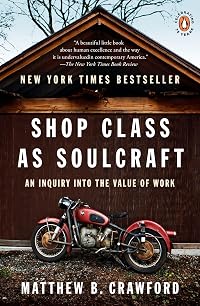
Shop Class as Soulcraft: An Inquiry into the Value of Work
by Matthew B. Crawford
On This Page
Description
In this wise and often funny book, a philosopher/mechanic systematically destroys the pretensions of the high-prestige workplace and makes an irresistible case for working with one's hands.Tags
Recommendations



















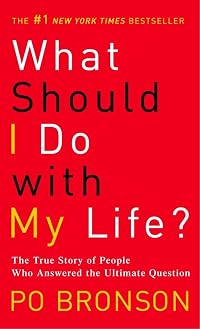




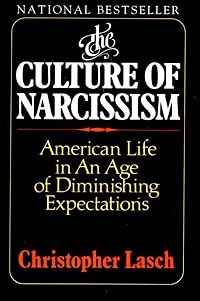
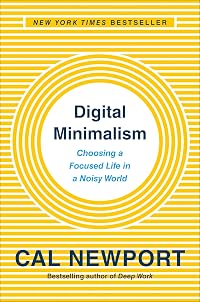



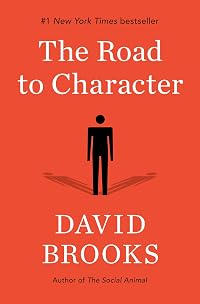

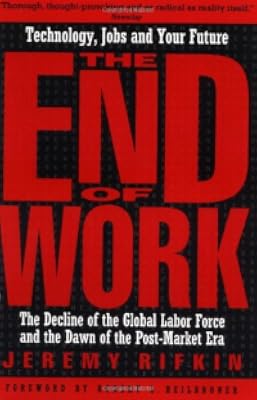
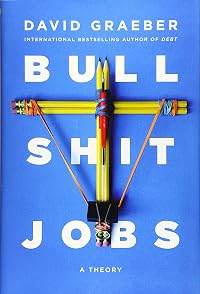


Member Recommendations

erik_galicki If you want to explore the human versus machine distinction and the implications of algorithmization. Hofstadter also addresses holism, reductionism, and Zen.
erik_galicki If you'd like to see an analysis of human versus machine strengths and some recommendations for how algorithmization and automation can be more human-centered.

erik_galicki Crawford doesn't consider socialism but, like Schumpeter, identifies bureaucratization and decreasing proprietorship as negative trends. Crawford, also like Schumpeter, is sympathetic to entrepreneurship and may share Schumpeter's tendency to (over?)romanticize it.
11

johnredmond Crawford's conclusions come from life but he has acknowledged Macintyre as an influence, and I think you can see Macintyre's work as providing the theoretical underpinning for Crawford's application in "shopcraft" (not that simple a relationship but it
Member Reviews
Summary: A philosopher turned motorcycle mechanic explores the nature of satisfying work and the intellectual dignity of the manual trades.
Why would a Ph.D. give up a prestigious job in a Washington think tank to open up a motorcycle repair shop? Why does he find greater intellectual satisfaction tearing apart a motorcycle engine, working with solvents, grease, and oil, than producing articles on political philosophy? This work is Matthew B. Crawford’s personal answer to those questions.
He begins with some observations that caught my attention and helped explain the title of the book. When I attended middle school, all the boys (sexist as we were in those days) had to take classes in the mechanical arts–shop class. Even though I was show more on the geekier end of the spectrum, I had to buy the requisite safety glasses and learn mechanical drawing, basic wood and metal working including working around power equipment without losing a finger or other appendage. We learned what tools to use for different jobs. From about the 1990’s on, such classes were phased out because the emphasis increasingly was on preparing for college, and for becoming a knowledge worker. Which explains Crawford’s friend who has a surfeit of power equipment (as well as the dearth of people in the trades).
Crawford argues that our society’s focus on “knowledge work” has degraded the manual trades. Principally, it fails to recognize the kind of intelligence it takes to wire a house, build a building, plumb a bathroom properly, or diagnose a misfiring problem in a motorcycle when all the diagnostic procedures fail to yield an answer. Crawford observes that we no longer know how to care for and repair our stuff–indeed, some of it has been engineered by people who haven’t thought about making such repairs, or made those repairs a proprietary process. We’ve separated thinking and doing, denigrating the doers whose work takes skill, intuition, problem-solving ability, and imagination, while upholding knowledge workers often disconnected from the world of things.
Crawford narrates his own journey from electrician to working for an abstracting service whose productivity demands impaired his ability to do what the work really required. After completing a doctorate in political philosophy, he went to work for a Washington think tank but quit after five fatiguing months of struggling to do anything of tangible worth. He found he had more of a sense of individual agency and connectedness to his work and community as an electrician or mechanic.
He takes us into a deep dive into the work of motorcycle repair, describing challenging repair jobs on old machines he’d never encountered. We learn about the “guild” of mechanics, the wisdom acquired from years of experience that leads to a kind of intuitive knowledge when one encounters a particular problem. He traces the journey from apprenticeship to becoming a master mechanic. This work occurs in a community of other mechanics, parts dealers, enthusiasts, and novices in which one is alienated neither from the material one works on or the web of relationships within which the work occurs.
The subtitle of this book is “an inquiry into the value of work.” Crawford argues that many are disconnected from the value of their work, and sometimes find this in leisure activities. Meaningful work, he would argue, involves full engagement with the stuff of one’s work, allowing for “progress in excellence,” contributing to a life well-lived by those served by the work. He argues that a humane economy allows for and rewards such work. He also notes the built in accountability of good work–an improperly vented toilet stinks up the whole house! Such accountability needs to be built into knowledge work as well, and happens best in community. At one time, for example, mortgage lenders were in a community and knew their clients and were responsible for good lending practices. The loss of this connection to one’s work contributed to the disaster of 2008.
I found myself applauding much of this book. My father-in-law, a high school educated laborer, designed and built his own garage–a structure still standing fifty years after he passed. This kind of intelligence needs to be honored and those who work in these kinds of jobs held up to high regard if they do their work to the standard of excellence Crawford describes. I hope at the same time that this will not have the effect of denigrating all knowledge work. I think of researchers who build their own research apparatus, write their own computer code and combine mental and mechanical skill with the same skillful agency Crawford describes. I think of skillful managers who combine technical expertise and soft skills to develop products that serve others while creating flourishing environments for those on their teams. His larger discussion of what makes good work applies both to manual trades and “knowledge work.” All good work involves both thinking and doing, agency and engagement, the flourishing both of worker and the common good.
Both manual and knowledge work can be organized in ways that demean or dignify the worker. Good societies will not play one off against the other but recognize the dignity of meaningful work in all arenas. Crawford also raises good questions about the communities within which good work takes place. Increasingly, I find myself wondering if we can afford the global economy we have created, where we rely on workers and supply chains half way around the planet while living disconnected economic lives from our neighbors. This book is about a lot more than shop class! show less
Why would a Ph.D. give up a prestigious job in a Washington think tank to open up a motorcycle repair shop? Why does he find greater intellectual satisfaction tearing apart a motorcycle engine, working with solvents, grease, and oil, than producing articles on political philosophy? This work is Matthew B. Crawford’s personal answer to those questions.
He begins with some observations that caught my attention and helped explain the title of the book. When I attended middle school, all the boys (sexist as we were in those days) had to take classes in the mechanical arts–shop class. Even though I was show more on the geekier end of the spectrum, I had to buy the requisite safety glasses and learn mechanical drawing, basic wood and metal working including working around power equipment without losing a finger or other appendage. We learned what tools to use for different jobs. From about the 1990’s on, such classes were phased out because the emphasis increasingly was on preparing for college, and for becoming a knowledge worker. Which explains Crawford’s friend who has a surfeit of power equipment (as well as the dearth of people in the trades).
Crawford argues that our society’s focus on “knowledge work” has degraded the manual trades. Principally, it fails to recognize the kind of intelligence it takes to wire a house, build a building, plumb a bathroom properly, or diagnose a misfiring problem in a motorcycle when all the diagnostic procedures fail to yield an answer. Crawford observes that we no longer know how to care for and repair our stuff–indeed, some of it has been engineered by people who haven’t thought about making such repairs, or made those repairs a proprietary process. We’ve separated thinking and doing, denigrating the doers whose work takes skill, intuition, problem-solving ability, and imagination, while upholding knowledge workers often disconnected from the world of things.
Crawford narrates his own journey from electrician to working for an abstracting service whose productivity demands impaired his ability to do what the work really required. After completing a doctorate in political philosophy, he went to work for a Washington think tank but quit after five fatiguing months of struggling to do anything of tangible worth. He found he had more of a sense of individual agency and connectedness to his work and community as an electrician or mechanic.
He takes us into a deep dive into the work of motorcycle repair, describing challenging repair jobs on old machines he’d never encountered. We learn about the “guild” of mechanics, the wisdom acquired from years of experience that leads to a kind of intuitive knowledge when one encounters a particular problem. He traces the journey from apprenticeship to becoming a master mechanic. This work occurs in a community of other mechanics, parts dealers, enthusiasts, and novices in which one is alienated neither from the material one works on or the web of relationships within which the work occurs.
The subtitle of this book is “an inquiry into the value of work.” Crawford argues that many are disconnected from the value of their work, and sometimes find this in leisure activities. Meaningful work, he would argue, involves full engagement with the stuff of one’s work, allowing for “progress in excellence,” contributing to a life well-lived by those served by the work. He argues that a humane economy allows for and rewards such work. He also notes the built in accountability of good work–an improperly vented toilet stinks up the whole house! Such accountability needs to be built into knowledge work as well, and happens best in community. At one time, for example, mortgage lenders were in a community and knew their clients and were responsible for good lending practices. The loss of this connection to one’s work contributed to the disaster of 2008.
I found myself applauding much of this book. My father-in-law, a high school educated laborer, designed and built his own garage–a structure still standing fifty years after he passed. This kind of intelligence needs to be honored and those who work in these kinds of jobs held up to high regard if they do their work to the standard of excellence Crawford describes. I hope at the same time that this will not have the effect of denigrating all knowledge work. I think of researchers who build their own research apparatus, write their own computer code and combine mental and mechanical skill with the same skillful agency Crawford describes. I think of skillful managers who combine technical expertise and soft skills to develop products that serve others while creating flourishing environments for those on their teams. His larger discussion of what makes good work applies both to manual trades and “knowledge work.” All good work involves both thinking and doing, agency and engagement, the flourishing both of worker and the common good.
Both manual and knowledge work can be organized in ways that demean or dignify the worker. Good societies will not play one off against the other but recognize the dignity of meaningful work in all arenas. Crawford also raises good questions about the communities within which good work takes place. Increasingly, I find myself wondering if we can afford the global economy we have created, where we rely on workers and supply chains half way around the planet while living disconnected economic lives from our neighbors. This book is about a lot more than shop class! show less
"Shop Class as Soulcraft" brings alive an experience that was once quite common, but now seems to be receding from society a the experience of making and fixing things with our hands. Those of us who sit in an office often feel a lack of connection to the material world, a sense of loss, and find it difficult to say exactly what we do all day. For anyone who felt hustled off to college, then to the cubicle, against their own inclinations and natural bents, "Shop Class as Soulcraft" seeks to restore the honor of the manual trades as a life worth choosing. On both economic and psychological grounds, Crawford questions the educational imperative of turning everyone into a "knowledge worker," based on a misguided separation of thinking from show more doing, the work of the hand from that of the mind. Crawford shows us how such a partition, which began a century ago with the assembly line, degrades work for those on both sides of the divide. But Crawford offers good news as well: the manual trades are very different from the assembly line, and from dumbed-down white collar work as well. They require careful thinking and are punctuated by moments of genuine pleasure. Based on his own experience as an electrician and mechanic, Crawford makes a case for the intrinsic satisfactions and cognitive challenges of manual work. The work of builders and mechanics is secure; it cannot be outsourced, and it cannot be made obsolete. Such work ties us to the local communities in which we live, and instills the pride that comes from doing work that is genuinely useful. A wholly original debut, "Shop Class as Soulcraft" offers a passionate call for self-reliance and a moving reflection on how we can live concretely in an ever more abstract world. show less
Shop Class as Soulcraft is a deeply insightful exploration of the value of skilled work in a world increasingly dominated by abstract, digital labor. Matthew Crawford makes a compelling case for the intellectual, ethical, and personal fulfillment found in hands-on craftsmanship.
This book isn’t just for tradespeople—it’s a call to rethink how we define meaningful work and a persuasive reminder that mastery, responsibility, and creativity can flourish outside the traditional office. Thought-provoking, eloquent, and inspiring, it challenges readers to reconnect with the tangible satisfaction of making things well.
This book isn’t just for tradespeople—it’s a call to rethink how we define meaningful work and a persuasive reminder that mastery, responsibility, and creativity can flourish outside the traditional office. Thought-provoking, eloquent, and inspiring, it challenges readers to reconnect with the tangible satisfaction of making things well.
I had this book in my hot hands for only the time it took me to read it. Since then, it's been loaned out. Right now, it's in the shop of a woman whose husband is gone a lot on trips--on his motorcycle with his cronies. I told her he would love it. She said he devours books quickly, and indeed, read it cover to cover in one evening not long before he took off on his next three-month road trip. He LOVED it.
The reason this book is important to me is not because I want anything to do with motorcycles. (The noise of "hogs" on the coast highway below me makes me furious.) However, Crawford is the first person to absolutely nail what it is that I feel is sadly and importantly missing from K-12 schooling: "Shop". Sad because it seems the show more majority of young persons I see exiting high school with their precious diploma cannot DO anything. With all the frenzied paper chasing in these decades, there seem to be fewer and fewer folks who can build something or simply do something expertly (let alone well). Further, there seem to be fewer and fewer young folks who can and have followed their interests; nope, there's little time or opportunity in their compulsory schooling to pursue them; and the experts to learn from are scarce.
I have another friend, an amateur radio operator like myself, to whom I sent the following quote from the book. (Abby, delete this if it infringes copyright.) There are not enough of these vignettes of great ethnographic writing in Crawford's book, but the few you find are real treasures.
"THE MOTORCYCLE AS MULE
Riding an early motorcycle entailed a certain preparation that went like this: Set the throttle at a very small opening (there would likely be no spring returning the throttle to idle position), set the choke at a position judged the appropriate one for the ambient temperature, and retard the spark timing manually by several degrees. Then approach the kick-starter with due apprehension, bracing yourself for yet another blow to your chronically bruised shin. The thing about kick-starters is, they tend to kick back. This is especially likely if you don't retard the timing far enough, as then the motor backfires mechanically, as it were, through the kick-starter, sending your shin to its fated meeting with the foot peg. With the bike balanced on the center stand, and you on one foot, use your whole weight on the kick-starter to ease the motor slowly through its power stroke and well into its exhaust stroke, judged by listening for air escaping from the open exhaust valve. Having positioned the piston at the start of its intake stroke, you are ready to kick-start the bike. But first check to make sure there are not attractive women present to witness your display, nor any of your rivals, for it is likely to be a drama of strenuous impotence.
Before taking that first kick, it is traditional to light a cigarette and set it dangling at an angle that suggests nonchalance. While you're at it, send up a little prayer for fuel atomization. You woudln't be riding a motorocycle if you weren't an optimist.
Ten or twelve kicks later, sweat dripping form your brow, you might get to ride the motorcyle. A quickening wind against your hot, flushed face is the reward for your labors. Sweeter still, the rush of acceleration carries you away from the scene you have made. But still you are not carefree. The spark timing must be adjusted manually for varying loads and engine speeds. What's more, the engine must be lubricated. (The weak point of the manual system was that it was entirely dependient upon the rider's memory. As a consequence, the forgetful man often let himself in for heavy repair bills, and the overcautions one used about twice as much oil as necessary in his desire to avoid such expense.)"
My friend wrote back immediately, saying: "EXCELLENT! I love it! But the excerpt does not address the unfortunate experience of "bustin' yer nuts" when your foot slips off the kick starter! (of course, that is not of concern to the likes of you...fine lady!)"
One of the more important take-home messages from Crawford's book is his emphasis on the "morality" of work--the integrity of doing a job well for which you are being paid or even for which your expertise has been solicited.
--sharon show less
The reason this book is important to me is not because I want anything to do with motorcycles. (The noise of "hogs" on the coast highway below me makes me furious.) However, Crawford is the first person to absolutely nail what it is that I feel is sadly and importantly missing from K-12 schooling: "Shop". Sad because it seems the show more majority of young persons I see exiting high school with their precious diploma cannot DO anything. With all the frenzied paper chasing in these decades, there seem to be fewer and fewer folks who can build something or simply do something expertly (let alone well). Further, there seem to be fewer and fewer young folks who can and have followed their interests; nope, there's little time or opportunity in their compulsory schooling to pursue them; and the experts to learn from are scarce.
I have another friend, an amateur radio operator like myself, to whom I sent the following quote from the book. (Abby, delete this if it infringes copyright.) There are not enough of these vignettes of great ethnographic writing in Crawford's book, but the few you find are real treasures.
"THE MOTORCYCLE AS MULE
Riding an early motorcycle entailed a certain preparation that went like this: Set the throttle at a very small opening (there would likely be no spring returning the throttle to idle position), set the choke at a position judged the appropriate one for the ambient temperature, and retard the spark timing manually by several degrees. Then approach the kick-starter with due apprehension, bracing yourself for yet another blow to your chronically bruised shin. The thing about kick-starters is, they tend to kick back. This is especially likely if you don't retard the timing far enough, as then the motor backfires mechanically, as it were, through the kick-starter, sending your shin to its fated meeting with the foot peg. With the bike balanced on the center stand, and you on one foot, use your whole weight on the kick-starter to ease the motor slowly through its power stroke and well into its exhaust stroke, judged by listening for air escaping from the open exhaust valve. Having positioned the piston at the start of its intake stroke, you are ready to kick-start the bike. But first check to make sure there are not attractive women present to witness your display, nor any of your rivals, for it is likely to be a drama of strenuous impotence.
Before taking that first kick, it is traditional to light a cigarette and set it dangling at an angle that suggests nonchalance. While you're at it, send up a little prayer for fuel atomization. You woudln't be riding a motorocycle if you weren't an optimist.
Ten or twelve kicks later, sweat dripping form your brow, you might get to ride the motorcyle. A quickening wind against your hot, flushed face is the reward for your labors. Sweeter still, the rush of acceleration carries you away from the scene you have made. But still you are not carefree. The spark timing must be adjusted manually for varying loads and engine speeds. What's more, the engine must be lubricated. (The weak point of the manual system was that it was entirely dependient upon the rider's memory. As a consequence, the forgetful man often let himself in for heavy repair bills, and the overcautions one used about twice as much oil as necessary in his desire to avoid such expense.)"
My friend wrote back immediately, saying: "EXCELLENT! I love it! But the excerpt does not address the unfortunate experience of "bustin' yer nuts" when your foot slips off the kick starter! (of course, that is not of concern to the likes of you...fine lady!)"
One of the more important take-home messages from Crawford's book is his emphasis on the "morality" of work--the integrity of doing a job well for which you are being paid or even for which your expertise has been solicited.
--sharon show less
Shop Class as Soulcraft: An Inquiry Into the Value of Work is one of the most thought-provoking books I’ve ever read. Author, thinker, and motorcycle mechanic Matthew B. Crawford tackles the sweeping subject of work in America and how it has changed dramatically over the past century, covering such broad topics as technology, vocational education, car and motorcycle repair, business management, the degradation of blue-collar work, and many other ideas and institutions we take for granted. Crawford challenges the easy assumptions of what he calls our “throwaway culture” to make a compelling case for the cognitive rigor, objective standards, and personal dignity inherent to skilled manual labor.
I was hooked from the start when he show more began talking about the pervasive ways technology has helped us not to help ourselves. He calls it “the hood beneath the hood,” when you open up your car to fix something yourself and are confronted with a more aesthetically pleasing view that precludes the possibility of your getting at the actual problem itself. Or when you’re confronted with a water faucet that you can’t turn on manually but must activate by inanely waving your hands before it to coax a short stream of water out. I’ve experienced this frustration myself with our DVD player that, presumably to make things “easier,” has no buttons on it but is instead controlled solely by the remote (which often doesn’t work).The rather sobering point is that as technology becomes more complex to increase our convenience, it also increases our dependence as we become passive users rather than active problem-solvers.
Crawford explains the evolution of vocational education and why it took on the stigma it still carries, even today when its cognitive and practical value has been demonstrated. He compares today’s knowledge worker and office environment to the fast-disappearing skilled craftsman, to the detriment of the former. Knowledge work is subject to offshoring to an extent unprecedented among the trades which require a person to be on site, pounding a nail or fixing a drain. Also under critical examination are the nebulous rules and qualifications which the office worker (and management) must navigate and often make up as they go along, as opposed to the carpenter who faces merely “the accusation of his level” (that is, an objective and unchanging standard).
Crawford is uniquely qualified to write a book like this, having lived on both sides of the knowledge worker/skilled craftsman divide. After college he worked for several months at a think tank, coming up with what he calls “the best arguments money could buy.” The work was extremely well paid but lacked the tactile satisfaction inherent to physical labor. He soon quit to start a motorcycle repair shop where he wrestles with the innards of recalcitrant bikes (and loves it).
Not only is it thought-provoking, but this book is also skillfully written. Crawford has a keen sense of phrasing and doesn’t waste a word. I found Shop Class as Soulcraft to be well worth the read, fascinating as well as slightly disturbing where our culture’s shortcomings and weaknesses are exposed. Still, there is hope for the next generation of workers. The skilled trades aren’t going away; people will always need houses built and healthcare provided and services skillfully performed. And today we are seeing a national shift toward career preparation that is broader than the traditional college-to-career path. The key is to find what you’re passionate about, what you’re good at, what challenges and stretches and becomes part of you somehow — and do it, regardless of what the larger culture thinks.
As a defense of hands-on, skilled labor, this book is convincing. As a confrontation of the fallacious and empty ideals we’ve inherited about knowledge work versus blue-collar jobs, it’s more important than ever. Recommended! show less
I was hooked from the start when he show more began talking about the pervasive ways technology has helped us not to help ourselves. He calls it “the hood beneath the hood,” when you open up your car to fix something yourself and are confronted with a more aesthetically pleasing view that precludes the possibility of your getting at the actual problem itself. Or when you’re confronted with a water faucet that you can’t turn on manually but must activate by inanely waving your hands before it to coax a short stream of water out. I’ve experienced this frustration myself with our DVD player that, presumably to make things “easier,” has no buttons on it but is instead controlled solely by the remote (which often doesn’t work).The rather sobering point is that as technology becomes more complex to increase our convenience, it also increases our dependence as we become passive users rather than active problem-solvers.
Crawford explains the evolution of vocational education and why it took on the stigma it still carries, even today when its cognitive and practical value has been demonstrated. He compares today’s knowledge worker and office environment to the fast-disappearing skilled craftsman, to the detriment of the former. Knowledge work is subject to offshoring to an extent unprecedented among the trades which require a person to be on site, pounding a nail or fixing a drain. Also under critical examination are the nebulous rules and qualifications which the office worker (and management) must navigate and often make up as they go along, as opposed to the carpenter who faces merely “the accusation of his level” (that is, an objective and unchanging standard).
Crawford is uniquely qualified to write a book like this, having lived on both sides of the knowledge worker/skilled craftsman divide. After college he worked for several months at a think tank, coming up with what he calls “the best arguments money could buy.” The work was extremely well paid but lacked the tactile satisfaction inherent to physical labor. He soon quit to start a motorcycle repair shop where he wrestles with the innards of recalcitrant bikes (and loves it).
Not only is it thought-provoking, but this book is also skillfully written. Crawford has a keen sense of phrasing and doesn’t waste a word. I found Shop Class as Soulcraft to be well worth the read, fascinating as well as slightly disturbing where our culture’s shortcomings and weaknesses are exposed. Still, there is hope for the next generation of workers. The skilled trades aren’t going away; people will always need houses built and healthcare provided and services skillfully performed. And today we are seeing a national shift toward career preparation that is broader than the traditional college-to-career path. The key is to find what you’re passionate about, what you’re good at, what challenges and stretches and becomes part of you somehow — and do it, regardless of what the larger culture thinks.
As a defense of hands-on, skilled labor, this book is convincing. As a confrontation of the fallacious and empty ideals we’ve inherited about knowledge work versus blue-collar jobs, it’s more important than ever. Recommended! show less
This book appalled me, even though the premise is wonderful: a reminder to enjoy work that changes the world in a tangible way--work that uses tools and is done with your hands instead of your mind. Great!
But almost every reference in the book has to do with Men Finding Meaning. About the only reference to a woman at work is a single paragraph where the omnipresent "he" in this book turns to a "she," and "she" is baking with a Betty Crocker cake mix. "She" never gets to do electrical work, or motorcycle repair, or any of the other trades in this book. Just faux-baking. It feels as if the author has never actually thought about the possibility of a woman picking up a socket wrench.
A worse sin to me, however, is that Crawford never show more acknowledges that women (mostly it's women in these roles) are physically changing the world all the time with their hands. I have to wonder why the work many women do on top of their regular jobs, of cooking, cleaning, and caring for family, and of fixing things at home to be more pleasant and/or just to function, doesn't register at all with Crawford as "soulcraft." Traditional women's work doesn't make the grade in this book as meaningful labor whereas it seems to me to be deeply meaningful.
Indeed, in a half-assed way the author inadvertently allowed me to reclaim physical labor I do with my hands every day as meaningful labor. I am reminded that I should take more pleasure in this work than I have done in the past. Rather than resent the cooking and cleaning and caring--the things that my education has taught me to disparage and resent--I have come to a realization that since these things must be done, I should do them well. All these thoughts came about in spite of the author rather than because of him, though.
So even though the message of the book had none of this in it, I'm glad to have read it, because I have begun to value this labor of mine more than I did before. My guess is Crawford's wife is doing all the housework for him and that's possibly the reason he doesn't know about its value. Let's hope she gets to write a book about her work experiences, too. show less
But almost every reference in the book has to do with Men Finding Meaning. About the only reference to a woman at work is a single paragraph where the omnipresent "he" in this book turns to a "she," and "she" is baking with a Betty Crocker cake mix. "She" never gets to do electrical work, or motorcycle repair, or any of the other trades in this book. Just faux-baking. It feels as if the author has never actually thought about the possibility of a woman picking up a socket wrench.
A worse sin to me, however, is that Crawford never show more acknowledges that women (mostly it's women in these roles) are physically changing the world all the time with their hands. I have to wonder why the work many women do on top of their regular jobs, of cooking, cleaning, and caring for family, and of fixing things at home to be more pleasant and/or just to function, doesn't register at all with Crawford as "soulcraft." Traditional women's work doesn't make the grade in this book as meaningful labor whereas it seems to me to be deeply meaningful.
Indeed, in a half-assed way the author inadvertently allowed me to reclaim physical labor I do with my hands every day as meaningful labor. I am reminded that I should take more pleasure in this work than I have done in the past. Rather than resent the cooking and cleaning and caring--the things that my education has taught me to disparage and resent--I have come to a realization that since these things must be done, I should do them well. All these thoughts came about in spite of the author rather than because of him, though.
So even though the message of the book had none of this in it, I'm glad to have read it, because I have begun to value this labor of mine more than I did before. My guess is Crawford's wife is doing all the housework for him and that's possibly the reason he doesn't know about its value. Let's hope she gets to write a book about her work experiences, too. show less
For me, Shop Class as Soulcraft didn't live up to its billing. I had read several positive reviews, both here and elsewhere, and the premise interested me: a meditation on the moral superiority of the trades over knowledge-work.
Crawford argues that the tradesman wins a battle against narcissism every day by holding his work up to the external standard of does it work? By contrast, the occupational standards governing so-called knowledge-workers are either arbitrary or non-existent, leading to an office politics based on teamwork or reputation, unaffiliated with the effectiveness of any product. And that's when the standards are not actively forcing the knowledge-worker to abandon his better judgment. Following Aristotle, Crawford show more exhorts the reader in the direction of an ethics of "moral virtue," "human flourishing," and "excellence," and argues (quite correctly in my view) that the modern office is conducive to none of these.
My critique is that Crawford is essentially telling us what we all already know—at least implicitly, at least in the form of an unarticulated awareness—about working in an office. Moreover, Shop Class as Soulcraft does very little to aid the reader in articulating this awareness, inasmuch as its analytical passages are quite opaque with philosobabble.
The best parts of Shop Class as Soulcraft are the autobiographical vignettes that Crawford intersperses. These passages say all that really needs to be said about the importance of working with one's own hands and of mastering one's own stuff. In places, Crawford reveals himself to be a playful and entertaining writer (read, e.g., the passage quoted at length here in seashar's review). I'd have loved a book that hummed with such personality throughout.
Probably the take-away message here is for high schoolers and their parents: college isn't for everybody. For some people, it really is just four more years of sitting at a desk, bored—to prepare you for a lifetime of sitting at a desk, bored. It is reasonable to balk at such a prospect. If that's you, then maybe Crawford has a point: maybe you'd be happier if you picked up a wrench instead. show less
Crawford argues that the tradesman wins a battle against narcissism every day by holding his work up to the external standard of does it work? By contrast, the occupational standards governing so-called knowledge-workers are either arbitrary or non-existent, leading to an office politics based on teamwork or reputation, unaffiliated with the effectiveness of any product. And that's when the standards are not actively forcing the knowledge-worker to abandon his better judgment. Following Aristotle, Crawford show more exhorts the reader in the direction of an ethics of "moral virtue," "human flourishing," and "excellence," and argues (quite correctly in my view) that the modern office is conducive to none of these.
My critique is that Crawford is essentially telling us what we all already know—at least implicitly, at least in the form of an unarticulated awareness—about working in an office. Moreover, Shop Class as Soulcraft does very little to aid the reader in articulating this awareness, inasmuch as its analytical passages are quite opaque with philosobabble.
The best parts of Shop Class as Soulcraft are the autobiographical vignettes that Crawford intersperses. These passages say all that really needs to be said about the importance of working with one's own hands and of mastering one's own stuff. In places, Crawford reveals himself to be a playful and entertaining writer (read, e.g., the passage quoted at length here in seashar's review). I'd have loved a book that hummed with such personality throughout.
Probably the take-away message here is for high schoolers and their parents: college isn't for everybody. For some people, it really is just four more years of sitting at a desk, bored—to prepare you for a lifetime of sitting at a desk, bored. It is reasonable to balk at such a prospect. If that's you, then maybe Crawford has a point: maybe you'd be happier if you picked up a wrench instead. show less
Members
- Recently Added By
Published Reviews
ThingScore 92
But at its best, the book is both impassioned and profound.
added by melmore
Crawford argues that the ideologists of the knowledge economy have posited a false dichotomy between knowing and doing. The fact of the matter is that most forms of real knowledge, including self-knowledge, come from the effort to struggle with and master the brute reality of material objects — loosening a bolt without stripping its threads, or backing a semi rig into a loading dock. All show more these activities, if done well, require knowledge both about the world as it is and about yourself, and your own limitations. They can’t be learned simply by following rules, as a computer does; they require intuitive knowledge that comes from long experience and repeated encounters with difficulty and failure. In this world, self-esteem cannot be faked: if you can’t get the valve cover off the engine, the customer won’t pay you. show less
added by melmore
It's not an insult to say that Shop Class is the best self-help book that I've ever read. Almost all works in the genre skip the "self" part and jump straight to the "help." Crawford rightly asks whether today's cubicle dweller even has a respectable self. Many of us work in jobs with no discernible products or measurable results. We manage brands and implement initiatives, all the while show more basing our self-esteem on the opinions of others.
You might call Crawford a locavore of work. He wants economic policies that are human in scale and provide maximum opportunity for self-reliance and self-employment. That may sound like Declaration of Independence language, but it's not an amber-encased ideal. As Crawford shows, all freedom takes is a little willingness to get your hands greasy. show less
You might call Crawford a locavore of work. He wants economic policies that are human in scale and provide maximum opportunity for self-reliance and self-employment. That may sound like Declaration of Independence language, but it's not an amber-encased ideal. As Crawford shows, all freedom takes is a little willingness to get your hands greasy. show less
added by waitingtoderail
Lists

Top Five Books of 2013
1,562 works; 721 members

Books discovered on LibraryThing
256 works; 36 members

Books & Films Referenced by Cal Newport's Deep Work
43 works; 1 member

2026 Reading Challenge
12 works; 1 member
Author Information

7 Works 3,081 Members
Matthew B. Crawford is the author of Shop Class as Soulcraft and The World Beyond Your Head. He earned a Ph.D. in Political Philosophy from the University of Chicago. He currently drives a 1970 Volkswagen Karmann Ghia.
Some Editions
Awards and Honors
Common Knowledge
- Alternate titles
- The Case for Working with Your Hands, Or, Why Office Work Is Bad for Us and Fixing Things Feels Good
- Original publication date
- 2009
- Dedication
- For my girls,
the whole happy troupe
B, G & J
And in loving memory of my father,
Frank S. Crawford, Jr.
For my girls,
the whole happy troupe
B, G & J
And in loving memory of my father
Frank S. Crawford, Jr. - First words
- Anyone looking for a good used machine tool should look to Noel Dempsey, a dealer in Richmond, Virginia.
Anyone looking for a good used machine tool should talk to Noel Dempsey, a dealer in Richmond, Virginia. (Introduction)
Tom Hull teaches welding, machine shop, auto shop, sheet metal work, and computer-aided drafting at Marshfield High School in Coos Bay, Oregon. - Last words
- (Click to show. Warning: May contain spoilers.)In practice, this means seeking out the cracks where individual agency and the love of knowledge can be realized today, in one's own life.
- Publisher's editor
- Mobley, Vanessa
- Blurbers
- Salam, Reihan; Tarcov, Nathan; Mansfield, Harvey; Dreher, Rod; Sennett, Richard; Lears, Jackson (show all 7); Borgmann, Albert
- Disambiguation notice
- "Shop Class as Soulcraft" and "The Case for Working with your Hands" are the same work: the former is the US title, the latter the UK title.
Classifications
Statistics
- Members
- 2,246
- Popularity
- 9,000
- Reviews
- 65
- Rating
- (3.73)
- Languages
- 5 — English, French, German, Italian, Spanish
- Media
- Paper, Audiobook, Ebook
- ISBNs
- 30
- ASINs
- 17