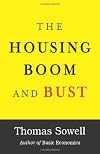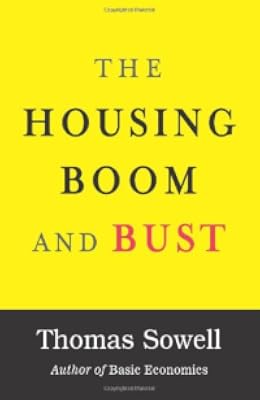
The Housing Boom and Bust
by Thomas Sowell
On This Page
Description
Explains how we got into the current economic disaster that developed out of the economics and politics of the housing boom and bust. The "creative" financing of home mortgages and "creative" marketing of financial securities based on these mortgages to countries around the world, are part of the story of how a financial house of cards was built up--and then collapsed.Tags
Recommendations



Member Reviews
This is ultimately a story about unintended consequences and irresponsible, self-interested politicians. Thomas Sowell offers detailed analysis of the housing “boom” of the 1990s through 2006 as well as the housing “bust” of the collapsing housing market in 2006 and (as of this writing in October 2010) was still ongoing. This is a story which has affected everyone reading this review, triggering as it did a cascading set of financial crises, and sadly, we’re not out o the woods yet.
You should be aware that Sowell is a conservative economist and commentator on politics and public policy, so if that turns you off immediately, I’d suggest avoiding the book. You should be aware, though, that Sowell is not partisan – he blames show more members of both parties for creating the policies that have led to the collapse of the housing market. His arguments are well-crafted and supported by specific data which he cites throughout.
Sowell provides five chapters: the economics of the housing boom; the politics of the housing boom; the housing bust; housing mystiques and mistakes; and one on “the past and the future” (in which he provides a historical analysis and offers comments on the actions of the Obama administration).
So what are his arguments about why the run-up (and subsequent collapse) of housing prices occurred? Sowell is eloquent and his arguments complex and interconnected, but I will raise some of his major points here (space doesn’t permit me to offer greater details and specific evidence for these points; for that, you’ll simply have to read the book:
Land-use restrictions (particularly in places like coastal California) began artificially increasing housing prices, creating a housing “bubble.” Politicians then intervened to address this bubble and increase the availability of affordable homes (and home loans). As part of this long-term effort, federal bank regulators used the 1977 Community Reinvestment Act (CRA) to press for racial equality in housing situations, forcing lenders to provide an increasing number of “subprime” housing loans to would-be home purchasers with poor credit. This situation was worsened under both the George H.W. Bush, Clinton, and George W. Bush administrations because of additional legislation passed (in 1992, 1999, and 2002) to further increase the rate of home ownership. HUD, Fannie Mae, Freddie Mac, and the Fed all played major roles in worsening the situation. This set of factors (along with others Sowell describes) drove the housing boom, predictably. The subsequent outcome of these disastrous policies should have been equally predictable, but sadly, most of us were caught off guard (and I include myself in this, having purchased a home at the height of the boom in 2006). Sowell skillfully punctures many of the myths being perpetuated by those responsible for the crisis in which we find ourselves, not the least of which is the idea that deregulation was to blame for the housing bust and that a new kind of FDR-style “New Deal” is needed to get us out of the economic situation in which we find ourselves. Quite the contrary: it was increased governmental intervention in the housing market and housing finance industry that precipitated the situation, and it is less intervention, not more, that is needed now. It was, in fact, the widespread, catastrophic, unintended consequences of the quixotic desire by members of both parties in government to increase the U.S. home ownership rate at any cost that drove the crisis. There is much more that could be said to address all the nuances of Sowell’s arguments, but I think I’ve captured the core of them here.
There is clearly room for a companion work to this one which analyzes, among other things, credit default swaps (CDSs), collateralized default obligations (CDOs), the credit crunch, the "shadow banking sector," as well as how and why the collapse of the housing market and the mortgage industry has had such widespread effects on the global economy and why the U.S. economy has failed to recover. I’d actually like to see Sowell write that companion piece in a couple years one we’re a little further down the road (I hope) to recovery.
The book is written with great clarity, and while written by a professional economist, intended for laymen. It is a fascinating story, not at all dry or boring as one might expect. I give it 4 stars out of 5. The book is well-cited, but I hate the citation format (unnumbered endnotes in prose/paragraph format), and while the Basic Books edition I read was published in 2010, most of the evidence cited is from no later than early-to-mid-2009. While the information is somewhat perishable, the additional year of data would have only solidified Sowell’s arguments.
Review copyright 2010 J. Andrew Byers show less
You should be aware that Sowell is a conservative economist and commentator on politics and public policy, so if that turns you off immediately, I’d suggest avoiding the book. You should be aware, though, that Sowell is not partisan – he blames show more members of both parties for creating the policies that have led to the collapse of the housing market. His arguments are well-crafted and supported by specific data which he cites throughout.
Sowell provides five chapters: the economics of the housing boom; the politics of the housing boom; the housing bust; housing mystiques and mistakes; and one on “the past and the future” (in which he provides a historical analysis and offers comments on the actions of the Obama administration).
So what are his arguments about why the run-up (and subsequent collapse) of housing prices occurred? Sowell is eloquent and his arguments complex and interconnected, but I will raise some of his major points here (space doesn’t permit me to offer greater details and specific evidence for these points; for that, you’ll simply have to read the book:
Land-use restrictions (particularly in places like coastal California) began artificially increasing housing prices, creating a housing “bubble.” Politicians then intervened to address this bubble and increase the availability of affordable homes (and home loans). As part of this long-term effort, federal bank regulators used the 1977 Community Reinvestment Act (CRA) to press for racial equality in housing situations, forcing lenders to provide an increasing number of “subprime” housing loans to would-be home purchasers with poor credit. This situation was worsened under both the George H.W. Bush, Clinton, and George W. Bush administrations because of additional legislation passed (in 1992, 1999, and 2002) to further increase the rate of home ownership. HUD, Fannie Mae, Freddie Mac, and the Fed all played major roles in worsening the situation. This set of factors (along with others Sowell describes) drove the housing boom, predictably. The subsequent outcome of these disastrous policies should have been equally predictable, but sadly, most of us were caught off guard (and I include myself in this, having purchased a home at the height of the boom in 2006). Sowell skillfully punctures many of the myths being perpetuated by those responsible for the crisis in which we find ourselves, not the least of which is the idea that deregulation was to blame for the housing bust and that a new kind of FDR-style “New Deal” is needed to get us out of the economic situation in which we find ourselves. Quite the contrary: it was increased governmental intervention in the housing market and housing finance industry that precipitated the situation, and it is less intervention, not more, that is needed now. It was, in fact, the widespread, catastrophic, unintended consequences of the quixotic desire by members of both parties in government to increase the U.S. home ownership rate at any cost that drove the crisis. There is much more that could be said to address all the nuances of Sowell’s arguments, but I think I’ve captured the core of them here.
There is clearly room for a companion work to this one which analyzes, among other things, credit default swaps (CDSs), collateralized default obligations (CDOs), the credit crunch, the "shadow banking sector," as well as how and why the collapse of the housing market and the mortgage industry has had such widespread effects on the global economy and why the U.S. economy has failed to recover. I’d actually like to see Sowell write that companion piece in a couple years one we’re a little further down the road (I hope) to recovery.
The book is written with great clarity, and while written by a professional economist, intended for laymen. It is a fascinating story, not at all dry or boring as one might expect. I give it 4 stars out of 5. The book is well-cited, but I hate the citation format (unnumbered endnotes in prose/paragraph format), and while the Basic Books edition I read was published in 2010, most of the evidence cited is from no later than early-to-mid-2009. While the information is somewhat perishable, the additional year of data would have only solidified Sowell’s arguments.
Review copyright 2010 J. Andrew Byers show less
Thomas Sowell’s The Housing Boom and Bust is a slim but powerful exposition of the 2007-2008 subprime mortgage crisis.
Tellingly, Sowell actually spends very little of this book’s ~150 pages on the events of those two years. Instead, he looks much farther back to the roots of the crisis. He first critiques the idea that there is – or recently has been – any real shortage of ‘affordable housing’ in the USA. He explains how many local communities have driven up the cost of housing by severe restrictions on building, often in the name of environmentalism or ‘preservation’, but always with the aim of keeping out those who are not already in.
He then provides a brilliant chapter on the government’s role in constructing and show more exacerbating the mortgage crisis itself. The aforementioned ‘shortage’ of housing was posed as a problem only government could step in and solve, especially for ‘the poor’ and racial minorities, with the result a concerted, persistent program of government regulations, threats, and sometimes outright bullying of lenders to force them into extending mortgages to millions of people who would never have qualified for them under traditional lending criteria:
Both the genesis of unaffordable housing in particular local areas and the response with national policies to make buying a home easier were political in origin, and government regulation is what forced lenders to meet arbitrary quotas by eroding traditional mortgage lending safeguards. The facts could not be plainer. Market criteria had long required such things as substantial down payments, as well as income and credit histories that made continuing payments likely. But all that was brushed aside in the political crusade for ‘affordable housing’ and bigger home ownership statistics. p. 44
Once this hothouse environment was in place, disaster was inevitable:
The bedrock question then is: Why did so many monthly mortgage payments stop coming? and the bedrock answer is: Because mortgage loans were made to people whose prospects of repaying them were less than in the past. Nor was this simply a matter of misjudgment by banks and other lenders. The political pressures to meet arbitrary lending quotas, set by officials with the power of economic life and death over banks and over Fannie Mae and Freddie Mac, led to riskier lending practices than in the past. p. 119
Sowell of course doesn’t let Wall Street off the hook entirely, but his book is an essential counterweight to equally excellent books on the subprime crisis such as Michael Lewis’s The Big Short, which focuses exclusively on the perfidies of the big investment banks, and which may mislead the unwary into thinking the subprime crisis can be reduced to a single locus for blame. I read Lewis and Sowell in succession, and recommend doing so to acquire a broad and balanced introduction to this pivotal chapter in American, and indeed global, financial history. show less
Tellingly, Sowell actually spends very little of this book’s ~150 pages on the events of those two years. Instead, he looks much farther back to the roots of the crisis. He first critiques the idea that there is – or recently has been – any real shortage of ‘affordable housing’ in the USA. He explains how many local communities have driven up the cost of housing by severe restrictions on building, often in the name of environmentalism or ‘preservation’, but always with the aim of keeping out those who are not already in.
He then provides a brilliant chapter on the government’s role in constructing and show more exacerbating the mortgage crisis itself. The aforementioned ‘shortage’ of housing was posed as a problem only government could step in and solve, especially for ‘the poor’ and racial minorities, with the result a concerted, persistent program of government regulations, threats, and sometimes outright bullying of lenders to force them into extending mortgages to millions of people who would never have qualified for them under traditional lending criteria:
Both the genesis of unaffordable housing in particular local areas and the response with national policies to make buying a home easier were political in origin, and government regulation is what forced lenders to meet arbitrary quotas by eroding traditional mortgage lending safeguards. The facts could not be plainer. Market criteria had long required such things as substantial down payments, as well as income and credit histories that made continuing payments likely. But all that was brushed aside in the political crusade for ‘affordable housing’ and bigger home ownership statistics. p. 44
Once this hothouse environment was in place, disaster was inevitable:
The bedrock question then is: Why did so many monthly mortgage payments stop coming? and the bedrock answer is: Because mortgage loans were made to people whose prospects of repaying them were less than in the past. Nor was this simply a matter of misjudgment by banks and other lenders. The political pressures to meet arbitrary lending quotas, set by officials with the power of economic life and death over banks and over Fannie Mae and Freddie Mac, led to riskier lending practices than in the past. p. 119
Sowell of course doesn’t let Wall Street off the hook entirely, but his book is an essential counterweight to equally excellent books on the subprime crisis such as Michael Lewis’s The Big Short, which focuses exclusively on the perfidies of the big investment banks, and which may mislead the unwary into thinking the subprime crisis can be reduced to a single locus for blame. I read Lewis and Sowell in succession, and recommend doing so to acquire a broad and balanced introduction to this pivotal chapter in American, and indeed global, financial history. show less
Certainly not an impartial account. Economics is messy but this is tied up in a neat little editorialized package. Nobel prize winners in economics famously have completely opposite opinions on this subject, always aligning with their personal politics, interestingly enough. This book is not about the confusing evidence that leads to so many diverging opinions about the 2008 financial crisis. It is a one-sided argument. I saw the author had also written "Basic Economics", which sounded like innocuous fundamentals. Then I saw that blamed all political parties and market players. But having finished the book, he really strongly blames liberal politicians acting on their own self interest, while at times some republicans played along. He show more does not agree that nobody saw this coming. He argues that conservatives did, and pled for reform to deaf ears (which I assume surely includes their own ears during their years of legislative power in the 1990s and 2000s, leading up to the crisis, though this is not discussed).
Affordable housing programs and environmentalism caused it all. Seriously. He barely mentioned the toxic derivatives created by investment banks or the large real estate investor speculation. He brushed aside bank mortgage fraud. He did not mention the deregulation of investment banking, the creation of unregulated real estate bonds, nor the large scale migration of investment holdings from treasuries (at too-low interest rates) to these new real estate securities (at better returns, and somehow risk free). He did not see market reasons for the bubble, only oppressive government forcing risky mortgage innovations down our throats.
I don't think I share the author's politics. And that shouldn't be a problem if we're just discussing the boring facts. But this is not a book about boring facts. This is a manifesto against government intervention in general. show less
Affordable housing programs and environmentalism caused it all. Seriously. He barely mentioned the toxic derivatives created by investment banks or the large real estate investor speculation. He brushed aside bank mortgage fraud. He did not mention the deregulation of investment banking, the creation of unregulated real estate bonds, nor the large scale migration of investment holdings from treasuries (at too-low interest rates) to these new real estate securities (at better returns, and somehow risk free). He did not see market reasons for the bubble, only oppressive government forcing risky mortgage innovations down our throats.
I don't think I share the author's politics. And that shouldn't be a problem if we're just discussing the boring facts. But this is not a book about boring facts. This is a manifesto against government intervention in general. show less
This is simply the best book I've read on the current recession (and there are several out). Sowell is concise in language, walks us through the economics of the situaiton step by step, and is quite even-handed when laying blame. (Unlike Morris in Catastrophe, he is not stumping for one party over another.)
Sowell's main point here is that the government carries the majority of the blame, as they were the ones who, through HUD, the Community Reinvestment Act, and their laxing standards for Fannie and Freddie, they pressured banks into issuing loans to those who can't repay them, in a plan to introduce an "ownership society." Predictably, many of these loans got defauled on. And Sowell offers many reasons why the current bailout will not show more fix, but prolong, the problem.
Sowell is not againt regulation per se, but takes a much more skeptical approach of it than Posner or Morris. His suggestion, though, on how to get through the recession, though, is to let money flow to productive channels rather than forcing it to areas it may not normally go (like what the bailouts are doing). And Sowell reminds us that to avoid such catastrophes in the fuure, we really should let banks be the assessors of their own risk, rather than having government tell them who and who not to lend money.
Excellent, excellent book. Why would we expect any less from this great economist? show less
Sowell's main point here is that the government carries the majority of the blame, as they were the ones who, through HUD, the Community Reinvestment Act, and their laxing standards for Fannie and Freddie, they pressured banks into issuing loans to those who can't repay them, in a plan to introduce an "ownership society." Predictably, many of these loans got defauled on. And Sowell offers many reasons why the current bailout will not show more fix, but prolong, the problem.
Sowell is not againt regulation per se, but takes a much more skeptical approach of it than Posner or Morris. His suggestion, though, on how to get through the recession, though, is to let money flow to productive channels rather than forcing it to areas it may not normally go (like what the bailouts are doing). And Sowell reminds us that to avoid such catastrophes in the fuure, we really should let banks be the assessors of their own risk, rather than having government tell them who and who not to lend money.
Excellent, excellent book. Why would we expect any less from this great economist? show less
A No Nonsense Explanation
If you want to learn why this latest economic crisis began explained colloquially in ordinary language, then Thomas Sowell's "The Housing Boom and Bust" is definitely a must read. With an economists acumen combined with the journalists touch, Sowell navigates us through the complex processes involved with the origins and the politics of housing.
I won't go through the details as Sowell's short book does a great job explaining them, but I will highlight what I thought were unique insights into the subprime crisis. Firstly, Sowell explains how certain housing markets like California had certain restrictions like lot-size laws, agricultural and environmental land reserves, which ironically helped accelerate the show more boom-bust cycle by artificially inflating house prices. As Sowell shows, this was in stark contrast to places like Dallas. This leads into one of Sowell's primary arguments, that government intervention actually led to the crisis through it's crusade for "affordable housing." So instead of removing these developmental restrictions, the government simply sought to force the private sector to make it easier to loan to the so-called 'subprimes' thus making housing more affordable for people with low-incomes.
I think a disclaimer though is in order. Sowell is a conservative, and so therefore his selectivity reflects his political biases. For example, Sowell does not even mention the "structural investment vehicles" like mortgage-backed securities or credit-default swaps which hedge funds used to finance these subprime loans. This unregulated securitization and financial innovations in the mortgage bond market is fundamental in understanding the macroeconomics of the crisis and the international scope. Although, not specifically in the scope of this book, Sowell's omission is rather unfortunate because it does distort the picture. The only other criticism is Sowell's over-emphasis on California while only briefly mentioning Cleveland which is often thought of as the center and origin of the subprime crisis, of which many homeowners were not actually subprime but were manipulated into refinancing or reversing (coincidentally, most were working-class black homeowners).
The book is incredibly relevant in learning about how and why we got to where we are now. I've read many books on this subject and I can say with confidence that Sowell's book is probably the easiest to understand and one of the most transparent. Overall, this is a must read. show less
If you want to learn why this latest economic crisis began explained colloquially in ordinary language, then Thomas Sowell's "The Housing Boom and Bust" is definitely a must read. With an economists acumen combined with the journalists touch, Sowell navigates us through the complex processes involved with the origins and the politics of housing.
I won't go through the details as Sowell's short book does a great job explaining them, but I will highlight what I thought were unique insights into the subprime crisis. Firstly, Sowell explains how certain housing markets like California had certain restrictions like lot-size laws, agricultural and environmental land reserves, which ironically helped accelerate the show more boom-bust cycle by artificially inflating house prices. As Sowell shows, this was in stark contrast to places like Dallas. This leads into one of Sowell's primary arguments, that government intervention actually led to the crisis through it's crusade for "affordable housing." So instead of removing these developmental restrictions, the government simply sought to force the private sector to make it easier to loan to the so-called 'subprimes' thus making housing more affordable for people with low-incomes.
I think a disclaimer though is in order. Sowell is a conservative, and so therefore his selectivity reflects his political biases. For example, Sowell does not even mention the "structural investment vehicles" like mortgage-backed securities or credit-default swaps which hedge funds used to finance these subprime loans. This unregulated securitization and financial innovations in the mortgage bond market is fundamental in understanding the macroeconomics of the crisis and the international scope. Although, not specifically in the scope of this book, Sowell's omission is rather unfortunate because it does distort the picture. The only other criticism is Sowell's over-emphasis on California while only briefly mentioning Cleveland which is often thought of as the center and origin of the subprime crisis, of which many homeowners were not actually subprime but were manipulated into refinancing or reversing (coincidentally, most were working-class black homeowners).
The book is incredibly relevant in learning about how and why we got to where we are now. I've read many books on this subject and I can say with confidence that Sowell's book is probably the easiest to understand and one of the most transparent. Overall, this is a must read. show less
This book started off promisingly, with a well-paced, easy-to-understand explanation of housing markets. I learned a few interesting facts was excited to learn more. Slowly, however, it started sliding downhill. First, there were some racially tinged comments, essentially assuming that racism can't be real because there's no way homo economicus would allow that. Then, he starts to complain about politicians, both broadly and specifically. Some of these complaints had more merit than others, and I'm sure there's some lessons to be learned here. Somehow, he managed to blame the housing crisis on regulation as opposed to deregulation, an idea which is presented as gospel without a lot of cogent argument behind it.
It really feels like show more Sowell only had about 90 pages worth of content, because after that, the book devolves into insane rants about government intervention, and ends with 10 pages claiming that FDR wasn't all that great and that the New Deal was maybe bad for America. According to Sowell, more people are beginning to realize this truth recently.
There is a pattern of odd repetition of ideas and phrases in here, often several pages apart. Sowell also a very strange habit of lambasting others for ignoring empirical data or massaging statistics, and then turning around and almost immediately making unsubstantiated claims or engaging in bizarre statistical interpretation. Overall, it's very odd, and makes a book that would have been an easy read quite the slog to finish. show less
It really feels like show more Sowell only had about 90 pages worth of content, because after that, the book devolves into insane rants about government intervention, and ends with 10 pages claiming that FDR wasn't all that great and that the New Deal was maybe bad for America. According to Sowell, more people are beginning to realize this truth recently.
There is a pattern of odd repetition of ideas and phrases in here, often several pages apart. Sowell also a very strange habit of lambasting others for ignoring empirical data or massaging statistics, and then turning around and almost immediately making unsubstantiated claims or engaging in bizarre statistical interpretation. Overall, it's very odd, and makes a book that would have been an easy read quite the slog to finish. show less
An extremely concise book recapping the housing collapse of late 2000s. Not mincing words or pulling punches, Dr. Sowell likely refers to President Bush by name more than he did to President Obama. But that is not to say he doesn't squarely place much of the blame for regulatory and economic meddling on those who deserve the "credit."
Most interesting was his lesson of the Great Depression and federal involvement which only worsened, or at least prolonged the misery of unemployment. Dr. Sowell illustrates that is was World War II which ended the lingering effects of horrible economic circumstances of the late 1930's. Yet is was not for the popular reason of "ramped up war production"; rather it was the war effort put an end to the New show more Deal! Also, consider those serving in the military are not factored into unemployment numbers.
The conclusion of the first chapter sets the tone for the rest of the book (p. 29):
Most interesting was his lesson of the Great Depression and federal involvement which only worsened, or at least prolonged the misery of unemployment. Dr. Sowell illustrates that is was World War II which ended the lingering effects of horrible economic circumstances of the late 1930's. Yet is was not for the popular reason of "ramped up war production"; rather it was the war effort put an end to the New show more Deal! Also, consider those serving in the military are not factored into unemployment numbers.
The conclusion of the first chapter sets the tone for the rest of the book (p. 29):
" When it comes to the home mortgage boom and bust, who was to blame? The borrowers? The lenders? The government? The financial markets?show less
The answer is yes. All were responsible and many were irresponsible.
Economics cannot explain such things. For that, we must turn to the politics of housing."
Members
- Recently Added By
Lists

Books Read in 2026
1,994 works; 67 members
Author Information

77+ Works 15,414 Members
Thomas Sowell is the Rose and Milton Friedman Senior Fellow on Public Policy at the Hoover Institution, Stanford University.
Awards and Honors
Distinctions
Work Relationships
Has as a reference guide/companion
Common Knowledge
- Canonical title
- The Housing Boom and Bust
Classifications
Statistics
- Members
- 299
- Popularity
- 106,625
- Reviews
- 10
- Rating
- (3.93)
- Languages
- English
- Media
- Paper, Audiobook, Ebook
- ISBNs
- 9
- ASINs
- 5