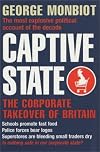
Captive State: The Corporate Takeover of Britain
by George Monbiot
On This Page
Description
George Monbiot seeks to uncover what many have suspected but few have been able to prove: that big business is taking over Britain.Tags
Recommendations

























Member Reviews
Great Britain remains a self-confessed and highly proud land for being widely open to business and finance. It can make for Kafkaesque situations, such as when the mounted branch of the London Metropolitan police displayed the HSBC logo on its stirrups, or when the queen, during the Millennium, lighted up a firework starting by the giant letters 'BRITISH GAS' illuminating the sky. Such situations, highly ridiculous, can be funny. The journalist George Monbiot, though, starkly reminds us here that there really is nothing to laugh about.
Such silly facts, far from being isolated, reflect indeed for him the massive takeover exerted by corporates now invading even the pillars of our democracy. Here's the burning question, then: whose show more interests, exactly, are serving our governments? That of the citizens electing them? Or that of private and powerful companies snaking their way even into our laws? The multiple examples he offers leave us wondering, to say the least...
To clearly illustrate his point, he delves in here upon this very peculiar British way, radical and original, to finance most of our public services -the Private Finance Initiative (PFI). Set up by the Tories and gone mad under the New Labour, such delegating of costs to private companies has had indeed a terrible impact from public transports to infrastructures, education, the NHS, the prison system, and, even, the development of public spaces, all fields and sectors where private interest (the race for profits) now dominate over public ones, to the point of clashing with them dangerously at times.
It's a worrying picture, yet George Monbiot refuses to be pessimistic. In fact, he claims that if such corporate became so powerful in the first place is because we, citizens, have too often let them and the politicians serving them get away with it all. All is not lost -political engagement and participation coupled with active pressuring campaigns to fight the issue can still make an impact. He, in fact, gives the example the massive protests which happened during the World Trade Organisation conference back in Seattle in 1999, and those results had even impacted the conference itself. Well...
It's a great eye-opener, and the pictures it offers are quite bleak despite the optimism of the author. Do we really have any said in the decisions concerning us all? Published in 2000, so before the 2008 financial crash, such optimism might have been relevant back then. From our vantage point, though, I believe it's quite clear by now that it has been dashed. It doesn't mean this book is irrelevant. In fact, if anything, it shows that the writing was on the wall long ago already. Tories, Labour: who cares? It's the same establishment, with the same interests, and run by oligarchs trapped in the same bubble away from the reality most of the rest of us experience. With public services on their knees, I don't think there's much left to save... Kafkaesque it was back then; Kafkaesque it will remains, then. show less
Such silly facts, far from being isolated, reflect indeed for him the massive takeover exerted by corporates now invading even the pillars of our democracy. Here's the burning question, then: whose show more interests, exactly, are serving our governments? That of the citizens electing them? Or that of private and powerful companies snaking their way even into our laws? The multiple examples he offers leave us wondering, to say the least...
To clearly illustrate his point, he delves in here upon this very peculiar British way, radical and original, to finance most of our public services -the Private Finance Initiative (PFI). Set up by the Tories and gone mad under the New Labour, such delegating of costs to private companies has had indeed a terrible impact from public transports to infrastructures, education, the NHS, the prison system, and, even, the development of public spaces, all fields and sectors where private interest (the race for profits) now dominate over public ones, to the point of clashing with them dangerously at times.
It's a worrying picture, yet George Monbiot refuses to be pessimistic. In fact, he claims that if such corporate became so powerful in the first place is because we, citizens, have too often let them and the politicians serving them get away with it all. All is not lost -political engagement and participation coupled with active pressuring campaigns to fight the issue can still make an impact. He, in fact, gives the example the massive protests which happened during the World Trade Organisation conference back in Seattle in 1999, and those results had even impacted the conference itself. Well...
It's a great eye-opener, and the pictures it offers are quite bleak despite the optimism of the author. Do we really have any said in the decisions concerning us all? Published in 2000, so before the 2008 financial crash, such optimism might have been relevant back then. From our vantage point, though, I believe it's quite clear by now that it has been dashed. It doesn't mean this book is irrelevant. In fact, if anything, it shows that the writing was on the wall long ago already. Tories, Labour: who cares? It's the same establishment, with the same interests, and run by oligarchs trapped in the same bubble away from the reality most of the rest of us experience. With public services on their knees, I don't think there's much left to save... Kafkaesque it was back then; Kafkaesque it will remains, then. show less
IF YOU HAVE NOT READ THIS BOOK, THEN SHAME UPON YOU.
Have you ever noticed the sanctity of the reformed smoker? He/she is always the first to cough, grimace and make disapproving noises when some unfortunate lights up in their vicinity: well, I am fully aware that the first line of my review of a book written 15 years ago, and which I have only just got around to reading, is every bit as irrationally biased - but I stand by it.
Captive State is a compelling and credible dissection of British Government in particular, but also World governance. Monbiot manages to be both 'chatty' enough to keep the average reader (me) engrossed from page 1 to 360, but also has sufficient gravitas to indicate his knowledge in the area. I was amazed that a show more topic which has the potential to be a difficult read could be so gripping. The background to TTIP, PFI's and other current issues are covered from scratch. One could (I did) begin with the sketchiest of a grasp of both these concepts and come away with a working understanding.
I am not going to provide a second rate explanation of Monbiot, I will simply say that this book can be despatched to your door, for less than three English pounds and I will guarantee that you will consider it to be the most sensible expenditure that you have made in many a year... So what are you waiting for? Shouldn't you be visiting your favourite book seller? show less
Have you ever noticed the sanctity of the reformed smoker? He/she is always the first to cough, grimace and make disapproving noises when some unfortunate lights up in their vicinity: well, I am fully aware that the first line of my review of a book written 15 years ago, and which I have only just got around to reading, is every bit as irrationally biased - but I stand by it.
Captive State is a compelling and credible dissection of British Government in particular, but also World governance. Monbiot manages to be both 'chatty' enough to keep the average reader (me) engrossed from page 1 to 360, but also has sufficient gravitas to indicate his knowledge in the area. I was amazed that a show more topic which has the potential to be a difficult read could be so gripping. The background to TTIP, PFI's and other current issues are covered from scratch. One could (I did) begin with the sketchiest of a grasp of both these concepts and come away with a working understanding.
I am not going to provide a second rate explanation of Monbiot, I will simply say that this book can be despatched to your door, for less than three English pounds and I will guarantee that you will consider it to be the most sensible expenditure that you have made in many a year... So what are you waiting for? Shouldn't you be visiting your favourite book seller? show less
Reading a book that's so clearly tied to a specific period of time (like this one) several years (or decades) later is always a little strange experience: it's interesting to read about specific events and experiences in the past, but I find myself wondering what the book would say about things now, or what actually happened next in the specific examples. Of course, some areas of the matters discussed in this book are still very much on the agenda, and on very much the same terms: planning, supermarkets, corporate influence over the education system, etc.
On the whole, this was a lucidly written and engaging book and gave me plenty of food for thought.
On the whole, this was a lucidly written and engaging book and gave me plenty of food for thought.
Presents an interesting perspective with a lot of case studies - too many or too much detail for my liking. The case studies just went on and on and became quite tiresome. Yea I know, there's an enormous amount of moral corruption out there these days but the message to the masses would be better made with shorter punchier examples that referenced on-line material for those whe need it.
Ratings
Members
- Recently Added By
Author Information

25+ Works 3,222 Members
George Monbiot is one of the world's most influential radical thinkers. A weekly columnist for the Guardina, he is also the best-selling author of The Age of Consent and Captive State. In 1995, Nelson Mandela presented him with a United Nations Global 500 Award for outstanding environmental achievement.
Classifications
Statistics
- Members
- 355
- Popularity
- 89,283
- Reviews
- 4
- Rating
- (3.79)
- Languages
- English
- Media
- Paper, Ebook
- ISBNs
- 3
- ASINs
- 1