
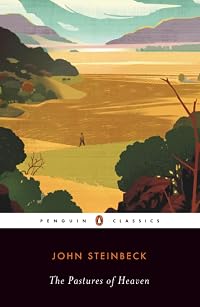
The Pastures of Heaven
by John Steinbeck
On This Page
Description
Classic Literature. Fiction. Literature. Short Stories. In Nobel Prize winner John Steinbeck’s beautifully rendered depictions of small yet fateful moments that transform ordinary lives, these twelve early stories introduce both the subject and style of artistic expression that recur in the most important works of his career. Each of these self-contained stories is linked to the others by the presence of the Munroes, a family whose misguided behavior and lack of sensitivity precipitate show more disasters and tragedies. As the individual dramas unfold, Steinbeck reveals the self-deceptions, intellectual limitations, and emotional vulnerabilities that shape the characters’ reactions and gradually erode the harmony and dreams that once formed the foundation of the community. show lessTags
Recommendations






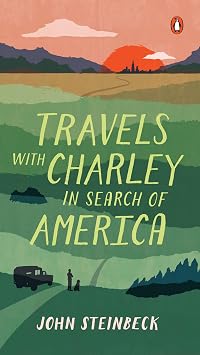



Member Recommendations
Member Reviews
The Pastures of Heaven is John Steinbeck’s 1932 collection of twelve intertwining short stories set in a fertile valley near Salinas and Monterey, California. As time passes, the characters, all of whom know each other in the way that people in small communities usually do, come and go as their individual stories and fates unfold. Some set their roots so deeply that they and their descendants will be there forever, but others are only there long enough for some personal tragedy or failure to send them on their way.
In the collection’s second story, one Bert Battle, a man with a history of personal failure, comes to the valley to take over a farm that locals believe is both cursed and haunted. Bert, though, makes such a success of the show more farm that he is soon accepted into the community and even becomes one of the most influential citizens in the entire valley. Reflecting upon his great success at the valley’s general store one day, Bert remarks, “Maybe my curse and the farm’s curse got to fighting and killed each other off.” This leads the storekeeper to make a prophetic observation of his own, one that sets the tone for the rest of the book: “Maybe your curse and the farm’s curse have mated and gone into a gopher hole like a pair of rattlesnakes. Maybe there’ll be a lot of baby curses crawling around the Pastures the first thing we know.”
It was only a joke on the storekeeper’s part – but that is exactly what would happen.
Several of Steinbeck’s stories are about dreamers who cannot resist the lure of the valley’s beauty and tranquility. They come seeking shelter but find that their personal failings travel to the valley with them. One man tries to raise his little boy in a kind of isolated poverty he believes will give the child an untainted life of the mind, only to watch his world crumble when school authorities demand that his son attend public school. A woman comes to town with her mentally disturbed daughter hoping that the solitude will be good for both of them; an abandoned baby is found and taken into the care of a local rancher; two sisters decide to supplement their income by opening up a home business; and a new schoolteacher comes to town hoping to leave her family’s past behind her for good. And it does not end well for any of them.
Along the way, a few dreams do seem to come true. But those “baby curses” are always out there waiting to destroy those who dare to dream, especially those who dare to dream as big as the protagonist of the collection’s next-to-last story (the stories are numbered, not titled separately). Richard Whiteside came to the West to start a family dynasty and he immediately went to work building the family home that he envisioned would anchor the Whitesides there for many generations to come. But Richard’s personal “baby curse” just smiled and waited in the background.
The Pastures of Heaven is certainly not an optimistic short story collection, but readers of the book will get a preview of many of the themes that would influence John Steinbeck’s work throughout the rest of his career. show less
In the collection’s second story, one Bert Battle, a man with a history of personal failure, comes to the valley to take over a farm that locals believe is both cursed and haunted. Bert, though, makes such a success of the show more farm that he is soon accepted into the community and even becomes one of the most influential citizens in the entire valley. Reflecting upon his great success at the valley’s general store one day, Bert remarks, “Maybe my curse and the farm’s curse got to fighting and killed each other off.” This leads the storekeeper to make a prophetic observation of his own, one that sets the tone for the rest of the book: “Maybe your curse and the farm’s curse have mated and gone into a gopher hole like a pair of rattlesnakes. Maybe there’ll be a lot of baby curses crawling around the Pastures the first thing we know.”
It was only a joke on the storekeeper’s part – but that is exactly what would happen.
Several of Steinbeck’s stories are about dreamers who cannot resist the lure of the valley’s beauty and tranquility. They come seeking shelter but find that their personal failings travel to the valley with them. One man tries to raise his little boy in a kind of isolated poverty he believes will give the child an untainted life of the mind, only to watch his world crumble when school authorities demand that his son attend public school. A woman comes to town with her mentally disturbed daughter hoping that the solitude will be good for both of them; an abandoned baby is found and taken into the care of a local rancher; two sisters decide to supplement their income by opening up a home business; and a new schoolteacher comes to town hoping to leave her family’s past behind her for good. And it does not end well for any of them.
Along the way, a few dreams do seem to come true. But those “baby curses” are always out there waiting to destroy those who dare to dream, especially those who dare to dream as big as the protagonist of the collection’s next-to-last story (the stories are numbered, not titled separately). Richard Whiteside came to the West to start a family dynasty and he immediately went to work building the family home that he envisioned would anchor the Whitesides there for many generations to come. But Richard’s personal “baby curse” just smiled and waited in the background.
The Pastures of Heaven is certainly not an optimistic short story collection, but readers of the book will get a preview of many of the themes that would influence John Steinbeck’s work throughout the rest of his career. show less
The Pastures of Heaven is solid Steinbeck. Not solid gold Steinbeck (though thank God there's plenty of that elsewhere), but there's still plenty in here to sink your teeth into. Taking place in a California valley called 'Las Pasturas del Cielo' – the titular 'Pastures of Heaven' – the book follows a succession of well-drawn characters as they navigate the challenges of their lives in quietly distinctive moments.
This can sometimes be frustrating for the reader, particularly at first, for each chapter begins with a new character in a new circumstance in the valley (the characters are only distantly linked to one another). This requires the reader to reset each time and again put in the hard work of embracing a new character as their show more situation is established. You constantly feel like you're reading the opening chapter of a novel all the way to the end, and you can wonder at the point of the book.
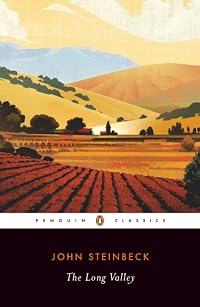
However, once you embrace this, and perhaps begin to view it as a succession of short stories rather than a novel (similar to The Long Valley), the book comes into its own. Though The Pastures of Heaven is early-period Steinbeck, he writes very well and in their self-contained chapters his characters navigate a breadth of human experience. Often quietly warm and painfully sad, never transcending but never sinking into misery and despair either, this is not only a fine snapshot of life but quintessential 'Steinbeck Country'. And that's always a fine place to roam for a while. show less
This can sometimes be frustrating for the reader, particularly at first, for each chapter begins with a new character in a new circumstance in the valley (the characters are only distantly linked to one another). This requires the reader to reset each time and again put in the hard work of embracing a new character as their show more situation is established. You constantly feel like you're reading the opening chapter of a novel all the way to the end, and you can wonder at the point of the book.
However, once you embrace this, and perhaps begin to view it as a succession of short stories rather than a novel (similar to The Long Valley), the book comes into its own. Though The Pastures of Heaven is early-period Steinbeck, he writes very well and in their self-contained chapters his characters navigate a breadth of human experience. Often quietly warm and painfully sad, never transcending but never sinking into misery and despair either, this is not only a fine snapshot of life but quintessential 'Steinbeck Country'. And that's always a fine place to roam for a while. show less
Families living in a little rural valley in California do the whole lives of quiet desperation thing in this series of interconnected short stories that lack the oomph of Steinbeck's later works. It's like seeing the stumbling, early steps toward themes, characters, and settings that he'll one day dance through with grace and power.
I'm glad I read this, but that doesn't totally offset how bored I was while reading it.
I'm glad I read this, but that doesn't totally offset how bored I was while reading it.
This was not Steinbeck's first book, but it was the one that caused people to start taking notice of his talent. The book reminded me of another favorite short story cycle of mine, Sherwood Anderson's Winesburg, Ohio. Both books follow individual characters living near each other in a small place. Some of the same characters drift in and out of the stories. These books are dissections of small town and country life, where on the surface it looks normal, just an average place, but underneath is a seething mass of human nature. The subject matter is often dark in both books. Neither Steinbeck nor Anderson were writers to shy away from exposing the shadow selves we so often repress, knowingly or not. And they do not judge; they simply show more show, as all good writers do. show less
I'd always assumed that Steinbeck was an overly sentimental and moralizing author who would annoy me with rotten cliches about the value of every human being and simple rural life while emphasizing romantic and simple tragedy in a way that tread perilously close kitsch. Turns out I was wrong. Not that he's totally unlike the writer I imagined, but it was a caricature that, if I'd really thought about it, I should have realized couldn't be true. It's not the first time and (sadly) won't be the last time that I've taken an exaggerated dislike to something just because it's popular.
The book itself? The characters are (mostly) well drawn, the stories interesting, the setting well realized. Most of the stories seem to turn on the notion show more that, ultimately, we all live alone with our various needs, desires, and fears. When people try to intervene in the lives of their neighbors it often goes sour, through a lack of understanding or a conflation of their neighbors needs with their own. Family is paramount and there are a couple of examples where the bond between husband and wife transcends the general limitation on humanity's ability to know and support one another. Interesting, the bonds between parents and children seem much looser. There are a few times where I felt it was all being laid on just a tad thick.
The description of small scale agriculture is lovely and sentimental and I can't help but think that it would have been particularly potent for my parents and others (many of my parents' age) who are one generation removed from the land. I wonder how much this contributed to Steinbeck's popularity in the 20th century and how it will change in the years to come as fewer and fewer people have recent family, or youthful personal, experience with life on a small farm. show less
The book itself? The characters are (mostly) well drawn, the stories interesting, the setting well realized. Most of the stories seem to turn on the notion show more that, ultimately, we all live alone with our various needs, desires, and fears. When people try to intervene in the lives of their neighbors it often goes sour, through a lack of understanding or a conflation of their neighbors needs with their own. Family is paramount and there are a couple of examples where the bond between husband and wife transcends the general limitation on humanity's ability to know and support one another. Interesting, the bonds between parents and children seem much looser. There are a few times where I felt it was all being laid on just a tad thick.
The description of small scale agriculture is lovely and sentimental and I can't help but think that it would have been particularly potent for my parents and others (many of my parents' age) who are one generation removed from the land. I wonder how much this contributed to Steinbeck's popularity in the 20th century and how it will change in the years to come as fewer and fewer people have recent family, or youthful personal, experience with life on a small farm. show less
Steinbeck’s second work, published in 1932, is a series of interconnected short stories about a valley near Salinas, California. A Spanish explorer “discovers” it in the 1700s and names it Las Pasturas del Cielo. The subsequent stories take place in the 1800s. As with many short story collections, some are more appealing than others. They are written in Steinbeck’s flowing literary style. It is easy to picture the residents of this small farming community. Steinbeck excels at establishing his characters’ traits quickly.
This book captures the irony of living in a “heavenly” valley while experiencing pain and suffering. It is easy to find comparisons to the Garden of Eden. I am glad to have read it to see how Steinbeck’s show more writing progressed. I am a fan of his later works, especially The Grapes of Wrath and Cannery Row. I hope to eventually read his complete catalogue. I listened to the audio book, narrated by Sean Runnette in a low key, fluid style.
3.5 show less
This book captures the irony of living in a “heavenly” valley while experiencing pain and suffering. It is easy to find comparisons to the Garden of Eden. I am glad to have read it to see how Steinbeck’s show more writing progressed. I am a fan of his later works, especially The Grapes of Wrath and Cannery Row. I hope to eventually read his complete catalogue. I listened to the audio book, narrated by Sean Runnette in a low key, fluid style.
3.5 show less
In 1919, Sherwood Anderson published a collection of short stories centering around a town. The book was called Winesburg, Ohio. It remained popular into the 1930s. Around this time, a young journalist named Elizabeth Ingels developed an idea of interconnected stories similar to Anderson's work, but based in California. She mentioned the idea to a young writer named John Steinbeck. At the time, Steinbeck was struggling with his first novel (the later published To a God Unknown) and had managed to publish his second (the cringe-worthy Cup of Gold). He had yet to find his voice and his readers. So he did what any young, unappreciated artist has at least struggled with—he borrowed a good idea.
Now I've heard the argument from some of show more Steinbeck's devoted fans and scholars: Steinbeck's idea was unique from Ingels' original concept... Ingels wasn't ever going to do anything with the idea anyway... whatever. It doesn't matter and here's why: this book kind of sucks (relatively speaking, anyway). No, some people love it. Many do in fact. I didn't. I consider this one of the author's worsts. This is the twenty-second book I've read of Steinbeck's and, well, personally, Burning Bright made a bigger impact on me. Burning Bright? The experimental one about circus clowns and farmers and sailors? Yes, that one.
What the casual reader of Steinbeck may not know is that the author's earliest works are often far from the realism that Steinbeck is generally known for. The author repeatedly tried to separate himself from this label, a categorization that was cemented with works such as In Dubious Battle and The Grapes of Wrath. This spiritual, magical Steinbeck is most evident in the author's earliest books and latest books. Sometimes these subtle elements of magic worked for the author, other times they didn't; largely, they're either missed or ignored.
The Pastures of Heaven holds some of this early Steinbeck magic. Sometimes it works, other times it doesn't. Either way, the collection as a whole has a rather absurd feel to it. Curses, gnomes, and sex-dealing proprietors of a Mexican restaurant who take “buy one, get one free” to a new level... yet, it's all Steinbeck. The author didn't spend as much time with the setting as he did in later works, but his signature style of laying out the scenery and breathing life into it is intact.
But where The Pastures of Heaven succeeds most is in its characters. I would argue that, amongst Steinbeck's earliest works, this is one of his most character-centric books. These are brief character studies of the people who populate the valley. In these short pieces, no character is given the time to be developed fully, however. Aside from some of the characters, and a couple stories, there's nothing horribly exciting about this collection. Compared to Steinbeck's greatest works, nothing in these stories stands out. Compared to the town of Winesburg, Ohio, however, Las Pasturas del Cielo, California, is much more spellbinding. show less
Now I've heard the argument from some of show more Steinbeck's devoted fans and scholars: Steinbeck's idea was unique from Ingels' original concept... Ingels wasn't ever going to do anything with the idea anyway... whatever. It doesn't matter and here's why: this book kind of sucks (relatively speaking, anyway). No, some people love it. Many do in fact. I didn't. I consider this one of the author's worsts. This is the twenty-second book I've read of Steinbeck's and, well, personally, Burning Bright made a bigger impact on me. Burning Bright? The experimental one about circus clowns and farmers and sailors? Yes, that one.
What the casual reader of Steinbeck may not know is that the author's earliest works are often far from the realism that Steinbeck is generally known for. The author repeatedly tried to separate himself from this label, a categorization that was cemented with works such as In Dubious Battle and The Grapes of Wrath. This spiritual, magical Steinbeck is most evident in the author's earliest books and latest books. Sometimes these subtle elements of magic worked for the author, other times they didn't; largely, they're either missed or ignored.
The Pastures of Heaven holds some of this early Steinbeck magic. Sometimes it works, other times it doesn't. Either way, the collection as a whole has a rather absurd feel to it. Curses, gnomes, and sex-dealing proprietors of a Mexican restaurant who take “buy one, get one free” to a new level... yet, it's all Steinbeck. The author didn't spend as much time with the setting as he did in later works, but his signature style of laying out the scenery and breathing life into it is intact.
But where The Pastures of Heaven succeeds most is in its characters. I would argue that, amongst Steinbeck's earliest works, this is one of his most character-centric books. These are brief character studies of the people who populate the valley. In these short pieces, no character is given the time to be developed fully, however. Aside from some of the characters, and a couple stories, there's nothing horribly exciting about this collection. Compared to Steinbeck's greatest works, nothing in these stories stands out. Compared to the town of Winesburg, Ohio, however, Las Pasturas del Cielo, California, is much more spellbinding. show less
Members
- Recently Added By
Lists

1930s
262 works; 5 members

Reading LIst
648 works; 1 member
Author Information

473+ Works 206,648 Members
In recent years Steinbeck has been elevated to a more prominent status among American writers of his generation. If not quite at the world-class artistic level of a Hemingway or a Faulkner, he is nonetheless read very widely throughout the world by readers of all ages who consider him one of the most "American" of writers. Born in Salinas County, show more California on February 27, 1902, Steinbeck was of German-Irish parentage. After four years as a special student at Stanford University, he went to New York, where he worked as a reporter and as a hod carrier. Returning to California, he devoted himself to writing, with little success; his first three books sold fewer than 3,000 copies. Tortilla Flat (1935), dealing with the paisanos, California Mexicans whose ancestors settled in the country 200 years ago, established his reputation. In Dubious Battle (1936), a labor novel of a strike and strike-breaking, won the gold medal of the Commonwealth Club of California. Of Mice and Men (1937), a long short story that turns upon a melodramatic incident in the tragic friendship of two farm hands, written almost entirely in dialogue, was an experiment and was dramatized in the year of its publication, winning the New York Drama Critics Circle Award. It brought him fame. Out of a series of articles that he wrote about the transient labor camps in California came the inspiration for his greatest book, The Grapes of Wrath (1939), the odyssey of the Joad family, dispossessed of their farm in the Dust Bowl and seeking a new home, only to be driven on from camp to camp. The fiction is punctuated at intervals by the author's voice explaining this new sociological problem of homelessness, unemployment, and displacement. As the American novel "of the season, probably the year, possibly the decade," it won the Pulitzer Prize in 1940. It roused America and won a broad readership by the unusual simplicity and tenderness with which Steinbeck treated social questions. Even today, The Grapes of Wrath remains alive as a vivid account of believable human characters seen in symbolic and universal terms as well as in geographically and historically specific ones. Ma Joad is one of the most memorable characters in twentieth-century American fiction. It is her courage that sustains the family. Steinbeck's best and most ambitious novel after The Grapes of Wrath is East of Eden (1952), a saga of two American families in California from before the Civil War through World War I. Cannery Row (1945), The Wayward Bus (1947), and Sweet Thursday (1955) are lighter works that find Steinbeck returning to the lighthearted tone of Tortilla Flat as he recounts picaresque adventures of modern-day picaros. The Winter of Our Discontent (1961) struck some reviewers as being appropriately titled because of its despairing treatment of humanity's fall from grace in a wasteland world where money is king. Steinbeck also wrote important nonfiction, including Russian Journal (1948) in collaboration with the photographer Robert Capa; Once There Was a War (1958) and America and Americans (1966), which features pictures by 55 leading photographers and a 70-page essay by Steinbeck. His interest in marine biology led to two books primarily about sea life, Sea of Cortez (1941) (with Edward F. Ricketts) and The Log from the Sea of Cortez (1951). Travels with Charley (1962) is an engaging account of his journey of rediscovery of America, which took him through approximately 40 states. Steinbeck was married three times and died in New York City on December 20, 1968 of heart disease and congestive heart failure. He was 66, and had been a life-long smoker. (Bowker Author Biography) show less
Some Editions
Series
Belongs to Publisher Series
Work Relationships
Is contained in
Common Knowledge
- Canonical title
- The Pastures of Heaven
- Original title
- The Pastures of Heaven
- Original publication date
- 1932 (Engels) (Engels); 1964 (Nederlands) (Nederlands)
- People/Characters
- George Battle; Myrtle Cameron Battle; John Battle (son of George and Myrtle Battle); the Mustrovics; T. B. Allen (storekeeper); Pat Humbert (show all 52); John Whiteside; Bert Munroe; Mrs. Munroe (wife of Bert Munroe); Mae Munroe (daughter of Bert and Mrs. Munroe); Jimmie Munroe (son of Bert and Mrs. Munroe); Manfred "Manny" Munroe (son of Bert and Mrs. Munroe); Edward "Shark" Wicks (husband of Katherine Mullock Wicks); Katherine Mullock Wicks (wife of Edward "Shark" Wicks); Alice Wicks (daughter of Edward and Katherine Wicks); Tom Breman; Mrs. Breman; Miss Burke; Jack; Franklin Gomez (adoptive father of Tularecito); Pancho (hired man of Franklin Gomez); Tularecito (foundling adopted by Franklin Gomez); Miss Martin (teacher); Mary "Molly" Morgan (teacher); Helen Van Deventer (wife of Hubert Van Deventer); Hubert Van Deventer (husband of Helen Van Deventer | husband of Helen Van Deventer); Hilda Van Deventer (daughter of Helen and Hubert Van Deventer); Dr. Phillips; Joe (servant); Junius Maltby (husband of Mamie Quaker Maltby); Mamie Quaker Maltby (wife of Junius Maltby); Jakob Stutz; Robert Louis "Robbie" Maltby (son of Junius and Mamie Maltby); Cleo Banks (wife of Raymond Banks); Mrs. Allen; Takashi Kato (classmate of Robert Louis "Robbie" Maltby); Mr. Kato (father of Takashi Kato); Raymond Banks (husband of Cleo Banks); Guiermo Lopez (father of Rosa and Maria Lopez); Rosa Lopez (sister of Maria Lopez); Maria Lopez (sister of Rosa Lopez); Allen Huenneker; Willa Whiteside (wife of John Whiteside); Joe Morgan (brother of Mary "Molly" Morgan); Tom Morgan (brother of Mary "Molly" Morgan); Mrs. Morgan (mother of Mary "Molly" Morgan); George Morgan (father of Mary "Molly" Morgan); William "Bill" Whiteside (son of John and Willa Whiteside); Ed; Richard Whiteside (father of John Whiteside); Alicia Whiteside (mother of John Whiteside); Tiburcio Vasquez (bandit)
- Important places
- Las Pasturas del Cielo, California, USA; Salinas Valley, California, USA; Corral de Tierra, Monterey, California, USA; California, USA; Carmel-by-the-Sea, California, USA
- Dedication
- To my father and mother
- First words
- When the Carmelo Mission of Alta California was being built, some time around 1776, a group of twenty converted Indians abandoned religion during a night, and in the morning they were gone from their huts.
- Last words
- (Click to show. Warning: May contain spoilers.)He thrust the gear lever; the car gathered speed and swept down the grade toward the long Caramel Valley and toward the sun where it was setting in the ocean at the valley's mouth.
- Original language
- English
Classifications
Statistics
- Members
- 1,453
- Popularity
- 16,075
- Reviews
- 36
- Rating
- (4.03)
- Languages
- 15 — Danish, Dutch, English, Finnish, French, German, Greek, Italian, Norwegian (Bokmål), Portuguese, Romanian, Slovenian, Spanish, Swedish, Turkish
- Media
- Paper, Audiobook, Ebook
- ISBNs
- 51
- ASINs
- 51