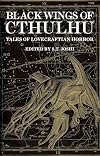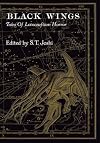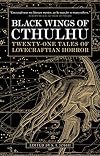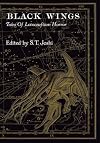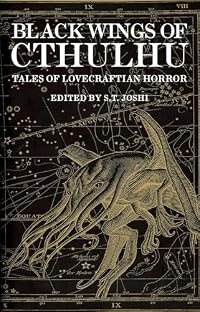
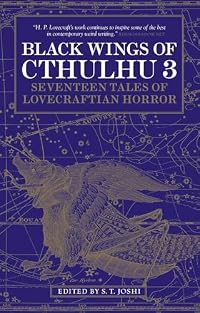
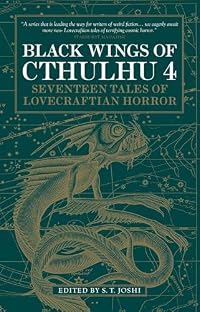
Black Wings of Cthulhu: Tales of Lovecraftian Horror
by S. T. Joshi (Editor)
Black Wings of Cthulhu (1)
On This Page
Description
Modern Masters of Terror The works of H. P. Lovecraft have inspired brilliant writers for decades, leading Stephen King to call him the ?twentieth century's greatest practitioner of the classic horror tale." S.T. Joshi?the twenty-first century's preeminent expert on all things Lovecraftian?gathers greatest modern acolytes, including Caitlin R. Kiernan, Ramsey Campbell, Michael Shea, Brian Stableford, Nicholas Royle, Darrell Schweitzer and W.H.Pugmire, each of whom serves up a new show more masterpiece of cosmic terror that delves deep into the human psyche to horrify and disturb. show lessTags
Recommendations








Member Reviews
My heart generally sinks when I pick up a genre anthology - I usually end up severely disappointed and not a little resentful at the pot-boilers I have had to wade through - but this is a wonderful exception.
Not that it is perfect. Lovecraftian stories do not easily translate to the American South West and California and it is usually, though not always, a mistake to set such stories in deserts and sunshine.
We can also do without literary experimentation in a genre where the forms are well set, and everything depends on clarity of story line and on an atmosphere that must not need too much hard work to take in.
But there are surprisingly few lapses of this type and I must put this down to superb editing by the estimable S T Joshi who has show more made Lovecraftian studies his own over several decades.
Of course, Lovecraftian is not Lovecraft. Derleth is not Lovecraft. Anything that follows is going to be derivative so our judgment has to be solely on what gives new insight into cosmic horror.
Perhaps the best way forward is to give praise where praise is due. There are 21 stories and most of them are excellent.
Caitlin Kernan's opening 'Pickman's Other Model (1929)', which is not exclusive to this anthology, is perhaps closest to Lovecraft himself though clearly comes from another type of mind - it is no pastiche.
Pickman also appears in an offering from that stalwart Brian Stapleford who gives us a finely tuned and allusive piece soaked in his knowledge of the literature.
Another genre master Ramsey Campbell also takes his mission seriously in what amounts to a masterfully learned piece, not without humour, brilliantly showing a descent into madness and a horrible fate.
Michael Cisco's 'Violence, Child of Trust' gets away with a bit of narrative experimentation, saying little that is not suggestive, but what is being suggested is the stuff of our deepest nightmares.
The anthology really gets going with Michael Shea's 'Passing Spirits' which is more existential than cosmic horror. We cannot be sure if the Lovecraftian elements are caused by a brain tumour.
Laird Barron's 'The Broadsword' is genuinely horrific with Lovecraftian themes being directed at bloody effects that cause genuine discomfort.
'Tunnels' by Philip Haldeman makes similar effective use of place as unstable. Barron gives us that American meme, the sinister hotel, and Haldeman forces us to worry about instinctual forces beneath us.
The murder of a child and their fear will always tug at us. Barron's tale and 'Howling in the Dark' by Darrell Schweitzer play here with the borderline between madness and psychopathy to great effect.
W H Pugmire's Gothic fantasy is also genuinely disturbing in the way we find in some East European symbolic literature or the works of Ligotti. It is indescribably mournful and sinister. I strongly recommend it.
Nicholas Royle's 'Rotterdam' is deceptively pedestrian compared to the other tales and is perhaps only indirectly Lovecraftian but it still works as a picture of murderous psychosis in a frustrated man.
Jonathan Thomas' 'Tempting Providence' has moments of excessive literariness and description but it builds up to an exciting climax that does what cosmic horror should do - unsettle us about reality.
Norman Partidge's 'Lesser Demons' was probably my favourite because of its creative subversion of the all-conquering zombie meme into an invasion of ghouls and lesser demons. It works. I wanted more.
Perhaps my second favourite was a wry and very British tale of English town life by Michael Marshall Smith that beautifully suggested the monstrous beneath the normal and our preference for simply not knowing.
None of these stories represent pastiche and some manage to do something very difficult - show a wry humour about the horrible without making the horrible any less horrible. Very twenty-first century.
Just because I have not mentioned something does not mean that it is not good. This is a superb collection and Joshi, the authors and Titan Books are to be congratulated. show less
Not that it is perfect. Lovecraftian stories do not easily translate to the American South West and California and it is usually, though not always, a mistake to set such stories in deserts and sunshine.
We can also do without literary experimentation in a genre where the forms are well set, and everything depends on clarity of story line and on an atmosphere that must not need too much hard work to take in.
But there are surprisingly few lapses of this type and I must put this down to superb editing by the estimable S T Joshi who has show more made Lovecraftian studies his own over several decades.
Of course, Lovecraftian is not Lovecraft. Derleth is not Lovecraft. Anything that follows is going to be derivative so our judgment has to be solely on what gives new insight into cosmic horror.
Perhaps the best way forward is to give praise where praise is due. There are 21 stories and most of them are excellent.
Caitlin Kernan's opening 'Pickman's Other Model (1929)', which is not exclusive to this anthology, is perhaps closest to Lovecraft himself though clearly comes from another type of mind - it is no pastiche.
Pickman also appears in an offering from that stalwart Brian Stapleford who gives us a finely tuned and allusive piece soaked in his knowledge of the literature.
Another genre master Ramsey Campbell also takes his mission seriously in what amounts to a masterfully learned piece, not without humour, brilliantly showing a descent into madness and a horrible fate.
Michael Cisco's 'Violence, Child of Trust' gets away with a bit of narrative experimentation, saying little that is not suggestive, but what is being suggested is the stuff of our deepest nightmares.
The anthology really gets going with Michael Shea's 'Passing Spirits' which is more existential than cosmic horror. We cannot be sure if the Lovecraftian elements are caused by a brain tumour.
Laird Barron's 'The Broadsword' is genuinely horrific with Lovecraftian themes being directed at bloody effects that cause genuine discomfort.
'Tunnels' by Philip Haldeman makes similar effective use of place as unstable. Barron gives us that American meme, the sinister hotel, and Haldeman forces us to worry about instinctual forces beneath us.
The murder of a child and their fear will always tug at us. Barron's tale and 'Howling in the Dark' by Darrell Schweitzer play here with the borderline between madness and psychopathy to great effect.
W H Pugmire's Gothic fantasy is also genuinely disturbing in the way we find in some East European symbolic literature or the works of Ligotti. It is indescribably mournful and sinister. I strongly recommend it.
Nicholas Royle's 'Rotterdam' is deceptively pedestrian compared to the other tales and is perhaps only indirectly Lovecraftian but it still works as a picture of murderous psychosis in a frustrated man.
Jonathan Thomas' 'Tempting Providence' has moments of excessive literariness and description but it builds up to an exciting climax that does what cosmic horror should do - unsettle us about reality.
Norman Partidge's 'Lesser Demons' was probably my favourite because of its creative subversion of the all-conquering zombie meme into an invasion of ghouls and lesser demons. It works. I wanted more.
Perhaps my second favourite was a wry and very British tale of English town life by Michael Marshall Smith that beautifully suggested the monstrous beneath the normal and our preference for simply not knowing.
None of these stories represent pastiche and some manage to do something very difficult - show a wry humour about the horrible without making the horrible any less horrible. Very twenty-first century.
Just because I have not mentioned something does not mean that it is not good. This is a superb collection and Joshi, the authors and Titan Books are to be congratulated. show less
It seems Joshi and I have very different understandings of the term "Lovecraftian story".
Broadly speaking, I feel that Lovecraft's stories include the following traits, to a varying degree: weird events or situations, whose hidden truths are revealed by the protagonists; dense, gothic writing that emphasises atmosphere over plot, but still follows a definite story progression to a distinct end; by the end of the story, the reader understands what has been going on. They also touch on some themes (the importance of imagination, the insignificance of humanity before the universe, corruption, maintaining a futile candlelight against the dreadfulness beyond our ken) and strike a fairly serious mood.
This book offers a wide variety of show more stories, all of which touch on some of these issues, but many of which deviate so strongly that I can't honestly consider them Lovecraftian. To my mind, "Lovecraftian" writing should be really quite close to that of Lovecraft, in the same way that a story isn't Wodehousian simply by featuring young Edwardians or pig-stealing. I don't mean they need to be a pastiche, but there need to be many points of similarity. Otherwise, the term "Cthulhu Mythos" seems more appropriate.
Several of the stories are very literary and artsy in style, full of metaphor and ambiguous writing, but a big departure from Lovecraft. These also tend not to feature very clear plots, with the reader left to try and puzzle out what might have been going on. A couple are fairly lucid supernatural stories, but not very close to Lovecraft either in themes, genre or the nature of the supernatural within them. There are several twist endings, which Lovecraft studiously avoided to concentrate on atmosphere. The chief problem is that these departures often combine, leaving you with stories that have only a tenuous claim to Lovecraftianism. A couple seem to have been included on the bizarre strength of mentioning HP Lovecraft, rather than any intrinsic property of the stories. There were only a handful that I feel comfortable categorising as Lovecraftian.
The range of stories in this book will mean that most people who want something Lovecraftian can probably find a few that suit their taste. If you have a very broad palate, you may enjoy most of them. Personally, I have no time for literary fiction and little for very artsy writing, and found several stories annoying, while a couple of others I simply thought were bad. However, there were also some very compelling stories I was delighted to read. The overall score represents my take on the whole collection.
Also worth noting: as sadly traditional for Lovecraft, women are pretty few and far between. There's one female protagonist (Susie, although she's less a protagonist and more a literary device, to be honest) and I don't think any of them would pass the Bechdel test.
My highlights: Copping Squid; Tempting Providence; Desert Dreams; The Broadsword; The Dome
Also ran: Tunnels, Howling in the Dark; Usurped; Substitution; Lesser Demons
Not particularly my thing: Pickman's Other Model; The Truth about Pickman; Passing Spirits; Inhabitants of Wraithwood; Denker's Book; Susie
Unimpressed: Engraving, The Correspondence of Cameron Thaddeus Nash; Violence, Child of Trust; An Eldritch Matter
No seriously, what?: Rotterdam show less
Broadly speaking, I feel that Lovecraft's stories include the following traits, to a varying degree: weird events or situations, whose hidden truths are revealed by the protagonists; dense, gothic writing that emphasises atmosphere over plot, but still follows a definite story progression to a distinct end; by the end of the story, the reader understands what has been going on. They also touch on some themes (the importance of imagination, the insignificance of humanity before the universe, corruption, maintaining a futile candlelight against the dreadfulness beyond our ken) and strike a fairly serious mood.
This book offers a wide variety of show more stories, all of which touch on some of these issues, but many of which deviate so strongly that I can't honestly consider them Lovecraftian. To my mind, "Lovecraftian" writing should be really quite close to that of Lovecraft, in the same way that a story isn't Wodehousian simply by featuring young Edwardians or pig-stealing. I don't mean they need to be a pastiche, but there need to be many points of similarity. Otherwise, the term "Cthulhu Mythos" seems more appropriate.
Several of the stories are very literary and artsy in style, full of metaphor and ambiguous writing, but a big departure from Lovecraft. These also tend not to feature very clear plots, with the reader left to try and puzzle out what might have been going on. A couple are fairly lucid supernatural stories, but not very close to Lovecraft either in themes, genre or the nature of the supernatural within them. There are several twist endings, which Lovecraft studiously avoided to concentrate on atmosphere. The chief problem is that these departures often combine, leaving you with stories that have only a tenuous claim to Lovecraftianism. A couple seem to have been included on the bizarre strength of mentioning HP Lovecraft, rather than any intrinsic property of the stories. There were only a handful that I feel comfortable categorising as Lovecraftian.
The range of stories in this book will mean that most people who want something Lovecraftian can probably find a few that suit their taste. If you have a very broad palate, you may enjoy most of them. Personally, I have no time for literary fiction and little for very artsy writing, and found several stories annoying, while a couple of others I simply thought were bad. However, there were also some very compelling stories I was delighted to read. The overall score represents my take on the whole collection.
Also worth noting: as sadly traditional for Lovecraft, women are pretty few and far between. There's one female protagonist (Susie, although she's less a protagonist and more a literary device, to be honest) and I don't think any of them would pass the Bechdel test.
My highlights: Copping Squid; Tempting Providence; Desert Dreams; The Broadsword; The Dome
Also ran: Tunnels, Howling in the Dark; Usurped; Substitution; Lesser Demons
Not particularly my thing: Pickman's Other Model; The Truth about Pickman; Passing Spirits; Inhabitants of Wraithwood; Denker's Book; Susie
Unimpressed: Engraving, The Correspondence of Cameron Thaddeus Nash; Violence, Child of Trust; An Eldritch Matter
No seriously, what?: Rotterdam show less
Some of the stories captured the Lovecraftian feel of cosmic horror and dread. However, most of them felt like homages to Lovecraft rather than his style or genre.
Overall, a decent compilation of short stories by authors who are more in love with Lovecraft than his craft.
Overall, a decent compilation of short stories by authors who are more in love with Lovecraft than his craft.
A mixed bag, as with all anthologies, but a good introduction by S t Joshi. Some of this was very, very good, especially the last fifth, but some was diabolical (pun intended). My overall rating refers to an average of all the stories individual ratings which I kept a record of. Overall, good, but no cigar.
Standout stories from Laird Barron, Norman Partridge, Michael Marshall Smith and Jason Van Hollander. But why there are only two women authors included, and of the stories there are no women protagonists at all, which made the collection really lopsided and ultimately disappointing.
(Reprinted from the Chicago Center for Literature and Photography [cclapcenter.com]. I am the original author of this essay, as well as the owner of CCLaP; it is not being reprinted illegally.)
It's true that I don't much care for story collections, although I do have a softer spot in my heart for the related story compilation format; and I just had a chance to read two better-than-average ones, actually, Mark Brand's Thank You, Death Robot and S.T. Joshi's Black Wings: New Tales of Lovecraftian Horror. Both are similar in set-up, a couple of respected genre authors being asked to assemble a collection of stories by other respected genre authors, all on a similar theme, with Brand's (a Chicagoan who I recently had the pleasure of show more meeting) being all about evil robots, and Joshi's (from our pals at PS Publishing) consisting entirely of tales inspired by either the style or mythos of HP Lovecraft; and that's why in general I tend to like compilations like these more than just random story collections by a single author, because at least these stick to one unified idea, and often try to reach an equilibrium of quality as well. Of course, that doesn't stop the trait from being there that I dislike so much in story collections, that the pieces found within tend to veer all over the place in both tone and length -- some are classical homages to their main subject, some ironic modern twists, some not much more than a short bad joke, others little novellas unto themselves. They're both excellent for what they are, and come highly recommended to existing fans of the subjects, but also deftly illustrate why I tend to do only short, non-committal reviews of such collections, in that I find it hard to say much more about them and have it remain true for the entire book.
Out of 10: 8.4 show less
It's true that I don't much care for story collections, although I do have a softer spot in my heart for the related story compilation format; and I just had a chance to read two better-than-average ones, actually, Mark Brand's Thank You, Death Robot and S.T. Joshi's Black Wings: New Tales of Lovecraftian Horror. Both are similar in set-up, a couple of respected genre authors being asked to assemble a collection of stories by other respected genre authors, all on a similar theme, with Brand's (a Chicagoan who I recently had the pleasure of show more meeting) being all about evil robots, and Joshi's (from our pals at PS Publishing) consisting entirely of tales inspired by either the style or mythos of HP Lovecraft; and that's why in general I tend to like compilations like these more than just random story collections by a single author, because at least these stick to one unified idea, and often try to reach an equilibrium of quality as well. Of course, that doesn't stop the trait from being there that I dislike so much in story collections, that the pieces found within tend to veer all over the place in both tone and length -- some are classical homages to their main subject, some ironic modern twists, some not much more than a short bad joke, others little novellas unto themselves. They're both excellent for what they are, and come highly recommended to existing fans of the subjects, but also deftly illustrate why I tend to do only short, non-committal reviews of such collections, in that I find it hard to say much more about them and have it remain true for the entire book.
Out of 10: 8.4 show less
Standard 2.5 stars. Not bad, a bit caught up with revisiting (and name checking) Lovecraft, instead of being "new" and / or scary, but some good ones in here.
Members
- Recently Added By
Lists

Books Read By artturnerjr - 2013
24 works; 1 member

Lovecraftian anthologies
137 works; 4 members
Author Information

S. T. Joshi is a freelance writer, a scholar, and an editor. He is the author of The Unbelievers: The Evolution of Modern Atheism and God's Defenders: What They Believe and Why They Are Wrong, and the editor of Atheism: A Reader, The Agnostic Reader, H. L Mencken on Religion; Documents of American Prejudice; In Her Place: A Documentary History of show more Prejudice against Women; and What Is Man? And Other Irreverent Essays. He is also the editor of the American Rationalist. show less
All Editions
Awards and Honors
Awards
Series

Work Relationships
Contains
Common Knowledge
- Original publication date
- 2010
- People/Characters
- Vera Marie Endecott; William Thurber; Ellen Thurber; Charles Hoyt Fort; Richard Upton Pickman; Carlos Amijo (show all 29); H. P. Lovecraft; Nyarlathotep; Pershing Dennard; Terry Walker; Mel Clayton; Wanda Blankenship; Elgin Bane; Eric Ordbecker; Mark Ordbecker; Brad Phelps; Meta Phelps; Dale Winslow; Michael Parkington; Charlie Musgrove; Langford Meyer Denker; Apollonius Rhodius; Eblis Mauran; Hank Foster; Alastair Thurber; Silas Eliot; August Derleth; Bob Shaw; David Thompson
- Epigraph
- The one test of the really weird is simply this—whether or not there be excited in the reader a profound sense of dread, and of contact with unknown spheres and powers; a subtle attitude of awed listening, as if for the bea... (show all)ting of black wings, or the scratching of outside shapes and entities on the known universe's utmost rim.
— H.P. Lovecraft, "Supernatural Horror in Literature" - Blurbers
- Bloch, Robert
Classifications
- Genres
- Fiction and Literature, Horror, Fantasy
- DDC/MDS
- 813.0873808 — Literature & rhetoric American literature in English American fiction in English By type Genre fiction Adventure fiction Horror fiction; Ghost fiction Horror fiction Anthologies Collections
- LCC
- PN6120.95 .H727 .B53 — Language and Literature Literature (General) Literature (General) Collections of general literature Fiction
- BISAC
Statistics
- Members
- 299
- Popularity
- 106,753
- Reviews
- 9
- Rating
- (3.62)
- Languages
- English, French
- Media
- Paper, Ebook
- ISBNs
- 6
- ASINs
- 6