
Darrell Schweitzer
Author of Tales From the Spaceport Bar
About the Author
Author and editor Darrell Schweitzer was born on August 27, 1952. He primarily writes fantasty, horror, and science fiction works, but he also writes literary criticism and edits collections of essays on various writers within his preferred genres. He has published over three hundred short stories. show more His individual work has been nominated three times for the World Fantasy Award and he received it once as part of the editorial team of Weird Tales. (Bowker Author Biography) show less
Image credit: Darrell Schweitzer (right)
Series
Works by Darrell Schweitzer
Exploring Fantasy Worlds: Essays on Fantastic Literature (I.O. Evans Studies in the Philosophy & Criticism of Literature (1985) 24 copies
Conan's World and Robert E. Howard (Milford Series : Popular Writers of Today, Vol. 17) (1978) 21 copies
Discovering Classic Fantasy Fiction: Essays on the Antecedents of Fantastic Literature (1996) 17 copies
Weird Tales: The Best of the 1920s — Editor — 14 copies
Speaking of the Fantastic: Interviews with Writers of Science Fiction and Fantasy (2002) — Editor — 13 copies
The Mysteries of the Faceless King: The Best Short Fiction of Darrell Schweitzer Volume 1 (2020) 10 copies
Speaking of Horror: Interviews With Writers of the Supernatural (Milford Series, Popular Writers of Today) (1994) 9 copies
Science Fiction Voices, No. 5: Interviews With Science-Fiction Writers (Science Fiction Voices) (1981) 6 copies
Weird Tales Volume 61 Number 6, October-November 2006 — Editor — 6 copies
Deadly Things: A Collection of Mysterious Tales / The Judgment of the Gods and Other Verdicts of History (Wildside Mystery Double #2) (2010) 3 copies, 1 review
Weird Tales Volume 61 Number 5, August-September 2006 — Editor — 3 copies
Pennies From Hell 3 copies
To Become a Sorcerer 3 copies
The Dead Kid 3 copies
Weird Tales Volume 58 Number 4, Summer 2002 — Editor — 2 copies
Weird Tales Volume 58 Number 3, Spring 2002 — Editor — 2 copies
Sometimes You Have To Shout About It 2 copies
Kvetchula 2 copies
Runaway 2 copies
The Eater Of Hours 2 copies
Into the Dark Land [Julian] 2 copies
The Cloth Gods of Zhamiir 2 copies
Ghost 2 copies
Savages 2 copies
THEY NEVER FOUND HIS HEAD - POEMS OF SENTIMENT & REFLECTION - Lovecraft and Cthulhu Mythos Limericks 2 copies
Worlds of Fantasy & Horror Volume 1 Number 2, Spring 1995 (Weird Tales No. 310) (1995) — Editor — 2 copies
The Adventure of the Death-Fetch 2 copies
How It Ended 1 copy
Honored Be Her Name 1 copy
Philcon 93 1 copy
PseudoPod 368: Short & Nasty 1 copy
Flesh and Shadow 1 copy
Tom O'Bedlam's Night Out 1 copy
Transients 1 copy
The Faces of Midnight 1 copy
Those Of The Air 1 copy
The Epilogue Of The Sword 1 copy
Seeing Them [short fiction] 1 copy
Kvetchula's Daughter 1 copy
Clocks 1 copy
The Young Guy from Fuggoth 1 copy
Once Upon a Future — Contributor — 1 copy
Ghost Dancing 1 copy
A Lost City Of the Jungle 1 copy
Sweep Me to My Revenge! 1 copy
Weird Tales Volume 57 Number 4, Summer 2001 — Editor — 1 copy
Alla morte della dea 1 copy
Into The Gathering Dark 1 copy
Howling In The Dark 1 copy
Told By Moonlight 1 copy
Spiderwebs in the Dark 1 copy
The Riddle Of The Horn 1 copy
The Hag 1 copy
Murdered By Love 1 copy
Worlds of Fantasy & Horror Volume 1 Number 4, Winter 1996/97 (Weird Tales No. 312) (1996) — Editor — 1 copy
The Dinosaurs Of Eden 1 copy
A Dark Miracle 1 copy
Divers Hands 1 copy
Associated Works
The Year's Best Fantasy and Horror: Eighth Annual Collection (1995) — Contributor — 330 copies, 6 reviews
The Pendragon Chronicles: Heroic Fantasy From the Time of King Arthur (1989) — Contributor — 325 copies, 2 reviews
Devils & Demons: A Treasury of Fiendish Tales Old & New (1991) — Contributor — 288 copies, 2 reviews
The Game Is Afoot: Parodies, Pastiches, and Ponderings of Sherlock Holmes (1994) — Contributor — 216 copies, 2 reviews
Masterpieces of Terror and the Unknown: A Treasury of Bizarre Tales Old and New (1993) — Contributor — 212 copies, 2 reviews
Isaac Asimov's Magical Worlds of Fantasy, Volume 3: Cosmic Knights (1954) — Contributor — 144 copies, 3 reviews
The Camelot Chronicles: Heroic Adventures from the Age of Legend (1992) — Contributor — 136 copies, 1 review
The Resurrected Holmes: New Cases from the Notes of John H. Watson, M.D. (1996) — Contributor — 91 copies, 1 review
The Chronicles of the Holy Grail: The Ultimate Quest from the Age of Arthurian Literature (1996) — Contributor — 78 copies, 1 review
World War Cthulhu: A Collection of Lovecraftian War Stories (2014) — Contributor — 73 copies, 4 reviews
Lovers & Other Monsters: A Collection of Amorous Tales of Fantasy, Old and New (1993) — Contributor — 64 copies, 1 review
High Seas Cthulhu: Swashbuckling Adventure Meets the Mythos (2007) — Contributor — 47 copies, 2 reviews
Madness on the Orient Express: 16 Lovecraftian Tales of an Unforgettable Journey (2014) — Contributor — 33 copies, 1 review
Searchers After Horror: New Tales of the Weird and Fantastic (2014) — Contributor — 30 copies, 3 reviews
The Collected Classical Stories and Classic Who Dunnits/boxed Set (2 volume set) (1996) — Contributor — 27 copies
Speculative Japan 2: The Man Who Watched the Sea and Other Tales of Japanese Science Fiction and Fantasy (2011) — Introduction — 22 copies
Short Things: Tales Inspired by "Who Goes There?" by John W. Campbell, Jr. (2020) 21 copies, 1 review
No Longer Dreams: An Anthology of Horror, Fantasy, and Science Fiction (2005) — Contributor — 13 copies, 1 review
Selections from The Improbable Adventures of Sherlock Holmes (2009) — Contributor — 12 copies, 1 review
Isaac Asimov's Science Fiction Magazine: Vol. 6, No. 2 [February 1982] (1982) — Contributor — 11 copies
Black Gate: Adventures in Fantasy Literature, Issue 15 (Spring 2011) (2011) — Author — 6 copies, 1 review
Faunus: The Journal of the Friends of Arthur Machen (Spring 2014, Number Twenty-Nine) — Contributor — 4 copies
The Witch and Warlock MEGAPACK ®: 25 Tales of Magic-Users (2015) — Contributor — 4 copies, 2 reviews
InterGalactic Medicine Show, Issue 26 — Contributor — 2 copies
Studies in Weird Fiction 15, Summer 1994 — Contributor, some editions — 2 copies
Once Upon a Future: The Third Borgo Press Book of Science Fiction Stories (2011) — Contributor — 2 copies, 1 review
Aboriginal Science Fiction No. 59 & 60 Winter 1998 — Book Reviewer — 2 copies
Imps & Minions (Odds & Ends #2) — Contributor — 1 copy
Aboriginal Science Fiction No. 55 & 56 Spring 1998 — Contributor — 1 copy
Rod Serling's the Twilight Zone Magazine 1987 01 January-February — Contributor — 1 copy
Quantum : Science Fiction and Fantasy Review, No.41 (Winter/Spring [1991/]1992) — Contributor — 1 copy
Terra Incognita, Number 1 — Contributor — 1 copy
Tagged
Common Knowledge
- Legal name
- Schweitzer, Darrell Charles
- Other names
- Allen, Zadok
Schweitzer, Darrell Charles (birth name) - Birthdate
- 1952-08-27
- Gender
- male
- Education
- Villanova University
- Occupations
- writer
editor
essayist
critic - Organizations
- Science Fiction and Fantasy Writers of America
Weird Tales (editor) - Relationships
- Brahen, Marilyn Mattie (spouse)
- Nationality
- USA
- Birthplace
- Woodbury, New Jersey, USA
- Places of residence
- Philadelphia, Pennsylvania, USA
- Associated Place (for map)
- USA
Members
Discussions
THE DEEP ONES: "The Dead Kid" by Darrell Schweitzer in The Weird Tradition (April 2021)
Darrell Schweitzer in The Weird Tradition (August 2011)
Reviews

Brother Schweitzer here offers the only contemporary published tome of Elder Filking of which I am aware. It is a veritable thingsend to someone like me, who, though steeped in the lore and unmentionable fluids of Those Who Shall Return, has never had the pious pleasure of attending one of the blasphemous conventicles organized by the Reverend Robert Price under the aegis of the Cthulhu Prayer Breakfast.
The quality of the lyrics is pretty high. My particular favorite is the "Hymn to show more Yog-Sothoth" to the tune Nun danket. (19) Alas, there are only ten hymns included, making it an inadequate resource for a regular congregation or choir. The madness undergirding our tenuous reality demands a more wide-ranging liturgical inventory. Given that all of the songs in this volume are of Brother Schweitzer's own invention, however, it is a reasonable achievement. A more robust volume would draw on the exudations of a larger corps of scribes.
A notable error arises in connection with the hymn "An Eldritch Horror Is Our God." (15) While it does quite effectively expose the cosmic horror lying at the back of the German reformer's famous song, it is missing a line at the conclusion of each full stanza. (The text gives two stanzas printed as four.) I propose a one-line refrain to conclude each: "Iä! Iä! Cthulhu fhtagn!" Alternatively, the title itself "An Eldritch Horror Is Our God" scans adequately.
Allen Koszowski's illustrations are also quite suitable. show less
The quality of the lyrics is pretty high. My particular favorite is the "Hymn to show more Yog-Sothoth" to the tune Nun danket. (19) Alas, there are only ten hymns included, making it an inadequate resource for a regular congregation or choir. The madness undergirding our tenuous reality demands a more wide-ranging liturgical inventory. Given that all of the songs in this volume are of Brother Schweitzer's own invention, however, it is a reasonable achievement. A more robust volume would draw on the exudations of a larger corps of scribes.
A notable error arises in connection with the hymn "An Eldritch Horror Is Our God." (15) While it does quite effectively expose the cosmic horror lying at the back of the German reformer's famous song, it is missing a line at the conclusion of each full stanza. (The text gives two stanzas printed as four.) I propose a one-line refrain to conclude each: "Iä! Iä! Cthulhu fhtagn!" Alternatively, the title itself "An Eldritch Horror Is Our God" scans adequately.
Allen Koszowski's illustrations are also quite suitable. show less
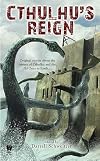
This new anthology of original work has a simple postulate - that Cthulhu and his monstrously indifferent hordes have arrived and that humanity has to die or survive in their midst.
After that, the writers have been left to their imaginations and, as you might expect, the results are highly variable, crossing genres and even the two traditions of the mythos (orthodox Lovecraftian and heterodox, and tainted to us purists, Derlethian).
The best are short and keep to the essence of Lovecraft - a show more sense of unease or cosmic horror at the world turned upside down and a hint of psychological states that are mad in form but real in content. There is a fair anount of the visceral but none of the writers over-indulge and the one that is most brutal in this respect (Ian Watson's) is fully justified by the story line.
Watson's has a pure Lovecraftian title, 'The Walker in the Cemetery' and others of this quality include contributions by Mike Allen with his psychological nightmare 'Her Acres of Pastoral Playground' as well as a tale of true spiritual horror that will unnerve anyone with faith in religion in Will Murray's 'What Brings The Void'.
There is a bleak but thought-provoking tale of mutating human resistance in the cracks of the new world from Jay Lake in 'Such Bright and Risen Madness in Our Names' and a work of true imaginative cosmic horror in 'The Holocaust of Ecstasy' from that old master Brian Stableford.
Indeed, only Stableford thinks his way with any depth into the Mythos, creating an extension of it that is a cogent update of Lovecraft's own vision, not dwelling on the horror of pain and suffering caused by the monsters but, like Will Murray, on the utter cold indifference of Lovecaft's creations to what we aspire to or want.
The underlying horror of the Mythos is that forces out there are not our enemy, we are just in the way. It is our projection of what we do to flies, wasps, slugs and cockroaches. 'As flies to wanton boys are we to the gods, they kill us for their sport' (King Lear).
Others are good enough anthology material - solid work by Don Webb that echoes Stephen King (a good mix of the two masters' styles in 'Sanctuary'), Matt Cardin's noble attempt to get inside the skin of a theologian of the new regime, a traditional tale that slips over the edge into acceptability from John R. Fultz and a jolly bit of adventure with no side to it from Gregory Frost.
Laird Barron's ambitious but ultimately over-written 'Vastation' gets an honourable mention for effort - this could be a seriously good book with some discipline but cannot be contained within a short story.
As a footnote, in a book with remarkably little contemporary commentary and thankfully no obvious fashionable eco-think, Don Webb neatly manages to bring the current and recent scandal of priestly paedophilia into play but the instinct of the writers is to make the stories highly personal and familial or get lost in Golden Age tropes or accept that the new world of Cthulhu can have little concern with the old and will present us with existential challenges that place our current concerns as trivial.
The interesting psychological aspect of the anthology is that, faced with radical cosmic horror, the story tellers tend to let the destruction of humanity be pictured like a Hollywood disaster movie and then move on, consciously or subconsciously, quickly and far away from the social towards family, buddy and individual responses.
The irony, of course, is that Cthulhu's indifference results in a form of Stirnerism in which individuals shrink back into their existential selves with concern only for the remnants immediately around them. Is this what would happen if Professor Hawking is right and the aliens that we may attract one day are powerful and malign? Are we not, after all, more like rats than ants?
On the other hand, a few writers (who I will have the good manners not to name) are prolix and obscure in that way that only some self-consciously literary Americans can be or are just plain lazy, predictable, obvious and dull while the closing 'hopeful' Derlethian space opera (well hopeful, if the billions that currently make up the human race survives as a boy, an autistic girl, a tired mum and a dog, all of course from an American professorial family), which I hope was written in ironically pedestrian style with a deliberate lack of imagination, should not be in there at all. The least interesting always seem to be the longest tales.
In other words, like all new and original anthologies, it is a mix of talent with diamonds amongst the rough. Recommended for hard line Cthulhu addicts but the rest of humanity may be puzzled by the in-references or depressed by the sheer hopelessness of much of the best content. show less
After that, the writers have been left to their imaginations and, as you might expect, the results are highly variable, crossing genres and even the two traditions of the mythos (orthodox Lovecraftian and heterodox, and tainted to us purists, Derlethian).
The best are short and keep to the essence of Lovecraft - a show more sense of unease or cosmic horror at the world turned upside down and a hint of psychological states that are mad in form but real in content. There is a fair anount of the visceral but none of the writers over-indulge and the one that is most brutal in this respect (Ian Watson's) is fully justified by the story line.
Watson's has a pure Lovecraftian title, 'The Walker in the Cemetery' and others of this quality include contributions by Mike Allen with his psychological nightmare 'Her Acres of Pastoral Playground' as well as a tale of true spiritual horror that will unnerve anyone with faith in religion in Will Murray's 'What Brings The Void'.
There is a bleak but thought-provoking tale of mutating human resistance in the cracks of the new world from Jay Lake in 'Such Bright and Risen Madness in Our Names' and a work of true imaginative cosmic horror in 'The Holocaust of Ecstasy' from that old master Brian Stableford.
Indeed, only Stableford thinks his way with any depth into the Mythos, creating an extension of it that is a cogent update of Lovecraft's own vision, not dwelling on the horror of pain and suffering caused by the monsters but, like Will Murray, on the utter cold indifference of Lovecaft's creations to what we aspire to or want.
The underlying horror of the Mythos is that forces out there are not our enemy, we are just in the way. It is our projection of what we do to flies, wasps, slugs and cockroaches. 'As flies to wanton boys are we to the gods, they kill us for their sport' (King Lear).
Others are good enough anthology material - solid work by Don Webb that echoes Stephen King (a good mix of the two masters' styles in 'Sanctuary'), Matt Cardin's noble attempt to get inside the skin of a theologian of the new regime, a traditional tale that slips over the edge into acceptability from John R. Fultz and a jolly bit of adventure with no side to it from Gregory Frost.
Laird Barron's ambitious but ultimately over-written 'Vastation' gets an honourable mention for effort - this could be a seriously good book with some discipline but cannot be contained within a short story.
As a footnote, in a book with remarkably little contemporary commentary and thankfully no obvious fashionable eco-think, Don Webb neatly manages to bring the current and recent scandal of priestly paedophilia into play but the instinct of the writers is to make the stories highly personal and familial or get lost in Golden Age tropes or accept that the new world of Cthulhu can have little concern with the old and will present us with existential challenges that place our current concerns as trivial.
The interesting psychological aspect of the anthology is that, faced with radical cosmic horror, the story tellers tend to let the destruction of humanity be pictured like a Hollywood disaster movie and then move on, consciously or subconsciously, quickly and far away from the social towards family, buddy and individual responses.
The irony, of course, is that Cthulhu's indifference results in a form of Stirnerism in which individuals shrink back into their existential selves with concern only for the remnants immediately around them. Is this what would happen if Professor Hawking is right and the aliens that we may attract one day are powerful and malign? Are we not, after all, more like rats than ants?
On the other hand, a few writers (who I will have the good manners not to name) are prolix and obscure in that way that only some self-consciously literary Americans can be or are just plain lazy, predictable, obvious and dull while the closing 'hopeful' Derlethian space opera (well hopeful, if the billions that currently make up the human race survives as a boy, an autistic girl, a tired mum and a dog, all of course from an American professorial family), which I hope was written in ironically pedestrian style with a deliberate lack of imagination, should not be in there at all. The least interesting always seem to be the longest tales.
In other words, like all new and original anthologies, it is a mix of talent with diamonds amongst the rough. Recommended for hard line Cthulhu addicts but the rest of humanity may be puzzled by the in-references or depressed by the sheer hopelessness of much of the best content. show less

As one among innumerable collections of Lovecraftian short fiction, a couple of features distinguish the recent Cthulhu's Reign. First, all of the stories are new, evidently commissioned for this volume, with none garnered from zines and prior anthologies. Second, the unusual theme that they share is that of the Cthulhoid eschaton accomplished: the stars have been right, and humanity's domination of Earth is over and done with.
There are a total of fifteen stories, each by a different show more author. Most of them don't venture too far beyond the return of our alien landlords; only in a couple instances does the narrative comprehend events that follow the end of our history by more than a single generation of dispossessed humans. In at least a few cases, the packaging seems to work against the content--that is to say, the story might have had more dramatic force if the reader hadn't come to it already informed that the setting was "an Earth ruled by Cthulhu, or his minions (or even his enemies)" (per Schweitzer's introduction, 6). All of them show a distinct level of creativity beyond the ordinary Lovecraft pastiche. After all, while the wholesale return of the Old Ones is an invariable element of the mythos, HPL only actualized it in narrative once, in the brief, dream-inspired "Nyarlathotep" (1920).
The stories that do go further into the future than the immediate aftermath of the Old Ones' return are certainly the most exotic. I liked the surreal solipsism of Laird Barron's "Vastation," and Brian Stableford offers piquant food for thought (or is it thought for food?) in "The Holocaust of Ecstasy." In other standouts among the generally high-quality selections, I appreciated the well-informed Central Texas setting of "Sanctuary," as well as its wry blasphemous features that were surely imperative in a story written by Don Webb and dedicated to Robert Price. The most overtly theological entry is "The New Pauline Corpus" by Matt Cardin, which demonstrates even better than Webb's story how adaptable the human religious attitude really is. More pedestrian Cthulhu cultists feature in "Ghost Dancing" by the volume's editor, and in "The Seals of New R'lyeh" by Gregory Frost. The last couple of stories, "Nothing Personal" by Richard A. Lupoff and "Remnants" by Fred Chappell, both expand the context to an interplanetary scale, and tip the genre strongly toward science fiction.
The experience of reading these tales over the course of a week or so brought into relief for me the background sense of recent cataclysm that seems to be part of early 21st-century life, whether it's the 9-11-2001 events, hurricane Katrina, the Deepwater Horizon catastrophe, or the flood of Pakistan, it seems like the world has always just gone to hell. At one point, someone mentioned Houston in conversation, and I found myself mentally groping for the horrible event that had just befallen that city, before realizing with some relief that it was merely a passage from Cthulhu's Reign that I had mentally misfiled too closely to "fact." show less
There are a total of fifteen stories, each by a different show more author. Most of them don't venture too far beyond the return of our alien landlords; only in a couple instances does the narrative comprehend events that follow the end of our history by more than a single generation of dispossessed humans. In at least a few cases, the packaging seems to work against the content--that is to say, the story might have had more dramatic force if the reader hadn't come to it already informed that the setting was "an Earth ruled by Cthulhu, or his minions (or even his enemies)" (per Schweitzer's introduction, 6). All of them show a distinct level of creativity beyond the ordinary Lovecraft pastiche. After all, while the wholesale return of the Old Ones is an invariable element of the mythos, HPL only actualized it in narrative once, in the brief, dream-inspired "Nyarlathotep" (1920).
The stories that do go further into the future than the immediate aftermath of the Old Ones' return are certainly the most exotic. I liked the surreal solipsism of Laird Barron's "Vastation," and Brian Stableford offers piquant food for thought (or is it thought for food?) in "The Holocaust of Ecstasy." In other standouts among the generally high-quality selections, I appreciated the well-informed Central Texas setting of "Sanctuary," as well as its wry blasphemous features that were surely imperative in a story written by Don Webb and dedicated to Robert Price. The most overtly theological entry is "The New Pauline Corpus" by Matt Cardin, which demonstrates even better than Webb's story how adaptable the human religious attitude really is. More pedestrian Cthulhu cultists feature in "Ghost Dancing" by the volume's editor, and in "The Seals of New R'lyeh" by Gregory Frost. The last couple of stories, "Nothing Personal" by Richard A. Lupoff and "Remnants" by Fred Chappell, both expand the context to an interplanetary scale, and tip the genre strongly toward science fiction.
The experience of reading these tales over the course of a week or so brought into relief for me the background sense of recent cataclysm that seems to be part of early 21st-century life, whether it's the 9-11-2001 events, hurricane Katrina, the Deepwater Horizon catastrophe, or the flood of Pakistan, it seems like the world has always just gone to hell. At one point, someone mentioned Houston in conversation, and I found myself mentally groping for the horrible event that had just befallen that city, before realizing with some relief that it was merely a passage from Cthulhu's Reign that I had mentally misfiled too closely to "fact." show less
A lot of Lovecraftian pastiches deal, like HPL's stories themselves, with the discovery of a dreadful thing that is about to happen, or is narrowly averted, or with a terrible fate that overtakes the solitary narrator.
What if the dreadful thing has already happened? What if the terrible fate has overtaken the world. That's the approach of this collection of stories, which offer fifteen views of life after the stars have gotten right, Cthulhu has risen, and the coming of the Old Ones has show more changed everything. Not, I need hardly say, for the better.
A few of the stories here are standouts for originality of vision, great writing, or both. I particularly like Ian Watson's "The Walker in the Cemetery," Gregory Frost's "The Seals of New R'lyeh," and Laird Barron's "Vastation." show less
What if the dreadful thing has already happened? What if the terrible fate has overtaken the world. That's the approach of this collection of stories, which offer fifteen views of life after the stars have gotten right, Cthulhu has risen, and the coming of the Old Ones has show more changed everything. Not, I need hardly say, for the better.
A few of the stories here are standouts for originality of vision, great writing, or both. I particularly like Ian Watson's "The Walker in the Cemetery," Gregory Frost's "The Seals of New R'lyeh," and Laird Barron's "Vastation." show less
Lists
Awards


You May Also Like


Associated Authors
Statistics
- Works
- 189
- Also by
- 143
- Members
- 2,213
- Popularity
- #11,588
- Rating
- 3.6
- Reviews
- 40
- ISBNs
- 177
- Languages
- 3
- Favorited
- 4

