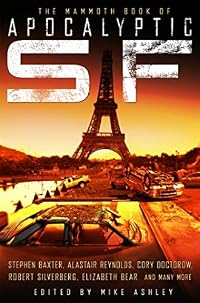
The Mammoth Book of Apocalyptic SF
by Mike Ashley (Editor)
On This Page
Description
The last sixty years have been full of stories of one or other possible Armageddon, whether by nuclear war, plague, cosmic catastrophe or, more recently, global warming, terrorism, genetic engineering, AIDS and other pandemics. These stories, both pre- and post-apocalyptic, describe the fall of civilization, the destruction of the entire Earth, or the end of the Universe itself. Many of the stories reflect on humankind's infinite capacity for self-destruction, but the stories are by no means show more all downbeat or depressing - one key theme explores what the aftermath of a cataclysm might be and how humans strive to survive. show lessTags
Recommendations

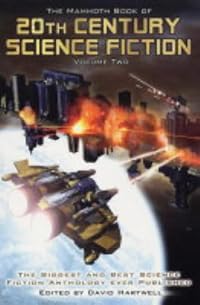
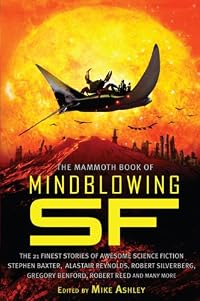
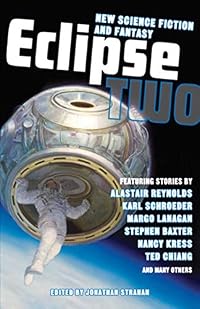
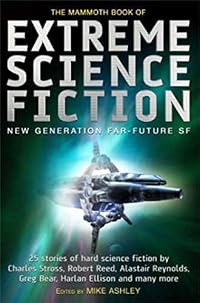








Member Recommendations
Member Reviews
This is rather a disappointing collection. I found it hard to recommend a single story as a must-read. The few famous names appear to have produced relative pot-boilers although I liked Alastair Reynolds gritty contribution in 'Sleepover'. One or two of the rest are downright dull or silly.
What I found interesting was the sharp decline in quality between the first half, about the fact of apocalypse if you like, and the second half which was supposed to be more about what happened to the human race after it had happened.
Perhaps writers can somehow feed into the excitement and adventure of collapse and actual break-down but have greater difficulty in imagining the reality of life when humanity has been deprived of much of its social and show more material support structure.
A world like that of Cormac McCarthy's 'The Road' will have very little science in it and the fiction is likely to come down to describing a degradation of human complexity under conditions of survival.
There is also too much parochial Middle American angst in this volume to satisfy anyone outside that closed culture.
In this context, what was striking was how no writer appeared to get to grips with perhaps the most dramatic theoretical models for post-apocalyptic survival - the trans-human and the post-human. Intellectual circles are full of this for good or ill but not these writers.
Too many writers seemed stuck in the meme of climate change which, bluntly, might be fascinating to the more New Age type of Western political activist but is utterly boring to those of us who are far more interested in our species than in a somewhat abstract view of the planet's fate.
Many of these stories are already looking dated after only two years. The only writer who seems to come to terms with the real ideological struggle in the West – between ‘conservative’ transcendentalists looking to the past and forward-looking trans-humanists – is Paul di Fillipo.
His story – ‘Life in the Anthropocene’ – is not great but at least, with some irony and dark humour, he makes an attempt to play with the main intellectual themes of our time, with the ‘ordinary bloke’ caught between two types of fanatic much as most of us are.
The book is weak not because of poor editing – though I suspect Mike Ashley may have been a bit indulgent and not ruthless enough with some of his commissions – but because science fiction itself may be in crisis: well over half come from this century.
But the disappointment is not absolute – if you start on the basis of not expecting too much then there is stimulation to be found even if one or two stories result in a barely stifled yawn.
What would I recommend? I have praised Alastair Reynolds deeply dystopian ‘Sleepover’ and there was merit in Dominic Green’s ‘The Clockwork Atomic Bomb’ which sent a shiver down the spine at how failed state disorder and high weapons science might create a world permanently on the edge.
Cory Doctorow’s ‘When Sysdamins Ruled the Earth’ is just a daft nerd’s wet dream, but, though not science fiction at all, more the sort of transcendentalist allegory which I usually loathe, Linda Nagata’s ‘The Flood’ has a certain magic to it.
David Barnett’s ‘End of the World Show’ has a very British wry detached humour, although it has to be said that the SF style that tries to be funny and detached about serious matters becomes a little tiresome before too long.
There is something lazy about this style as if the social critic refuses to think in any depth about what he is trying to satirize. There are two or three examples in the book and only Barnett’s really amuses. One of them is almost unreadable in its attempted literary cleverness.
Frederick Pohl’s ‘Fermi and Frost’ is compassionate and grim but not in the first rank but I liked Kage Baker’s ‘The Books'. It was that rather rare thing in this volume, optimistic as well as charming and compassionate. I hope Baker gets the chance to develop the tale in a book one day.
I won’t moan about the weak or portentous ones or the ones that seem too dated or the obscure ones or the well written ones that went nowhere. I suppose it is hard to complain about anything by Fritz Leiber – he pulls off a bit of scientific nonsense in a ‘Pail of Air’ as only he could.
A last comment is left in praise of F. Gwynplaine MacIntyre’s ‘World Without End’ which postulates what might happen to someone who can’t die as the world dies. The story is not a complete success but this writer captures the post-apocalyptic human condition in a unique way and I recommend it.
His not-very-bright loser heroine is a clever invention – other writers like to have scientists and middle class people all at sea for their apocalypse but MacIntyre has been wiser.
An apocalypse is unlikely to spare those who think they deserve to survive – his heroine stands for the common humanity that most college-educated SF writers systematically and arrogantly ignore. Indeed. this book represents the crisis in SciFi.
Perhaps SciFi is in some sort of panic about its own relevance. It has become alternately excessively literary and wordy, excessively detached and ironic and excessively unthinking and ideological. It is a mere reflection of the déclassé educated middle class writer’s anxieties.
The best science fiction engages with humanity as humanity rather than seeking simply to ask how nice educated people will cope with change or else it centres itself on plausible investigation, not of too many ideas but one significant change and its effects.
That change could be dramatic – the arrival of aliens – but everything else remains solid and plausible in the reaction of the world to it.
Science fiction has forgotten the lessons of its master HG Wells, and it now pours out ideas and fantastic consequences in what can only be described as post-modern hysteria.
It is as if science fiction is desperate to get attention when it is probably only a matter of too many writers chasing too few opportunities to be published and getting desperate to be noticed.
Whether for this reason or its lack of engagement with the human condition, this volume is not bad but it is not good either. show less
What I found interesting was the sharp decline in quality between the first half, about the fact of apocalypse if you like, and the second half which was supposed to be more about what happened to the human race after it had happened.
Perhaps writers can somehow feed into the excitement and adventure of collapse and actual break-down but have greater difficulty in imagining the reality of life when humanity has been deprived of much of its social and show more material support structure.
A world like that of Cormac McCarthy's 'The Road' will have very little science in it and the fiction is likely to come down to describing a degradation of human complexity under conditions of survival.
There is also too much parochial Middle American angst in this volume to satisfy anyone outside that closed culture.
In this context, what was striking was how no writer appeared to get to grips with perhaps the most dramatic theoretical models for post-apocalyptic survival - the trans-human and the post-human. Intellectual circles are full of this for good or ill but not these writers.
Too many writers seemed stuck in the meme of climate change which, bluntly, might be fascinating to the more New Age type of Western political activist but is utterly boring to those of us who are far more interested in our species than in a somewhat abstract view of the planet's fate.
Many of these stories are already looking dated after only two years. The only writer who seems to come to terms with the real ideological struggle in the West – between ‘conservative’ transcendentalists looking to the past and forward-looking trans-humanists – is Paul di Fillipo.
His story – ‘Life in the Anthropocene’ – is not great but at least, with some irony and dark humour, he makes an attempt to play with the main intellectual themes of our time, with the ‘ordinary bloke’ caught between two types of fanatic much as most of us are.
The book is weak not because of poor editing – though I suspect Mike Ashley may have been a bit indulgent and not ruthless enough with some of his commissions – but because science fiction itself may be in crisis: well over half come from this century.
But the disappointment is not absolute – if you start on the basis of not expecting too much then there is stimulation to be found even if one or two stories result in a barely stifled yawn.
What would I recommend? I have praised Alastair Reynolds deeply dystopian ‘Sleepover’ and there was merit in Dominic Green’s ‘The Clockwork Atomic Bomb’ which sent a shiver down the spine at how failed state disorder and high weapons science might create a world permanently on the edge.
Cory Doctorow’s ‘When Sysdamins Ruled the Earth’ is just a daft nerd’s wet dream, but, though not science fiction at all, more the sort of transcendentalist allegory which I usually loathe, Linda Nagata’s ‘The Flood’ has a certain magic to it.
David Barnett’s ‘End of the World Show’ has a very British wry detached humour, although it has to be said that the SF style that tries to be funny and detached about serious matters becomes a little tiresome before too long.
There is something lazy about this style as if the social critic refuses to think in any depth about what he is trying to satirize. There are two or three examples in the book and only Barnett’s really amuses. One of them is almost unreadable in its attempted literary cleverness.
Frederick Pohl’s ‘Fermi and Frost’ is compassionate and grim but not in the first rank but I liked Kage Baker’s ‘The Books'. It was that rather rare thing in this volume, optimistic as well as charming and compassionate. I hope Baker gets the chance to develop the tale in a book one day.
I won’t moan about the weak or portentous ones or the ones that seem too dated or the obscure ones or the well written ones that went nowhere. I suppose it is hard to complain about anything by Fritz Leiber – he pulls off a bit of scientific nonsense in a ‘Pail of Air’ as only he could.
A last comment is left in praise of F. Gwynplaine MacIntyre’s ‘World Without End’ which postulates what might happen to someone who can’t die as the world dies. The story is not a complete success but this writer captures the post-apocalyptic human condition in a unique way and I recommend it.
His not-very-bright loser heroine is a clever invention – other writers like to have scientists and middle class people all at sea for their apocalypse but MacIntyre has been wiser.
An apocalypse is unlikely to spare those who think they deserve to survive – his heroine stands for the common humanity that most college-educated SF writers systematically and arrogantly ignore. Indeed. this book represents the crisis in SciFi.
Perhaps SciFi is in some sort of panic about its own relevance. It has become alternately excessively literary and wordy, excessively detached and ironic and excessively unthinking and ideological. It is a mere reflection of the déclassé educated middle class writer’s anxieties.
The best science fiction engages with humanity as humanity rather than seeking simply to ask how nice educated people will cope with change or else it centres itself on plausible investigation, not of too many ideas but one significant change and its effects.
That change could be dramatic – the arrival of aliens – but everything else remains solid and plausible in the reaction of the world to it.
Science fiction has forgotten the lessons of its master HG Wells, and it now pours out ideas and fantastic consequences in what can only be described as post-modern hysteria.
It is as if science fiction is desperate to get attention when it is probably only a matter of too many writers chasing too few opportunities to be published and getting desperate to be noticed.
Whether for this reason or its lack of engagement with the human condition, this volume is not bad but it is not good either. show less
This is a collection of science fiction short stories linked by a common theme - how will civilisation, humanity, the Earth end? There are 24 stories, only 9 written before the year 2000 and 4 of those written before 1990. Perhaps the apocalypse is more popular nowadays. There is a good mix of authors, both familiar and new to me.
That there will be an end is inevitable, whether it is the ever-looming personal end of death, the end of our particular civilisation, the end perhaps through evolution of the human race and ultimately the end of our environment with the death of the Sun and the ultimate end of the Universe. The interest is in the different approaches to these events. In this collection I detect two distinct strands of show more thought.
Firstly, that the end is a good thing and a welcome relief. The most prominent idea here is that we are all so jolly beastly that our ending is a good thing for all concerned. A lesser thread through this collection is that we become debased as a penance for past sins - hubris, arrogance, ignorance - and continue as a race, but with all our best times and greatest achievements in the past.
Secondly, there is a group of stories here that give a sense of hope through continuity. Yes, people will die and civilisations will rise and fall, but the essence of the Universe will continue, enriched, perhaps, by our particular contribution to it. Evolution may alter the balance of life and geologic time may alter the very ground we walk on, but something remains and carries on.
My favourite story? ‘Guardians of the Phoenix’ by Eric Brown. show less
That there will be an end is inevitable, whether it is the ever-looming personal end of death, the end of our particular civilisation, the end perhaps through evolution of the human race and ultimately the end of our environment with the death of the Sun and the ultimate end of the Universe. The interest is in the different approaches to these events. In this collection I detect two distinct strands of show more thought.
Firstly, that the end is a good thing and a welcome relief. The most prominent idea here is that we are all so jolly beastly that our ending is a good thing for all concerned. A lesser thread through this collection is that we become debased as a penance for past sins - hubris, arrogance, ignorance - and continue as a race, but with all our best times and greatest achievements in the past.
Secondly, there is a group of stories here that give a sense of hope through continuity. Yes, people will die and civilisations will rise and fall, but the essence of the Universe will continue, enriched, perhaps, by our particular contribution to it. Evolution may alter the balance of life and geologic time may alter the very ground we walk on, but something remains and carries on.
My favourite story? ‘Guardians of the Phoenix’ by Eric Brown. show less
I was hoping for survival stories against the odds, society breakdown, firearms, ravaging gangs and smoke on the horizon, instead I got a lot of mediocre science fiction. This is not post apocolyptic SF but rather SF that has "apocalypse " in the title only. Some of these stories are readable, but the majority are not. Avoid.
Most of the stories were interesting with a few memorable ones and one or two that I just skipped, overall good enough to buy another one in this series.
The Mammoth Book of the End of the World is an anthology compiled by Mike Ashley. All in all, it is a good collection of stories. My favorites:
* The Clockwork Atom Bomb by Dominic Green: In the near future where the world is falling apart, an inspector checks on some hot bombs in a suburb in Africa.
* Bloodletting by Kate Wilhelm: Very chilling story about a woman whose husband is responsible for creating a deadly plague.
* When Sysadmins Ruled the World by Cory Doctorow: Good, fun story about network administrators who survive a plague because they are in the controlled environment of server rooms.
* Fermi and Frost by Frederick Pohl. A scientist and a boy survive a nuclear winter in Iceland, one of the only places on earth prepared for show more dealing with cold.
* Sleepover by Alastair Reynolds is a fascinating story about a man woken up from a cryogenic sleep to a new world.
* Pallbearer by Robert Reed is a very interesting story about a non believer who lives near a small, religious community in a world a few generations after a plague.
* And the Deep Blue Sea by Elizabeth Bear is about a motorcyclist delivery girl who transverses a desolate world to deliver mail.
* The Man Who Walked Home by James TiptreeJr. is about a apparition that appears over the centuries in a post-apocalyptic world, and the advanced civilization that finally works out what is occurring.
* A Pail of Air by Fritz Leiber. Great story about a small family that survive a cataclysm by living in a "Nest" and discover after many years hat they are not alone.
* Guardians of the Phoenix by Eric Brown takes place in a "mad max" world, where a small team of survivors battle the elements (and other survivors) in search of water.
* Terraforming Terra by Jack Williamson is a very fascinating story about clones sent to the moon to wait, and occasionally be reborn, to repopulate the earth after an asteroid hits & destroys the earth.
* A Star Called Wormwood by Elizabeth Counihan is about the last man in the world. He is surrounded by intelligent, genetically altered animals and uses glass to create beautiful music. show less
* The Clockwork Atom Bomb by Dominic Green: In the near future where the world is falling apart, an inspector checks on some hot bombs in a suburb in Africa.
* Bloodletting by Kate Wilhelm: Very chilling story about a woman whose husband is responsible for creating a deadly plague.
* When Sysadmins Ruled the World by Cory Doctorow: Good, fun story about network administrators who survive a plague because they are in the controlled environment of server rooms.
* Fermi and Frost by Frederick Pohl. A scientist and a boy survive a nuclear winter in Iceland, one of the only places on earth prepared for show more dealing with cold.
* Sleepover by Alastair Reynolds is a fascinating story about a man woken up from a cryogenic sleep to a new world.
* Pallbearer by Robert Reed is a very interesting story about a non believer who lives near a small, religious community in a world a few generations after a plague.
* And the Deep Blue Sea by Elizabeth Bear is about a motorcyclist delivery girl who transverses a desolate world to deliver mail.
* The Man Who Walked Home by James TiptreeJr. is about a apparition that appears over the centuries in a post-apocalyptic world, and the advanced civilization that finally works out what is occurring.
* A Pail of Air by Fritz Leiber. Great story about a small family that survive a cataclysm by living in a "Nest" and discover after many years hat they are not alone.
* Guardians of the Phoenix by Eric Brown takes place in a "mad max" world, where a small team of survivors battle the elements (and other survivors) in search of water.
* Terraforming Terra by Jack Williamson is a very fascinating story about clones sent to the moon to wait, and occasionally be reborn, to repopulate the earth after an asteroid hits & destroys the earth.
* A Star Called Wormwood by Elizabeth Counihan is about the last man in the world. He is surrounded by intelligent, genetically altered animals and uses glass to create beautiful music. show less
some very good stuff, but some so-so
Ratings
Members
- Recently Added By
Lists

Short story anthologies
19 works; 3 members
Author Information

Mike Ashley has specialized in the history of science fiction and fantasy for more than 30 years. He is the author and editor of over a hundred books that in total have sold over a million copies worldwide.
All Editions
Some Editions
Series
Belongs to Publisher Series
Mammoth Books (Mammoth Books 161)
Work Relationships
Common Knowledge
- Original publication date
- 2010
- First words
- We seem to have a fascination for the Apocalypse, the end of all things.
- Last words
- (Click to show. Warning: May contain spoilers.)"What?" they whispered. "Why?"
Classifications
- Genres
- Fiction and Literature, Science Fiction, Horror
- DDC/MDS
- 823.08762080914 — Literature & rhetoric English & Old English literatures English fiction By type Genre fiction Adventure fiction Speculative fiction Science fiction Collections and anthologies Collections Modern period 20th century 1900–2000
- LCC
- PR1309 .S3 .M358 — Language and Literature English English Literature Collections of English literature
- BISAC
Statistics
- Members
- 255
- Popularity
- 126,601
- Reviews
- 6
- Rating
- (3.55)
- Languages
- English
- Media
- Paper, Ebook
- ISBNs
- 3
- ASINs
- 3