
John R. Trimble
Author of Writing With Style: Conversations on the Art of Writing
About the Author
Works by John R. Trimble
Editing Your Own Prose 1 copy
Tagged
Common Knowledge
Members
Reviews
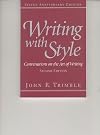
Writing with Style has been around for almost 35 years, but this Silver Anniversary edition remains relevant and fresh. Trimble teaches concise lessons, replete with examples, in thinking well, readability, punctuation, quoting, and so on. In the opening chapter, he establishes an appealing thesis: a novice writer, unaware of the social implications of what he's doing, writes unconsciously, "like a person who turns his chair away from the
listener[and] mumbles at length to the wall." A show more thoughtful writer, on the other hand, draws upon objectivity, empathy, and courtesy, because he knows that "good writing is good manners." show less
listener[and] mumbles at length to the wall." A show more thoughtful writer, on the other hand, draws upon objectivity, empathy, and courtesy, because he knows that "good writing is good manners." show less
Excellent little book that I can't really recommend highly enough. A joy to read because it really is written conversationally--this is not mere book jacket blurb. It's as if Trimble is across the table from you in your kitchen helping you think about writing. If you find Strunk & White to be dry as dust and other writing books too technical in nature you'll find this very worthwhile.
This is one of the best books I've read about writing. Unfortunately, I disagree with Trimble's endorsement of foul language. He evidently thinks profanity can make writers more expressive and "raw," and quotes other famous writers who use it unapologetically.
But foul language is inappropriate in any context (Prov. 4:24, 17:20, 19:1; Matt. 5:21-22, 15:11, 16-20; Ecc. 5:6; Eph. 4:29, 31-32; Col. 3:8; James 3:5-12). Rather than making him more sophisticated, refined, or expressive, foul show more language makes the writer look vulgar, intemperate, and dumb. It reveals that he lacks either the sense, the prudence, or the restraint needed for refining his language. show less
But foul language is inappropriate in any context (Prov. 4:24, 17:20, 19:1; Matt. 5:21-22, 15:11, 16-20; Ecc. 5:6; Eph. 4:29, 31-32; Col. 3:8; James 3:5-12). Rather than making him more sophisticated, refined, or expressive, foul show more language makes the writer look vulgar, intemperate, and dumb. It reveals that he lacks either the sense, the prudence, or the restraint needed for refining his language. show less

I enjoyed reading Writing With Style but I'm at a loss to understand why, especially since many parts of it weren't particularly helpful to me.
Two-thirds of the book deals with college (or perhaps advanced high-school) students writing essays. None of the examples branch out into workplace memos or reports, or even fiction writing. Certainly, the tips given can absolutely be expanded to those sorts of writing projects, but this book doesn't mention that.
Much of the discussion relates to one show more of the "fundamental" rules he gives: "Tinker to get the words right." But this is often an impossibility, especially for beginners. It's similar to when I tried -- and failed -- to learn how to drive stick-shift. There's a particular "feeling" you get when you know exactly when to shift to another gear -- but you can only obtain that knowledge after much practice. Likewise, it's hard for beginning writers to know "that sounds good" at first, because they just don't have the feel for what should sound good.
The final third of the book offers rules of grammar and punctuation. The rules given are quite clear, but there are too few examples, and no skill sets to practice with. (Thanks, Trimble; Fowler would have made me say there are no skill sets with which to practice.)
Ultimately, this is a strange little book. It's clearly meant for college-level composition classes, yet it doesn't offer any essay questions or workbook-style practices. It's still a very good read for any type of writer because it does contain many valuable tips, and it's short enough that non-college-age readers won't mind the academic focus.
----------------------
LT Haiku:
"Books on writing tend
to be windy [and] boring":
This one is different! show less
Two-thirds of the book deals with college (or perhaps advanced high-school) students writing essays. None of the examples branch out into workplace memos or reports, or even fiction writing. Certainly, the tips given can absolutely be expanded to those sorts of writing projects, but this book doesn't mention that.
Much of the discussion relates to one show more of the "fundamental" rules he gives: "Tinker to get the words right." But this is often an impossibility, especially for beginners. It's similar to when I tried -- and failed -- to learn how to drive stick-shift. There's a particular "feeling" you get when you know exactly when to shift to another gear -- but you can only obtain that knowledge after much practice. Likewise, it's hard for beginning writers to know "that sounds good" at first, because they just don't have the feel for what should sound good.
The final third of the book offers rules of grammar and punctuation. The rules given are quite clear, but there are too few examples, and no skill sets to practice with. (Thanks, Trimble; Fowler would have made me say there are no skill sets with which to practice.)
Ultimately, this is a strange little book. It's clearly meant for college-level composition classes, yet it doesn't offer any essay questions or workbook-style practices. It's still a very good read for any type of writer because it does contain many valuable tips, and it's short enough that non-college-age readers won't mind the academic focus.
----------------------
LT Haiku:
"Books on writing tend
to be windy [and] boring":
This one is different! show less
Lists
You May Also Like


Statistics
- Works
- 2
- Members
- 752
- Popularity
- #33,828
- Rating
- 4.0
- Reviews
- 10
- ISBNs
- 5