
Ágota Kristóf (1935–2011)
Author of The Notebook; The Proof; The Third Lie
About the Author
Series
Works by Ágota Kristóf
Associated Works
Tagged
Common Knowledge
- Canonical name
- Kristóf, Ágota
- Legal name
- Kristóf Ágota [Hungarian word order]
- Birthdate
- 1935-10-30
- Date of death
- 2011-07-27
- Gender
- female
- Occupations
- author
- Awards and honors
- Gottfried Keller Preis (2001)
Austrian State Prize for European Literature (2008) - Nationality
- Hungary
- Birthplace
- Csikvánd, Hungary
- Places of residence
- Csikvánd, Hungary
Neuchâtel, Neuchâtel, Switzerland - Place of death
- Neuchâtel, Neuchâtel, Switzerland
- Associated Place (for map)
- Neuchâtel, Neuchâtel, Switzerland
Members
Reviews
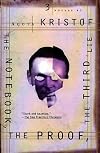
Toughening exercises....resistance....a composition.
War.....mortal solitude.....a composition
Love....objectivity.....a composition.
Truth.....lies....a composition.
Words.....immortality.....a composition.
The sharpened graphite moves silently in the dark attic on naive white paper sheets, reciting nightmarish trepidation. Every thought, every word emitting a chaotic soul finds refuge in the scribbling of the graphite. Amid the sirens of an air raid, it moves zealously. New pages are explored show more as the skeletons swing to the sad tunes of a harmonica like couple of wind chimes. It does not fear the stomping of the soldiers, the shots of a rifle, the abuse of an old lady. The pencil is fearless. It seeks truth, it endures lies. It keeps on moving even as agonizing cries of a rape fills the air, as pigs grunt to the sight of a shimmering knife and fresh graves are born under the vegetable beds in the garden. The pencil writes the darkest desires, the chaos of solitude. As the houses are destroyed, streets get vacant; the notebook overflows. While Harelip embraces the dog on her bare skin; Lucas writes. Claus writes. As Clara embraces Thomas; Lucas writes. Young Mathias writes too. Victor wants to write. To the sound of the detective movie Klaus . T. writes. Writing helps. Words release the excruciating pain that does not find a listening ear or an obliging mouth.
She says, “Yes. There are lives sadder than the saddest of books.”
I say, “Yes. No book, no matter how sad, can be as sad as life
It is the universal truth; nobody wants a war. Wars begin on a lie. It further creates a complex mesh of lies. The lies then slowly seep into the innocent lives and become a concrete part of the living. Wars arise from the world of Utopian delusions. People live in a deluded world that the war has gifted them. If a war is commenced to bring happiness to the land, then why does the land become a grave to happiness. Lives that find death cruel for being denied the frosty embrace, plead other lives to bless them with death. To ask a life to release another life is not the liberation that a war should seek. Kristof with her lucid text makes it crystal clear, that a war- torn land can be reconstructed and restored to normality; as if it has been untouched by conflict. Sadly, it is the shattered lives that do not get the respected privilege. The wounds of the war breathe with the people as long as they live, which at times can seem forever. The war may restore the buildings, but it cannot restore the dead. Laws can exonerate the innocent lives that were executed. But, can it restore Clara’s grey hair to its original sheen? Can the war restore the lost youth that it ravenously swallowed? The only gifts that war ever bestows on the privileged citizens are the art to kill and an impassive life, dwelling in the abyss of mortal solitude. Lucas/Claus knew the exact precision of killing a life. War had taught them the skill. At times, they would offer a vulnerable life the gift of death; if one mercifully begged. It was not something they sought to do, but absolutely needed to do. The brothers had triumphed over every aspect of pain, be it heat, hunger, cold or anything that causes soreness. They never cried even when their grandmother abused them or people in the streets heckled them with tortuous condemnations. They could defend themselves just as they defended Harelip. The war had taught them. The war had become their school. Mathias did not cry either. The war had taught him too. Kristof meticulously brings a world where one is fortunate to glimpse the next sunrise or the magical sunset. People do things not because they desire to; it is absolutely needed to. A place where nauseated absurdities thrive in normality. A place where humanity wanes in a treacherous barter system.
"Two or three hundred of them pass by, flanked by soldiers. A few women are carrying small children on their backs, or cradled against their breasts. One of them falls; hands reach out to catch the child and the mother; they must be carried, because a soldier has already pointed his rifle at them."
Kristof’s trilogy which begins with the twins arriving at their Grandmother’s house in Little Town, is a war in itself. Alongside the periphery of the country’s war, each of Kristof’s characters is a casualty of a simmering private war. The atrocity of the external war trickles down bringing an internal chaotic conundrum. Fear and grief become the only recognizable sentiments. For some of the characters the war had begun much before their country knelt to the brutal conflict. Lucas becomes an integral part in this trilogy. His life explores the inconsistent terrains of war, communist acquisitions, counter-revolution and later on the capitalist environments. It is evident when later Claus confirms the doubts by declaring, “It is a society based on money. No place for questions on life." Although, Lucas is an interesting character; it was the characterization of Harelip, Mathias and the ‘Officer’ that intrigued me the most. Harelip’s desperation of finding love ; Mathias struggle to find a place in “societal regularity” and the isolation of the Officer from his asphyxiated love , made me ponder on whether if given a chance would they hold a placard pronouncing , “Don’t come in the world of mine.”
Akin to her characters, Kristof’s prose if simple yet convoluted. Maybe, even equating to the onset of a war. Eventually, a war finds its conclusion. A war victim never gets that privilege. A war creates heroes of men, but, has the war ever thought about the women and children who have been victims and will live in deathly solitude and eternal pain. As life progresses, memories may fade, pain may diminish, but it does not disappear. Are men the only heroes of the war? Kristof audaciously makes this point.
“It’s like an illness. A sort of illness of the soul.....excessive solitude”.
‘Mortal solitude’ becomes a major salient feature of the war. Kristof gives the ‘state of solitude’ a demonic personality. The desperation that stems from loneliness blurs the lines between fact and fiction. Truth and lies amalgamate into an obnoxious lattice of desire and loss. The dead are woken up by stubborn memories that never fade; sex becomes a lucrative trade in the ongoing barter system, forlorn emotions seek refuge in objective love; the panic of old wounds reopening and the skepticism over validity of the dead that are found everywhere and nowhere. It is in this curse of solitude that one seeks the comfort of a grave. --- “The best place to sleep was the grave of someone you have loved.”
Lucas, Claus, Victor and the others struggle to free themselves from the ugly depths of solitude; nonetheless it was only seclusion what they searched to write their nightmares. Peace was a rare commodity in their lives. Is death then a better option? As one of the twins says, “I tell him that life is totally useless, that it’s nonsense, an aberration, infinite suffering, and the invention on a non-God whose evil surpasses understanding."
All is not lost, as Kristof elucidates that beneath the ruthless layers of desperation, there lies the strongest bond of love which survives the atrocities of the war.
“Love is not a reliable word.......It lacks precision and objectivity.”
Kristof evaluates the idea of the so called “normality of love”. In the incongruous world of war could ‘normal love’ ever survive? All the characters in the book are in a frantic struggle to find love and be loved. The burgeoning solitude leads to the desperation of desiring a sense of belonging. With abandonment comes the wish for of a touch, an embrace; irrespective of the methods and act of achieving the idea of love. The pain of promiscuity, incest and at times even rape takes a backseat when it comes to being “loved”. Kristof compels you to question the normality of love. Who is to decide the regulations of love? Who is to define rationality of love? The soldier who rapes numerous women and goes home to a loving wife and a child? The men who fathered bastard children who were left at the orphanage? Or those who suffocate homosexuality? If you ask Victor or Lucas or Harelip or Clara or Yasmine or even the Officer who listened to the gramophone while desiring death, they may probably tell you that in the absurdities of love one seeks its normality, similarly as one seeks humanity in the inhumanity of the war.
“I’m convinced---that every human being is born to write a book......he who writes nothing is lost, he has merely pass through life without leaving a trace.”
Stories perish beside the bodies in the grave. While death justifies the treachery of life, it fails to recognize the agony of its journey; words are then needed bestow immortality. In this saga of love and separation, Kristof bequeaths the said honor to the lives of the anonymous war victims by immortalizing their plagued existence through her genuine words. I jot down couple sentences, stare, cry, smile and then go back to those words as if they were mine. Clutching the pages, I walk down the empty streets , the songs of the harmonica still lingering in the cafes, the blue building priding the street, the bookseller’s shop is open ; Joseph’s horse-drawn wagon lurking at the door. The desk is vacant, not a soul in sight. Next to the stack of books, a set of blank pages blush to the flirtatious breeze. A note: - ‘Chapter title - eternal words.’ The pencil in my hand smiles: - Ágota Kristóf. show less
Claus är i själva verket Lucas, eller är han inte det? Kristof placerar konstant sina figurer i nya sammanhang, nya konstellationer och därmed upplöses det jag som berättar i Den tredje lögnen. Som ville Kristof berätta historien om livet man inte fick, när man lever i exil. Drömmen och föreställningen om det som inte blev, längtan efter det, den förlorade identiteten, som man fortfarande bär med sig, berättat på ett just drömlikt sätt. Och denna upplösning av jaget är show more central. Från vi-form genom tredjeperson och sedan till slut fram till jaget. Bara för att visa att jaget inte betyder något. Det finns ingen anledning att leva om det inte finns en gemenskap. Allt är förgäves utan kärlek. show less
Yarın, şu evim dediğim şeye sahip olacağım nihayet, büyük bir şehrin yoksul bir semtinde. Yoksul bir semt, zira insan yoktan nasıl zengin olur, dışarlıklıyken, hiç yeri yurdu olmamışken, zengin olmayı da istememişken?
Bir adam köpeğine son kez sarılırken heykele dönüşüyor. Bir kadın, kocasının uyurken tam da yerdeki baltanın üzerine düşüp ölmesine anlam veremiyor. Bir çocuk, doğar doğmaz onu terk eden ebeveyninden mektup bekleyerek her gün iki kez show more posta kutusunu kontrol ediyor. Bir başkası, çocukluğunun bir tren penceresinden kayboluşunu izliyor. Deliliğin, umutsuzluğun, yalnızlığın, yersiz yurtsuzluğun zehri, yaşamın her zerresini istila ediyor.
Yazarın 1956’daki zorunlu göçünün ardından hayallerinden, çocukluğundan ilhamla yazdığı yirmi beş öyküden oluşan Önemi Yok tuhaf, rahatsız edici, absürd ve bir o kadar da dokunaklı bir kitap.
“Kristóf’un cümleleri iskelet gibi, kan ve deriden titizlikle arındırılmış tarifsiz bir hüznün anıları.”
The New York Times show less
Bir adam köpeğine son kez sarılırken heykele dönüşüyor. Bir kadın, kocasının uyurken tam da yerdeki baltanın üzerine düşüp ölmesine anlam veremiyor. Bir çocuk, doğar doğmaz onu terk eden ebeveyninden mektup bekleyerek her gün iki kez show more posta kutusunu kontrol ediyor. Bir başkası, çocukluğunun bir tren penceresinden kayboluşunu izliyor. Deliliğin, umutsuzluğun, yalnızlığın, yersiz yurtsuzluğun zehri, yaşamın her zerresini istila ediyor.
Yazarın 1956’daki zorunlu göçünün ardından hayallerinden, çocukluğundan ilhamla yazdığı yirmi beş öyküden oluşan Önemi Yok tuhaf, rahatsız edici, absürd ve bir o kadar da dokunaklı bir kitap.
“Kristóf’un cümleleri iskelet gibi, kan ve deriden titizlikle arındırılmış tarifsiz bir hüznün anıları.”
The New York Times show less
Şifreli yazılarımı tuttuğum hatıra defterimi ve ilk şiirlerimi Macaristan’da bıraktım. Erkek kardeşlerimi, annemi babamı, haber bile vermeden, bir veda bile etmeden geride bıraktım. Ama hepsinden de önemlisi o gün, 1956’nın o Kasım sonu, bir halka olan aidiyetimi kesin olarak kaybettim.
Macaristan’daki ilk mutlu yıllar, savaş sonrası yoksulluk, yatılı okul dönemi, “çocukluğun gümüş ipliği”nin kopuşu, Stalin’in ölümü, sürgün, Lozan yılları, show more yeni bir ülke, anadil ve düşman dil... Ágota Kristóf bebeği ve kocasıyla yirmi bir yaşında sığınmacı olarak yerleştiği İsviçre’de hiçbir zaman tam anlamıyla hâkim olamayacağı, asla kendine ait kılamayacağı, ne yazabildiği ne de okuyabildiği düşman bir dille tanışır. Bundan böyle kendini bir halkın parçası hissedemediği gibi ötekilik hissini de her daim içinde taşır.
Yazarın tek otobiyografik metni olan Okumaz Yazmaz ölçülü, kısa cümleleri, ne eksik ne de fazla sözcükleriyle doğrudan okurun kalbine sesleniyor.
“Bu kitap küçük bir mücevher.”
Kirkus Reviews
“Kristóf yaklaşık elli sayfada, başkalarının bütün bir kariyeri boyunca hedefleyebileceği şeyi başarıyor. Katıksız bir deha.”
Max Porter show less
Macaristan’daki ilk mutlu yıllar, savaş sonrası yoksulluk, yatılı okul dönemi, “çocukluğun gümüş ipliği”nin kopuşu, Stalin’in ölümü, sürgün, Lozan yılları, show more yeni bir ülke, anadil ve düşman dil... Ágota Kristóf bebeği ve kocasıyla yirmi bir yaşında sığınmacı olarak yerleştiği İsviçre’de hiçbir zaman tam anlamıyla hâkim olamayacağı, asla kendine ait kılamayacağı, ne yazabildiği ne de okuyabildiği düşman bir dille tanışır. Bundan böyle kendini bir halkın parçası hissedemediği gibi ötekilik hissini de her daim içinde taşır.
Yazarın tek otobiyografik metni olan Okumaz Yazmaz ölçülü, kısa cümleleri, ne eksik ne de fazla sözcükleriyle doğrudan okurun kalbine sesleniyor.
“Bu kitap küçük bir mücevher.”
Kirkus Reviews
“Kristóf yaklaşık elli sayfada, başkalarının bütün bir kariyeri boyunca hedefleyebileceği şeyi başarıyor. Katıksız bir deha.”
Max Porter show less
Lists
Awards


You May Also Like


Associated Authors
Statistics
- Works
- 32
- Also by
- 1
- Members
- 3,263
- Popularity
- #7,843
- Rating
- 4.1
- Reviews
- 133
- ISBNs
- 257
- Languages
- 27
- Favorited
- 13