
James H. Schmitz (1911–1981)
Author of The Witches of Karres
About the Author
Series
Works by James H. Schmitz
Balanced Ecology [short story] 13 copies
Undercurrents 5 copies
Goblin Night 5 copies
Rogue Psi 4 copies
Company Planet 4 copies
Greenface 4 copies
The Telzey Toy [short story] 4 copies
We Don't Want Any Trouble 3 copies
Resident Witch 3 copies
Compulsion 3 copies
Trouble Tide 3 copies
Sleep No More 3 copies
Left Hand Right Hand 3 copies
The Lion Game [short story] 3 copies
Caretaker 3 copies
Tuvela 1 2 copies
Legacy and Other Stories 2 copies
TELZEY AMBERDON, T N T, TRIGGER AND FRIENDS & THE HUB: DANGEROUS TERRITORY (Federation of the Hub) (2001) 2 copies
Sour Note On Palayata [short story] 2 copies
Works of James Schmitz 2 copies
Complete Short Fiction 2 copies
One Step Ahead 2 copies
The Illusionists 2 copies
The Ties of Earth 2 copies
Crime Buff 2 copies
Just Curious 2 copies
Poltergeist 2 copies
The End of the Line 2 copies
Research Alpha 2 copies
Prądy czasu 1 copy
A Pride of Monster 1 copy
Plazmoidy 1 copy
On Our Way to the Future 1 copy
Forget It [Heslet Quillan] 1 copy
The Lion Game 1 1 copy
Tuvela 2 1 copy
Harvest Time [Trigger Argee] 1 copy
Would You? 1 copy
Where the Time Went 1 copy
Swift Completion 1 copy
Ties Of Earth 1 1 copy
Ties Of Earth 2 1 copy
Undercurrents 1 1 copy
The Lion Game 2 1 copy
Undercurrents 2 1 copy
Faddist 1 copy
Poltergeist Original 1 copy
Clean Slate 1 copy
The Big Terrarium 1 copy
The Altruist 1 copy
Attitudes 1 copy
Associated Works
The Science Fiction Hall of Fame, Volume Two B: The Greatest Science Fiction Novellas of All Time (1973) — Contributor — 912 copies, 11 reviews
The Big Book of Science Fiction: The Ultimate Collection (2016) — Contributor — 521 copies, 8 reviews
The Norton Book of Science Fiction: North American Science Fiction, 1960-1990 (1993) — Contributor — 344 copies, 6 reviews
Isaac Asimov's Magical Worlds of Fantasy, Volume 2: Witches (1984) — Contributor — 153 copies, 1 review
Analog Anthology #1: Fifty Years of the Best Science Fiction From Analog (1980) — Contributor — 118 copies, 1 review
Analog Science Fiction/Science Fact: Vol. LXXXVII, No. 4 (June 1971) (1971) — Contributor — 27 copies
Analog Science Fiction/Science Fact: Vol. XC, No. 1 (September 1972) (1972) — Contributor — 27 copies
Analog Science Fiction/Science Fact: Vol. LXXXVI, No. 5 (January 1971) (1971) — Contributor — 23 copies
Analog Science Fiction/Science Fact: Vol. LXXXIX, No. 1 (March 1972) (1972) — Contributor — 21 copies
Analog Science Fiction/Science Fact: Vol. LXXXVIII, No. 1 (September 1971) (1971) — Contributor — 19 copies
Analog Science Fiction/Science Fact: Vol. LXXVI, No. 6 (February 1966) (1966) — Contributor — 16 copies
Analog Science Fiction/Science Fact: Vol. LXXXII, No. 4 (December 1968) (1968) — Contributor — 15 copies
Androids, Time Machines and Blue Giraffes: A Panorama of Science Fiction (1973) — Contributor — 13 copies, 1 review
Analog Science Fact/Science Fiction: Vol. LXXIV, No. 5 (January 1965) (1965) — Contributor — 11 copies
Analog Science Fact/Science Fiction: Vol. LXXIII, No. 4 (June 1964) (1964) — Contributor — 10 copies
Analog Science Fact/Science Fiction: Vol. LXXIV, No. 1 (September 1964) (1964) — Contributor — 9 copies
Nature's Revenge: Eerie Stories of Revolt Against the Human Race (1978) — Contributor — 8 copies, 1 review
10 Lost Vintage Sci-Fi Masterpieces for Hardcore Fans Only! (2009) — Contributor — 4 copies, 1 review
Amazing Stories Vol. 36, No. 11 [November 1962] — Contributor — 1 copy
Avontuur in ruimte & tijd nummer 3 — Contributor — 1 copy
Tagged
Common Knowledge
- Canonical name
- Schmitz, James H.
- Legal name
- Schmitz, James Henry
- Other names
- Schmitz, James
- Birthdate
- 1911-10-15
- Date of death
- 1981-04-18
- Gender
- male
- Education
- Realgymnasium, Hamburg
- Occupations
- writer
short story writer
novelist - Organizations
- United States Army (pilot)
- Cause of death
- congestive lung failure
- Nationality
- USA
- Birthplace
- Free Hanseatic City of Hamburg, German Empire
- Places of residence
- Hamburg, Germany
Chicago, Illinois, USA
Inglewood, California, USA - Place of death
- Los Angeles, California, USA
- Map Location
- California, USA
Members
Discussions
Agent of Vega in Good Show Sir! — bad science fiction and fantasy covers (May 19)
Aim for the stars in Good Show Sir! — bad science fiction and fantasy covers (August 2025)
Cat Woman in Good Show Sir! — bad science fiction and fantasy covers (March 2025)
June Group Read: Exploring the worlds of James H. Schmitz in 75 Books Challenge for 2019 (July 2019)
Les sorcières de Karres in SF & Fantasy (October 2012)
Sci fi -read in 1990 in Name that Book (August 2010)
Reviews
Rating: 3.5* of five
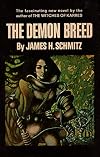
In 1968, this book's original version appeared as a two-part novella called "The Tuvela" (which title I prefer) in Analog magazine. The author was, at that time, fifty-seven. He had spent most of his early life in Germany, where his American family was based and his father sold International Harvester equipment. He was the very rare optimistic writer of Space Opera, whose characters were thrown into extreme situations; but they came from, and one is left to feel returned show more to, ordinary and reasonably pleasant lives.
The main thing everyone latches onto, however, is the fact that a Schmitz Hero was as likely to be female as male. And when I capitalize Hero, it is deliberate and thoughtful. A heroine is thrust into a situation where she must Rise Above her femaleness and save the day. Schmitz had no time for suchlike goins-on. Nile Etland, the Hero of this book, starts out as the omnicompetent person she remains; her ascension to Hero status comes from her willingness to overcome her *human* responses to stress and thus save the day:
She's not a girl making girl-noises as she forces herself to do what needs to be done. She's a human being with human responses and she quells them in order to make the world safe for democracy or humanity or whatever. I was clear that her fight against the enemy was about survival but never really cottoned on to the bigger picture until after the battle.
The battle in question takes place on a water-world that's been colonized by humans. As we know now, water worlds are common as pig tracks in the universe, appearing in many if not most other star systems. Like a Hot Jupiter and a Super-Earth, it's something our own solar system failed to produce or retain, we can't figure out which as of yet. Schmitz, probably all unknowing unless he was a time traveler (an eventuality I do not scorn to entertain, given his attitudes), posited the existence of a water-world with a terrestrial atmosphere:
So more or less they're pelagic mangroves on an Earth-in-Pangaean-times. That was nothing short of prescient in 1968. It's extra impressive given the fact that the man was born in 1911. Isn't that about the time the last plesiosaurs died out? Nandy-Cline is a part of a pan-Galactic human polity, seemingly similar to the colonial world of the Bronze Age Greeks and Phoenicians. The ships of the Overgovernment are like the ships of the Athenian or Carthaginian (aka Phoenician) navies, they fly the homeland's flag and squash the most egregious floutings of the social contract. Of course, being so far removed from the nuts-and-bolts of daily living, the Overgovernment takes a necessarily broad view of what the social contract holds:
That sounds grimly familiar, doesn't it. Your individual well-being is none of their business, but the functioning of human society as a whole is, and a carefully managed business it is. The plot of this book is, well, direct and pared-down compared to what we're accustomed to in this age of book bloat:
We could call that shorthand for much longer and possibly more interesting scenes of character development. Of which there is comparatively little for anyone except Nile. She is notably endowed with powers of observation and analysis in abundances not ascribed to any other person or being on the page. It was a novella when in came out, so this is comprehensible. It's not ideal in today's world, and for once that's a shame because this story is one the modern marketplace would like, with its gender-neutral heroics.
Because this story takes place within Schmitz's shared-worlds universe called "The Hub" there are connections to the broader story of humanity in colonized space. This is dealt with in an end section, I don't think it's exactly considered a chapter, titled: "Conclusions of the Evaluating Committee of the Lords of Sessegur, Chiefs of the Dark Ships—Subject: The Human-Parahuan Engagement of Nandy-Cline". This purports to be the minutes of a governing body's committee charged with the observation and assessment of species' behaviors and their consequences, as they pertain to larger issues of cohabiting the galaxy with the aforementioned Lords. So this short tale assumes larger and more resonant meaning in the Schmitzverse, and therefore illuminates the true nature of all aspects of our existence. We are not alone. As we judge, so we are in turn judged...and the judges aren't always known to us.
Sobering thought, that. show less
In 1968, this book's original version appeared as a two-part novella called "The Tuvela" (which title I prefer) in Analog magazine. The author was, at that time, fifty-seven. He had spent most of his early life in Germany, where his American family was based and his father sold International Harvester equipment. He was the very rare optimistic writer of Space Opera, whose characters were thrown into extreme situations; but they came from, and one is left to feel returned show more to, ordinary and reasonably pleasant lives.
The main thing everyone latches onto, however, is the fact that a Schmitz Hero was as likely to be female as male. And when I capitalize Hero, it is deliberate and thoughtful. A heroine is thrust into a situation where she must Rise Above her femaleness and save the day. Schmitz had no time for suchlike goins-on. Nile Etland, the Hero of this book, starts out as the omnicompetent person she remains; her ascension to Hero status comes from her willingness to overcome her *human* responses to stress and thus save the day:
She was frightened; and knowing that now of all times she couldn't afford to be frightened simply was making it that much worse. For moments her thoughts became a shifting blur of anxieties. She tried to force them back to what she would say to the Everliving, to anticipate questions to which she must have answers. It didn't work too well. But the physical reactions faded gradually again.
She's not a girl making girl-noises as she forces herself to do what needs to be done. She's a human being with human responses and she quells them in order to make the world safe for democracy or humanity or whatever. I was clear that her fight against the enemy was about survival but never really cottoned on to the bigger picture until after the battle.
The battle in question takes place on a water-world that's been colonized by humans. As we know now, water worlds are common as pig tracks in the universe, appearing in many if not most other star systems. Like a Hot Jupiter and a Super-Earth, it's something our own solar system failed to produce or retain, we can't figure out which as of yet. Schmitz, probably all unknowing unless he was a time traveler (an eventuality I do not scorn to entertain, given his attitudes), posited the existence of a water-world with a terrestrial atmosphere:
Nandy-Cline's pelagic floatwood forests, forever on the move about the watery planet where one narrow continent and the polar ice massifs represented the only significant barriers to the circling tides of ocean.
***
Beneath the surface they were linked by an interlocking net of ponderous roots which held the island sections clamped into a single massive structure.
So more or less they're pelagic mangroves on an Earth-in-Pangaean-times. That was nothing short of prescient in 1968. It's extra impressive given the fact that the man was born in 1911. Isn't that about the time the last plesiosaurs died out? Nandy-Cline is a part of a pan-Galactic human polity, seemingly similar to the colonial world of the Bronze Age Greeks and Phoenicians. The ships of the Overgovernment are like the ships of the Athenian or Carthaginian (aka Phoenician) navies, they fly the homeland's flag and squash the most egregious floutings of the social contract. Of course, being so far removed from the nuts-and-bolts of daily living, the Overgovernment takes a necessarily broad view of what the social contract holds:
The Overgovernment evidently isn't interested in establishing a paradisiac environment for the harmless citizen. Its interest is in the overall quality of the species.
***
"It's been a long time between wars," Mavig said. "That's part of our problem. How about the overall Hub reaction, Director?"
"We'll let it be a three day sensation," said Sindhis. "Then we'll release a series of canned sensations which should pretty well crowd the Nandy-Cline affair out of the newscasts and keep it out. I foresee no difficulties."
That sounds grimly familiar, doesn't it. Your individual well-being is none of their business, but the functioning of human society as a whole is, and a carefully managed business it is. The plot of this book is, well, direct and pared-down compared to what we're accustomed to in this age of book bloat:
"In brief," Ticos said slowly, "the Great Palach intends to discredit the Tuvela Theory by showing he can torture the Guardian to death and add her to his collection of trophies?"
***
A very different type of mentality seemed involved. A mentality which systematically tortured human minds and bodies, leaving the victims degraded in death and carefully preserving their degradation, as if that were a goal in itself. . . .
***
Roles were distributed and the party set off.
We could call that shorthand for much longer and possibly more interesting scenes of character development. Of which there is comparatively little for anyone except Nile. She is notably endowed with powers of observation and analysis in abundances not ascribed to any other person or being on the page. It was a novella when in came out, so this is comprehensible. It's not ideal in today's world, and for once that's a shame because this story is one the modern marketplace would like, with its gender-neutral heroics.
Because this story takes place within Schmitz's shared-worlds universe called "The Hub" there are connections to the broader story of humanity in colonized space. This is dealt with in an end section, I don't think it's exactly considered a chapter, titled: "Conclusions of the Evaluating Committee of the Lords of Sessegur, Chiefs of the Dark Ships—Subject: The Human-Parahuan Engagement of Nandy-Cline". This purports to be the minutes of a governing body's committee charged with the observation and assessment of species' behaviors and their consequences, as they pertain to larger issues of cohabiting the galaxy with the aforementioned Lords. So this short tale assumes larger and more resonant meaning in the Schmitzverse, and therefore illuminates the true nature of all aspects of our existence. We are not alone. As we judge, so we are in turn judged...and the judges aren't always known to us.
Sobering thought, that. show less

In this 2nd collection of short stories set in the Galactic Hub, Schmitz weaves together a series of YA-style science-fiction stories with a bit of a hard-boiled detective sentimentality to the dialog. These are fun, pulpy stories in the vein of Flash Gordon or Buck Rogers with lots of evil geniuses that need thwarting and puzzles to be solved. The twist being that the protagonists here are a pair of strong young females in Telzey Amberdon and Trigger Argee. More interestingly, while there show more are many 'good guy' male personas, they are all secondary characters and are rarely, if ever, called upon to rescue the capable main characters - although they do rescue each other now & again. show less

The third Schmitz book I've read and the second one about Telzey. These books follow a pattern. The Telzey character is like a cardboard cut out, in that she has no empathy or emotions of any kind. And her mental powers keep becoming more superhuman each story. With the lack of morals as well, in terms of prying into other people's minds and restructuring their personality to make them nicer people, she comes across as monstrous but it is clear that isn't how the author wants the reader to show more see her.
It is so far away from how a real teenage girl would act/react it suggests that the author lacked empathy with other people. The stories set up ingenious situations but lack real drama - even in the Witches of Karres which isn't quite so bad - there is a wimp out every time some excitement needs to be racked up. Things are resolved far too simply, by coincidence or in the case of the Telzey books by her general ability to do just about anything. show less
It is so far away from how a real teenage girl would act/react it suggests that the author lacked empathy with other people. The stories set up ingenious situations but lack real drama - even in the Witches of Karres which isn't quite so bad - there is a wimp out every time some excitement needs to be racked up. Things are resolved far too simply, by coincidence or in the case of the Telzey books by her general ability to do just about anything. show less

James Schmitz is a science fiction author who seems to be getting forgotten, although to their credit Baen books has done an excellent job of bringing books back into print. I read several of Schmitz's stories in the late 60's and in the 70's and what I remember about them more than anything was that they featured strong female characters. They are not damsel in distress types, not decorations, they don't swoon or fall to pieces. What they are are strong characters who just happen to be show more women.
The Demon Breed was first published in John Campbell's Analog magazine in 1968 as "The Tuvela" a title I prefer because it really is what the story is about. I won't tell you what a Tuvela is. You need to read the book. You need to learn as the reader and if you don't figure it out you will be gently guided. They are all around us even if you don't notice them until they are needed. Nile Etland is the star of our story, a young female scientist who steps up to an unexpected challenge.
Schmitz has created a unique and very interesting world that the story is set in - interesting characters, interesting critters and very interesting plants. This is really science fiction and very much an adventure story, but there are some subtleties and interesting speculations about ecology, evolution and psychology laced into it to make this much more than a plain vanilla adventure. I really enjoyed this re-read and did not want to put the book down. 4+ stars show less
The Demon Breed was first published in John Campbell's Analog magazine in 1968 as "The Tuvela" a title I prefer because it really is what the story is about. I won't tell you what a Tuvela is. You need to read the book. You need to learn as the reader and if you don't figure it out you will be gently guided. They are all around us even if you don't notice them until they are needed. Nile Etland is the star of our story, a young female scientist who steps up to an unexpected challenge.
Schmitz has created a unique and very interesting world that the story is set in - interesting characters, interesting critters and very interesting plants. This is really science fiction and very much an adventure story, but there are some subtleties and interesting speculations about ecology, evolution and psychology laced into it to make this much more than a plain vanilla adventure. I really enjoyed this re-read and did not want to put the book down. 4+ stars show less
Lists
Awards


You May Also Like


Associated Authors
Statistics
- Works
- 114
- Also by
- 89
- Members
- 6,196
- Popularity
- #3,966
- Rating
- 3.8
- Reviews
- 117
- ISBNs
- 135
- Languages
- 5
- Favorited
- 30