

Mordecai Richler (1931–2001)
Author of Barney's Version
About the Author
Novelist, journalist and screenwriter Mordecai Richler was born on January 27, 1931 in Montreal, Quebec, Canada. He attended Sir George Williams College for two years. He lived in Paris, Spain and England, and while in England worked as a journalist and radio and television scriptwriter. His fourth show more novel, The Apprenticeship of Duddy Kravitz (1959), was received with far more enthusiasm than previous efforts. He has written a number of screenplays (including Fun with Dick and Jane and the script for The Apprenticeship of Duddy Kravitz). His awards include the Governor-General Awards, the Commonwealth Writer's Prize and the Ruth Schwartz Children's Book Award. (Bowker Author Biography) Mordecai Richler, the author of such distinguished novels as "The Apprenticeship of Duddy Kravitz," "St. Urbain's Horseman," & "Solomon Gursky Was Here," was born in Montreal in 1931. He has won the Commonwealth Prize, the Paris Review Humour Prize, & was nominated for an Academy Award for his screenplay of "Duddy Kravitz." Over the years he has contributed to "Atlantic Monthly," "GQ," "Esquire," "Harper's," "The New York Review of Books," "The New York Times Book Review," & "The New Yorker" (which will publish a portion of "On Snooker"). Richler is married & has five children; he now divides his time between winters in London & seven months at a cottage on Lake Memphremagog in Quebec. (Publisher Provided) show less
Series
Works by Mordecai Richler
The Apprenticeship of Duddy Kravitz [1974 film] (1974) — Screenwriter/Original novel — 10 copies, 3 reviews
The Art of Kissing [short story] 2 copies
Robertson Davies 2 copies
Ḥanikhuto shel Dudi Ḳravits 1 copy
Légy bátor és erős 1 copy
Richler Mordecai 1 copy
Associated Works
The Innocents Abroad; or, The New Pilgrim's Progress (1869) — Introduction, some editions — 4,377 copies, 60 reviews
For the Love of Books: 115 Celebrated Writers on the Books They Love Most (1999) — Contributor — 479 copies, 4 reviews
Counterpoints: 25 Years of The New Criterion on Culture and the Arts (2007) — Contributor — 47 copies
Antaeus No. 61, Autumn 1988 - Journals, Notebooks & Diaries (1988) — Contributor — 38 copies, 2 reviews
Tagged
Common Knowledge
- Canonical name
- Richler, Mordecai
- Birthdate
- 1931-01-27
- Date of death
- 2001-07-03
- Gender
- male
- Education
- Baron Byng High School
Sir George Williams College - Occupations
- novelist
screenwriter
essayist - Organizations
- Impure Wool Society (1995)
- Awards and honors
- Order of Canada (Companion, 2001)
CBA Libris Award (Author of the Year, 1998)
Governor General's Literary Award (1968, 1971)
Commonwealth Writers Prize (1990, 1998)
Giller Fiction Prize (1997)
Writers Guild of America Award (1975) (show all 7)
Stephen Leacock Award (1998) - Relationships
- Richler, Daniel (son)
Richler, Jacob (son)
Richler, Emma (daughter)
Richler, Noah (son)
Richler, Martha (daughter)
Rosenberg, Leah (mother) - Cause of death
- cancer
- Nationality
- Canada
- Birthplace
- Montréal, Quebec, Canada
- Places of residence
- Montréal, Quebec, Canada
London, England, UK
Paris, France - Place of death
- Montréal, Quebec, Canada
- Burial location
- Mount Royal Cemetery, Montréal, Québec, Canada
- Associated Place (for map)
- Canada
Members
Reviews
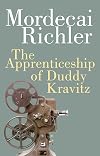
What bugs me about the Bildungsroman is the scent of sanctimony that often accompanies it: lessons are learned, obstacles overcome, and what emerges is a well-rounded and faintly smug protag like David Copperfield who looks back on his youthful misadventures with an air of tolerant amusement. That's not what happens to Duddy K though: what he learns about life and human nature in the course of the novel he mostly misinterprets or misuses, and if anything he's a less sympathetic character show more when we leave him on the cusp of majority than at any point prior. That's not to say he's unlikeable — driven by a blunt sense of justice, intolerant of hypocrites, and unafraid to make a fool of himself, there's plenty to get behind — but his dedication to seeing others only in terms of what he can get out of them means his allure is of the car-wreck kind. The extended introduction, framed through the sad story of the schoolmaster MacPherson, tormented by the young Duddy, eloquently prefigures this theme.
I can see what made this novel popular. The dialogue and the atmosphere of mid-century Montreal, especially the Jewish 'hood and its characters, is very convincing. I love how D will casually "grab a couple of smoked meats" to cheer himself up after a reverse, his frustrated ver gerhargets and all his haring about town in harebrained pursuit of the big score. And every character's convincing, too. In fact, you can see it as a book about the disturbances caused by Duddy's "apprenticeship" in the lives of those unlucky enough to fall into his orbit. By putting this amoral loose-cannon at the heart of his novel, Richler draws the reader's focus and sympathy to the supporting cast and the setting, which I guess is what the book is really about and explains why I liked it so much. show less
I can see what made this novel popular. The dialogue and the atmosphere of mid-century Montreal, especially the Jewish 'hood and its characters, is very convincing. I love how D will casually "grab a couple of smoked meats" to cheer himself up after a reverse, his frustrated ver gerhargets and all his haring about town in harebrained pursuit of the big score. And every character's convincing, too. In fact, you can see it as a book about the disturbances caused by Duddy's "apprenticeship" in the lives of those unlucky enough to fall into his orbit. By putting this amoral loose-cannon at the heart of his novel, Richler draws the reader's focus and sympathy to the supporting cast and the setting, which I guess is what the book is really about and explains why I liked it so much. show less

I discovered delight in the grotesque and the transgressive in this book. I read this book 40 years ago at age 17. Many things stick in my mind: the movie star hung on a hook in the closet, the mogul who undergoes a sex change operation in order to take the advice of a disgruntled aide and go f**k himself, the grade-school pageant in which the kids perform scenes from De Sade's Justine, and , especially, the beautiful young ingenue who can only go as far sexually as the behavior she has show more witnessed in the movies. The poor protagonist, suffering from impotency, writhes in anxiety as he waits for the day when she sees her first porno. show less

Quite frankly, I'd never even heard of Mordecai Richler until I read the autobiography of his British editor and publisher, Diana Athill. She predicted he'd become the grand old man of Canadian literature, and apparently he did. Lord only knows what I was busy doing at the time. In any event, I picked up a cheap kindle copy of "Barney's Version". It's a book that should be, in certain ways, familiar to fans of the mid-century New York golden age -- Roth, Bellow, Mailer, and all the rest -- show more but we're in Montreal, Canada if we're not hanging around the bohemian quarters of Paris after the war, and the titular Barney's a die-hard Canadiens fan. Still, the novel's prose is a joy: equal parts nostalgic, quick-witted and swinging. Also, the frequent footnotes, that undercut Barney's eponymous version, prove themselves to be a surprisingly effective comic and literary device.
Barney, it must be said, is a bit more of a jerk than most of the main characters created by the aforementioned authors: acerbic, moneyed, hard-drinking. But he's not without his charm, or his attractions, at least to his three wives, all of whom are rendered wonderfully, if not exactly fondly. "Barney's Version" is a bit more of a comedy than the sort of book the aforementioned Big Three usually produced: Richler seems willing much more willing to play his main character's eccentricities, terrible decisions, pet peeves, and misfortunes for genuine laughs than any of those authors would have. Filled with good bits and big characters and even an unsolved murder mystery, "Barney's Version" is, if absolutely nothing else, a lot of fun to read.
But it's more than fun, really. Barney's more-or-less past his prime when we meet him, and much of the book's plot describes his slow slide into irrelevance. Barney's a grouch, sure, but Richler still presents his halting progress toward death with genuine pathos. Whatever mistakes he has made in his life, Barney has made sure to surround himself with friends and family, most of whom stick by him as he prepares to leave this world. Barney, we learn, has grown rich off of connections with talents bigger than himself and middling, often state-supported Canadian television shows. But the author goes out of his way to show us that never losing track of the neighborhood kids he grew up with and showing undying loyalty to his kids -- even at their most problematic, were two things that Barney -- God rest his soul -- did right. Recommended. show less
Barney, it must be said, is a bit more of a jerk than most of the main characters created by the aforementioned authors: acerbic, moneyed, hard-drinking. But he's not without his charm, or his attractions, at least to his three wives, all of whom are rendered wonderfully, if not exactly fondly. "Barney's Version" is a bit more of a comedy than the sort of book the aforementioned Big Three usually produced: Richler seems willing much more willing to play his main character's eccentricities, terrible decisions, pet peeves, and misfortunes for genuine laughs than any of those authors would have. Filled with good bits and big characters and even an unsolved murder mystery, "Barney's Version" is, if absolutely nothing else, a lot of fun to read.
But it's more than fun, really. Barney's more-or-less past his prime when we meet him, and much of the book's plot describes his slow slide into irrelevance. Barney's a grouch, sure, but Richler still presents his halting progress toward death with genuine pathos. Whatever mistakes he has made in his life, Barney has made sure to surround himself with friends and family, most of whom stick by him as he prepares to leave this world. Barney, we learn, has grown rich off of connections with talents bigger than himself and middling, often state-supported Canadian television shows. But the author goes out of his way to show us that never losing track of the neighborhood kids he grew up with and showing undying loyalty to his kids -- even at their most problematic, were two things that Barney -- God rest his soul -- did right. Recommended. show less

Richler layers on enough historical and cultural references (including Duddy Kravitz and St. Urbain Street) within the first five pages that his novel starts requiring footnotes. Actually, the footnotes are there by design, added by a fictional editor of this fictional memoir by a fictional character named Barney Panofsky, who is out to redeem his reputation in his twilight years after a long-time acquaintance slanders him in another autobiography.
Barney's memory is beginning to suffer, show more demonstrated as he stumbles a bit to recollect certain trivia while rambling all over his personal timeline through the early chapters. Eventually he settles down to follow something more chronological, interspersed with notes from his present, and the narrative becomes easier to follow through its three parts delineated by his marriages. Barney's dry, sarcastic wit does him service and lends some rich humour, though he also succumbs to lashing out in anger as he knows how to hold (and act upon) a grudge.
Barney's background is Jewish Quebecois (just like Richler's own), but many of his reflections are universal: the too swift passage of time, the unremitting memories, the odd ways in which people can come and go from one's life. Regrets and honest self-assessments mount. There is no clear takeaway at the end this story, not even in the epilogue, which is perhaps the best verisimilitude of all. Even if it was sometimes absurd, Barney's was not so bad as lives go, and it feels like ending enough. show less
Barney's memory is beginning to suffer, show more demonstrated as he stumbles a bit to recollect certain trivia while rambling all over his personal timeline through the early chapters. Eventually he settles down to follow something more chronological, interspersed with notes from his present, and the narrative becomes easier to follow through its three parts delineated by his marriages. Barney's dry, sarcastic wit does him service and lends some rich humour, though he also succumbs to lashing out in anger as he knows how to hold (and act upon) a grudge.
Barney's background is Jewish Quebecois (just like Richler's own), but many of his reflections are universal: the too swift passage of time, the unremitting memories, the odd ways in which people can come and go from one's life. Regrets and honest self-assessments mount. There is no clear takeaway at the end this story, not even in the epilogue, which is perhaps the best verisimilitude of all. Even if it was sometimes absurd, Barney's was not so bad as lives go, and it feels like ending enough. show less
Lists
Awards


You May Also Like


Associated Authors
Statistics
- Works
- 53
- Also by
- 16
- Members
- 9,049
- Popularity
- #2,656
- Rating
- 3.8
- Reviews
- 136
- ISBNs
- 385
- Languages
- 15
- Favorited
- 27
