
Laurent Binet
Author of HHhH
About the Author
Image credit: Laurent Binet (book cover)
Works by Laurent Binet
Operación antropoide : cuaderno 3 copies
Associated Works
Tagged
Common Knowledge
- Canonical name
- Binet, Laurent
- Birthdate
- 1972-07-19
- Gender
- male
- Occupations
- teacher
professor
writer - Organizations
- University of Paris III
- Nationality
- France
- Birthplace
- Paris, France
- Places of residence
- Paris, France
- Associated Place (for map)
- Paris, France
Members
Reviews
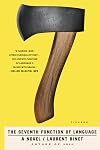
This is a book on multiple levels. I enjoyed it as a mystery with a lot of twists and turns, but also as an over-the-top satire of (mostly) French theorists. Binet has several games going on.
"Life is not a novel. Or at least you would like to believe so."
"A novel is not a dream: you can die in a novel. Then again, the central character is not normally killed. Except, perhaps, at the end of the story."
"Simon tries to be more specific: 'How do you know that you're not in a novel? How do you show more know that you are not living inside a work of fiction. How do you know that you're real?'"
"But, novel or not, it will not be said that he just let it happen. Simon does not believe in salvation, he does not believe that he has a mission on earth, but he does believe that the future is unwritten and that, even if he is in the hands of a sadistic, capricious novelist, his destiny is not yet settled."
"He must deal with this hypothetical novelist the way he deals with God: always act as if God did not exist because if God does exist, he is at best a bad novelist ... It is never too late to change the course of the story."
The narrator (Binet) is conscious of writing a novel, addresses the readers directly about some of his choices, allows Simon to reflect on his role as a character and to try to exercise free will (is it free will or just part of the story?).
As Pilate asked, what is truth? Most of the characters are famous philosophers and literary critics. Some events are as real as they are improbable. Roland Barthes was really hit and killed by a laundry van. Louis Althusser really strangled his wife. Other events are totally made up. Presumably nobody really pissed on Umberto Eco in a café in Bologna. (There really was a bomb set off in the railway station). Julia Kristeva was probably not really running a group of umbrella-toting Bulgarian assassins. Binet kills off several people (including Derrida) ahead of schedule to fit his story line.
While I know something about French literature and philosophy, theory is not my bag. I was constantly looking up things to sort out what was real and what Binet made up.
Simon, Bianca, and Bayard are likable and engaging characters. The critics and philosophers mostly come across as arrogant and self-absorbed, not at all likable. Truth or fiction? No doubt many former grad students were cheering on the reaper. show less
"Life is not a novel. Or at least you would like to believe so."
"A novel is not a dream: you can die in a novel. Then again, the central character is not normally killed. Except, perhaps, at the end of the story."
"Simon tries to be more specific: 'How do you know that you're not in a novel? How do you show more know that you are not living inside a work of fiction. How do you know that you're real?'"
"But, novel or not, it will not be said that he just let it happen. Simon does not believe in salvation, he does not believe that he has a mission on earth, but he does believe that the future is unwritten and that, even if he is in the hands of a sadistic, capricious novelist, his destiny is not yet settled."
"He must deal with this hypothetical novelist the way he deals with God: always act as if God did not exist because if God does exist, he is at best a bad novelist ... It is never too late to change the course of the story."
The narrator (Binet) is conscious of writing a novel, addresses the readers directly about some of his choices, allows Simon to reflect on his role as a character and to try to exercise free will (is it free will or just part of the story?).
As Pilate asked, what is truth? Most of the characters are famous philosophers and literary critics. Some events are as real as they are improbable. Roland Barthes was really hit and killed by a laundry van. Louis Althusser really strangled his wife. Other events are totally made up. Presumably nobody really pissed on Umberto Eco in a café in Bologna. (There really was a bomb set off in the railway station). Julia Kristeva was probably not really running a group of umbrella-toting Bulgarian assassins. Binet kills off several people (including Derrida) ahead of schedule to fit his story line.
While I know something about French literature and philosophy, theory is not my bag. I was constantly looking up things to sort out what was real and what Binet made up.
Simon, Bianca, and Bayard are likable and engaging characters. The critics and philosophers mostly come across as arrogant and self-absorbed, not at all likable. Truth or fiction? No doubt many former grad students were cheering on the reaper. show less
Rating: 4.5* of five
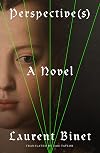
The Publisher Says: A pulse-quickening murder mystery set in Renaissance Florence by the renowned author of HHhH.
As dawn breaks over the city of Florence on New Year’s Day 1557, Jacopo da Pontormo is discovered lying on the floor of a church, stabbed through the heart. Above him are the frescoes he labored over for more than a decade—masterpieces all, rivaling the works of Michelangelo in the Sistine Chapel. When guards search his quarters, they find an obscene show more painting of Venus and Cupid—with the face of Venus replaced by that of Maria de’ Medici, the Duke of Florence’s oldest daughter. The city erupts in chaos.
Who could have committed these crimes: murder and lèse-majesté? Giorgio Vasari, the great art historian, is picked to lead the investigation. Letters start to fly back and forth—between Maria and her aunt Catherine de’ Medici, the queen of France; between Catherine and the scheming Piero Strozzi; and between Vasari and Michelangelo—carrying news of political plots and speculations about the identity of Pontormo’s killer. The truth, when it comes to light, is as shocking as the bold new artworks that have made Florence the red-hot center of European art and intrigue.
Bursting with characters and historical color, Laurent Binet’s Perspective(s) is a whodunit like no other—a labyrinthine murder mystery that shows us Renaissance Florence as we’ve never seen it before. This is a dark, dazzling, unforgettable read.
I RECEIVED A DRC FROM THE PUBLISHER VIA NETGALLEY. THANK YOU.
My Review: From the framing device of a trove of discovered letters forward, this book represents the kind of games I most enjoy authors playing. Binet's the son of an historian, and it shows...for good and ill. The good is the playfulness of his choices to focus narrative attention on; the ill is his necessary fictionalizing of real figures of the well-studied past at times slipping into...absurdity, silliness, OTT recherche Proustian locutionary excess?...well, too-muchness, anyhow.
It is, I'll say clearly and now, well worth the effort to accept without engaging too much critical overdrive. (My worst readerly failing.)
Sort out fact from fiction exactly as much as suits you; nothing in your pleasure will change knowing more than you're told on the pages of the story about the people (note I did not say characters) on these pages. The murdered man emerges as we all do from the memories of those around us, as a blurry-edged shadow. It is unclear to me if he was actually guilty of lèse-majesté—and I do not care to establish this. Or any other of the many interesting side-lights Author Binet shines onto Savonarola's Florence. (I'd be a really bad puritan. I've always got a question they don't like, and am absolutely guaranteed to perform every sex act they abominate...in public, to show how they can't tell *me* what to do!)
The character Vasari is, in a word, adroit. No matter what he's asked to do, or be, or fix, he's got it, understands the assignment and the subtext, has a guy who knows a guy on his side. It's always good to know a Vasari because he might be oily but he's effective. People in power love Vasari-type guys. If you're the guy he knows who's got the connections he can use, you will never get public credit—that's all his—but he won't forget you. Until he does.
No, not a bestie to rely on, but a great guy to read about, and a top-notch sleuth.
As the pages flew by I realized I was in that reading flow state that's ever elusive. I was deep into Author Binet's imagination (Michelangelo as gossipy old queen, Marie de'Medici as old queen in political hot water) and unaware of the ever-advancing hour. When I closed the cover at two-thirty, I was sad to see it all end. I'm not sure why the very slightly repetitious recaps Binet's Vasari offers the reader to explain the resolution of the killing didn't weigh more heavily on my pleasure in the read...my conclusion is that I like Vasari's very natural-feeling shifts in tone. These do, however, slow the story's roll a but more than I myownself would prefer (that missing half-star above). Vasari is, as mentioned before, an operator, so he's bound to have different conversational registers for different people. In an epistolary novel that's both easy to present and easy to explain. No one in this collection of invented letters has an overview of the situation, just one corner of the composition, so everyone's responding to events as honestly as they feel safe doing; but they're all watching their tone because this was a dangerous time (see link to Savonarola above). It's similar to the effect of my doted-on The Case of Cem.
I'm delighted with this read. I'm recommending it to most all y'all because it's fun to see an author summon the attitudes of people long-dead in this honest, ambivalent way. I don't think the readers averse to history will be that tempted, though I hope one or two will try it out. show less
The Publisher Says: A pulse-quickening murder mystery set in Renaissance Florence by the renowned author of HHhH.
As dawn breaks over the city of Florence on New Year’s Day 1557, Jacopo da Pontormo is discovered lying on the floor of a church, stabbed through the heart. Above him are the frescoes he labored over for more than a decade—masterpieces all, rivaling the works of Michelangelo in the Sistine Chapel. When guards search his quarters, they find an obscene show more painting of Venus and Cupid—with the face of Venus replaced by that of Maria de’ Medici, the Duke of Florence’s oldest daughter. The city erupts in chaos.
Who could have committed these crimes: murder and lèse-majesté? Giorgio Vasari, the great art historian, is picked to lead the investigation. Letters start to fly back and forth—between Maria and her aunt Catherine de’ Medici, the queen of France; between Catherine and the scheming Piero Strozzi; and between Vasari and Michelangelo—carrying news of political plots and speculations about the identity of Pontormo’s killer. The truth, when it comes to light, is as shocking as the bold new artworks that have made Florence the red-hot center of European art and intrigue.
Bursting with characters and historical color, Laurent Binet’s Perspective(s) is a whodunit like no other—a labyrinthine murder mystery that shows us Renaissance Florence as we’ve never seen it before. This is a dark, dazzling, unforgettable read.
I RECEIVED A DRC FROM THE PUBLISHER VIA NETGALLEY. THANK YOU.
My Review: From the framing device of a trove of discovered letters forward, this book represents the kind of games I most enjoy authors playing. Binet's the son of an historian, and it shows...for good and ill. The good is the playfulness of his choices to focus narrative attention on; the ill is his necessary fictionalizing of real figures of the well-studied past at times slipping into...absurdity, silliness, OTT recherche Proustian locutionary excess?...well, too-muchness, anyhow.
It is, I'll say clearly and now, well worth the effort to accept without engaging too much critical overdrive. (My worst readerly failing.)
Sort out fact from fiction exactly as much as suits you; nothing in your pleasure will change knowing more than you're told on the pages of the story about the people (note I did not say characters) on these pages. The murdered man emerges as we all do from the memories of those around us, as a blurry-edged shadow. It is unclear to me if he was actually guilty of lèse-majesté—and I do not care to establish this. Or any other of the many interesting side-lights Author Binet shines onto Savonarola's Florence. (I'd be a really bad puritan. I've always got a question they don't like, and am absolutely guaranteed to perform every sex act they abominate...in public, to show how they can't tell *me* what to do!)
The character Vasari is, in a word, adroit. No matter what he's asked to do, or be, or fix, he's got it, understands the assignment and the subtext, has a guy who knows a guy on his side. It's always good to know a Vasari because he might be oily but he's effective. People in power love Vasari-type guys. If you're the guy he knows who's got the connections he can use, you will never get public credit—that's all his—but he won't forget you. Until he does.
No, not a bestie to rely on, but a great guy to read about, and a top-notch sleuth.
As the pages flew by I realized I was in that reading flow state that's ever elusive. I was deep into Author Binet's imagination (Michelangelo as gossipy old queen, Marie de'Medici as old queen in political hot water) and unaware of the ever-advancing hour. When I closed the cover at two-thirty, I was sad to see it all end. I'm not sure why the very slightly repetitious recaps Binet's Vasari offers the reader to explain the resolution of the killing didn't weigh more heavily on my pleasure in the read...my conclusion is that I like Vasari's very natural-feeling shifts in tone. These do, however, slow the story's roll a but more than I myownself would prefer (that missing half-star above). Vasari is, as mentioned before, an operator, so he's bound to have different conversational registers for different people. In an epistolary novel that's both easy to present and easy to explain. No one in this collection of invented letters has an overview of the situation, just one corner of the composition, so everyone's responding to events as honestly as they feel safe doing; but they're all watching their tone because this was a dangerous time (see link to Savonarola above). It's similar to the effect of my doted-on The Case of Cem.
I'm delighted with this read. I'm recommending it to most all y'all because it's fun to see an author summon the attitudes of people long-dead in this honest, ambivalent way. I don't think the readers averse to history will be that tempted, though I hope one or two will try it out. show less

Well, that was lots of fun. A 'what if' of history retold. The Vikings went further than Newfoundland and reached the Caribbean, Columbus set sail but never returned to Europe with his discovery of the New World. In fact the 'New World' turned out to be Europe itself discovered by a small band of armed Incas. The conquistadors-in-reverse took on and conquered the continent. The emperor Atahualpa leading them. All the main characters of European history appear including Pedro Pizarro in a show more very different role, Charles V the Holy Roman Emperor, Queen Isabella, Henry VIII, Luther, Erasmus, Barbarossa, Michelangelo, Titian, Cervantes, El Greco and many others. Written in a very apposite, folkloric, simple style as well as being highly amusing it highlights some of the absurdities of European history of the time. Atahualpa himself is a very worthy hero. What if indeed. show less
Someone in Paris pushed Roland Barthes under a laundry truck. Round up the unusual suspects: Foucault, Althusser, Bernard-Henri Levy, Kristeva and Sollers, Deleuze and Guattari, Eco, and the ever-maligned Derrida. In The 7th Function of Language, Laurent Binet's form of roman à clef, or maybe it's French Theory fan fiction, the real-life accidental death of literary critic Barthes in 1980 becomes the fromage of a fictional international murder investigation assigned to the character of a show more budget-suit-wearing policier detective who considers all these famous university types to be parasites, sexual deviants, and commies. An adjacent mystery involves a stolen secret incantation, a mythical 7th factor of communication offering its incantor, such as a rogue politician or challenger in a clandestine finger-amputating debate cult, mind-manipulating powers! The real case to solve is whether the novel 7th Function is intended as a burlesque satire of postmodern theory and its intellectual formulators, or an angry critique. If this novel was about American academics set in the climate of today's U.S. culture wars, we could easily recognize it as a how-to manual of the demagogic right-wing troll-o-sphere. The irony is not lost that Barthes, who famously argued in The Death of the Author for the importance of interpreting text instead of author intent, is the dead author/character. The novel has literary prowess, clever polysemic layers, and Binet is a knowledgeable interpreter of postmodern canon when the book veers usefully into encyclopedic summaries of topics like semiotics versus rhetoric, continental versus analytic philosophy, and decoding the subtext of James Bond. Meanwhile, the majority of word count is spent on a gonzo and increasingly violent plot in which the unschooled detective investigating who did Barthes murder discovers himself on a trail of semiotician's signs leading to a labyrinthian conspiracy of French presidential candidates, academic enemies, and international espionage–the detective learns who done it is less important than the what did it mean. But it still feels like the living people who have the same names and distinctive contributions to thought as the miscreants in this facade end up libeled. One wonders why the author writing a theory novel is so intent on presenting the greatest theorists and philosophers of the late twentieth century as a clique of snobs, hedonists, addicts, debauchers, phonies, killers, and spies. I am willing to consider that a lot was lost in the French to English translation and that The 7th Function of Language is intended to only be hilarious, but by my interpretation it is mean, violent, and anti-intellectual. show less
Lists
Take Four Books (1)
THE WAR ROOM (1)
Awards


You May Also Like


Associated Authors
Statistics
- Works
- 9
- Also by
- 2
- Members
- 4,275
- Popularity
- #5,880
- Rating
- 3.8
- Reviews
- 219
- ISBNs
- 175
- Languages
- 20
- Favorited
- 3