
Eric Vuillard
Author of The Order of the Day
About the Author
Image credit: Éric Vuillard en 2018
Works by Eric Vuillard
Sorrow of the Earth: Buffalo Bill, Sitting Bull and the Tragedy of Show Business (2014) — Author — 104 copies, 7 reviews
Les orphelins 6 copies
Ronan Barrot, Repetition: [Exposition, Paris, 3 avril-17 mai 2014], Galerie Claude Bernard (2014) 1 copy
Dagsordenen en historie 1 copy
Tagged
Common Knowledge
- Canonical name
- Vuillard, Éric
- Legal name
- Vuillard, Eric
- Birthdate
- 1968-05-04
- Gender
- male
- Education
- Université (Diplôme d'études approfondies, Histoire)
- Awards and honors
- Franz-Hessel-Preis (2012)
- Relationships
- Derrida, Jacques (Directeur de DEA)
- Nationality
- France
- Birthplace
- Lyon, Rhône, Auvergne-Rhône-Alpes, France
- Places of residence
- Rennes, Brittany, France
- Map Location
- France
- Associated Place (for map)
- France
Members
Reviews
Shortlisted for the 2021 International Booker Prize, which describes itself as for "the finest fiction from around the world, translated into English." Leaving aside "finest", is this fiction? We have a very well known model for this sort of thing, it's been around since 430 B.C. - Herodotus' "Histories". Herodotus blended fact, myth, and narrative, he related facts and told stories, and gave us a fantastic picture of the worlds he described. Despite controversy over the nature and veracity show more of his work from the very beginning, he has still earned the name "father of history". Should we give him a Nobel Prize for Fiction in recognition of his fine work? Probably not. (Ok, he’s dead, for one, which violates a Nobel guideline, and technically it’s a Literature not Fiction prize, but bear with.) Herodotus wouldn't have considered what he was doing as writing fiction, and similarly I don't think what Vuillard is doing here is writing fiction either. I'm against this attempt to poach it from historiography.
Going back to "finest", now. Well, it's very short, half the size of what I'd consider a novella. So that's a strike. In terms of plot and character development, well, how much can you do in such a short space. It's necessarily impressionistic, but I will say that it makes a strong impression. It gets across a history of peasant uprisings and the resulting slaughter of said peasants forcefully, and it leaves a forceful impression of its central character of Thomas Müntzer, all thanks in large part to the impassioned and colloquial language the translator (and I assume Vuillard himself) use. This passage, for instance, impresses me:
Language like that will keep me turning pages, for sure. Literary language that shakes its closed fist, that spits with zeal and menace and urgency, something like a Nick Cave and the Bad Seeds song from back in the day. In fact, yeah, I love that analogy. "I'm your Loverman," Müntzer threatens. And he's waiting outside your door, you German princes, and he's bucking and braying and pawing at the floor, and he's howling with pain, and he's shouting your name and asking for more. Insert crunching guitar noise here. show less
Going back to "finest", now. Well, it's very short, half the size of what I'd consider a novella. So that's a strike. In terms of plot and character development, well, how much can you do in such a short space. It's necessarily impressionistic, but I will say that it makes a strong impression. It gets across a history of peasant uprisings and the resulting slaughter of said peasants forcefully, and it leaves a forceful impression of its central character of Thomas Müntzer, all thanks in large part to the impassioned and colloquial language the translator (and I assume Vuillard himself) use. This passage, for instance, impresses me:
Something terrible inhabits him, agitates him. He is enraged. He wants the rulers' skins, he wants to sweep away the church, he wants to gut all those bastards. But maybe he doesn't know this yet, and for the moment he is choking it down. He wants to put an end to all that pomp and miserable circumstance. Vice and wealth devastate him; their conjunction devastates him. He wants to inspire fear. The difference between Müntzer and Hus is that Müntzer is thirsty, hungry and thirsty, terribly hungry and thirsty, and nothing can sate him, nothing can slake his thirst. He'll devour old bones, branches, stones, mud, milk, blood, fire. Everything.
Language like that will keep me turning pages, for sure. Literary language that shakes its closed fist, that spits with zeal and menace and urgency, something like a Nick Cave and the Bad Seeds song from back in the day. In fact, yeah, I love that analogy. "I'm your Loverman," Müntzer threatens. And he's waiting outside your door, you German princes, and he's bucking and braying and pawing at the floor, and he's howling with pain, and he's shouting your name and asking for more. Insert crunching guitar noise here. show less
"This great jumble of misery… is dominated by a mysterious respect for lies. Political manoeuvring tramples facts." (pg. 114)
Not short and sweet but short and bitter, Éric Vuillard's pseudo-novel The Order of the Day is a literary colonic: bracing and beneficial, but you're still not entirely sure you want this tube up your arse. It has that peculiar and pretentious French approach of meta-analysis, that complete negation of any attempt at storytelling that means you're unsure if you can show more even classify it as a novel.
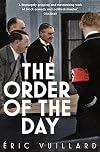
The Order of the Day addresses, in a restless and flitting way, the collusion of businessmen in Hitler's rise to power and the general shabbiness of Europe's 'elites' in responding to his cheap depredations, focusing on a series of backroom meetings and diplomatic summits. Surprisingly, the Munich Conference with Chamberlain and Daladier is not the centrepiece (despite being on the book's cover), and Vuillard is more concerned with the incestuous dalliances of German businesses and the farcical Anschluss of 1938.
This is to the book's credit; rather than beat the dead Appeasement horse of Munich, Vuillard uses his literary license to expose some of the inconvenient truths that were quietly buried after the war. That the Allies at Nuremberg employed the Nazis' own prolific executioner to carry out their war-crime sentences (pg. 56) may be little more than trivia, but Vuillard hauls onto the centre of his stage the various German companies that facilitated Hitler's rise to power, profited from its slave-labour during the war and, sickeningly, thrived after it. No defeat for them, and some of the names remain familiar: Opel, Krupp, Bayer, BMW, Siemens, Allianz… the list is disconcertingly long. "They are here beside us, among us," Vuillard writes. "They are our cars, our washing machines, our household appliances, our clock radios, our homeowner's insurance, our watch batteries" (pg. 16).
Vuillard doesn't do much with this information, but it's refreshing to have it aired. Some of these companies "merged and formed omnipotent conglomerates" (pg. 127), but they maintained their scot-free influence on our world. Krupp, Vuillard notes, became a powerful figure in the EU's Common Market, "a pillar of Pax Europaea", and notes with appropriate cynicism that nowadays its "watchwords… are 'openness' and 'transparency'" (pp127-8) even as they obfuscate on their Nazi past and engage in that trend for corporate whitewashing which is a plague on any genuine openness in our societies. The Order of the Day is too brief in its haranguing to be a useful call-to-arms, and as literature it's non-descript, but as a brief and impotent squall of indignation at the tawdry compromises of our world it has some potency. show less
Not short and sweet but short and bitter, Éric Vuillard's pseudo-novel The Order of the Day is a literary colonic: bracing and beneficial, but you're still not entirely sure you want this tube up your arse. It has that peculiar and pretentious French approach of meta-analysis, that complete negation of any attempt at storytelling that means you're unsure if you can show more even classify it as a novel.
The Order of the Day addresses, in a restless and flitting way, the collusion of businessmen in Hitler's rise to power and the general shabbiness of Europe's 'elites' in responding to his cheap depredations, focusing on a series of backroom meetings and diplomatic summits. Surprisingly, the Munich Conference with Chamberlain and Daladier is not the centrepiece (despite being on the book's cover), and Vuillard is more concerned with the incestuous dalliances of German businesses and the farcical Anschluss of 1938.
This is to the book's credit; rather than beat the dead Appeasement horse of Munich, Vuillard uses his literary license to expose some of the inconvenient truths that were quietly buried after the war. That the Allies at Nuremberg employed the Nazis' own prolific executioner to carry out their war-crime sentences (pg. 56) may be little more than trivia, but Vuillard hauls onto the centre of his stage the various German companies that facilitated Hitler's rise to power, profited from its slave-labour during the war and, sickeningly, thrived after it. No defeat for them, and some of the names remain familiar: Opel, Krupp, Bayer, BMW, Siemens, Allianz… the list is disconcertingly long. "They are here beside us, among us," Vuillard writes. "They are our cars, our washing machines, our household appliances, our clock radios, our homeowner's insurance, our watch batteries" (pg. 16).
Vuillard doesn't do much with this information, but it's refreshing to have it aired. Some of these companies "merged and formed omnipotent conglomerates" (pg. 127), but they maintained their scot-free influence on our world. Krupp, Vuillard notes, became a powerful figure in the EU's Common Market, "a pillar of Pax Europaea", and notes with appropriate cynicism that nowadays its "watchwords… are 'openness' and 'transparency'" (pp127-8) even as they obfuscate on their Nazi past and engage in that trend for corporate whitewashing which is a plague on any genuine openness in our societies. The Order of the Day is too brief in its haranguing to be a useful call-to-arms, and as literature it's non-descript, but as a brief and impotent squall of indignation at the tawdry compromises of our world it has some potency. show less
When we think of Hitler and the Nazis in the years leading up to World War Two, we think of an unstoppable, unplacatable force. But were they really like that? Or were they just masters of the art of the bluff, taken too seriously by those they wished to cow? And what of those who enabled their rise to power - did they have a choice in the matter? This novel explores such questions, taking a fresh and critical look at the events of the 1930s, and some of the characters on the European stage show more at that time who might have shrunk from view, either by happenstance or by choice... show less
I am not at all familiar with the history of Germany's annexation of Austria as Hitler came to power. In less than 150 pages, Vuillard explains how this happened with a voice dripping with disdain and snarkiness. And he is right to be disdainful and mocking of the heads of industry and heads of state who so easily and fearfully gave in. It is at times comical: the traffic jam of broken-down tanks that Hitler wanted to accompany him into Austria. A fly-on-the-wall view of a historical event show more from inside the cabinets of the men involved. show less
Lists
Awards


You May Also Like


Associated Authors
Statistics
- Works
- 16
- Members
- 1,776
- Popularity
- #14,496
- Rating
- 3.7
- Reviews
- 71
- ISBNs
- 150
- Languages
- 19
- Favorited
- 3


