
Carolyn Kizer (1924–2014)
Author of Cool, Calm, and Collected: Poems 1960-2000
About the Author
Carolyn Kizer was born in Spokane, Washington on December 10, 1924. At 17, she had a poem, When You Are Distant, published in The New Yorker. She received a bachelor's degree from Sarah Lawrence College in 1945 and afterward did graduate work in Chinese at Columbia University. In 1959, she helped show more found the journal Poetry Northwest and served as its editor until 1965. Her first collection of poetry, The Ungrateful Garden, was published in 1961. Her other collections include Knock Upon Silence and Harping On. Her best known work was the five-part cycle Pro Femina. She received the Pulitzer Prize in 1985 for her collection Yin and a Poetry Society of America Frost Medal in 1988. A skilled translator, she translated works from Urdu, Macedonian, Yiddish, and Chinese, including the Tang poet Tu Fu and the a modern woman poet Shu Ting. Kizer died from complications of dementia on October 9, 2014 at the age of 89. (Bowker Author Biography) show less
Image credit: Poetry Foundation
Works by Carolyn Kizer
Associated Works
The Making of a Poem: A Norton Anthology of Poetic Forms (2000) — Contributor — 1,474 copies, 9 reviews
No More Masks: An Anthology of Twentieth-Century American Women Poets (1993) — Contributor, some editions — 226 copies, 3 reviews
From Totems to Hip-Hop: A Multicultural Anthology of Poetry Across the Americas 1900-2002 (2002) — Contributor — 181 copies
The Sweet Breathing of Plants: Women Writing on the Green World (2001) — Contributor — 101 copies, 1 review
She Rises Like the Sun: Invocations of the Goddess by Contemporary American Women Poets (1989) — Contributor — 72 copies
Tagged
Common Knowledge
- Legal name
- Kizer, Carolyn Ashley
- Birthdate
- 1924-12-10
- Date of death
- 2014-10-09
- Gender
- female
- Education
- Sarah Lawrence College (BA|1945)
Columbia University
University of Washington - Occupations
- poet
essayist
translator - Organizations
- National Endowment for the Arts (Literature Director)
Poetry Northwest (Founding Editor)
University of North Carolina at Chapel Hill
Iowa Writers' Workshop - Awards and honors
- Frost Medal (1987/1988)
American Academy of Arts and Letters Academy Award (Literature ∙ 1985)
Aiken Taylor Award (1997) - Cause of death
- dementia
- Nationality
- USA
- Birthplace
- Spokane, Washington, USA
- Places of residence
- Sonoma, California, USA
- Place of death
- Sonoma, California, USA
- Associated Place (for map)
- California, USA
Members
Reviews
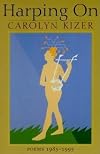
This is part of an experiment for me. I didn't know anything about Kizer except that she contributed to anthology of translations of Horace's Odes that I recently read. This is a later collection of hers. The poetry is much more about story and its impact than form, which tends to be free form, and which she seems to want to be even freer. Her poems go a on few pages, read a little like a micro-fiction. They are compressed, meaningful, easy to read and satisfying. They aren't super quotable. show more I enjoyed her quieter feminism, her translations, which are very free and sometimes irreverent, and her awareness of her time and place. It was a nice sample of and introduction to Kizer.
One of my favorite poems, called American Beauty, is a tribute to Ann London, the main promoter of the ERA amendment in the 1970's and a friend of Kizer's, who passed away in the 1970's of breast cancer. She also has a poem called Anniversaries, with references to the novel of same name by [[Uwe Johnson]]. Like Johnson's novel, she writes about living on Riverside Drive in Manhattan, and like Johnson, she captures the various shocked responses to the assassination of JFK in 1963. American Beauty can be found online in several places, including here: https://www.poetrynook.com/poem/american-beauty-0
2025
https://www.librarything.com/topic/369129#8818548 show less
One of my favorite poems, called American Beauty, is a tribute to Ann London, the main promoter of the ERA amendment in the 1970's and a friend of Kizer's, who passed away in the 1970's of breast cancer. She also has a poem called Anniversaries, with references to the novel of same name by [[Uwe Johnson]]. Like Johnson's novel, she writes about living on Riverside Drive in Manhattan, and like Johnson, she captures the various shocked responses to the assassination of JFK in 1963. American Beauty can be found online in several places, including here: https://www.poetrynook.com/poem/american-beauty-0
2025
https://www.librarything.com/topic/369129#8818548 show less
I've spent the last several years on a quest to discover new poets, and Kizer is one of the best I've found. Her appeal to me is in her radical leftist view of the world and her erudite use of literary references. I also found her free form of translation very interesting. If you like slightly formal poetry that's about big world issues, give her a try.
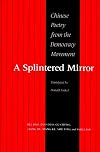
A nice collection of poetry from China’s Democracy movement in the late 80’s and early 90’s, though a little uneven at times – of the seven poets featured, Bei Dao, Gu Cheng, and Shu Ting stand out. Surprisingly optimistic and strong, when the lyrics pop they really pop.
Favorites:
“The sky is grey.
The road is grey.
The buildings are grey.
The rain is grey.
Out of the dead grey void
two children walk,
one bright red
and one light green.”
- Gu Cheng
From Answer, by Bei Dao:
“Now I come to show more be judged,
and I’ve nothing to say but this:
Listen. I don’t believe!
OK. You’ve trampled
a thousand enemies underfoot. Call me
a thousand and one.”
From Love Story, by Bei Dao:
“After all, there’s only one world for us –
the height of summer.
Yet we go on playing children’s games
with grown-up rules,
heedless of those fallen by the roadside,
heedless of the ships that have run aground.
…
This is no longer a simple story.
There’s you and me.
And there are other people.”
From Capital “I” by Gu Cheng:
“Oh, I laugh at death, that ragged curtain
which will never come down on my miracle play.
I’m all humanity, stalking the long corridors of time,
climbing the multicolored cliffs of every continent.
Rivers carry my songs,
earthquakes scatter my bones,
rainclouds rinse my hair.”
The poem “Parting” by Gu Cheng:
“Now, as we cross this ancient threshold,
let’s have no farewells,
no valedictions.
They seem so hollow –
silence is best.
Reticence is no pretense.
Let’s bequeath our memory to the future,
our dreams to the night,
our tears to the sea,
and our windy sighs to its sails.”
And “Missing You” by Shu Ting:
“A multi-colored chart without a boundary;
An equation chalked on the board, with no solution;
A one-stringed lyre that tells the beads of rain;
A pair of useless oars that never cross the water.
Waiting buds in suspended animation;
The setting sun is watching from a distance.
Though in my mind there may be an enormous ocean,
What emerges is the sum: a pair of tears.
Yes, from these vistas, from these depths,
Only this.”
Lastly the poem “Notes on the City of the Sun”, by Bei Dao, which ends by describing life very simply as a “net”, an image which has stuck with me for twenty years. After all, isn’t everything interconnected? show less
Favorites:
“The sky is grey.
The road is grey.
The buildings are grey.
The rain is grey.
Out of the dead grey void
two children walk,
one bright red
and one light green.”
- Gu Cheng
From Answer, by Bei Dao:
“Now I come to show more be judged,
and I’ve nothing to say but this:
Listen. I don’t believe!
OK. You’ve trampled
a thousand enemies underfoot. Call me
a thousand and one.”
From Love Story, by Bei Dao:
“After all, there’s only one world for us –
the height of summer.
Yet we go on playing children’s games
with grown-up rules,
heedless of those fallen by the roadside,
heedless of the ships that have run aground.
…
This is no longer a simple story.
There’s you and me.
And there are other people.”
From Capital “I” by Gu Cheng:
“Oh, I laugh at death, that ragged curtain
which will never come down on my miracle play.
I’m all humanity, stalking the long corridors of time,
climbing the multicolored cliffs of every continent.
Rivers carry my songs,
earthquakes scatter my bones,
rainclouds rinse my hair.”
The poem “Parting” by Gu Cheng:
“Now, as we cross this ancient threshold,
let’s have no farewells,
no valedictions.
They seem so hollow –
silence is best.
Reticence is no pretense.
Let’s bequeath our memory to the future,
our dreams to the night,
our tears to the sea,
and our windy sighs to its sails.”
And “Missing You” by Shu Ting:
“A multi-colored chart without a boundary;
An equation chalked on the board, with no solution;
A one-stringed lyre that tells the beads of rain;
A pair of useless oars that never cross the water.
Waiting buds in suspended animation;
The setting sun is watching from a distance.
Though in my mind there may be an enormous ocean,
What emerges is the sum: a pair of tears.
Yes, from these vistas, from these depths,
Only this.”
Lastly the poem “Notes on the City of the Sun”, by Bei Dao, which ends by describing life very simply as a “net”, an image which has stuck with me for twenty years. After all, isn’t everything interconnected? show less

Wow: an accident involving a nun and the dangerous times evoked by Ronald Reagan's re-election to the presidency wound together in an unforgettable juxtaposition. This is what poetry should be.
Lists
Awards


You May Also Like


Associated Authors
Statistics
- Works
- 23
- Also by
- 24
- Members
- 463
- Popularity
- #53,108
- Rating
- 3.8
- Reviews
- 10
- ISBNs
- 23