
Charles Alexander Eastman (1858–1939)
Author of Indian Boyhood
About the Author
A Santee Sioux, born in Red Falls, Minnesota, Charles Eastman was raised by his grandmother and uncle in Manitoba, Canada, where he learned Native American traditions and lore. As a teenager he returned to his father's family and attended mission schools and Beloit College. He graduated from show more Dartmouth College in 1887 and from Boston University School of Medicine in 1890. Although his background made him unwelcome in some parts of white society and his education made him uneasy in Native American cultures, he worked for his people throughout his life as a doctor, as a representative in Washington, D.C., and as a founder of the Society of American Indians. His first published book, Indian Boyhood (1902), written for children, tells the stories and traditions of the Sioux nation. Red Hunters and the Animal People (1904), Old Indian Days (1907), and Wigwam Evenings (1909), written with the help of his wife, Elaine Goodale Eastman, continue in this vein, but his later work, including The Soul of the Indian (1911), The Indian Today (1915), and his autobiography, From the Deep Woods to Civilization (1916), attempts to interpret Native American culture for white society, describing the problems of assimilation. (Bowker Author Biography) show less
Image credit: From "AMONG THE SIOUX
A Story of The Twin Cities and The Two Dakotas," Creswell, 1906
(Project Gutenberg)
(Project Gutenberg)
Works by Charles Alexander Eastman
From the Deep Woods to Civilization: Chapters in the Autobiography of an Indian (1916) 240 copies, 2 reviews
Light on the Indian World: The Essential Writings of Charles Eastman (The Library of Perennial Philosophy) (2003) 27 copies, 1 review
Indian Boyhood: The True Story of a Sioux Upbringing (2016) — Edited and Adapted — 19 copies, 3 reviews
Associated Works
Voice of the Turtle: American Indian Literature, 1900-1970 (1994) — Contributor — 139 copies, 1 review
Native Heritage: Personal Accounts by American Indians, 1790 to the Present (1995) — Contributor — 66 copies
Nothing But the Truth: An Anthology of Native American Literature (2000) — Contributor — 54 copies, 2 reviews
Hozho: Walking in Beauty: Native American Stories of Inspiration, Humor, and Life (2001) — Contributor — 15 copies
The Ethnic Image in Modern American Literature, 1900-1950, Volumes 1-2 (1984) — Contributor — 1 copy
Tagged
Common Knowledge
- Other names
- Oyihesa
Hakadah (birth name) - Birthdate
- 1858-02-19
- Date of death
- 1939-01-08
- Gender
- male
- Education
- Boston University (1890|MD)
Dartmouth College (BS|1887) - Occupations
- physician
writer - Organizations
- Santee Sioux Nation
- Relationships
- Eastman, Elaine Goodale (spouse)
- Nationality
- Dakota
USA - Birthplace
- Redwood Falls, Minnesota, USA
- Places of residence
- Minnesota, USA
Canada
South Dakota, USA - Place of death
- Detroit, Michigan, USA
- Map Location
- USA
Members
Reviews
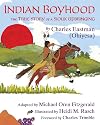
Bracketed with background information about the author, illustrator, and supporters of this book, Indian Boyhood presents a very simply told story for young children, filled with tiny details of text and illustration that imply a much larger tale. The writing is smoothly edited from Charles Eastman’s original text by Michael Oren Fitzgerald, combining the sense of a children’s picture book with the depth of genuine cultural difference and experience—a difference born of time, location show more and history, and beautifully portrayed.
Adults should read and enjoy the forward and preface—a wonderful introduction to the author and editor—while children will turn, of course, to the pictures first. But both should stop at the photographs that come before the story—two simple images that tell a tale of time and people lost, yet never gone.
“What boy would not be an Indian for a while…?” asks the author as his story begins. An enticing image of horse and rider, plain and shining sun, invites the reader to turn the page. But even the images are filled with secrets in this book, making it a treasure for older children too, to search and find how a tipi is decorated, why a family would flee, how a child would be hidden in a tree…
The story’s told in a pleasingly authentic voice, for all its simplicity, and rings gorgeously true. The Indian boy learns equally of hunting and herbs, an interesting background when history tells us he grew up to train as a doctor in the white man’s world. There’s beauty in knowing this changing world didn’t change him—just became a part of him.
I really enjoyed this book and would love to share it with a child, growing, as all of us do, in a world that never stays still, and learning, as all of us should, to wait before leaping to judgement.
Disclosure: I was given a copy by the publisher, Wisdom Tales, and I offer my honest review. show less
Adults should read and enjoy the forward and preface—a wonderful introduction to the author and editor—while children will turn, of course, to the pictures first. But both should stop at the photographs that come before the story—two simple images that tell a tale of time and people lost, yet never gone.
“What boy would not be an Indian for a while…?” asks the author as his story begins. An enticing image of horse and rider, plain and shining sun, invites the reader to turn the page. But even the images are filled with secrets in this book, making it a treasure for older children too, to search and find how a tipi is decorated, why a family would flee, how a child would be hidden in a tree…
The story’s told in a pleasingly authentic voice, for all its simplicity, and rings gorgeously true. The Indian boy learns equally of hunting and herbs, an interesting background when history tells us he grew up to train as a doctor in the white man’s world. There’s beauty in knowing this changing world didn’t change him—just became a part of him.
I really enjoyed this book and would love to share it with a child, growing, as all of us do, in a world that never stays still, and learning, as all of us should, to wait before leaping to judgement.
Disclosure: I was given a copy by the publisher, Wisdom Tales, and I offer my honest review. show less
I love firsthand accounts to begin with and I love a good book about history. This was a quick read. It's a small book. This is an honest account of Native practices, to the best of the author's remembrances, prior to the introduction of white and Christian influences, and the beliefs and/or motivations of those practices.
Whether you agree or disagree with the practices or the motivations, this is must read to try to understand another culture or to discover your own, if you happen to be show more native.
He describes in some detail the struggle of being a product of both worlds, what that encompasses and how his feelings evolved on the matter.
While this is an honest account, he was more than fair and gracious about the effects of white, Christian culture on the native population.
At times dry, and at other times very poetic, it's by far a good read and I intend to seek out more of his work. I would recommend this book to anyone, but you cannot have my copy. Good luck and good reading. show less
Whether you agree or disagree with the practices or the motivations, this is must read to try to understand another culture or to discover your own, if you happen to be show more native.
He describes in some detail the struggle of being a product of both worlds, what that encompasses and how his feelings evolved on the matter.
While this is an honest account, he was more than fair and gracious about the effects of white, Christian culture on the native population.
At times dry, and at other times very poetic, it's by far a good read and I intend to seek out more of his work. I would recommend this book to anyone, but you cannot have my copy. Good luck and good reading. show less

A picture book with words based on an American Indian tale adapted to the format of an Aesop-style fable by Charles Eastman in 1909. Eastman's writing is terribly dry, and he squeezes the life out of the story by forcing it into a format that was already archaic when it was originally published 100 years ago. The illustrations help a lot, and give some personality to the characters, but while they're cute and fun, there's nothing really special there.
 This review was written for LibraryThing Early Reviewers.
This is definitely an interesting book and an important accounting for traditions of the Sioux. Yet it is done from a perspective "after the white man's arrival." And this leads to my conclusion that Mr. Eastman's histrionics are putting an acceptable slant on this Native American's culture.
Essentially The Soul of the Indian is a comparison of Sioux religiosity to Christianity. Self-admittedly, the author explains the basis of Indian culture and religion is the antithesis of Biblical show more religion. Yet he then proceeds to find similarities of varying proportion. He extolls the virtue of Indian religion and expresses disdain for the materialism or monetarism of Christianity.
Mr. Eastman takes time to include a section on familiar hierarchy and societal culture. One aspect I found suspect was his play down of the warrior culture. Understanding this book was written after the segregation of Indians to reservations Mr. Eastman likely tempered this profile of his people, in an effort to "humanize" the Native Americans.
Hence, I sensed that while the author was conveying his culture to white man, he was simultaneously trying to raise the Sioux religion to the level he perceives Christianity. Struggling to veil his contempt for Christianity but fully cognizant that his target audience was Americans, he paints the Sioux as simply a different strain of Christianity.
Blaming some of the misconceptions and alterations of long-standing cultural modalities on arrival of the White, this book needs to be read with a grain of salt. Granted his interpretations may be truly a perspective free of my suspected distortion towards his audience, the same caution afforded to autobiographies applies to this first-person defense of culture and religion. show less
Essentially The Soul of the Indian is a comparison of Sioux religiosity to Christianity. Self-admittedly, the author explains the basis of Indian culture and religion is the antithesis of Biblical show more religion. Yet he then proceeds to find similarities of varying proportion. He extolls the virtue of Indian religion and expresses disdain for the materialism or monetarism of Christianity.
Mr. Eastman takes time to include a section on familiar hierarchy and societal culture. One aspect I found suspect was his play down of the warrior culture. Understanding this book was written after the segregation of Indians to reservations Mr. Eastman likely tempered this profile of his people, in an effort to "humanize" the Native Americans.
Hence, I sensed that while the author was conveying his culture to white man, he was simultaneously trying to raise the Sioux religion to the level he perceives Christianity. Struggling to veil his contempt for Christianity but fully cognizant that his target audience was Americans, he paints the Sioux as simply a different strain of Christianity.
Blaming some of the misconceptions and alterations of long-standing cultural modalities on arrival of the White, this book needs to be read with a grain of salt. Granted his interpretations may be truly a perspective free of my suspected distortion towards his audience, the same caution afforded to autobiographies applies to this first-person defense of culture and religion. show less
Lists
Awards


You May Also Like


Associated Authors
Statistics
- Works
- 27
- Also by
- 13
- Members
- 1,442
- Popularity
- #17,832
- Rating
- 3.6
- Reviews
- 30
- ISBNs
- 263
- Languages
- 9
