
António R. Damásio
Author of Descartes' Error: Emotion, Reason, and the Human Brain
About the Author
Antonio Damasio was born in Lisbon, Portugal and studied medicine at the University of Lisbon Medical School, where he also did his neurological residency and completed his doctorate. Eventually, he moved to the United States as a research fellow at the Aphasia Research Center in Boston. From 1976 show more to 2005, he was M.W. Van Allen Professor and Head of Neurology at the University of Iowa Hospitals and Clinics. He is currently the David Dornsife Professor of Neuroscience, Psychology, and Neurology, and director of the Brain and Creativity Institute at the University of Southern California. He has written several books on his research including Descartes' Error: Emotion, Reason, and the Human Brain, which won the Science et Vie prize; The Feeling of What Happens: Body and Emotion in the Making of Consciousness; and Looking for Spinoza: Joy, Sorrow, and the Feeling Brain. He has also received the Prince of Asturias Award in Science and Technology, the Kappers Neuroscience Medal, the Beaumont Medal from the American Medical Association, the Nonino Prize, the Reenpaa Prize in Neuroscience, and the Honda Prize. (Bowker Author Biography) show less
Works by António R. Damásio
The Feeling of What Happens: Body and Emotion in the Making of Consciousness (1999) 1,528 copies, 7 reviews
Unity of Knowledge: The Convergence of Natural and Human Science (Annals of the New York Academy of Sciences) (2001) 19 copies
Damasio Antonio 1 copy
mistério da consciência 1 copy
Associated Works
Tagged
Common Knowledge
- Canonical name
- Damásio, António R.
- Legal name
- Damásio, António Rosa
- Birthdate
- 1944-02-25
- Gender
- male
- Education
- University of Lisbon (MD|1969)
University of Lisbon (PhD|Medicine|1974) - Occupations
- neuroscientist
professor - Organizations
- American Academy of Arts and Sciences (USA)
National Academy of Sciences (USA)
European Academy of Arts and Sciences (EU)
Association of American Physicians (USA)
Royal Academy of Medicine (Belgium)
University of Southern California (show all 9)
Brain and Creativity Institute at USC
Salk Institute
Aphasia Research Center - Awards and honors
- Prince of Asturias Award (Science and Technology|2005)
Honda Prize
Kappers Neuroscience Medal
Beaumont Medal (American Medical Association)
Nonino Prize
Reenpaa Prize (show all 14)
Doctor honoris causa (University of Aachen|2002)
Doctor honoris causa (University of Aveiro|2003)
Doctor honoris causa (University of Copenhagen - Copenhagen Business School|2009)
Doctor honoris causa (University of Leiden|2010)
Doctor honoris causa (University Ramon Llull)
Doctor honoris causa (Barcelona|2010)
Doctor honoris causa (University of Coimbra|2011)
Doctor honoris causa (EPFL, Lausanne|2011) - Relationships
- Damásio, Hanna (wife)
- Nationality
- USA
Portugal - Birthplace
- Lisbon, Portugal
- Places of residence
- Lisbon, Portugal
Los Angeles, California, USA - Associated Place (for map)
- Los Angeles, California, USA
Members
Reviews

I love genre-less books...or at least ones that don't fit neatly into one category. This book is chockfull of accessible neuroscience with helpful diagrams, but it is also a memoir of searching, of curiosity, of embracing the past to understand the present. Damasio makes a strong case that Spinoza was ahead of the game in terms of understanding feeling and emotion in terms of a body-mind connection, but this is no dry scientific work of Spinozan-apologetics. Damasio embraces humanistic show more inquiry, contextualizing Spinoza's work in a well-researched (and sometimes suprisingly enjoyably sentimental) study of his life. Anathematized from the Sephardic community in Amsterdam, Spinoza's identity during his life was well-known, but his ideas were sub rosa. The inverse was to be his legacy (257). With this study, Damasio contends that Spinoza was a "forerunner of modern biological thinking" (259) in a very important and specific way. He does not resort to hero-worship--Damasio is clear regarding where he think Spinoza misses the mark. But in this book, the result of his "quiet simmering of hints and reflections" (263-4)--one of the best descriptions of the historian's craft I've encountered--Damasio concludes the big takeaway from Spinoza is that "Science can be combined with the best of a humanist tradition to permit a new approach to human affairs and lead to human flourishing." (283). But he is more expansive yet, making the case that our brain, with all its mappings and homeostatic processes and endeavor for self-preservation, is crucial in carrying out Spinoza's "virtuous life in civitas" (274), and that ultimately, even in the face of all we see in the news, "there simply is no alternative to believing we can make a difference." (288) show less
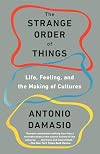
Homeostasis does the heavy lifting in Antonio Damasio’s account of life, subjectivity, consciousness, and culture. Not the homeostasis that your mom told you about, the one that describes the tendency towards a relatively stable equilibrium of independent elements. It’s that, of course, but it is also much more. For Damasio, homeostasis includes the notion of prevailing. Life, from its earliest beginnings, hasn’t been about maintaining the status quo, it’s been about prevailing. All show more life. From the tiniest bacteria to multi-talented mankind. This redefinition or realization (it could be either) underwrites Damasio’s claim to be setting the standard view of consciousness, subjectivity, even culture, on its head. Consciousness, it turns out, is as embedded in the basic homeostatic drives as is hunger or thirst or what have you. The order goes from the bottom up, not the top down.
Damasio is both a serious researcher and an accomplished writer on his scientific field of study. Much of this book is devoted to detailing the research by himself and others that support his view of homeostasis. Especially important in this regard is the fundamental contribution made by feelings. Feelings are not some flavouring added on to the dish of life. They are essential for homeostatic prevailing to succeed when life encounters a potentially hostile world. Damasio rightly notes the novelty of his position. If he’s right, philosophers and cognitive scientists have some hard thinking ahead.
Where Damasio’s story begins to fray is perhaps where it began. His initial inspiration for this book stemmed from reading Jean Genet’s account of creativity: “Beauty has no other origin but the singular wound, different for each person, hidden or visible.” Could homeostatic prevailing also explain human culture? Perhaps. Certainly if Damasio’s earlier story is close to accurate, there is no reason to think that homeostasis doesn’t underwrite culture. If it underwrites all aspects of life, that would follow. But does saying that get us anywhere? When something explains everything, it ends up not explaining much at all. To which the useful admonishment is — back to the rough ground.
Recommended. show less
Damasio is both a serious researcher and an accomplished writer on his scientific field of study. Much of this book is devoted to detailing the research by himself and others that support his view of homeostasis. Especially important in this regard is the fundamental contribution made by feelings. Feelings are not some flavouring added on to the dish of life. They are essential for homeostatic prevailing to succeed when life encounters a potentially hostile world. Damasio rightly notes the novelty of his position. If he’s right, philosophers and cognitive scientists have some hard thinking ahead.
Where Damasio’s story begins to fray is perhaps where it began. His initial inspiration for this book stemmed from reading Jean Genet’s account of creativity: “Beauty has no other origin but the singular wound, different for each person, hidden or visible.” Could homeostatic prevailing also explain human culture? Perhaps. Certainly if Damasio’s earlier story is close to accurate, there is no reason to think that homeostasis doesn’t underwrite culture. If it underwrites all aspects of life, that would follow. But does saying that get us anywhere? When something explains everything, it ends up not explaining much at all. To which the useful admonishment is — back to the rough ground.
Recommended. show less
Interesting, but not satisfying. I felt that Damasio has a lot to say about consciousness and the self and the brain, but that he didn't really do it in this book. It seemed that he jumped far too quickly from high-level constructions like "mind" to low-level brain areas, and with too little justification. His train of thought seems to go into tunnels and come out at unexpected places.
However, this dissatisfaction might reflect the reader's ignorance more than anything else. Damasio has show more certainly earned a second reading. I want to make sense of this book - the fact that I haven't yet might be my fault, or his, or the fault may lie somewhere in between. show less
However, this dissatisfaction might reflect the reader's ignorance more than anything else. Damasio has show more certainly earned a second reading. I want to make sense of this book - the fact that I haven't yet might be my fault, or his, or the fault may lie somewhere in between. show less
The closest I've read to a theory of life and everything in a while. Damasio demonstrates how feelings are mental representations of how close the inner environment of the viscera and the endocrine system is to the ideal of homeostasis. If the organism is in a state conducive to homeostasis then the feelings are of a pleasant nature. If far then of an unpleasant nature. The interesting thing is that the nature of emotion and affect in accompanying the regulation of homeostasis is new in show more terms of evolutionary time. Single celled bacteria don't have feelings, but they do exhibit many of the behaviours that our affect goes along with. Brilliant book - possibly revolutionary. show less
Lists
Awards


You May Also Like


Associated Authors
Statistics
- Works
- 19
- Also by
- 2
- Members
- 6,912
- Popularity
- #3,536
- Rating
- 3.7
- Reviews
- 79
- ISBNs
- 201
- Languages
- 18
- Favorited
- 11
