
Dan Koeppel
Author of Banana: The Fate of the Fruit That Changed the World
About the Author
Works by Dan Koeppel
Associated Works
Tagged
Common Knowledge
- Birthdate
- 1962
- Gender
- male
- Education
- Hampshire College
- Occupations
- columnist
media commentator - Nationality
- USA
- Associated Place (for map)
- USA
Members
Reviews

I loved looking at history through banana-colored lenses. Dan Koeppel did a really nice work here. He did a lot of research, went around the world to interview experts, and managed to write a book that focuses on the history and science of the banana. The book kept my interest quite high from beginning to end. The structure / organization is not linear at all, it would be best visualized with a firework explosion, but in a sense it works even better this way: it's like sitting down in a pub show more with one of the top experts on bananas, getting him completely drunk, and listening to him rant away. The result is a "narrative" that jumps around, gets distracted, goes back, has sudden moments of humor and unexpectedly moving paragraphs, but it all kind of fits together nicely. I really liked it that way. Despite the large amount of facts and trivia, the book is a light read.
The author tried to infuse this work with an overarching drama, which is "a banana blight that is tearing through banana crops worldwide". This is a fact, however there seem to be some solutions in place, and at least several alternatives. In any case, some chapters end with sentences like "this is why the banana you eat today might be the last of its kind you eat. Ever!". Hilarious! But please, go on! Bring us another one of whatever this guy is drinking!!
Koeppel spent many chapters on the history of United Fruit, the modern Chiquita. I knew it was a history of violent colonialism, but I didn't know to what extent. The history of the "banana republics" of Honduras, Guatemala, Panama, etc. is fascinating, dark and disturbing. Guatemala in particular, with the CIA-orchestrated conspiracy / coup that was very much related to United Fruit and bananas.
One minor flaw: the focus seems to be almost entirely on American bananas and their history, only a little bit on South-East Asia, and almost nothing on Africa. The book would have been more complete if it expanded a bit more on Africa and what the fruit meant for African history, too.
In the end, the author recommends us to buy fair trade bananas, to help plantation workers, and he gives us a bit more background, without pushing that agenda too much. show less
The author tried to infuse this work with an overarching drama, which is "a banana blight that is tearing through banana crops worldwide". This is a fact, however there seem to be some solutions in place, and at least several alternatives. In any case, some chapters end with sentences like "this is why the banana you eat today might be the last of its kind you eat. Ever!". Hilarious! But please, go on! Bring us another one of whatever this guy is drinking!!
Koeppel spent many chapters on the history of United Fruit, the modern Chiquita. I knew it was a history of violent colonialism, but I didn't know to what extent. The history of the "banana republics" of Honduras, Guatemala, Panama, etc. is fascinating, dark and disturbing. Guatemala in particular, with the CIA-orchestrated conspiracy / coup that was very much related to United Fruit and bananas.
One minor flaw: the focus seems to be almost entirely on American bananas and their history, only a little bit on South-East Asia, and almost nothing on Africa. The book would have been more complete if it expanded a bit more on Africa and what the fruit meant for African history, too.
In the end, the author recommends us to buy fair trade bananas, to help plantation workers, and he gives us a bit more background, without pushing that agenda too much. show less
I thoroughly enjoyed this book for multiple reasons, but I want to enumerate two:
Firstly, I loved the true cross section of the banana. Of all the topics he covered, particularly, I found it admirable how Koeppel explains the biological history of the banana (ex: how does a seedless banana procreate? how did we get to a seedless banana?) while remaining, for me, entertaining. Not every writer can/wants to make evolutionary biology thrilling. He also covers the historical distribution of show more bananas, the cultural significances across the globe, the story of the banana within U.S. history, and more. And I loved it all.
Secondly, the sheer breadth of documents Koeppel reviewed, interviewed conducted, and life experiences encountered and shared all relating to the frigging banana is astounding. It's clear that the book comes from a place founded in both passion of knowledge and passion of the banana. To a regular ol' chum on the street, "passion for the banana" may sound strange; I think it is abnormal, but as Koeppel reminds us in the book, EVERYONE has a minor passion for the banana. That personal narrative mixed into the historical perspectives simply hits the spot.
I love this book. show less
Firstly, I loved the true cross section of the banana. Of all the topics he covered, particularly, I found it admirable how Koeppel explains the biological history of the banana (ex: how does a seedless banana procreate? how did we get to a seedless banana?) while remaining, for me, entertaining. Not every writer can/wants to make evolutionary biology thrilling. He also covers the historical distribution of show more bananas, the cultural significances across the globe, the story of the banana within U.S. history, and more. And I loved it all.
Secondly, the sheer breadth of documents Koeppel reviewed, interviewed conducted, and life experiences encountered and shared all relating to the frigging banana is astounding. It's clear that the book comes from a place founded in both passion of knowledge and passion of the banana. To a regular ol' chum on the street, "passion for the banana" may sound strange; I think it is abnormal, but as Koeppel reminds us in the book, EVERYONE has a minor passion for the banana. That personal narrative mixed into the historical perspectives simply hits the spot.
I love this book. show less
Read Dan Koeppel's Banana: The Fate of the Fruit that Changed the World (Hudson Street Press, 2008), and I bet you'll never look at a banana quite the same way again. Expanding on a 2005 Popular Science article, Koeppel's book is a biological, political and commercial history of the banana. It is also a call to action, since the banana as we know it may be just years away from disappearing completely thanks to a fast-moving series of pathogens which have the potential to bring its reign atop show more the fruit bowl to a precipitous end.
Part travelogue, part exposé, part history lesson, Koeppel's book takes us from the banana plantations to Latin America to the village plots of Africa to the research labs of Belgium, where scientists are racing against time to combat the spreading plague and make the world safe for bananas. What remains to be seen is whether the ultimately successful fruit will be the variety we currently eat (the Cavendish), or if some other version will have to be (or even can be) modified to meet the consumer needs the Cavendish currently satisfies (easily transported, hard to bruise, on a regular ripening schedule). It's happened before; the variety of banana grown and marketed until the late 1950s was the Gros Michel, which succumbed to the same cocktail of diseases our current banana faces today.
The banana's checkered past is laid bare here as Koeppel peels away the decades of nefarious practices engaged in by the large banana companies in Central and South America and the Caribbean as they fought each other for the commercial edge (and in the process greatly abused their works, the environment, and the governments of the nations they practically controlled). And Koeppel's point about the inherent weaknesses of the banana as an export crop is a good one: if we followed the precepts of locavorism, the banana would be about the last thing most of us would be eating, and perhaps that's the way it should be. But, as he writes, that seems unlikely, so perhaps at least understanding what's behind what we're eating is the best we can do for now.
A worthy book; I learned a great deal.
http://philobiblos.blogspot.com/2009/03/book-review-banana.html show less
Part travelogue, part exposé, part history lesson, Koeppel's book takes us from the banana plantations to Latin America to the village plots of Africa to the research labs of Belgium, where scientists are racing against time to combat the spreading plague and make the world safe for bananas. What remains to be seen is whether the ultimately successful fruit will be the variety we currently eat (the Cavendish), or if some other version will have to be (or even can be) modified to meet the consumer needs the Cavendish currently satisfies (easily transported, hard to bruise, on a regular ripening schedule). It's happened before; the variety of banana grown and marketed until the late 1950s was the Gros Michel, which succumbed to the same cocktail of diseases our current banana faces today.
The banana's checkered past is laid bare here as Koeppel peels away the decades of nefarious practices engaged in by the large banana companies in Central and South America and the Caribbean as they fought each other for the commercial edge (and in the process greatly abused their works, the environment, and the governments of the nations they practically controlled). And Koeppel's point about the inherent weaknesses of the banana as an export crop is a good one: if we followed the precepts of locavorism, the banana would be about the last thing most of us would be eating, and perhaps that's the way it should be. But, as he writes, that seems unlikely, so perhaps at least understanding what's behind what we're eating is the best we can do for now.
A worthy book; I learned a great deal.
http://philobiblos.blogspot.com/2009/03/book-review-banana.html show less
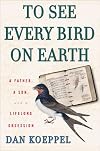
The other day, I was having my weekly coffee with friends when one of them said to me, (in relation to a FB post of mine she’d recently seen): “You’ve become a real Twitcher, haven’t you?”
I hadn’t started this book yet, but my answer was a resounding “no” for several reasons, though it was hard to really define them for her. Now that I have finished this book, it’s much easier, and I’ll get back to that at the end of my post.
To See Every Bird on Earth is meant to be, if show more you believe what it says on the wrapper, a book that explores the thrill of the chase across the world to witness as many of the earth’s birds as possible in a lifetime. There’s some of that, but mostly, it’s the culmination of what I’m guessing was a lot of therapy for the author; a psychological catharsis of his family’s dysfunction, written and published. In many ways, this book was marketed to the wrong demographic; those that find personal substance in others’ stories about personal journeys would find a lot to like in this book. Needless to say, it’s not my jam.
BUT having said that, in between the family drama being laid bare, there was a lot of interesting insight into the world of Big Listers. Big Listers are those that have seen thousands of the known species of birds in the world. Known species is a moving target, and is currently around 10 thousand. The biggest Big Lister has seen over 8 thousand. This is about big numbers, big money, and big obsessions – and very little about the birds. Koeppel, when he focuses on these people, does a better than credible job getting into their heads and their world and it was fascinating for me, in a rubber-necking kind of way. The chance to see the birds these people have seen is tantalising; how they go about it, like a military invasion, isn’t.
And ultimately, this is why I’m not a twitcher, neither of the hobby sized or obsessive Big Lister variety. True, I have the list of birds in my state, and I do check them off when I see them, noting the time and place. But I don’t count, I don’t plan, set goals, or study, and I’m embarrassed at how few bird songs I can identify after the 10 years I’ve spent tramping around the bush – and at how easily I can confuse myself over identifications.
But I have no desire to ‘do better’ because my hazy goal, set when I started this and unchanged since, isn’t to just see the birds. When I moved to Australia, not knowing how long I’d be here, I wanted to see Australia, I wanted to experience this place so far away from the rest of the world on so many levels. Looking for birds (which are, let’s be honest, the low-hanging fruit of the wildlife tree), makes me look up, down, and into the bush; I have to actually explore my surroundings, and in doing that I come much closer to actually experiencing this amazing land. The added bonus: not only have I seen (and am seeing) Australia in a way that will stay with me, but I have a new found sense of wonder wherever I go, including home to Florida. I apparently lived 90% of my life alongside hundreds of bird species I never knew about because I never paid attention. And by looking for the birds, I’m finding an entire world of wildlife right there for me to appreciate (or not, in the case of some).
So while I didn’t enjoy To See Every Bird on Earth as much as I’d hoped, I do thank its author for helping me clarify in my own mind my motivations for my avian hobby that definitely isn’t bird-watching. show less
I hadn’t started this book yet, but my answer was a resounding “no” for several reasons, though it was hard to really define them for her. Now that I have finished this book, it’s much easier, and I’ll get back to that at the end of my post.
To See Every Bird on Earth is meant to be, if show more you believe what it says on the wrapper, a book that explores the thrill of the chase across the world to witness as many of the earth’s birds as possible in a lifetime. There’s some of that, but mostly, it’s the culmination of what I’m guessing was a lot of therapy for the author; a psychological catharsis of his family’s dysfunction, written and published. In many ways, this book was marketed to the wrong demographic; those that find personal substance in others’ stories about personal journeys would find a lot to like in this book. Needless to say, it’s not my jam.
BUT having said that, in between the family drama being laid bare, there was a lot of interesting insight into the world of Big Listers. Big Listers are those that have seen thousands of the known species of birds in the world. Known species is a moving target, and is currently around 10 thousand. The biggest Big Lister has seen over 8 thousand. This is about big numbers, big money, and big obsessions – and very little about the birds. Koeppel, when he focuses on these people, does a better than credible job getting into their heads and their world and it was fascinating for me, in a rubber-necking kind of way. The chance to see the birds these people have seen is tantalising; how they go about it, like a military invasion, isn’t.
And ultimately, this is why I’m not a twitcher, neither of the hobby sized or obsessive Big Lister variety. True, I have the list of birds in my state, and I do check them off when I see them, noting the time and place. But I don’t count, I don’t plan, set goals, or study, and I’m embarrassed at how few bird songs I can identify after the 10 years I’ve spent tramping around the bush – and at how easily I can confuse myself over identifications.
But I have no desire to ‘do better’ because my hazy goal, set when I started this and unchanged since, isn’t to just see the birds. When I moved to Australia, not knowing how long I’d be here, I wanted to see Australia, I wanted to experience this place so far away from the rest of the world on so many levels. Looking for birds (which are, let’s be honest, the low-hanging fruit of the wildlife tree), makes me look up, down, and into the bush; I have to actually explore my surroundings, and in doing that I come much closer to actually experiencing this amazing land. The added bonus: not only have I seen (and am seeing) Australia in a way that will stay with me, but I have a new found sense of wonder wherever I go, including home to Florida. I apparently lived 90% of my life alongside hundreds of bird species I never knew about because I never paid attention. And by looking for the birds, I’m finding an entire world of wildlife right there for me to appreciate (or not, in the case of some).
So while I didn’t enjoy To See Every Bird on Earth as much as I’d hoped, I do thank its author for helping me clarify in my own mind my motivations for my avian hobby that definitely isn’t bird-watching. show less
Lists
You May Also Like


Associated Authors
Statistics
- Works
- 3
- Also by
- 1
- Members
- 1,142
- Popularity
- #22,480
- Rating
- 3.8
- Reviews
- 42
- ISBNs
- 24
- Languages
- 1
