

Erri De Luca
Author of God's Mountain
About the Author
Erri De Luca is an Italian author, translator, and poet, born in Naples in 1950. His first book, Non ora, non qui (Not now, not here), was published in 1989. He has published over fifty books including "Il più e il meno", and "La Faccia delle nuvole", in 2016. His awards includes the 2013 European show more Prize for Literature for his body of work. He was the winner of the 2016 Bad S-x in Fiction award for the book, The Day Before Happiness. (Bowker Author Biography) show less
Image credit: Erri De Luca en 2012
Series
Works by Erri De Luca
Come noi coi fantasmi: Lettere sull'anno sessantottesimo del secolo tra due che erano giovani in tempo (pasSaggi Bompiani) (Italian Edition) (1998) 4 copies
Il cronista scalzo 3 copies
L'urgenza della libertà: il Giubileo e gli anni sacri nella loro stesura d'origine, dal libro Levitico-Vaikrà (1999) 2 copies
Prime Persone (Italian Edition) 2 copies
L'edat experimental 1 copy
La città non rispose 1 copy
Prove di Risposta 1 copy
Il violino. Racconto 1 copy
Niet Hier 1 copy
Les pages ratées 1 copy
Përqafime 1 copy
Visita a un arbol 2009 1 copy
Associated Works
Tagged
Common Knowledge
- Birthdate
- 1950
- Gender
- male
- Nationality
- Italy
- Birthplace
- Naples, Italy
- Places of residence
- Lazio, Italy
- Associated Place (for map)
- Italy
Members
Reviews
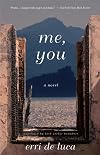
This started off OK, but then it took a real dive. The unnamed narrator recalls a summer he spent on the island of Ischia, off the coast near Naples. It's the 1950s; he's 16. He's just discovering adult relationships and what real work means. (It's a working fishing community, not a beach resort—at least not for the narrator and friends.) Standard stuff, but well handled and told in an appropriately nostalgic voice.
His uncle and the fisherman Nicola have clear memories of the war (and I'd show more love to read more about what it was like to grow up in a twice-defeated Naples, still effectively occupied). And then he meets Caia, a girl his age also summering on the island, and it turns out that she's Jewish and the Germans killed her father. And then the book turns to crap, because De Luca isn't satisfied to let the narrator have his growing-up experience of feeling a new kind of protective relation to this girl, rather than teenage lust or puppy love. No, he has to have Caia and the narrator acknowledge and discuss the idea that the boy is somehow inhabited by Caia's father's spirit. Give me a fucking break.
Even if you accept that, the way De Luca tells it is gratingly awful. The teenage boy is posited to utter:
De Luca is apparently Italy's most-read author (in part, I think, because he writes lots of short books). As an Italian translator, I thought it my duty to try him, and the English translations are easier for me to get than the Italian originals; I've also got [b:The Day Before Happiness|11662924|The Day Before Happiness|Erri DeLuca|http://photo.goodreads.com/books/1320437249s/11662924.jpg|16607955] and will power through that despite my experience with this one. I don't know what I was thinking; a popular author of short romantic and nostalgic tales should've made me expect what he turns out to be: the Italian Nicholas Sparks.
And that facile emotional manipulation is another complaint: By turning a coming-of-age story into what has no doubt been called, somewhere, "a searing exposé of the insidious aftereffects of the Holocaust," De Luca has appropriated a grief not his own. If Caia had remained inaccessible while she prompted these uncomfortable feelings in the narrator, that would've been fine; it would've remained his story and his experience. Instead De Luca represents her experience as coming actively, vocally into the story--he even has the narrator channelling Yiddish! He presumes, that is, to speak for her. But she, as a Holocaust victim, has her own voice and doesn't need De Luca's help; in Italian writing, [a:Edith Bruck|307054|Edith Bruck|http://www.goodreads.com/assets/nophoto/nophoto-U-50x66.jpg] would be the first point of reference. De Luca at least seems to acknowledge the futility of his attempt: the last line of the book is "Behind me a fire erupted that could not change the past." But he still wrote and published the book in the first place, thereby claiming some unearned authority as a voice of the Holocaust.
Two other gripes:
The Italian title is Tu, mio, which would translate as "You, mine" (or possibly "You, my" if we took "mio" as the possessive adjective rather than pronoun). The thing is, "You, mine" is something which Caia says to the narrator several times in the book: it's clearly a specific phrase which holds meaning for her. (I suspect it might allude to some Yiddish song or saying beginning "Du, meine..." which Caia's father used to address to her--which would make it "You, my.") "Me, you," on the other hand, is not a phrase which appears in the book, and besides it inverts what actually happens. It's not that the narrator starts with a clear sense of self from which he progresses to a sense of another (as "Me, You" implies); rather, he begins to understand himself as seen from the perspective of others, as being "possessed" (alas, all too literally!) by another. Brombert's translation was originally published in 1999 as Sea of Memory, which strikes me as utterly meaningless, but I'm not sure that Me, You is any improvement.
There are also a few typos in the book, such as "I was a good day" on p. 103. I attribute those to faulty OCR when Other Press scanned in the original 1999 Ecco Press edition, but they're unfortunate flaws in an otherwise attractively made paperback.
Disclosure: I was given this book by an Other Press rep at the MLA conference in Seattle, after I expressed curiosity about De Luca. show less
His uncle and the fisherman Nicola have clear memories of the war (and I'd show more love to read more about what it was like to grow up in a twice-defeated Naples, still effectively occupied). And then he meets Caia, a girl his age also summering on the island, and it turns out that she's Jewish and the Germans killed her father. And then the book turns to crap, because De Luca isn't satisfied to let the narrator have his growing-up experience of feeling a new kind of protective relation to this girl, rather than teenage lust or puppy love. No, he has to have Caia and the narrator acknowledge and discuss the idea that the boy is somehow inhabited by Caia's father's spirit. Give me a fucking break.
Even if you accept that, the way De Luca tells it is gratingly awful. The teenage boy is posited to utter:
I don't know what's been happening to me in this brief period since I got to know you, but it's a fulfillment. It's not just the love of a bewildered kid, it's anger against an evil I don't know, or know by only a few names, it's that I see you so alone you need someone to look after you, and that someone is me, an ordinary kid who feels the weight of years just because he happens to be near you.That's some of the most implausible dialogue I've ever read. Although it looks like it has some lumps of translatorese, it was still De Luca's idea to even have the characters hold this conversation. All the realism and pathos of the time, the place, the characters' time of life just went out the window. And there's more of it. Caia later tells the boy, "I had a wonderful time here in this cordial, carefree south where a kiss lasts no time at all, less than diving into water." Please admire the magnificently subtle fluorescent purple prose in which the narrator has clothed my humble thoughts.
De Luca is apparently Italy's most-read author (in part, I think, because he writes lots of short books). As an Italian translator, I thought it my duty to try him, and the English translations are easier for me to get than the Italian originals; I've also got [b:The Day Before Happiness|11662924|The Day Before Happiness|Erri DeLuca|http://photo.goodreads.com/books/1320437249s/11662924.jpg|16607955] and will power through that despite my experience with this one. I don't know what I was thinking; a popular author of short romantic and nostalgic tales should've made me expect what he turns out to be: the Italian Nicholas Sparks.
And that facile emotional manipulation is another complaint: By turning a coming-of-age story into what has no doubt been called, somewhere, "a searing exposé of the insidious aftereffects of the Holocaust," De Luca has appropriated a grief not his own. If Caia had remained inaccessible while she prompted these uncomfortable feelings in the narrator, that would've been fine; it would've remained his story and his experience. Instead De Luca represents her experience as coming actively, vocally into the story--he even has the narrator channelling Yiddish! He presumes, that is, to speak for her. But she, as a Holocaust victim, has her own voice and doesn't need De Luca's help; in Italian writing, [a:Edith Bruck|307054|Edith Bruck|http://www.goodreads.com/assets/nophoto/nophoto-U-50x66.jpg] would be the first point of reference. De Luca at least seems to acknowledge the futility of his attempt: the last line of the book is "Behind me a fire erupted that could not change the past." But he still wrote and published the book in the first place, thereby claiming some unearned authority as a voice of the Holocaust.
Two other gripes:
The Italian title is Tu, mio, which would translate as "You, mine" (or possibly "You, my" if we took "mio" as the possessive adjective rather than pronoun). The thing is, "You, mine" is something which Caia says to the narrator several times in the book: it's clearly a specific phrase which holds meaning for her. (I suspect it might allude to some Yiddish song or saying beginning "Du, meine..." which Caia's father used to address to her--which would make it "You, my.") "Me, you," on the other hand, is not a phrase which appears in the book, and besides it inverts what actually happens. It's not that the narrator starts with a clear sense of self from which he progresses to a sense of another (as "Me, You" implies); rather, he begins to understand himself as seen from the perspective of others, as being "possessed" (alas, all too literally!) by another. Brombert's translation was originally published in 1999 as Sea of Memory, which strikes me as utterly meaningless, but I'm not sure that Me, You is any improvement.
There are also a few typos in the book, such as "I was a good day" on p. 103. I attribute those to faulty OCR when Other Press scanned in the original 1999 Ecco Press edition, but they're unfortunate flaws in an otherwise attractively made paperback.
Disclosure: I was given this book by an Other Press rep at the MLA conference in Seattle, after I expressed curiosity about De Luca. show less
Una delle bellissime storie di De Luca, con i suoi personaggi dolenti, marginali, segnati, eppure pieni di vita e di gesti archetipici. Il linguaggio è prezioso, ritmato al gesto, come di chi zappa la terra.
E viene voglia di chiedersi quanti cavalli abbiamo seppellito.
E viene voglia di chiedersi quanti cavalli abbiamo seppellito.
"Il pesce è pesce quando sta nella barca". La prima frase, e da qui mi ha incollato questa storia di adolescenza del dopoguerra scritta in un linguaggio così lirico e teso da rinunciare a volte addirittura agli articoli, perché superflui, perché capaci solo di rallentare il respiro della narrazione.
C'è l'isola, c'è l'estate, c'è l'avventura, c'è l'amore, e tutto questo, invece di rimanere una piccola perla da racchiudere nel cuore e rimirare in un futuro borghese, diventa passione show more politica, intolleranza per l'abuso, decisione di rompere con gli schemi e diventare altro. show less
C'è l'isola, c'è l'estate, c'è l'avventura, c'è l'amore, e tutto questo, invece di rimanere una piccola perla da racchiudere nel cuore e rimirare in un futuro borghese, diventa passione show more politica, intolleranza per l'abuso, decisione di rompere con gli schemi e diventare altro. show less
La storia di Mosè e dei dieci comandamenti, la storia di un uomo che sale, sale verso la vetta delle montagne e verso il suo dio, che gli comanda di liberare un popolo e di condurlo verso la libertà, con lui, dio, che diventa guerriero e terrorista per il suo popolo.
E le parole divine spiegate in poesia ed etimologia, per consegnarle il peso e il valore.
Peso e valore sempre stravolti dai troppi interessi umani.
Non c'è come un'ateo per tradurre il linguaggio di dio, che diventa lingua viva show more invece che veicolo di scambio e di odio. show less
E le parole divine spiegate in poesia ed etimologia, per consegnarle il peso e il valore.
Peso e valore sempre stravolti dai troppi interessi umani.
Non c'è come un'ateo per tradurre il linguaggio di dio, che diventa lingua viva show more invece che veicolo di scambio e di odio. show less
Lists
Awards


You May Also Like


Associated Authors
Statistics
- Works
- 123
- Also by
- 2
- Members
- 4,152
- Popularity
- #6,059
- Rating
- 3.7
- Reviews
- 164
- ISBNs
- 409
- Languages
- 15
- Favorited
- 4
