
David Treuer
Author of The Heartbeat of Wounded Knee: Native America from 1890 to the Present
About the Author
David Treuer is Ojibwe from the Leech Lake Reservation in northern Minnesota. The author of four novels and two previous books of nonfiction, he has written for The New York Times, the Los Angeles Times, The Washington Post, and other publications. He teaches at the University of Southern show more California. show less
Image credit: Author David Treuer at the 2019 Texas Book Festival in Austin, Texas, United States. By Larry D. Moore, CC BY-SA 4.0, https://commons.wikimedia.org/w/index.php?curid=84683391
Works by David Treuer
The Heartbeat of Wounded Knee: Native America from 1890 to the Present (2019) 998 copies, 17 reviews
Associated Works
A Steady Brightness of Being: Truths, Wisdom, and Love from Celebrated Indigenous Voices (2025) — Contributor — 29 copies
Tagged
Common Knowledge
- Birthdate
- 1970
- Gender
- male
- Education
- Princeton University (B.A. with Honors, Anthropology)
University of Michigan (M. A., Anthropology)
University of Michigan (Ph.D., Anthropology) - Awards and honors
- Guggenheim Fellowship (2007)
Fulbright Fellowship (19960
Rhodes Scholarship Finalist (1992)
National Endowment for the Humanities Fellowship (2006)
University of Minnesota Writer of Distinction (1999) - Agent
- Joe Veltre
- Relationships
- Treuer, Anton (brother)
- Nationality
- Ojibwe Nation
USA - Birthplace
- Washington, D.C., USA
- Places of residence
- Washington, D.C., USA
Minneapolis, Minnesota, USA
Princeton, New Jersey, USA
Michigan, USA - Map Location
- USA
Members
Discussions
David Treuer in Book talk (December 2021)
Reviews
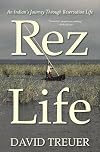
“Like reservations themselves, this book is a hybrid. It has elements of journalism, history, and memoir. As such it is meant to be suggestive rather than exhaustive. It is meant to capture some of the history and some of the truth of reservation life—which is not any one thing but many things depending on where you’re looking and to whom you’re talking.” – Dave Treuer, Rez Life
Based on the author’s above-stated purpose, I think he succeeds. Treuer starts the book with his show more personal experience growing up on a reservation. He then relates the results of many interviews that offer insights on what “rez” life is like today. In the process, he delivers a history of reservations, including past treaties, violations, and major changes in the law since conception. His primary focus is on his own tribe, the Ojibwe in the Great Lakes region, but he visits other tribes as well.
The book is structured around people and their stories. This works for the most part, though it can occasionally seem disjointed and allows for many digressions into side topics. Content includes the origins of casinos on Indian land, treaty rights, tribal sovereignty, and the various states of Indian cultures – some thriving and others dwindling. It highlights ongoing social problems on reservations such as poverty, violence, and substance abuse. It clears up many misconceptions. The author is obviously proud of his heritage. He remains optimistic, while not glossing over the challenges faced by reservation residents. show less
Based on the author’s above-stated purpose, I think he succeeds. Treuer starts the book with his show more personal experience growing up on a reservation. He then relates the results of many interviews that offer insights on what “rez” life is like today. In the process, he delivers a history of reservations, including past treaties, violations, and major changes in the law since conception. His primary focus is on his own tribe, the Ojibwe in the Great Lakes region, but he visits other tribes as well.
The book is structured around people and their stories. This works for the most part, though it can occasionally seem disjointed and allows for many digressions into side topics. Content includes the origins of casinos on Indian land, treaty rights, tribal sovereignty, and the various states of Indian cultures – some thriving and others dwindling. It highlights ongoing social problems on reservations such as poverty, violence, and substance abuse. It clears up many misconceptions. The author is obviously proud of his heritage. He remains optimistic, while not glossing over the challenges faced by reservation residents. show less

My favorite non-fiction books usually combine a strong personal narrative within the subject matter, and David Treuer does just that in The Heartbeat of Wounded Knee. Treuer grew up on a reservation in Minnesota, and he weaves the stories of family and friends into the brutal history of Native Americans. Treuer does an excellent job of chronicling hundreds of years of injustice and mistreatment with lots of primary documents and interviews. His intimate connection to the material and show more interesting outlook on current events definitely heightens the book. I highly recommend this to non-fiction readers who want to expand their understanding of Native American events and history. show less

A beautiful and disturbing novel set in the 1940s and early 1950s on a family resort in rural Minnesota, where a camp for German POW's across the river set the stage for tragedies that would befall both the wealthy Washburns who owned "The Pines", and their Indian neighbors on the nearby reservation. Told from multiple perspectives, this story touches on so many social issues it could have felt preachy, uber-topical or tailored for a women's club book discussion group. It is definitely none show more of those things. Excellent characterization; the right amount of narrative tension; twisty plot elements; a structure that insists you pay attention, but does not perversely confuse you. Every element is appropriately embedded in Story acted out by characters who rise up off the page as living beings, not authorial creations. After turning the last page I was tempted to read straight through it again---that's praise, not criticism. I thoroughly enjoyed this intricate story of intersecting lives. show less

this was a very slow read for me, but not because it was badly written or hard to pick up. it's so full of information - important information - that i couldn't read it too quickly. (which i know i did, and i will have to go back to this book, i think, a few times.) this is an excellent, full throated, well written explanation of many different tribes of native americans and their histories and heritages, and a trumpeting of their existence and thriving future. it's really well done, and in show more many cases is a bit of a rebuttal against some well respected and widely read histories.
i'm sure (mostly?) that i'd heard this before, but somehow it hadn't cemented into my brain - but columbus never even made it to mainland north america, after all we gave him "credit" for.
"...it wasn't merely 'germs and steel' that spelled the end of the 'red race.' The Cherokee, Choctaw, Creek, Chickasaw, and many others had weathered disease and rebounded. Moreover, they had done almost everything 'right' by the standards of the new republic. They had fought for the government (including under Jackson at the Battle of Horseshoe Bend). They had devoted themselves to farming and trade, developed court and legislative systems - they had proved themselves socially and culturally adaptive. And this had done nothing to assuage the determination of the colonists and settlers to seize their land and resources. "Neither superior technology nor an overwhelming number of settlers made up the mainspring of the birth of the United States or the spread of its power over the entire world,' writes historian Roxanne Dunbar-Ortiz. 'Rather, the chief cause was the colonialist settler-state's willingness to eliminate whole civilizations of people in order to possess their land.'"
"I cannot shake the belief that the ways in which we tell the story of our reality shapes that reality: the manner of telling makes the world. And I worry that if we tell the story of the past as a tragedy, we consign ourselves to a tragic future. If we insist on raging against our dependency on the United States and modernity itself, we miss something vital: as much as our past was shaped by the whims and violence of an evolving America, America, in turn, has been shaped by us." show less
i'm sure (mostly?) that i'd heard this before, but somehow it hadn't cemented into my brain - but columbus never even made it to mainland north america, after all we gave him "credit" for.
"...it wasn't merely 'germs and steel' that spelled the end of the 'red race.' The Cherokee, Choctaw, Creek, Chickasaw, and many others had weathered disease and rebounded. Moreover, they had done almost everything 'right' by the standards of the new republic. They had fought for the government (including under Jackson at the Battle of Horseshoe Bend). They had devoted themselves to farming and trade, developed court and legislative systems - they had proved themselves socially and culturally adaptive. And this had done nothing to assuage the determination of the colonists and settlers to seize their land and resources. "Neither superior technology nor an overwhelming number of settlers made up the mainspring of the birth of the United States or the spread of its power over the entire world,' writes historian Roxanne Dunbar-Ortiz. 'Rather, the chief cause was the colonialist settler-state's willingness to eliminate whole civilizations of people in order to possess their land.'"
"I cannot shake the belief that the ways in which we tell the story of our reality shapes that reality: the manner of telling makes the world. And I worry that if we tell the story of the past as a tragedy, we consign ourselves to a tragic future. If we insist on raging against our dependency on the United States and modernity itself, we miss something vital: as much as our past was shaped by the whims and violence of an evolving America, America, in turn, has been shaped by us." show less
Lists
Awards


You May Also Like


Associated Authors
Statistics
- Works
- 12
- Also by
- 2
- Members
- 2,021
- Popularity
- #12,721
- Rating
- 3.9
- Reviews
- 51
- ISBNs
- 65
- Languages
- 4
- Favorited
- 2

