
Clare Jackson
Author of Devil-Land: England Under Siege, 1588-1688
Works by Clare Jackson
Tagged
Common Knowledge
- Legal name
- Jackson, Janet Clare Louise
- Birthdate
- 1972
- Gender
- female
- Education
- Loretto School, Musselburgh, Scotland
Aberystwyth University
University of Cambridge (Sidney Sussex College) - Occupations
- senior tutor (Trinity Hall, University of Cambridge)
- Organizations
- Cambridge University
- Nationality
- UK
- Associated Place (for map)
- UK
Members
Reviews
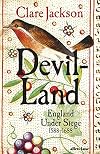
'Devil-land' is a narrative history of England (and to a much lesser extent Scotland and Ireland) from 1588 to 1688 told largely through the dispatches of diplomats to or sent overseas by the English Court (or the Protectorate) and through the propaganda pumped out as pamphlets and other works.
Jackson's diligence is not in question. As solid research, its status as winner of the Wolfson History Prize (2022) has been reasonably earned but we should not see it as the whole story by any means. show more It is certainly low on analysis and interpretation.
We are speaking here of a hundred years between the Armada when the Spanish Empire was a material threat and the invasion of the Dutch Prince of Orange, invited by much of the British Establishment to 'defend their liberties'.
One virtue of the book is the way it pinpoints something easily lost - the centrality of the execution (effectively judicial murder) of Mary, Queen of Scots, in defining foreign outrage at English political pragmatism and in setting a precedent for the execution of Charles I.
Ideology is important. Elizabeth had introduced an ideology of ruthless power that flummoxed a European political culture that placed a greater premium on the sanctity of the royal and the identification of that sanctity with such nations as existed.
This difference might be said to have been inherent in English political culture in light of the struggles between Yorkists and Lancastrians and Henry VIII's abandonment of a dynastic marriage and of the universal Catholic Church. The mystique was more in power than blood.
The Stuarts, from a stronger line of blood in their own estimation as Kings of Scotland, possessed a more European notion of the divinity of Kingship. It is the clash and management of the clash between these pragmatic and ideological visions of rule that destabilise England.
If we add in religion where High Anglicanism and then Catholicism offer more security of tenure for the divine monarch than the more demotic Low Anglican and Non-Conformist world-views then the struggle becomes national and cultural.
It would have taken highly skilled and sensitive monarchs to have preserved their prerogatives and the total allegiance of their populations (which means a popular blind eye to brutal repression of dissent). The Stuarts were self-evidently not up to that mark after James I died.
Cromwell was given a hospital pass in that respect. He could not claim 'divine' prerogative except through the providence (a sort of fatalism) of having acquired power - pragmatism justified after the fact - and his allegiances were 'Trumpian' (that half of the nation that had triumphed).
Jackson's tale of diplomatic manipulations and frustrations shows us how the political failures of the regime brought into play the foreign powers who presented themselves as threats to or allies of the differing world views in the England of the day.
We have to start with the stake of the ruling order in Protestantism which created two kinds of threat. The first was from Catholicism backing the claims of Spain and then of monarchs who might re-catholicise the country through edict over the heads of the Protestant majority.
The fear was visceral and very much overdone except that the burnings of martyrs under Mary, massacres in the French Wars of Religion and the massacres of Protestants in Ireland all created a popular fear that Catholics and invading troops would take lives and property.
The other threat was of embroilment in foreign wars at huge expense where picking one side or the other - the Dutch and the Protestant Princes or the Catholic Powers - had huge internal implications whether of high taxation, standing armies, commercial costs or alien threat.
There is no point in going through the constant shifting of influence and alliances in which five dynasties - [Spanish] Hapsburgs (initially), Stuarts, the Elector Palatines, Bourbons and the House of Orange (latterly) - played for high stakes since that is what you should read the book to understand.
Suffice it to say that part of the 'English problem' was that the interests of a dynasty - a sort of family firm - and of a self-perceived nation became almost impossible to bring into line in the eyes of both parties. Dynasticism and nationalism are often hard to reconcile under early modern conditions.
This tale of international relations and continual attempts at regime change from within and without is played out between just a few dynastic States (plus the Republican Netherlands) who saw England as of great strategic importance in their own games of continental hegemony or survival.
Although there are walk on parts for the Baltic, Russia, the Austrian Hapbsburgs, the Ottomans, the Poles and the Italians, this is a game largely played in North Western Europe between the Spanish Empire, France, the United Provinces, the German Princes, Denmark and the United Provinces.
Half way through the period, signs of future imperial struggle appear with conflicts in far away Indonesia, acquisitions through marriage and the Cromwellian raid on the Caribbean (as Elizabethans had raided the Spanish Empire before) but this is a European story and only part of it at that.
Where I would depart from Jackson (and one wonders if she was driven to this by publicists and publishers) is the attempt to make England into more of a basket case than it probably was since, barring a few years of civil war, some central authority was always present.
If we think of the state of France during the Wars of Religion and right up to the 1590s (and the Fronde and continuing tensions until Louis XIV finally stamped his authority on France), then England seems less unique. France appears a nation but is, in fact, a dynastic possession.
We can then add the disgusting warfare of the Thirty Years War before the Peace of Westphalia, the crumbling of Spanish Habsburg authority with revolts in Iberia and the constant struggle between the House of Orange and the Republic in the Netherlands.
Given that English disorder and disorders between England and Scotland and in Ireland (rather than just free and open political disagreement) were intermittent to say the least, to paint England as an extreme exception in being an example of disorder simply does not stand up.
And if it was unstable, it was unstable because it was relatively free and rarely distracted by the sort of continental adventurism that the Monarchy could ill afford and that the modern British State, though it seems not to know it, can ill afford today.
There is a confusion here of lively debate with political instability. If anything, once breakdown had been experienced in the 1640s and 1650s as a series of accidents under what must count as one of the stupidest of British monarchs matched only by his son James, elites tended to work to stability.
The problem here is not with the rambunctious English whose only fault seems to be that they were partial to the Anglican Church settlement, reducing competition for office, low taxation and their property rights and 'liberties' but with ideological monarchs trying to preserve magical beliefs.
Still, the book is excellent at giving something like real time accounts of the puzzlement of foreign aristocratic observers at this propensity of the English for individualism and excitable politics which seems to have lasted well into this century despite every elite effort to contain it.
Monarchs look weaker and a tad more stupid in this account although James I strikes us as wise in avoiding foreign entanglements and a skilled politician in keeping his ship of state on an even keel. Cromwell, of course, is one of the great men of history but still a failure in the end.
Kings were still being judged on their ability to maintain national security but national security was often interpreted in emotional and ideological ways. Parliaments were always wary of handing over resources not merely for the wrong war but to be used against themselves.
The story could be twisted into an argument against 'democracy' but this would be absurd. Regime instability was what it says on the tin. It only becomes national instability for a very short period of extreme violence from which lessons are learned. Trade generally continued regardless.
For much of this period, instability was there but superficial much like it is in the US today. The core of the regime (monarchical with attempted parliamentary restraint centred on getting cash) remained the same as different monarchs came and went. Cromwell ended up monarchical in effect.
Bursts of extreme violence did not recur very often outside the 1640s. Rebellions were generally crushed swiftly. Monarchical change in 1660 and 1689 avoided bloodshed. This is nothing like what had happened in the Thirty Years War or French Wars of Religion (Ireland excepted).
Monarchical repressions may have involved the quasi-extrajudicial murders of Stafford, most infamously of Charles I and of republicans involved in the Rye House Plot or the Monmouth rebels but killing was highly localised. There were no mass purges or slaughters in England outside the 1640s.
In other words, excepting the 1640s and the brutalities in Ireland, in general, regimes and elites were simply playing a high stakes game to stabilise the country around two competing narratives that eventually would become sanitised in a civilised way around Whigs and Tories.
We might better see the process as one of maturation in which an Anglican establishment tamed its own extremist high church, presbyterians and non conformists and the Catholic tendencies of the dynasty itself and built the capacity for peaceful regime change.
The fruits of this were the facts that the 1688 Revolution was England's last revolution (unlike in Europe), that English identity was cultural and not political so that it did not matter if Germans were monarchs and that ideological struggle could be turned into an elite game for advantage.
We see this today in the twenty first century with England 'revolting' only to get back on track with its identity in 2016, existing around a mythic monarchy with marginal power and seeing a centre-left government control the state on a ridiculously undemocratic vote without fighting in the streets.
The value of this book is not in telling the truth of England between the Armada and the Glorious Revolution but in allowing us to see just how confusing England had become to the rest of Europe, simultaneously unmanageable and expensive in attempts to influence it.
What struck this reader was that the French in particular had poured the equivalent of billions into trying to sustain a sympathetic Stuart Dynasty after 1660 (much like we pour billions into Ukraine) only to see it becoming a money pit that merely held the line against the inevitable.
In short, the England that Elizabeth created and the England that happily took on a Dutch chancer with no interest in the country shows a strong cultural and political continuity - that of a lively nation of individuals that could often get out of hand but which always veered back to the centre.
In this interpretation, the brutal Civil War of the 1640s and the republican experiment of the 1650s are still the focus of attention as necessary 'mistakes' that lance the boil of divine right dynasticism and permit the 'nation' to emerge in partnership with a more pragmatic monarchy.
In this interpretation, rather than the one implied in the book, England was only superficially unstable and the struggle to become a nation a slow process with a very bad decade or so rather than an example of a 'failed State'. England was rather a 'new-state-in-the-making'.
Still, 'Devil-land' remains an important source text for understanding this period better. Only one side of the story but a previously neglected one. The diplomats and scribblers offer insights unavailable elsewhere even if we cannot take their analytical skills for granted. show less
Jackson's diligence is not in question. As solid research, its status as winner of the Wolfson History Prize (2022) has been reasonably earned but we should not see it as the whole story by any means. show more It is certainly low on analysis and interpretation.
We are speaking here of a hundred years between the Armada when the Spanish Empire was a material threat and the invasion of the Dutch Prince of Orange, invited by much of the British Establishment to 'defend their liberties'.
One virtue of the book is the way it pinpoints something easily lost - the centrality of the execution (effectively judicial murder) of Mary, Queen of Scots, in defining foreign outrage at English political pragmatism and in setting a precedent for the execution of Charles I.
Ideology is important. Elizabeth had introduced an ideology of ruthless power that flummoxed a European political culture that placed a greater premium on the sanctity of the royal and the identification of that sanctity with such nations as existed.
This difference might be said to have been inherent in English political culture in light of the struggles between Yorkists and Lancastrians and Henry VIII's abandonment of a dynastic marriage and of the universal Catholic Church. The mystique was more in power than blood.
The Stuarts, from a stronger line of blood in their own estimation as Kings of Scotland, possessed a more European notion of the divinity of Kingship. It is the clash and management of the clash between these pragmatic and ideological visions of rule that destabilise England.
If we add in religion where High Anglicanism and then Catholicism offer more security of tenure for the divine monarch than the more demotic Low Anglican and Non-Conformist world-views then the struggle becomes national and cultural.
It would have taken highly skilled and sensitive monarchs to have preserved their prerogatives and the total allegiance of their populations (which means a popular blind eye to brutal repression of dissent). The Stuarts were self-evidently not up to that mark after James I died.
Cromwell was given a hospital pass in that respect. He could not claim 'divine' prerogative except through the providence (a sort of fatalism) of having acquired power - pragmatism justified after the fact - and his allegiances were 'Trumpian' (that half of the nation that had triumphed).
Jackson's tale of diplomatic manipulations and frustrations shows us how the political failures of the regime brought into play the foreign powers who presented themselves as threats to or allies of the differing world views in the England of the day.
We have to start with the stake of the ruling order in Protestantism which created two kinds of threat. The first was from Catholicism backing the claims of Spain and then of monarchs who might re-catholicise the country through edict over the heads of the Protestant majority.
The fear was visceral and very much overdone except that the burnings of martyrs under Mary, massacres in the French Wars of Religion and the massacres of Protestants in Ireland all created a popular fear that Catholics and invading troops would take lives and property.
The other threat was of embroilment in foreign wars at huge expense where picking one side or the other - the Dutch and the Protestant Princes or the Catholic Powers - had huge internal implications whether of high taxation, standing armies, commercial costs or alien threat.
There is no point in going through the constant shifting of influence and alliances in which five dynasties - [Spanish] Hapsburgs (initially), Stuarts, the Elector Palatines, Bourbons and the House of Orange (latterly) - played for high stakes since that is what you should read the book to understand.
Suffice it to say that part of the 'English problem' was that the interests of a dynasty - a sort of family firm - and of a self-perceived nation became almost impossible to bring into line in the eyes of both parties. Dynasticism and nationalism are often hard to reconcile under early modern conditions.
This tale of international relations and continual attempts at regime change from within and without is played out between just a few dynastic States (plus the Republican Netherlands) who saw England as of great strategic importance in their own games of continental hegemony or survival.
Although there are walk on parts for the Baltic, Russia, the Austrian Hapbsburgs, the Ottomans, the Poles and the Italians, this is a game largely played in North Western Europe between the Spanish Empire, France, the United Provinces, the German Princes, Denmark and the United Provinces.
Half way through the period, signs of future imperial struggle appear with conflicts in far away Indonesia, acquisitions through marriage and the Cromwellian raid on the Caribbean (as Elizabethans had raided the Spanish Empire before) but this is a European story and only part of it at that.
Where I would depart from Jackson (and one wonders if she was driven to this by publicists and publishers) is the attempt to make England into more of a basket case than it probably was since, barring a few years of civil war, some central authority was always present.
If we think of the state of France during the Wars of Religion and right up to the 1590s (and the Fronde and continuing tensions until Louis XIV finally stamped his authority on France), then England seems less unique. France appears a nation but is, in fact, a dynastic possession.
We can then add the disgusting warfare of the Thirty Years War before the Peace of Westphalia, the crumbling of Spanish Habsburg authority with revolts in Iberia and the constant struggle between the House of Orange and the Republic in the Netherlands.
Given that English disorder and disorders between England and Scotland and in Ireland (rather than just free and open political disagreement) were intermittent to say the least, to paint England as an extreme exception in being an example of disorder simply does not stand up.
And if it was unstable, it was unstable because it was relatively free and rarely distracted by the sort of continental adventurism that the Monarchy could ill afford and that the modern British State, though it seems not to know it, can ill afford today.
There is a confusion here of lively debate with political instability. If anything, once breakdown had been experienced in the 1640s and 1650s as a series of accidents under what must count as one of the stupidest of British monarchs matched only by his son James, elites tended to work to stability.
The problem here is not with the rambunctious English whose only fault seems to be that they were partial to the Anglican Church settlement, reducing competition for office, low taxation and their property rights and 'liberties' but with ideological monarchs trying to preserve magical beliefs.
Still, the book is excellent at giving something like real time accounts of the puzzlement of foreign aristocratic observers at this propensity of the English for individualism and excitable politics which seems to have lasted well into this century despite every elite effort to contain it.
Monarchs look weaker and a tad more stupid in this account although James I strikes us as wise in avoiding foreign entanglements and a skilled politician in keeping his ship of state on an even keel. Cromwell, of course, is one of the great men of history but still a failure in the end.
Kings were still being judged on their ability to maintain national security but national security was often interpreted in emotional and ideological ways. Parliaments were always wary of handing over resources not merely for the wrong war but to be used against themselves.
The story could be twisted into an argument against 'democracy' but this would be absurd. Regime instability was what it says on the tin. It only becomes national instability for a very short period of extreme violence from which lessons are learned. Trade generally continued regardless.
For much of this period, instability was there but superficial much like it is in the US today. The core of the regime (monarchical with attempted parliamentary restraint centred on getting cash) remained the same as different monarchs came and went. Cromwell ended up monarchical in effect.
Bursts of extreme violence did not recur very often outside the 1640s. Rebellions were generally crushed swiftly. Monarchical change in 1660 and 1689 avoided bloodshed. This is nothing like what had happened in the Thirty Years War or French Wars of Religion (Ireland excepted).
Monarchical repressions may have involved the quasi-extrajudicial murders of Stafford, most infamously of Charles I and of republicans involved in the Rye House Plot or the Monmouth rebels but killing was highly localised. There were no mass purges or slaughters in England outside the 1640s.
In other words, excepting the 1640s and the brutalities in Ireland, in general, regimes and elites were simply playing a high stakes game to stabilise the country around two competing narratives that eventually would become sanitised in a civilised way around Whigs and Tories.
We might better see the process as one of maturation in which an Anglican establishment tamed its own extremist high church, presbyterians and non conformists and the Catholic tendencies of the dynasty itself and built the capacity for peaceful regime change.
The fruits of this were the facts that the 1688 Revolution was England's last revolution (unlike in Europe), that English identity was cultural and not political so that it did not matter if Germans were monarchs and that ideological struggle could be turned into an elite game for advantage.
We see this today in the twenty first century with England 'revolting' only to get back on track with its identity in 2016, existing around a mythic monarchy with marginal power and seeing a centre-left government control the state on a ridiculously undemocratic vote without fighting in the streets.
The value of this book is not in telling the truth of England between the Armada and the Glorious Revolution but in allowing us to see just how confusing England had become to the rest of Europe, simultaneously unmanageable and expensive in attempts to influence it.
What struck this reader was that the French in particular had poured the equivalent of billions into trying to sustain a sympathetic Stuart Dynasty after 1660 (much like we pour billions into Ukraine) only to see it becoming a money pit that merely held the line against the inevitable.
In short, the England that Elizabeth created and the England that happily took on a Dutch chancer with no interest in the country shows a strong cultural and political continuity - that of a lively nation of individuals that could often get out of hand but which always veered back to the centre.
In this interpretation, the brutal Civil War of the 1640s and the republican experiment of the 1650s are still the focus of attention as necessary 'mistakes' that lance the boil of divine right dynasticism and permit the 'nation' to emerge in partnership with a more pragmatic monarchy.
In this interpretation, rather than the one implied in the book, England was only superficially unstable and the struggle to become a nation a slow process with a very bad decade or so rather than an example of a 'failed State'. England was rather a 'new-state-in-the-making'.
Still, 'Devil-land' remains an important source text for understanding this period better. Only one side of the story but a previously neglected one. The diplomats and scribblers offer insights unavailable elsewhere even if we cannot take their analytical skills for granted. show less
I am torn in rating this book, as it is insightful and makes unexpected connections. However, even as a general reader who has already read half a dozen histories of similar or shorter periods during this broadly seventeenth century period, I found this book hard going at times, as so many names are bandied about. I suspect that it is a specialist book dressed up as a general history.
Jackson sets herself the unenviable task of providing sufficient general historical background (with which show more readers about the period are probably already aware), before providing the impressions of external courtiers, ambassadors, clerics and businessmen into primarily English politics.
Following an introductory chapter foreshadowing the alleged incomprehension with which English politics was viewed by foreign ambassadors and visitors in the period from 1588 to 1688, the first chapter discusses the execution of Mary, Queen of Scots, in 1587 after nineteen years’ imprisonment in England. This is described as the first regicide by royalty, with Mary, Queen of Scots, and Elizabeth I both being granddaughters of Henry VII, and Mary being a Scottish queen and widow of a French king, but considered ineligible to succeed to the English throne as she was Roman Catholic. I also had not taken on board (or remembered) that the king of Scotland, James VI, was Mary’s son (but Protestant) and that it had been agreed that he was to succeed Elizabeth upon her death (which he did in 1603). Elizabeth was reviled abroad as “an immoral, heretic bastard, responsible for Mary’s death.”
I would consider Devil-Land a supplementary book about this hundred year period, as it necessarily only offers brief insights from a foreign perspective into the major events, with which I have a little familiarity, as I have read several histories of the period recently. Devil -Land was interesting, but not essential.
However, because it looks at English history from a foreign viewpoint I did find that some of the observations recorded were surprising or unexpected. For example, I found the discussion of the German Palatinate [based in Heidelberg, where Elizabeth Stuart (daughter of James I of England) had married Frederick, the Elector of the Palatinate] very interesting in explaining how early Stuart England/Great Britain was viewed from the European perspective. Also due to political concern to ensure Catholic Spain and France did not unite against the Protestant Protectorate, England entered into an alliance with Catholic France rather than fellow Protestant Netherlands (United Provinces). show less
Jackson sets herself the unenviable task of providing sufficient general historical background (with which show more readers about the period are probably already aware), before providing the impressions of external courtiers, ambassadors, clerics and businessmen into primarily English politics.
Following an introductory chapter foreshadowing the alleged incomprehension with which English politics was viewed by foreign ambassadors and visitors in the period from 1588 to 1688, the first chapter discusses the execution of Mary, Queen of Scots, in 1587 after nineteen years’ imprisonment in England. This is described as the first regicide by royalty, with Mary, Queen of Scots, and Elizabeth I both being granddaughters of Henry VII, and Mary being a Scottish queen and widow of a French king, but considered ineligible to succeed to the English throne as she was Roman Catholic. I also had not taken on board (or remembered) that the king of Scotland, James VI, was Mary’s son (but Protestant) and that it had been agreed that he was to succeed Elizabeth upon her death (which he did in 1603). Elizabeth was reviled abroad as “an immoral, heretic bastard, responsible for Mary’s death.”
I would consider Devil-Land a supplementary book about this hundred year period, as it necessarily only offers brief insights from a foreign perspective into the major events, with which I have a little familiarity, as I have read several histories of the period recently. Devil -Land was interesting, but not essential.
However, because it looks at English history from a foreign viewpoint I did find that some of the observations recorded were surprising or unexpected. For example, I found the discussion of the German Palatinate [based in Heidelberg, where Elizabeth Stuart (daughter of James I of England) had married Frederick, the Elector of the Palatinate] very interesting in explaining how early Stuart England/Great Britain was viewed from the European perspective. Also due to political concern to ensure Catholic Spain and France did not unite against the Protestant Protectorate, England entered into an alliance with Catholic France rather than fellow Protestant Netherlands (United Provinces). show less
Lists
Awards


You May Also Like


Statistics
- Works
- 4
- Members
- 318
- Popularity
- #74,347
- Rating
- 3.9
- Reviews
- 2
- ISBNs
- 13