
Edward Lear (1812–1888)
Author of The Owl and the Pussycat (Jan Brett)
About the Author
Edward Lear was born in Holloway, England, to Jeremiah (a stockbroker) and Ann Lear, tutored at home by his sister, and briefly attended the Royal Academy schools. Both an author and an illustrator, he earned his living as an artist from the age of 15, mainly by doing landscapes. What he is show more remembered for is his nonsense books, especially his popularization of the limerick. Along with Lewis Carroll, he is considered to be the founder of nonsense poetry. In addition to his limericks, he created longer nonsense poems. The best---and best known---is The Jumblies, in which the title characters go to sea in a sieve; it is a brilliant, profound, silly, and sad expression of the need to leave the security of the known world and experience the wonder and danger of the unknown. His other most notable work is The Owl and the Pussy Cat, a less complex poem whose title characters also go to sea. Lear produced humorous alphabets and botany books as well. His wordplay, involving puns, neologisms, portmanteau words, and anticlimax, retains its vitality today and has influenced such contemporary writers of children's nonsense verse as Shel Silverstein, Ogden Nash, and Laura Richards (Bowker Author Biography) show less
Image credit: Engraved by Andrew from a photograph taken in San Remo, by Roncarolo.
Works by Edward Lear
The Nonsense Books: The Complete Collection of the Nonsense Books of Edward Lear (with Over 400 Original Illustrations) (2009) 19 copies
THERE WAS A YOUNG LADY WHOSE NOSE...AND OTHER NONSENSE RHYMES by Edward Lear edited by Alice Mills (1999 Hardcover 9 x 6 inches 125 pages Mynah / Random House AU) (1999) 14 copies, 1 review
Edward Lear in the Levant: Travels in Albania, Greece and Turkey in Europe, 1848-49 (1988) 10 copies
Delphi Complete Poetical Works of Edward Lear (Illustrated) (Delphi Poets Series Book 41) (2014) 9 copies
Nonsense songs and laughable lyrics 9 copies
Children's Classics Box Set: The Hare And The Tortoise And Other Fables/ There Was A Young Lady Whose Nose And Other Nonsense Rhymes (1999) 8 copies
Edward Lear, the Corfu years : a chronicle presented through his letters and journals (1988) 8 copies
The history of the 7 families of the Lake Pipple-Popple, and The story of the 4 little children who went round the world (1968) 7 copies
Edward Lear in Greece; a loan exhibition from the Gennadius Library, Athens. Circulated by the International Exhibitions Foundation, 1971-1972 (1971) 7 copies
The Walrus and the Carpenter and Other Nonsense Verse (Mini Classics) (Mini Classics) (1993) 6 copies
Nonsense books. By: Edward Lear, with all the original illustrations: (Children's Classics) (2017) 6 copies
Later letters of Edward Lear, author of "The book of nonsense" to Chichester Fortescue (lord Carlingford), Lady Waldegrave and others (1977) 5 copies
Про то, чего не может быть 3 copies
The book of nonsense to which is added more nonsense, with all the original pictures and verses (1900) 3 copies
LEAR IN THE ORIGINAL: Drawings and Limericks by Edward Lear for his Book of Nonsense (1975) 3 copies
Lear’s Book of Nonsense 2 copies
Edward Lear 2 copies
Lear in Sicily: Twenty line drawings by Edward Lear illustrating a tour made in May--July 1847 in the company of Jo (1938) 2 copies, 1 review
Edward Lear in Southern Italy : Journals of a Landscape Painter in Southern Calabria and the Kingdom of Naples (1964) 2 copies
Limericks; verses 2 copies
LIMERICKS BY LEAR. 1 copy
Kniha třesků a plesků 1 copy
O livro dos disparates 1 copy
Мир вверх тормашками 1 copy
Книга чепухи 1 copy
LIMERICKS BY LEAR. 1 copy
SEM CABEÇA E SEM PE 1 copy
Nonsense Books 1888 1 copy
SEM CABEÇA NEM PÉ 1 copy
How pleasant to know Mr. Lear. For narrator and orchetra. [Score.] — Lyrics — 1 copy
Kringle Krangles hat 1 copy
El omnibus, sin sentido 1 copy
Edward Lear's Birds 1 copy
Edward Lear's Indian Journal: Watercolours and extracts from the diary of Edward Lear (1873-1875) (1953) 1 copy
Minette et le hibou 1 copy
De Uil en de Poes 1 copy
Edward Lears Nonsense Book 1 copy
Edward Lears Kompletter Nonsens II. Zweite Lieferung. Lieder, Balladen und Geschichten. (1985) 1 copy
Favorite Funny Poems 1 copy
O Livro dos Disparates 1 copy
Libro dei nonsense, Il 1 copy
Edward Lear Limericks--Three Books in One: The Owl and the Pussy Cat, the Duck & the Kangaroo, and a Book of Nonsense (2010) 1 copy
Edward Lears kompletter Nonsens. Ins Deutsche geschmuggelt von Hans Magnus Enzensberger (1977) 1 copy
Edward Lear sketches of parrots relating to illustrations of the family of Psittacidae, or parrots 1 copy
Uued rõivad : [luuletus] 1 copy
Associated Works
The Best Poems of the English Language: From Chaucer Through Robert Frost (2004) — Contributor — 1,250 copies, 3 reviews
The Illustrated Treasury of Children's Literature, Volumes 1-2 (1955) — Contributor — 523 copies, 4 reviews
World Poetry: An Anthology of Verse from Antiquity to Our Time (1998) — Contributor — 499 copies, 2 reviews
The Norton Anthology of English Literature, 4th Edition, Volume 2 (1979) — Contributor — 271 copies, 1 review
Nursery Rhyme Comics: 50 Timeless Rhymes from 50 Celebrated Cartoonists (2011) — Contributor — 227 copies, 27 reviews
The Graphic Canon, Vol. 2: From "Kubla Khan" to the Brontë Sisters to The Picture of Dorian Gray (2012) — Contributor — 213 copies, 2 reviews
The Children's Treasury: Best Loved Stories and Poems from Around the World (1987) — Contributor — 164 copies, 2 reviews
The Sophisticated Cat: A Gathering of Stories, Poems, and Miscellaneous Writings About Cats (1992) — Contributor — 112 copies, 1 review
The Graphic Canon of Children's Literature: The World's Greatest Kids' Lit as Comics and Visuals (2014) — Contributor — 101 copies, 1 review
Buzz Words: Poems About Insects (Everyman's Library Pocket Poets Series) (2021) — Contributor — 56 copies
The Dedalus Book of British Fantasy: 19th Century (European Literary Fantasy Anthologies) (1991) — Contributor — 47 copies
Edward Lear (Holloway 1812-Sanremo 1888) — Photographer — 1 copy
Tagged
Common Knowledge
- Canonical name
- Lear, Edward
- Legal name
- Lear, Edward
- Birthdate
- 1812-05-12
- Date of death
- 1888-01-29
- Gender
- male
- Education
- Royal Academy Schools
- Occupations
- poet
painter
illustrator - Organizations
- Zoological Society
- Relationships
- Church, Charles (friend)
Tennyson, Alfred (friend)
Tennyson, Emily Sellwood Tennys (friend)
Ruskin, John (friend) - Cause of death
- heart disease
- Nationality
- UK
- Birthplace
- Holloway, Middlesex, England, UK
- Places of residence
- Rome, Italy
Corfu, Greece - Place of death
- San Remo, Liguria, Italy
- Burial location
- Cimitero monumentale della foce, Sanremo, Italy
- Map Location
- England, UK
Members
Reviews
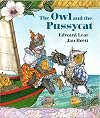
I've read several illustrated versions of the Owl and the Pussycat, and hands-down, this one has the MOST GORGEOUS illustrations I've ever seen! My only complaint about this book is that it wasn't bigger, because the illustrations really do merit closer study (the dimensions of this book are relatively small, the pages are not paper, but cardboard, so this is a book designed to stand up to wear and tear from smaller kids, and these kinds of books usually tend to be smaller length and show more width-wise for easier handling by smaller hands)
There is not one single page that does not have beautiful illustrations. The feathers on the owl are individually-drawn, and the cat looks too adorable in her dress. The poem itself might be silly, but the illustrations really do bring the words to life. show less
There is not one single page that does not have beautiful illustrations. The feathers on the owl are individually-drawn, and the cat looks too adorable in her dress. The poem itself might be silly, but the illustrations really do bring the words to life. show less

I was initially drawn to Jan Brett’s artwork for it’s Ukrainian and Eastern European flavour, but I love the fact that she explores other cultures for different books. Poems like Lear’s “The Owl and the Pussycat” do not focus on specific tropes or use culture-specific language, so they are the perfect literary medium to pair with an experimental style, which Brett does in this instance by choosing to place the Owl and the Pussycat in a decidedly South American setting. Even though show more Brett moves away from her signature detailed-border style with this book I still found that the artwork tells of the couple’s journey across the ocean very effectively. She uses the frame of the ocean to give montages of sea-life and really pushes the boundaries of composition to give Lear’s simplistic poem more depth, picturing the Owl catching dinner in the ocean and the Pussycat’s insistent attitude that they marry. The story may not have the unique draw of Brett’s Ukrainian folktales, but it is a charming addition to her oeuvre none-the-less! show less

Edward Lear's classic children's poem, originally included in his 1871 collection, Nonsense Songs, Stories, Botany, and Alphabets, is here presented in picture-book form, with lovely watercolor illustrations by Charlotte Voake. As the story unfolds, the titular strigine and feline heroes head to sea in a pea-green boat, serenading and then proposing to one another, before wedding in a tropical paradise. The poem concludes as the happy pair dances by the light of the moon...
Although long show more aware of The Owl and the Pussy-Cat, which was recently named Britain's favorite children's poem, I had never had the pleasure of reading it, before picking up this edition illustrated by Voake. I'm glad that I finally got around to it, as it is a wonderful little work, one that is immense fun to read to aloud, and one whose imaginative nonsense leaves the reader wanting more. Fortunately for them, popular British children's author Julia Donaldson recently penned a sequel, The Further Adventures of The Owl and the Pussy-Cat, also illustrated by Voake. show less
Although long show more aware of The Owl and the Pussy-Cat, which was recently named Britain's favorite children's poem, I had never had the pleasure of reading it, before picking up this edition illustrated by Voake. I'm glad that I finally got around to it, as it is a wonderful little work, one that is immense fun to read to aloud, and one whose imaginative nonsense leaves the reader wanting more. Fortunately for them, popular British children's author Julia Donaldson recently penned a sequel, The Further Adventures of The Owl and the Pussy-Cat, also illustrated by Voake. show less

This is a wonderful book and not just for lovers of travel. Edward Lear, renowned for his nonsense verse and his exquisite water colours came to Crete in 1864 and this beautiful volume records his travels and experiences in Crete. Lear came to Crete after a long and loving sojourn in Corfu.
First let me deal with the book qua book. The copy I have is a particularly fine production that was published in Athens in the 'Romiosyni Series' (studies and translations in the field of modern Greek show more culture). I quote from an entry on Abebooks : "Full brown cloth, illus. blocked in gilt to front board; 117pp.; illus. bw. drawings/tipped-in col. plates". This a truly handsome book that is lovely to behold and grand to hold. The illustrations are Lear's own work and are beautiful (BTW when they say tipped in it indicates that the illustrations are printed separately from the book itself and are effectively glued onto the pages. There are intruguing sketches, gorgeous watercolours and, amusing cartoons scattered throughout the text which is quarto in format. It also includes a map, a glossary, and an index. What more could one want in a travel book?
The text is adapted from Lear's handwritten journal and at least one page of his actual journal is reproduced. Lear managed to arrive in Crete during a particularly wet and cold April and stayed until May and while the weather improved during his stay it clearly influenced his opinions and they are also coloured by comparison to his beloved Corfu. For all of the negative taint Lear still finds the people unremittingly kind and generous, if dirty and odorous. The landscapes and the crops - such as he can see them - leave him largely unimpressed but for a modern reader comparing the historic landscapes and the current is enlightening. I, for one, had never realised or noticed that the olive trees at the westernmost end of the island are stunted but, on close inspection, it holds true to this day. Some Cretophiles I have spoken with found Lear's somewhat disparaging descriptions a barrier to enjoying this magnificent volume but I had no such problem. I love this book and will recommend it to anyone and everyone. show less
First let me deal with the book qua book. The copy I have is a particularly fine production that was published in Athens in the 'Romiosyni Series' (studies and translations in the field of modern Greek show more culture). I quote from an entry on Abebooks : "Full brown cloth, illus. blocked in gilt to front board; 117pp.; illus. bw. drawings/tipped-in col. plates". This a truly handsome book that is lovely to behold and grand to hold. The illustrations are Lear's own work and are beautiful (BTW when they say tipped in it indicates that the illustrations are printed separately from the book itself and are effectively glued onto the pages. There are intruguing sketches, gorgeous watercolours and, amusing cartoons scattered throughout the text which is quarto in format. It also includes a map, a glossary, and an index. What more could one want in a travel book?
The text is adapted from Lear's handwritten journal and at least one page of his actual journal is reproduced. Lear managed to arrive in Crete during a particularly wet and cold April and stayed until May and while the weather improved during his stay it clearly influenced his opinions and they are also coloured by comparison to his beloved Corfu. For all of the negative taint Lear still finds the people unremittingly kind and generous, if dirty and odorous. The landscapes and the crops - such as he can see them - leave him largely unimpressed but for a modern reader comparing the historic landscapes and the current is enlightening. I, for one, had never realised or noticed that the olive trees at the westernmost end of the island are stunted but, on close inspection, it holds true to this day. Some Cretophiles I have spoken with found Lear's somewhat disparaging descriptions a barrier to enjoying this magnificent volume but I had no such problem. I love this book and will recommend it to anyone and everyone. show less
Lists
Awards


You May Also Like


Associated Authors
Statistics
- Works
- 309
- Also by
- 61
- Members
- 11,266
- Popularity
- #2,088
- Rating
- 4.0
- Reviews
- 217
- ISBNs
- 620
- Languages
- 19
- Favorited
- 13
