
Frank O'Hara (1926–1966)
Author of Lunch Poems
About the Author
Frank O'Hara 1926-1966 Poet Frank O'Hara was born in Baltimore, MD and raised in Massachusetts. He served in the Navy and then studied at Harvard and the University of Michigan. From 1952 to 1966, O'Hara was on the staff at the Museum of Modern Art. He was a critic and a playwright and stayed show more active in the art scene. O'Hara published six books of poetry from 1952 until his death. Frank O'Hara died in 1966 when he was run down by a dune buggy on Fire Island. The Collected Poems of Frank O'Hara edited by Donald Allen (Knopf, 1971), the first of several posthumous collections, shared the 1972 National Book Award for Poetry. (Bowker Author Biography) show less
Image credit: Photo © Gianni Bates
Works by Frank O'Hara
The Arion Press announces publication of a limited edition of Biotherm (for Bill Berkson) : the last long poem of the late Frank O'Hara (1926-1966) with forty-two lithographs… (1990) 5 copies, 1 review
Larry Rivers; an exhibition of the Poses Institute of Fine Arts, Brandeis University (1965) 3 copies
The Great American Artists Series: Albert P. Ryder, Jackson Pollock, Stuart Davis, Thomas Eakins, Willem de Kooning, Win (1959) 3 copies
Till minne av mina känslor : dikter 2 copies
The Collected Poems of Frank O'Hara 2 copies
A city winter and other poems 2 copies
Two Pieces 1 copy
Having a Coke with You 1 copy
Poesie 1 copy
Arshile Gorky 1 copy
Nature and new painting 1 copy
Associated Works
The Making of a Poem: A Norton Anthology of Poetic Forms (2000) — Contributor — 1,464 copies, 9 reviews
World Poetry: An Anthology of Verse from Antiquity to Our Time (1998) — Contributor — 496 copies, 2 reviews
Gay and Lesbian Poetry in Our Time (Stonewall Inn Editions) (1988) — Contributor — 189 copies, 1 review
Poetry Speaks Expanded: Hear Poets Read Their Own Work from Tennyson to Plath (2007) — Contributor — 157 copies, 2 reviews
The Norton Anthology of American Literature, Volume 2: 1865 to Present (1979) — Contributor, some editions — 135 copies
Writing New York: A Literary Anthology (Expanded 10th-Anniversary Edition) (2008) — Contributor — 101 copies, 1 review
A Controversy of Poets: An Anthology of Contemporary American Poetry, (1965) — Contributor — 83 copies
The Heath Anthology of American Literature, Concise Edition (2003) — Contributor — 72 copies, 1 review
The Serpent and the Fire: Poetries of the Americas from Origins to Present (2024) — Contributor — 15 copies
Sunlight on the River: Poems About Paintings, Paintings About Poems (2015) — Contributor — 11 copies, 2 reviews
Locus Solus I — Contributor — 5 copies
Locus Solus V — Contributor — 1 copy
Tagged
Common Knowledge
- Canonical name
- O'Hara, Frank
- Legal name
- O'Hara, Francis Russell
- Birthdate
- 1926-06-27
- Date of death
- 1966-07-25
- Gender
- male
- Education
- New England Conservatory
Harvard University (A.B. | English | 1950)
University of Michigan (M.A. | English Literature | 1951) - Occupations
- poet
assistant curator
art critic
playwright - Organizations
- Museum of Modern Art
United States Navy
New School for Social Research - Awards and honors
- National Book Award for Poetry (1972)
- Relationships
- LeSueur, Joe (companion)
- Cause of death
- ruptured liver (after being hit by car on Fire Island)
- Nationality
- USA
- Birthplace
- Baltimore, Maryland, USA
- Places of residence
- Grafton, Massachusetts, USA
New York, New York, USA - Place of death
- Mastic Beach, Long Island, New York, USA
- Burial location
- Green River Cemetery, East Hampton, New York, USA
- Associated Place (for map)
- New York, USA
Members
Reviews

I came to this because Don Draper came to this and I now have this piece of surreal word art in common with him. It is art, I am convinced. The words are asploshed in colors and hues and have ceased to mean what they meant before their reading. It’s weird. It’s not bad, just weird.
Maybe, the Beat Generation was akin to our GenZ, a fragmented, disoriented group trying to find something that holds them together in a world that seems to be more concerned with highlighting their show more differences.
Words serve as symbols, placeholders for an intention. When the intention shifts, and what is old is released and no longer needed maybe that is when words take on new meanings for a new group who have no desire to share in the old ways and are not given to the old intentions. Beat poets are train conductors announcing the next stop and where you ought to look to find your follow-on connections.
I suspect O’Hara was here heralding a new era, a new thought process. At this juncture, though, some 3 generations later, it is probably fair to wonder what the point was, and if it really mattered. show less
Maybe, the Beat Generation was akin to our GenZ, a fragmented, disoriented group trying to find something that holds them together in a world that seems to be more concerned with highlighting their show more differences.
Words serve as symbols, placeholders for an intention. When the intention shifts, and what is old is released and no longer needed maybe that is when words take on new meanings for a new group who have no desire to share in the old ways and are not given to the old intentions. Beat poets are train conductors announcing the next stop and where you ought to look to find your follow-on connections.
I suspect O’Hara was here heralding a new era, a new thought process. At this juncture, though, some 3 generations later, it is probably fair to wonder what the point was, and if it really mattered. show less
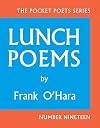
I've been meaning to read this book since falling in love with "Why I am Not a Painter" back when I took that Modern Poetry class. I slipped into my bag when I was heading out to take my twelve-year-old to the ACT -- and read most of it while sitting with the other parents of adolescents taking the test early -- and occasionally giggling, to the surprise of the other parents.
But the early poems are so well-crafted, so light and funny and accessible and easy. Making me wish I lived the kind show more of life that afforded me hour long lunch breaks on the streets of New York City. As the collection goes on, though, many of the poems are more and more opaque, and suddenly it was work to fight my way into them. Not that they wouldn't be worth the work, but it left me wishing that the entire collection was all "lunch poems."
But as someone who has recently jumped into publishing, perhaps my favorite part of the book was the unexpected inclusion of the correspondence between O'Hara and his publisher, Lawrence Ferlinghetti, on the acceptance and formation of this work.
Now I need a copy of the collection with "Why I am Not a Painter." show less
But the early poems are so well-crafted, so light and funny and accessible and easy. Making me wish I lived the kind show more of life that afforded me hour long lunch breaks on the streets of New York City. As the collection goes on, though, many of the poems are more and more opaque, and suddenly it was work to fight my way into them. Not that they wouldn't be worth the work, but it left me wishing that the entire collection was all "lunch poems."
But as someone who has recently jumped into publishing, perhaps my favorite part of the book was the unexpected inclusion of the correspondence between O'Hara and his publisher, Lawrence Ferlinghetti, on the acceptance and formation of this work.
Now I need a copy of the collection with "Why I am Not a Painter." show less

Frank O’Hara is a rallying call to the greatness within. The blooming and texture and momentum of his language carry one through at once wholly idiosyncratic, at once cannily universal pictures of truth. Such fight and such mastery. I love the compounding, diversifying images, their momentum and the vital cadence of the language that delivers them.

“Ut pictura poesis,” Horace wrote in the first century BC. “As is painting so is poetry.”
In his Poetry Foundation blog post “Poets and Painters”, Martin Earl writes “Painters and poets have been wed from the beginning. Language itself has pictorial roots. …Poets are attracted to the symbolic and pictographic traces of their own language in painting. For poets, painting is full of atavistic vocabularies. Painters, on the other hand, have always looked to poets to articulate show more what we might call their sublime backwardness.”
Frank O’Hara was part of the “New York School” of poets, a title borrowed from the painters in New York city whose circles Frank frequented. Painters were his friends and art was a big part of his life. He worked at various jobs at the Museum of Modern Art, wrote regular art criticism, and was the curator of several exhibitions of painters of the Abstract Expressionist movement.
If he was here to see it, I think the Arion Press edition would be especially pleasing to this “poet among painters”. O’Hara took deliberate care in the spaces, indents, and line lengths for the poem, and the generous page size of the AP edition allows these to be printed as intended and gives Dine space to meld his art into a poem that resonated with him from the first time he read it. In the Publisher’s Note, Andrew Hoyem writes that “The poem signified for Dine a literary equivalent to his own disjunctive impulses in visual art” and goes on to state that
“Dine’s work elevates this publication to a true livre d’artiste: Here is an artist inspired by a work of literature, paying homage to it and to the writer with a visual interpretation and interpenetration.”
The sheer size of the pages, with text unencumbered by a constrained page, and the images Dine drew into and around the text, created a powerful reading experience as I read through the poem. Poetry by nature speaks in metaphor and allusion and I have to say that I was reminded of that prose master of allusion, James Joyce. This is not a bad thing for me, as I enjoy the work of unraveling his works, especially if I have a skeleton key or some annotations to help me along. And lo and behold, Bill Berkson has provided a glossary to help with some of the more obscure references, quotations, and allusions in the poem.
Berkson, to whom the poem is dedicated, also contributed the essay “Air and Such” to be included with the AP edition. He says,
It [Biotherm] portrays the relationship of two very close friends in their ways of speaking together. To some degree, any two friends talk with one another as neither would with anyone else. This is a function of what Frank O’Hara called “the appropriate sense of space”—the fluctuating space that two people feel and invent between themselves.
Those who venture to read Biotherm have the honor of being invited into this space that formed between the two poets.
As I’ve mentioned a couple of times, Biotherm is huge and its impact is commensurate with that physical size! The unbound sheets are 22 by 15 inches. The paper is English mouldmade T. H. Saunders Waterford. I’m not sure I’ve run across this particular paper before but 23 years after printing, it still smells divine when you open up the portfolio box. Being unbound sheets actually made the reading even more enjoyable as one could hold a sheet at a time or simply flip them over within the box. If sheets of this size were bound it would limit how the book could be read. All in all, I’d have to say this is one of the gems in the crown of the Arion Press.
Going back to a favorite passage in Berkson’s essay:
It [Biotherm] seems to be saying, “Since we don’t love each other in any ordinary way, what are we doing in each others life?” and then: “but doing without each other is much more insane.”
Ah, poets! That statement kind of sums up my relationship with and love for poetry. And I can’t think of any better way to be introduced to the poetry of Frank O’Hara than the Arion Press edition of Biotherm. This is a worthy addition to any library. Although probably one of the more collectible of the Arion Press titles due to the stature of the artist, don’t just collect it. Read it. We can all use more poetry in our lives.
AVAILABILITY: The Arion Press Biotherm was issued in an edition of 150, with 25 of them accompanied by an extra suite of eight gravure prints selected from the images in the book. Both the stand-alone book and the book with the suite of prints are still available from the Press. If you are a subscriber, it seems they are offering a special price on the book through the end of August 2013.
NOTE: The Whole Book Experience would like to thank Andrew Hoyem and the Arion Press for the generosity that made this review possible.
For more book reviews, including the physical book and overall reading experience, visit my blog The Whole Book Experience at http://www.thewholebookexperience.com/ show less
In his Poetry Foundation blog post “Poets and Painters”, Martin Earl writes “Painters and poets have been wed from the beginning. Language itself has pictorial roots. …Poets are attracted to the symbolic and pictographic traces of their own language in painting. For poets, painting is full of atavistic vocabularies. Painters, on the other hand, have always looked to poets to articulate show more what we might call their sublime backwardness.”
Frank O’Hara was part of the “New York School” of poets, a title borrowed from the painters in New York city whose circles Frank frequented. Painters were his friends and art was a big part of his life. He worked at various jobs at the Museum of Modern Art, wrote regular art criticism, and was the curator of several exhibitions of painters of the Abstract Expressionist movement.
If he was here to see it, I think the Arion Press edition would be especially pleasing to this “poet among painters”. O’Hara took deliberate care in the spaces, indents, and line lengths for the poem, and the generous page size of the AP edition allows these to be printed as intended and gives Dine space to meld his art into a poem that resonated with him from the first time he read it. In the Publisher’s Note, Andrew Hoyem writes that “The poem signified for Dine a literary equivalent to his own disjunctive impulses in visual art” and goes on to state that
“Dine’s work elevates this publication to a true livre d’artiste: Here is an artist inspired by a work of literature, paying homage to it and to the writer with a visual interpretation and interpenetration.”
The sheer size of the pages, with text unencumbered by a constrained page, and the images Dine drew into and around the text, created a powerful reading experience as I read through the poem. Poetry by nature speaks in metaphor and allusion and I have to say that I was reminded of that prose master of allusion, James Joyce. This is not a bad thing for me, as I enjoy the work of unraveling his works, especially if I have a skeleton key or some annotations to help me along. And lo and behold, Bill Berkson has provided a glossary to help with some of the more obscure references, quotations, and allusions in the poem.
Berkson, to whom the poem is dedicated, also contributed the essay “Air and Such” to be included with the AP edition. He says,
It [Biotherm] portrays the relationship of two very close friends in their ways of speaking together. To some degree, any two friends talk with one another as neither would with anyone else. This is a function of what Frank O’Hara called “the appropriate sense of space”—the fluctuating space that two people feel and invent between themselves.
Those who venture to read Biotherm have the honor of being invited into this space that formed between the two poets.
As I’ve mentioned a couple of times, Biotherm is huge and its impact is commensurate with that physical size! The unbound sheets are 22 by 15 inches. The paper is English mouldmade T. H. Saunders Waterford. I’m not sure I’ve run across this particular paper before but 23 years after printing, it still smells divine when you open up the portfolio box. Being unbound sheets actually made the reading even more enjoyable as one could hold a sheet at a time or simply flip them over within the box. If sheets of this size were bound it would limit how the book could be read. All in all, I’d have to say this is one of the gems in the crown of the Arion Press.
Going back to a favorite passage in Berkson’s essay:
It [Biotherm] seems to be saying, “Since we don’t love each other in any ordinary way, what are we doing in each others life?” and then: “but doing without each other is much more insane.”
Ah, poets! That statement kind of sums up my relationship with and love for poetry. And I can’t think of any better way to be introduced to the poetry of Frank O’Hara than the Arion Press edition of Biotherm. This is a worthy addition to any library. Although probably one of the more collectible of the Arion Press titles due to the stature of the artist, don’t just collect it. Read it. We can all use more poetry in our lives.
AVAILABILITY: The Arion Press Biotherm was issued in an edition of 150, with 25 of them accompanied by an extra suite of eight gravure prints selected from the images in the book. Both the stand-alone book and the book with the suite of prints are still available from the Press. If you are a subscriber, it seems they are offering a special price on the book through the end of August 2013.
NOTE: The Whole Book Experience would like to thank Andrew Hoyem and the Arion Press for the generosity that made this review possible.
For more book reviews, including the physical book and overall reading experience, visit my blog The Whole Book Experience at http://www.thewholebookexperience.com/ show less
Lists
hopes (1)
Awards


You May Also Like


Associated Authors
Statistics
- Works
- 52
- Also by
- 40
- Members
- 3,651
- Popularity
- #6,932
- Rating
- 4.1
- Reviews
- 32
- ISBNs
- 58
- Languages
- 7
- Favorited
- 38