

Vera Brittain (1893–1970)
Author of Testament of Youth
About the Author
Series
Works by Vera Brittain
Testament of a Generation: The Journalism of Vera Brittain and Winifred Holtby (1985) 57 copies, 2 reviews
Brittain, Vera Archive 1 copy
England's Hour 1 copy
Envoy Extraordinary: A Study of Vijaya Lakshmi Pandit and Her Contribution to Modern India (Routledge Revivals) (2021) 1 copy
Account Tendered 1 copy
On being an author 1 copy
Literary Testaments 1 copy
Associated Works
The Assassin's Cloak: An Anthology of the World's Greatest Diarists (2000) — Contributor, some editions — 622 copies, 9 reviews
Written by Herself, Volume II: Women's Memoirs from Britain, Africa, Asia, and the United States (1996) — Contributor — 93 copies, 1 review
Gender in Modernism: New Geographies, Complex Intersections (2007) — Contributor — 12 copies, 1 review
Tagged
Common Knowledge
- Legal name
- Brittain, Vera Mary
- Birthdate
- 1893-12-29
- Date of death
- 1970-03-29
- Gender
- female
- Education
- Somerville College, Oxford
- Occupations
- writer
pacifist
autobiographer - Organizations
- Anglican Pacifist Fellowship
Peace Pledge Union
Voluntary Aid Detachment
Six Point Group - Relationships
- Holtby, Winifred (companion|1919|Holtby's death|1935)
Catlin, George Edward Gordon (husband|1925|her death|1970)
Catlin, John (brother)
Williams, Shirley (daughter) - Short biography
- Vera Brittain is best kown today for her memoirs of life during and after World War I. She met Winifred Holtby in 1919 and the two writers shared a home and care of Brittain's children with George Gordon Catlin until Holtby's death in 1935.
- Nationality
- UK
- Birthplace
- Newcastle-under-Lyme, England, UK
- Places of residence
- Newcastle-under-Lyme, England, UK
Macclesfield, Cheshire, England, UK
Buxton, Derbyshire, England, UK
London, Middlesex, England, UK - Place of death
- Wimbledon, London, Middlesex, England, UK
- Burial location
- Granezza British Cemetery, Vicenza, Veneto, Italy (part of her ashes scattered on her brother Edward's grave|1970)
St James the Great churchyard, Old Milverton, Warwickshire, England (part of her ashes scattered on her husband George Catlin's grave|1979) - Map Location
- England, UK
Members
Discussions
Group Read, November 2014: Testament of Youth in 1001 Books to read before you die (November 2014)
Testament of Youth - Part 1 in Group Reads - Literature (July 2013)
Reviews
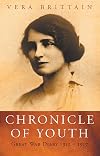
Although Vera Brittain later re-worked her actual WW1 diary into a novel, I don't think anything could supersede the original account, as the writer moves through life with no idea of what the future will hold.
As it opens in 1913, I was reminded of the collected letters of the young Queen Mother- having recently 'come out', Vera Brittain's days focus on dances, Church, social events and occasional events at her brother Edward's public school- where she meets the three friends of his who will show more so go on to influence her life.
We see an increasing seriousness and devotion to study, as, despite her father's negativity, she embarks on courses that will lead her to acceptance at Oxford. Meanwhile, occasional meetings with one of the friends- Roland Leighton- turn slowly to love. But as War breaks out, the calm, measured thoughtful life recorded in her journal is to become one of torment.
To the reader, who knos what's going to happen, so many little incidents, recorded at the tie with no great thought, come to later have a dreadful portent. - notably, perhaps, the Headmaster's speech when (just prior to the War) he tells the boys that "if a man could not be useful to his country, he was better dead." Yet many little observations on nature, life, religion have a poignancy when read in hindsight.
Abandoning her university career for nursing, her diary records endless anguish over those she loves - news reports and hints in their letters of major onslaughts, the desperate hope of leave, the wretchedness when a letter fails to come through...
As Roland's sister, Clare Leighton, comments in the Introduction, "Perhaps too, it is important to chronicle a war as seen and experienced by the young. It is strange how vividly a visual memory can be stamped into the soft wax of the very young."
Amazing, heart-rending writing. show less
As it opens in 1913, I was reminded of the collected letters of the young Queen Mother- having recently 'come out', Vera Brittain's days focus on dances, Church, social events and occasional events at her brother Edward's public school- where she meets the three friends of his who will show more so go on to influence her life.
We see an increasing seriousness and devotion to study, as, despite her father's negativity, she embarks on courses that will lead her to acceptance at Oxford. Meanwhile, occasional meetings with one of the friends- Roland Leighton- turn slowly to love. But as War breaks out, the calm, measured thoughtful life recorded in her journal is to become one of torment.
To the reader, who knos what's going to happen, so many little incidents, recorded at the tie with no great thought, come to later have a dreadful portent. - notably, perhaps, the Headmaster's speech when (just prior to the War) he tells the boys that "if a man could not be useful to his country, he was better dead." Yet many little observations on nature, life, religion have a poignancy when read in hindsight.
Abandoning her university career for nursing, her diary records endless anguish over those she loves - news reports and hints in their letters of major onslaughts, the desperate hope of leave, the wretchedness when a letter fails to come through...
As Roland's sister, Clare Leighton, comments in the Introduction, "Perhaps too, it is important to chronicle a war as seen and experienced by the young. It is strange how vividly a visual memory can be stamped into the soft wax of the very young."
Amazing, heart-rending writing. show less
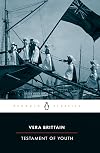
In 1933, Vera's Brittain's memoir of her life before, during, and immediately after WWI was published. The book is an incredibly moving account of what it was like to come of age during the Great War. There are three parts to the book. The first part tells about life for a young woman growing up in a Victorian household, and all of the pressures, expectations, and naivety that came along with it. It also sets the stage for Brittain's relationships with four young men, including her brother show more and her later fiancé, all of whom would serve in the war. In the second section, Vera enlists as a nurse. She works several places: London, Malta, and France. She shares many details of the work, the conditions, and the emotional and physical toll. This section vividly depicts what it was like to repeatedly "say goodbye" to loved ones and the stress of waiting to hear if friends and family had survived each battle. The third section is about the immediate aftermath of the war: how she deals with the losses she suffers, her views on international politics, and whether she desires to try to balance her work with marriage and children.
I really loved this book. Brittain's writing is honest and she doesn't shy away from sharing her grief or her opinions. She writes with great emotion without being overly dramatic, even in dramatic circumstances. I was sucked right in to her world. I particularly loved the first and second sections. The third lost a little momentum for me, with the views on world politics. It felt less personal. I also read in the afterward that the man she ended up marrying didn't want to be as big a part of the book as she wanted him to be. So that probably made it harder to write with the honestly and poignancy that she achieved in the first sections.
I put off reading this book for quite a few years because it is long, but I found it very readable and I'm glad I finally got to it. It's an important viewpoint of a woman who served in WWI. show less
I really loved this book. Brittain's writing is honest and she doesn't shy away from sharing her grief or her opinions. She writes with great emotion without being overly dramatic, even in dramatic circumstances. I was sucked right in to her world. I particularly loved the first and second sections. The third lost a little momentum for me, with the views on world politics. It felt less personal. I also read in the afterward that the man she ended up marrying didn't want to be as big a part of the book as she wanted him to be. So that probably made it harder to write with the honestly and poignancy that she achieved in the first sections.
I put off reading this book for quite a few years because it is long, but I found it very readable and I'm glad I finally got to it. It's an important viewpoint of a woman who served in WWI. show less

To me and my contemporaries, with our cheerful confidence in the benignity of fate, War was something remote, unimaginable, its monstrous destructions and distresses safely shut up, like the Black Death and the Great Fire, between the covers of history books. ... What really mattered were not these public affairs, but the absorbing incidents of our own private lives -- and now, suddenly, the one had impinged upon the other, and public events and private lives had become inseparable. (p. show more 98)
For those who read this memoir, War will never more be "something remote, unimaginable." It will be real, searingly painful, ineffective and so obviously wrong. When World War I broke out in 1914, Vera Brittain was only 18 and had recently overcome tremendous odds to be admitted to Oxford. When her fiancé Roland, her brother Edward, and two good friends all joined the Army, Brittain left her studies to become a nurse. She served first in London, later in Malta, and finally at the front in France before returning to England.
Brittain was an early feminist; every decision she made went against the norm, something she was keenly aware of:
Probably no ambitious girl who has lived in a family which regards the subservience of women as part of the natural order of creation ever completely recovers from the bitterness of her early emotions. Perhaps it is just as well; women have still a long way to travel before their achievements are likely to be assessed without irrelevant sex considerations entering in to bias the judgment of the critic ... (p. 59)
She was driven, but also understood the "frivolity" of pursuing a degree in wartime. Her nursing experience forms the heart of this book, and is also the most emotional. Brittain describes each hospital's harsh and inadequate conditions, and some of the soldiers under her care. When she is assigned to a ward for German prisoners, the reader begins to understand that "the enemy" also have mothers, wives, and families who love them. And, while Brittain is "doing her bit," she experiences tremendous personal loss as those she loves lose their lives in the conflict. I found myself holding back tears, and cautiously turning the pages, fearing the next death.
After the war, Brittain found that not only had her country changed, but so had she:
Only the permanence of my fondest ambitions, and the strange and growing likeness of my son to Edward, reminds me that I am still the individual who went to Uppingham Speech Day in 1914, for although I was a student at Oxford in both my lives, it was not the same Oxford and I was not the same student. (p. 495)
Her experience left permanent emotional scars, and she struggled to cope with being part of "the lost generation." Still, she was able to return to Oxford, and obtained her degree shortly after the university began awarding them to women. Brittain became a regular lecturer with the League of Nations Union. She returned to Europe, touring several countries to understand the impact and aftermath of the war; this once again brought home the pointlessness of it all.
This is one of the most moving and powerful books I've ever read. If all you know of war is strategy, tactics, good guys and bad guys, then you must read this book. Brittain has left us an important legacy. In her words:
Perhaps, after all, the best that we who were left could do was refuse to forget, and to teach our successors what we remembered in the hope that they, when their own day came, would have more power to change the state of the world than this bankrupt, shattered generation. (p.646) show less
For those who read this memoir, War will never more be "something remote, unimaginable." It will be real, searingly painful, ineffective and so obviously wrong. When World War I broke out in 1914, Vera Brittain was only 18 and had recently overcome tremendous odds to be admitted to Oxford. When her fiancé Roland, her brother Edward, and two good friends all joined the Army, Brittain left her studies to become a nurse. She served first in London, later in Malta, and finally at the front in France before returning to England.
Brittain was an early feminist; every decision she made went against the norm, something she was keenly aware of:
Probably no ambitious girl who has lived in a family which regards the subservience of women as part of the natural order of creation ever completely recovers from the bitterness of her early emotions. Perhaps it is just as well; women have still a long way to travel before their achievements are likely to be assessed without irrelevant sex considerations entering in to bias the judgment of the critic ... (p. 59)
She was driven, but also understood the "frivolity" of pursuing a degree in wartime. Her nursing experience forms the heart of this book, and is also the most emotional. Brittain describes each hospital's harsh and inadequate conditions, and some of the soldiers under her care. When she is assigned to a ward for German prisoners, the reader begins to understand that "the enemy" also have mothers, wives, and families who love them. And, while Brittain is "doing her bit," she experiences tremendous personal loss as those she loves lose their lives in the conflict. I found myself holding back tears, and cautiously turning the pages, fearing the next death.
After the war, Brittain found that not only had her country changed, but so had she:
Only the permanence of my fondest ambitions, and the strange and growing likeness of my son to Edward, reminds me that I am still the individual who went to Uppingham Speech Day in 1914, for although I was a student at Oxford in both my lives, it was not the same Oxford and I was not the same student. (p. 495)
Her experience left permanent emotional scars, and she struggled to cope with being part of "the lost generation." Still, she was able to return to Oxford, and obtained her degree shortly after the university began awarding them to women. Brittain became a regular lecturer with the League of Nations Union. She returned to Europe, touring several countries to understand the impact and aftermath of the war; this once again brought home the pointlessness of it all.
This is one of the most moving and powerful books I've ever read. If all you know of war is strategy, tactics, good guys and bad guys, then you must read this book. Brittain has left us an important legacy. In her words:
Perhaps, after all, the best that we who were left could do was refuse to forget, and to teach our successors what we remembered in the hope that they, when their own day came, would have more power to change the state of the world than this bankrupt, shattered generation. (p.646) show less

Books about female friendship are ubiquitous these days, but in Vera Brittain's day (1893-1970) it was all about noble male friendship (a.k.a. mateship here in Australia) while close female friendships were sometimes the subject of speculation and gossip. Just as Brittain's Testament of Youth (1933) was the first to step outside the male experience of WW1, so too was her story of her intimate but platonic friendship with a woman who meant the world to her. Testament of Friendship is poignant show more reading because Winifred Holtby (1898-1935) died aged only 37 from Bright's Disease, (now known as nephritis, i.e. kidney disease.)
Despite its tragic conclusion, the book is a lively account of two clever young women determined to do something useful in the world. They met at Oxford, where in the absence of men mostly at the front, they enjoyed comparative respect for women. Both had served in the war, Vera as a Voluntary Aid Detachment (VAD) nurse and Winifred in the Women's Army Auxiliary Corps (WAAC), an experience which she used in her writing, as seen in the Sensational Snippet I published last week. Although Brittain's pacifism cost her some respect during WW2 which was looming even as she wrote this tribute to her friend, Testament of Friendship documents how young women could be politically active as feminists, socialists and pacifists, and could take on significant roles in the issues of the day.
At the same time, the women shared a grief for all that had been lost in the devastation of that pointless war. Vera had lost her fiancé, her two close friends and her brother, while Winifred's 'love of her life' returned psychologically damaged and not capable of settling to anything. Oxford, they found on their return, was a changed place too. Chapter VI explains how it was inhabited by three incompatible groups engaged in a spiritual tug-of-war:
Of all that I have read about the aftermath of WW2, I had never come across this dissection of the ferment in universities!
To read the rest of my review please visit https://anzlitlovers.com/2023/04/10/testament-of-friendship-1940-by-vera-brittai... show less
Despite its tragic conclusion, the book is a lively account of two clever young women determined to do something useful in the world. They met at Oxford, where in the absence of men mostly at the front, they enjoyed comparative respect for women. Both had served in the war, Vera as a Voluntary Aid Detachment (VAD) nurse and Winifred in the Women's Army Auxiliary Corps (WAAC), an experience which she used in her writing, as seen in the Sensational Snippet I published last week. Although Brittain's pacifism cost her some respect during WW2 which was looming even as she wrote this tribute to her friend, Testament of Friendship documents how young women could be politically active as feminists, socialists and pacifists, and could take on significant roles in the issues of the day.
At the same time, the women shared a grief for all that had been lost in the devastation of that pointless war. Vera had lost her fiancé, her two close friends and her brother, while Winifred's 'love of her life' returned psychologically damaged and not capable of settling to anything. Oxford, they found on their return, was a changed place too. Chapter VI explains how it was inhabited by three incompatible groups engaged in a spiritual tug-of-war:
- The dons in their academic twilight, barely illumined by occasional visits from younger or more enterprising colleagues who had joined the Army or taken posts in Government offices. These senior members of the academic staff had waited out the war in discomfort, not because they were pacificists, but because the chaos of war threatened their decorous intellectual routine;
- The returning servicemen, back to finish their interrupted studies, impatient with the university's restrictions on their liberty after years of peril, independence and extreme responsibility. Ex-colonels and majors in their late twenties did not respect curfews to protect morality!
- The youthful contingent of schoolboys and schoolgirls who had spent the war in classrooms and on playing fields resented the transformation of Oxford by their disillusioned seniors. Even as the Treaty of Versailles was setting up the conditions for WW2, their aspirations were to build a new world. So battles raged in common rooms, debating societies and university magazines.
Of all that I have read about the aftermath of WW2, I had never come across this dissection of the ferment in universities!
To read the rest of my review please visit https://anzlitlovers.com/2023/04/10/testament-of-friendship-1940-by-vera-brittai... show less
Lists
Female Author (1)
Favourite Books (1)
Women in War (1)
Awards


You May Also Like


Associated Authors
Statistics
- Works
- 42
- Also by
- 8
- Members
- 4,166
- Popularity
- #6,045
- Rating
- 4.1
- Reviews
- 87
- ISBNs
- 103
- Languages
- 5
- Favorited
- 14
