
About the Author
Series
Works by John Brockman
This Will Make You Smarter: New Scientific Concepts to Improve Your Thinking (Edge Question Series) (2012) — Editor — 907 copies, 17 reviews
What We Believe but Cannot Prove: Today's Leading Thinkers on Science in the Age of Certainty (2006) — Editor — 851 copies, 14 reviews
This Explains Everything: Deep, Beautiful, and Elegant Theories of How the World Works (2012) — Editor — 694 copies, 15 reviews
What Is Your Dangerous Idea? Today's Leading Thinkers on the Unthinkable (2007) — Editor — 668 copies, 8 reviews
This Idea Must Die: Scientific Theories That Are Blocking Progress (Edge Question Series) (2014) — Editor — 445 copies, 9 reviews
The Next Fifty Years: Science in the First Half of the Twenty-first Century (2002) — Editor — 410 copies, 10 reviews
What Should We Be Worried About?: Real Scenarios That Keep Scientists Up at Night (Edge Question Series) (2014) — Editor — 357 copies, 10 reviews
Intelligent Thought: Science versus the Intelligent Design Movement (2006) — Editor — 295 copies, 6 reviews
What Are You Optimistic About?: Today's Leading Thinkers on Why Things Are Good and Getting Better (2007) — Editor — 289 copies, 3 reviews
This Will Change Everything: Ideas That Will Shape the Future (2009) — Editor — 286 copies, 6 reviews
Thinking: The New Science of Decision-Making, Problem-Solving, and Prediction (Best of Edge Series) (2013) — Editor — 278 copies, 1 review
Is the Internet Changing the Way You Think?: The Net's Impact on Our Minds and Future (Edge Question Series) (2011) — Editor — 262 copies, 6 reviews
What Have You Changed Your Mind About?: Today's Leading Minds Rethink Everything (2009) — Editor — 238 copies, 3 reviews
This Idea Is Brilliant: Lost, Overlooked, and Underappreciated Scientific Concepts Everyone Should Know (2017) — Editor — 213 copies, 6 reviews
What to Think About Machines That Think: Today's Leading Thinkers on the Age of Machine Intelligence (Edge Question Series) (2015) — Editor — 204 copies, 5 reviews
Know This: Today's Most Interesting and Important Scientific Ideas, Discoveries, and Developments (2017) — Editor — 169 copies, 3 reviews
The Universe: Leading Scientists Explore the Origin, Mysteries, and Future of the Cosmos (2012) — Editor — 161 copies, 6 reviews
Life: The Leading Edge of Evolutionary Biology, Genetics, Anthropology, and Environmental Science (2016) — Editor — 131 copies, 2 reviews
Culture: Leading Scientists Explore Societies, Art, Power, and Technology (Best of Edge Series) (2011) — Editor — 109 copies, 2 reviews
The Mind: Leading Scientists Explore the Brain, Memory, Personality, and Happiness (Best of Edge Series) (2011) — Editor — 100 copies, 1 review
Science at the Edge: Conversations with the Leading Scientific Thinkers of Today (2004) — Editor — 92 copies, 3 reviews
The Last Unknowns: Deep, Elegant, Profound Unanswered Questions About the Universe, the Mind, the Future of Civilization, and the Meaning of Life (2019) 72 copies, 4 reviews
My Einstein: Essays by Twenty-four of the World's Leading Thinkers on the Man, His Work, and His Legacy (2006) — Editor — 64 copies
What We Believe But Can Not Prove 2 copies
The Next 50 Years 1 copy
Associated Works
Tagged
Common Knowledge
- Birthdate
- 1941-02-16
- Gender
- male
- Education
- California State University, Chico (MA)
- Occupations
- literary agent
author
editor - Organizations
- Edge Foundation
- Nationality
- USA
- Birthplace
- Boston, Massachusetts, USA
- Places of residence
- Boston, Massachusetts, USA
- Associated Place (for map)
- Boston, Massachusetts, USA
Members
Reviews
This Idea Is Brilliant: Lost, Overlooked, and Underappreciated Scientific Concepts Everyone Should Know by John Brockman
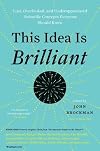
Science begins and ends with humility.
Or at least the 2018 collection of scientific essays called “This Idea Is Brilliant” does. The book, edited by John Brockman, includes scores of short responses to The Edge Question of 2017: "What scientific term or concept ought to be more widely known?"
The replies to that question are many and varied, yet the second essay in the book, by psychologist Adam Waytz suggests The Illusion of Explanatory Depth. Basically this means the less we know the show more more we think we know. Waytz concludes, "Only through gaining expertise in a topic do people recognize its complexity and calibrate their confidence accordingly." The IOED, as he calls it, "provides us with much-needed humility."
The book's last essay returns to that theme, and in fact is called Humility. Barnaby Marsh, an evolutionary dynamics scholar, argues that even the most brilliant scientific ideas are usually replaced, or at least amended, at some point in the future by some other brilliant scientific ideas. Brilliant ideas are less conclusions than steps along the way.
Within that framework we read 500 pages full of amazing ideas, most of which pass over the heads of laymen like myself. Take Parallel Universes of Quantum Mechanics or Spontaneous Symmetry Breaking, for example. Yet researcher Peter Norwig argues for Counting as a scientific concept worth greater emphasis. Too many people, both in science and out, simply aren't doing the math, he says.
On the topic of Premature Optimization, writer Kevin Kelly argues that "the greatest source of failure is prior success." You don't need a degree in science to understand that. Once you've reached the top, it's all downhill. Unless you are Tom Brady, of course.
Journalism professor Charles Seife makes a case for The Texas Sharpshooter. This is a reference to the story about the Texan who shot holes in the side of his barn, then drew a bullseye around each one. Similarly, some researchers seem to have a talent for adjusting their objectives to fit their findings.
So there is much to appreciate in Brockman's book. If you don't understand one brief essay, just stay humble, admit it and go on to the next. show less
Or at least the 2018 collection of scientific essays called “This Idea Is Brilliant” does. The book, edited by John Brockman, includes scores of short responses to The Edge Question of 2017: "What scientific term or concept ought to be more widely known?"
The replies to that question are many and varied, yet the second essay in the book, by psychologist Adam Waytz suggests The Illusion of Explanatory Depth. Basically this means the less we know the show more more we think we know. Waytz concludes, "Only through gaining expertise in a topic do people recognize its complexity and calibrate their confidence accordingly." The IOED, as he calls it, "provides us with much-needed humility."
The book's last essay returns to that theme, and in fact is called Humility. Barnaby Marsh, an evolutionary dynamics scholar, argues that even the most brilliant scientific ideas are usually replaced, or at least amended, at some point in the future by some other brilliant scientific ideas. Brilliant ideas are less conclusions than steps along the way.
Within that framework we read 500 pages full of amazing ideas, most of which pass over the heads of laymen like myself. Take Parallel Universes of Quantum Mechanics or Spontaneous Symmetry Breaking, for example. Yet researcher Peter Norwig argues for Counting as a scientific concept worth greater emphasis. Too many people, both in science and out, simply aren't doing the math, he says.
On the topic of Premature Optimization, writer Kevin Kelly argues that "the greatest source of failure is prior success." You don't need a degree in science to understand that. Once you've reached the top, it's all downhill. Unless you are Tom Brady, of course.
Journalism professor Charles Seife makes a case for The Texas Sharpshooter. This is a reference to the story about the Texan who shot holes in the side of his barn, then drew a bullseye around each one. Similarly, some researchers seem to have a talent for adjusting their objectives to fit their findings.
So there is much to appreciate in Brockman's book. If you don't understand one brief essay, just stay humble, admit it and go on to the next. show less
The Last Unknowns: Deep, Elegant, Profound Unanswered Questions About the Universe, the Mind, the Future of Civilization, and the Meaning of Life by John Brockman
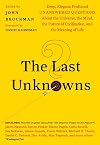
The swan song for the two-decades-long Annual Question feature of Brockman's www.edge.org website. Not having another question for all ~300 of the highly intelligent contributors to try to answer, he asked them to supply their own questions but to refrain from offering answers or discussions. The result is a book with very few words per page -- an unusual kind of profundity or just a case of intellectual performance art?
What We Believe but Cannot Prove: Today's Leading Thinkers on Science in the Age of Certainty (Edge Question Series) by John Brockman
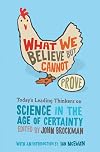
As much as I love reading about what thinkers read and thinking about what thinkers read, the ultimate is reading about what thinkers think. Follow me so far? This book was actually the first produced by the annual Edge.org question (http://edge.org/annual-questions), and it was ever as much the trove I was looking for as it was with the others in the series I've read. Oddly, it's the hardest to find. This one was an ILL. Everything was mind-expanding, except for some that were a bit lazy show more and dialed-in, and I had a minor-to-middling quibble with anyone who said anything along the lines of, "We cannot prove anything, can we? That's science!" Oh, okay, we get it, you're smart, showoff, now think of something original. show less
This Idea Must Die: Scientific Theories That Are Blocking Progress (Edge Question Series) by John Brockman
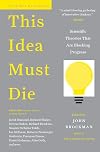
The question asked is, "What scientific idea is ready for retirement?" This collection of short essays provides answers from "175 of the world's most influential scientists, economists, artists, and philosophers" (according to the blurb on the back cover). I found it to be a mixed bag, as you might expect. A few were insightful. Several were interesting. Others were informative, obvious, uninspired, flawed, straw-man attacks, semantic rants, or (in one case) loony. Most, however (even the show more loony one) were, in some way, thought provoking. (Although, to be honest, my first thought after reading the loony one was 'What fairy tale universe is this guy calling in from?') These, of course, are my personal, subjective impressions. Your opinions may vary. Regardless, the collection does provide insights into what some of the top experts in fields ranging from physics to psychology are thinking about, including issues on which they agree and disagree. (I imagine there are some lively...discussions between physicists during breaks at conferences about String Theory). show less
Lists
Awards


You May Also Like


Associated Authors
Statistics
- Works
- 53
- Also by
- 1
- Members
- 9,062
- Popularity
- #2,651
- Rating
- 3.5
- Reviews
- 160
- ISBNs
- 257
- Languages
- 13
- Favorited
- 3