
Rodney Stark (1934–2022)
Author of The Rise of Christianity
About the Author
Rodney Stark is the distinguished professor of the social sciences and codirector of the Institute for Studies of Religion at Baylor University and honorary professor of sociology at Peking University in Beijing. He is the author or coauthor of a number of books in seventeen different languages, show more including the best-selling The Rise of Christianity (HarperSanFranrisco, 1997). show less
Image credit: courtesy of Prof. Rodney Stark
Works by Rodney Stark
The Victory of Reason: How Christianity Led to Freedom, Capitalism, and Western Success (2005) 731 copies, 12 reviews
Cities of God: The Real Story of How Christianity Became an Urban Movement and Conquered Rome (2006) 444 copies, 5 reviews
The Triumph of Christianity: How the Jesus Movement Became the World's Largest Religion (2011) 331 copies, 5 reviews
For the Glory of God: How Monotheism Led to Reformations, Science, Witch-Hunts, and the End of Slavery (2003) 300 copies, 2 reviews
American Piety: The Nature of Religious Commitment (Patterns of Religious Commitment) (1968) 21 copies
Wayward shepherds: prejudice and the Protestant clergy (Patterns of American prejudice series) (1971) 17 copies
Doing Sociology: A Global Perspective: Using MicroCase ExplorIt Workbook (with CD-ROM) (1998) 13 copies
Falso Testemunho: Desmascarando Séculos de História Anticatólica: Desmascarando Séculos de História Anticatólica 5 copies, 1 review
Patterns of religious commitment 2 copies
Der Sieg des Abendlandes: Christentum und kapitalistische Freiheit (Edition Sonderwege bei Manuscriptum) (2019) 1 copy, 1 review
Η εξάπλωση του Χριστιανισμού 1 copy
Sociology 1 copy
Il trionfo della fede 1 copy
The Future Of Religon 1 copy
Society Today 1 copy
Associated Works
Latter-Day Saint Social Life: Social Research on the LDS Church and Its Members (Religious Studies Center Specialized Monograph Series, Vol. 12) (1998) — Contributor — 17 copies
Mormons and Mormonism: An Introduction to an American World Religion (2001) — Contributor — 14 copies
The Mormon History Association's Tanner Lectures: The First Twenty Years (2006) — Contributor — 9 copies
Tagged
Common Knowledge
- Canonical name
- Stark, Rodney
- Legal name
- Stark, Rodney William
- Birthdate
- 1934-07-08
- Date of death
- 2022-07-21
- Gender
- male
- Education
- University of California, Berkeley (MA|1965|Ph.D|1971)
University of Denver (BA|1959) - Occupations
- sociologist
professor
comparative religion scholar - Organizations
- Baylor University
University of Washington
United States Army - Awards and honors
- Pacific Sociological Association Distinguished Scholarship Award (1993)
- Nationality
- USA
- Birthplace
- Jamestown, North Dakota, USA
- Places of residence
- Woodway, Texas, USA
Berkley, California, USA - Place of death
- Woodway, Texas, USA
- Map Location
- North Dakota, USA
Members
Reviews
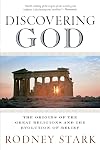
Rarely have I been so disappointed by a book - even 'Evolving God' was less disappointing. I am just under halfway through and I can't stand it any more. Stark totally dismisses Ancient Egyptian religion as a polytheistic 'temple faith' that gave nothing to its people. The only thing he deems of any worth is Akhenaten's heresy because it is somehow obvious that monotheism is much better than polytheism. For Stark, the only worthwhile discoveries of God are those of a capricious deity who show more deems his creations to have no value whatsoever and who consigns the overwhelming majority to eternal damnation for the edification of the infinitesimal elect. Oh, I forgot, the other acceptable and valid discovery is of a deity who takes one very insignificant group of human beings as his 'chosen people' - the rest of humanity being completely unworthy of the attention of the supreme being and who should furthermore be subject to periodic genocides because of (among other terribly important factors) their inability to say shiboleth. Greek religion is also dismissed as degenerate as that of the Egyptians. A tradition that gave us philosophy, science, math, ethics, and democracy is summarily judged to be worthless superstition. (I wonder if one could even find an Athenian of the 5th century BCE who actually believed in the their creation myths as literal truth. But, suppose one could; how is that any different from the belief of many 21st century Americans that an apple and snake determined the fate of humanity?)
The faith of the Egyptians led to a civilization that lasted for 3,000 years and that left for all humanity some of its most meaningful monuments and symbols. Even the cross as a symbol of divinely granted life is something we owe as much to the Egyptians as to the Romans. The Egyptians were also the first (as far as we know) to develop the archetype of the godman whose death and resurrection redeems creation. As for their 'temple faith that had nothing to do with the common man', the Egyptians enthusiastically participated in every celebration of every 'god.' They knew that they formed a valued part of the order of creation and that the pharaoh and priests carried out rituals necessary to maintain that order just as they carried out similar rituals that were also essential to that same divinely mandated order. Religion was an integral part of their lives - so integral that they would not understand the question; 'What is your religion?' The Egyptians also understood the need for dualism in creation. They understood that it was not possible for Horus to destroy Seth because they knew that chaos was just as necessary to creation as order. If chaos seemingly gained the upper hand, Egyptians knew that that was the way of creation. They did not assume that they were worthless worms in the sight of God and that any setback or illness was because they had angered their 'god.' They also knew that what we take as their 'gods' were nothing more than attributes of God and that their myths were just ways of finding some understanding of that which is essentially unknowable. Before you decide to jump on me, I should point out that I know that Egypt was not a paradise and that there were many priests who encouraged every superstition so that they could benefit from it. What I am referring to are their ideas - I understand that a lot was lost in their application. However, one should always keep in mind that, of all the peoples and religious systems in the world, the Egyptians were unique in one way. When they thought of paradise, they saw it as being just like Egypt, only a little better. I suppose that is of no importance to Stark. Just as it is of no importance that almost everyone who was privileged enough to experience Ancient Egypt said that the Egyptians were the 'happiest and most satisfied people in the world.'
I regret buying the electronic version of the book. I just don't think that returning it in an email to the publishers would have the same effect as sending back the book itself. I do not think that I should agree with the author of every book I buy, to the contrary. However, an author who publishes a book with a title such as this one should give the religions of the Greeks and Egyptians an honest review. Otherwise he should make it clear on the cover of the book that he believes that the only great religions are those that are monotheistic and that engender things like pogroms, inquisitions, jihads, and genocide.
All this aside, I should be grateful to Mr. Stark. I had been debating whether I should leave my Judeo-Christian traditions and beliefs completely behind and embrace Perennial Philosophy or not. Mr. Stark made me see the choice in the starkest of terms and, because of him, there is no longer any debate within me. He made me see that I want nothing to do with certainties of this kind of monotheism as they are false certainties that have given the human beings little in exchange for all that they have cost us. show less
The faith of the Egyptians led to a civilization that lasted for 3,000 years and that left for all humanity some of its most meaningful monuments and symbols. Even the cross as a symbol of divinely granted life is something we owe as much to the Egyptians as to the Romans. The Egyptians were also the first (as far as we know) to develop the archetype of the godman whose death and resurrection redeems creation. As for their 'temple faith that had nothing to do with the common man', the Egyptians enthusiastically participated in every celebration of every 'god.' They knew that they formed a valued part of the order of creation and that the pharaoh and priests carried out rituals necessary to maintain that order just as they carried out similar rituals that were also essential to that same divinely mandated order. Religion was an integral part of their lives - so integral that they would not understand the question; 'What is your religion?' The Egyptians also understood the need for dualism in creation. They understood that it was not possible for Horus to destroy Seth because they knew that chaos was just as necessary to creation as order. If chaos seemingly gained the upper hand, Egyptians knew that that was the way of creation. They did not assume that they were worthless worms in the sight of God and that any setback or illness was because they had angered their 'god.' They also knew that what we take as their 'gods' were nothing more than attributes of God and that their myths were just ways of finding some understanding of that which is essentially unknowable. Before you decide to jump on me, I should point out that I know that Egypt was not a paradise and that there were many priests who encouraged every superstition so that they could benefit from it. What I am referring to are their ideas - I understand that a lot was lost in their application. However, one should always keep in mind that, of all the peoples and religious systems in the world, the Egyptians were unique in one way. When they thought of paradise, they saw it as being just like Egypt, only a little better. I suppose that is of no importance to Stark. Just as it is of no importance that almost everyone who was privileged enough to experience Ancient Egypt said that the Egyptians were the 'happiest and most satisfied people in the world.'
I regret buying the electronic version of the book. I just don't think that returning it in an email to the publishers would have the same effect as sending back the book itself. I do not think that I should agree with the author of every book I buy, to the contrary. However, an author who publishes a book with a title such as this one should give the religions of the Greeks and Egyptians an honest review. Otherwise he should make it clear on the cover of the book that he believes that the only great religions are those that are monotheistic and that engender things like pogroms, inquisitions, jihads, and genocide.
All this aside, I should be grateful to Mr. Stark. I had been debating whether I should leave my Judeo-Christian traditions and beliefs completely behind and embrace Perennial Philosophy or not. Mr. Stark made me see the choice in the starkest of terms and, because of him, there is no longer any debate within me. He made me see that I want nothing to do with certainties of this kind of monotheism as they are false certainties that have given the human beings little in exchange for all that they have cost us. show less
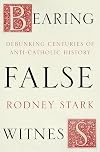
The motives of the author for writing this polemic against “anti-Catholic myths" do not appear to stem from any genuinely-held beliefs; the impression one gets is that he simply wants to further his reputation as someone who has a "new" and somewhat contrarian approach to religious history. One of the main accusations that the author makes against the perpetrators of these so-called myths is that they select and distort evidence. With this assertion he is hoisted with his own petard; you show more would expect an academic to deal honestly and fairly with the facts and his sources; but in his zeal to whitewash the Catholic Church of any wrongdoing, he cites only those that support his arguments and excludes any that would disprove them.
The arguments in his first essay “Sins of Antisemitism” are particularly specious. The church did not invent antisemitism, he claims, because hostile treatment of the Jews had been pervasive in the ancient world. This is contrary to most scholarly opinion, that all the empires that ruled Judea - Persian, Macedonian and Roman until 70 CE - implicitly or explicitly regarded the Jews' "ancient practices" - including both the Temple rites and the exclusivity of the Jewish God - as the "constitution" of the Judean or Jewish people. Until the Roman era, religion was not yet regarded as a separate form of identity, distinct from nationality or ethnicity. When, under the multi-national and multi-ethnic hegemony of the Roman empire, religion did become a relevant classification of its subjects - and later citizens – Judaism, unlike Christianity, was a permitted religion. Stark quotes the anti-Jewish remarks of a number of Greek and Roman writers as evidence of ancient antisemitism. His reference to Suetonius’ “Twelve Caesars” is a prime example of Stark’s careful selective use of evidence in order to support his argument; the emperor Tiberius did, as Stark reports, order the Jews in Rome to burn all their religious vestments and banished Jews from the city. What he does not reveal is that, according to Suetonius, the same decree applied to Egyptians and followers of other foreign cults; in other words, it was a general xenophobic action, rather than one directed specifically at Jews or their religion. In another example of so-called antisemitism that he gives, the emperor Titus’ imposition of a special tax on all Jews in the empire, he fails to mention that the fiscus judaicus was not a punishment simply for being Jewish, but for the Jewish revolt against Rome of 68-70 CE, or that the emperor Nerva abolished the tax, when he came to power in 96 CE.
The author’s defence of the anti-Jewish complexion of the gospels, as merely the criticism of one group of Jews by another group of coreligionists, is almost laughable. He characterizes it as “in-house prophetic criticism”, no different in kind from the polemics against other Jews made by Biblical prophets such as Isaiah. Anti-Christian texts in the Talmud and other rabbinical writings are cited as evidence of the other side of a lively debate between competing religious philosophies. His conclusion from all this, that the Church did not “translate the antagonisms of the New Testament into a warrant for anti-Semitic attacks”, completely ignores the role of Church Fathers, such as Ambrose of Milan or Augustine of Hippo, whose anti-Jewish interpretation of the gospels conditioned Christian attitudes and behavior towards Jews for centuries afterward. Even more striking is his omission to mention the institutionalized hostility towards Jews of the Roman-Byzantine state, the enforcement arm of the early church. Emperor Theodosius’ law code, promulgated in 438 CE which barred Jews from holding positions in the military and civil service and banned the building of new synagogues, can rightly be considered the “invention” of official antisemitism. This was replaced a 100 years later by Justinian’s codex which imposed even more severe restrictions on Jews, effectively making them non-citizens of the empire. In his history of Medieval Christianity, Kevin Madigan makes the point that, what was mandated in law was not necessarily prosecuted in practice; but he goes on to say “ Justinian formulated a view of Jews as second-class citizens, a view given a sacred imprimatur by later papal and ecclesiastical decrees.” What’s not anti-Semitic about this?
The Theodosian code also made paganism illegal; but that does not prevent Stark from arguing, in another essay which I have neither the knowledge nor the space to investigate here fully, against the accusation that Christianity brutally suppressed paganism. In this latter essay, in order to prove how paganism continued to flourish under their rule, the author includes a table showing how many of various emperors’ consular appointments were pagans. In the present essay, there is no such table reporting the appointment of Jewish consuls. Beyond the confines of the Byzantine empire, the early Church persecuted Jews there too; there was, for example, particularly vicious legislation in late 7th century CE Visigothic Spain, where all Jewish religious practices were banned and Jews reduced to the status of slaves.
Stark absolves the Church from any responsibility for the massacres of European Jews perpetrated by the Crusaders en route to the Holy Land. In another essay, “Crusading for Land, Loot and Converts”, he extensively leans on the expert opinion of Jonathan Riley-Smith, that the Crusades were not motivated by the expectation of material gain. However, he completely fails to mention this same Crusader expert’s opinion that “Popes and preachers, who had to present the theology of violence to ordinary Christian could never fully control the passions they aroused. A crusade was fought against those perceived to be the external and internal (my italics) foes of Christendom”. The massacre or forced conversion of Jews was perpetrated “with the aim of creating a uniformly Christian society by eliminating their religion.” Even if the horrific persecutions of the Jews during the Crusades had not been part of the Church’s plan, and a few clerics – notably Bernard of Clervaux – did try to prevent further such occurrences, that hardly absolves the Church from responsibility for the actions of a movement that it created and motivated. For both early and medieval church, religious conformity was paramount, as that consolidated its power; if this meant periodically purging both the practices of other religions and those who practiced them – of which, once pagans and non-orthodox Christian “heretics” had been dealt with, only the Jews persisted – that’s what they did.
Religious uniformity is also the issue he takes up in the second essay, “The Suppressed Gospels”. This amounts to a diatribe against the published works on the so-called gnostic gospels, such as The Secret Gospel of Thomas, The Gospel of Mary, The secret Book of John and The Gospel of Judas. These are all later gospels - from the second and third centuries - copies of which were discovered in Egypt and were often written in ancient Coptic; some of them were discovered as long ago as 1945, others more recently. They present alternative narratives about Jesus and other figures from the standard Christian Bible, they generally have very different religious philosophies from orthodox Christianity, and often deal with hidden secrets and cosmologies that will only be revealed to the Select – hence their description as gnostic. The fact that orthodox Christianity and the standard Christian Bible survived, while these lost works and the religious philosophies they represented did not, means that the latter were either suppressed by the Church, or that they just died out. The author strongly disputes the former, while advocating the latter argument, on the grounds that most of these later gospels had philosophies that were unappealing; he further claims that the philosophies presented by the gnostic gospels were more pagan than Christian. The opposition of the early Church to these gnostic philosophies, he claims, was no more than an exposure of their fallacies and essentially non-Christian nature. However, given the indisputable - but unmentioned by Stark - suppression by the Church of far less deviant varieties of early Christianity – Marcionism, Arianism, Monophysitism, etc – than the gnostics, there is no reason to give it the benefit of the doubt in the case of the latter. By definition, the imposition of orthodoxy means the exclusion of everything else; it is thus no coincidence that it was in the areas where Arianism held out longer – Lombard Italy and early Frankish Gaul – that Jews were protected and allowed to function as full members of society.
The scenario painted by Elaine Pagels and Karen Armstrong, in their book about the Gospel of Judas – systematically excoriated and misquoted by Stark – of a very varied early Christianity with many disparate voices, is far more in line with what we now believe about the development of Rabbinic Judaism, which emerged from the same milieu at around the same period. According to the traditional narrative, the Rabbis were the guardians of the single true strand of the Israelite religion that survived the destruction of the Jerusalem Temple. However, archaeological evidence for the existence of other strains of Judaism from the 3rd to the 6th centuries CE – probably strongly influenced by Hellenism - is both very extensive and highly suggestive. The Rabbis were the only ones whose literature survived to provide a narrative and, as the saying goes, history is written by the winners. Unlike the Orthodox Church, the Rabbis lacked the power of a state that would have allowed them to suppress the more syncretic varieties of Judaism; but they did not need to, as under the hostility of the Byzantine Church-State toward any non-orthodoxy – which included Judaism in all its forms - only the most coherent and single-mindedly led variety could survive.
The author predictably comes to the defence of Cardinal Eugenio Pacelli, later Pope Pius XII; he vigorously denies that Pacelli was in effect a collaborator of the Nazis – as he has been depicted in “Hitler’s Pope” by John Cornwell and by other authors – or that he had not spoken out against their systematic genocidal policy towards Jews, and had done little or nothing to assist Jews throughout the war. In the mass of material about Pacelli’s role during the Holocaust that has been published since then, it is very difficult to weigh up the validity of the totally contrasting arguments either defending or condemning him; each proponent quotes multiple sources to support his point of view. The fact that there have been leading Jewish figures – such as Chaim Weizman, quoted by Stark – who have publically praised Pacelli, does not vindicate the point of view of his defenders any more than the attacks of prominent Catholics prove his guilt. It is too easy for anyone who has not adequately and exhaustively researched the topic to come to the wrong conclusion; it is also too easy for someone with an agenda to find “evidence” to support a pre-determined conclusion. For example, one of the “proofs” of Pacelli’s outspoken opposition to nazism cited by Stark, is a sermon that he gave in Notre Dame Cathedral in Paris in 1937; in it he is supposed to have “identified Germany as ‘that noble and powerful Nation whom bad shepherds would lead astray into an ideology of race.’ ” Stark gets this quotation from Ronald Rychlak, a Vatican apologist, who in turn quotes a book by Ralph Stewart. For anyone interested in what Pacelli actually said at Notre Dame, the sermon can be found in full on line (in French) on the Notre Dame web site, In vain you will look there for the cited quotation; in fact Pacelli was at pains to avoid making political judgements, saying “..when the church raises its voice on the grand questions of the day.. it does not mean to favor or disfavor any particular side or political party..”. This does not prove that Pacelli wasn’t using his influence behind the scenes to ease the plight of the Jews under the nazis, but it does illustrate the author’s cavalier use of sources.
Some of the so-called myths that the author combats are straw-men; like the Protestant work ethic or the “imposition” of the Dark Ages, these are superficial readings of history that most people with any historical knowledge would have no problem in dismissing. They are merely there to add substance and distract from other “myths” where his arguments are more problematic. Stark is a sociologist, not a historian – and it shows – but for a book written by someone who claims the mantle of a scholar, the standard of scholarship is poor. In fact, the way that the first and last letters of the book’s title “Bearing False Witness”, are picked out in large “illuminated” capitals on the cover, tempt me to believe that it is all an elaborate joke. show less
The arguments in his first essay “Sins of Antisemitism” are particularly specious. The church did not invent antisemitism, he claims, because hostile treatment of the Jews had been pervasive in the ancient world. This is contrary to most scholarly opinion, that all the empires that ruled Judea - Persian, Macedonian and Roman until 70 CE - implicitly or explicitly regarded the Jews' "ancient practices" - including both the Temple rites and the exclusivity of the Jewish God - as the "constitution" of the Judean or Jewish people. Until the Roman era, religion was not yet regarded as a separate form of identity, distinct from nationality or ethnicity. When, under the multi-national and multi-ethnic hegemony of the Roman empire, religion did become a relevant classification of its subjects - and later citizens – Judaism, unlike Christianity, was a permitted religion. Stark quotes the anti-Jewish remarks of a number of Greek and Roman writers as evidence of ancient antisemitism. His reference to Suetonius’ “Twelve Caesars” is a prime example of Stark’s careful selective use of evidence in order to support his argument; the emperor Tiberius did, as Stark reports, order the Jews in Rome to burn all their religious vestments and banished Jews from the city. What he does not reveal is that, according to Suetonius, the same decree applied to Egyptians and followers of other foreign cults; in other words, it was a general xenophobic action, rather than one directed specifically at Jews or their religion. In another example of so-called antisemitism that he gives, the emperor Titus’ imposition of a special tax on all Jews in the empire, he fails to mention that the fiscus judaicus was not a punishment simply for being Jewish, but for the Jewish revolt against Rome of 68-70 CE, or that the emperor Nerva abolished the tax, when he came to power in 96 CE.
The author’s defence of the anti-Jewish complexion of the gospels, as merely the criticism of one group of Jews by another group of coreligionists, is almost laughable. He characterizes it as “in-house prophetic criticism”, no different in kind from the polemics against other Jews made by Biblical prophets such as Isaiah. Anti-Christian texts in the Talmud and other rabbinical writings are cited as evidence of the other side of a lively debate between competing religious philosophies. His conclusion from all this, that the Church did not “translate the antagonisms of the New Testament into a warrant for anti-Semitic attacks”, completely ignores the role of Church Fathers, such as Ambrose of Milan or Augustine of Hippo, whose anti-Jewish interpretation of the gospels conditioned Christian attitudes and behavior towards Jews for centuries afterward. Even more striking is his omission to mention the institutionalized hostility towards Jews of the Roman-Byzantine state, the enforcement arm of the early church. Emperor Theodosius’ law code, promulgated in 438 CE which barred Jews from holding positions in the military and civil service and banned the building of new synagogues, can rightly be considered the “invention” of official antisemitism. This was replaced a 100 years later by Justinian’s codex which imposed even more severe restrictions on Jews, effectively making them non-citizens of the empire. In his history of Medieval Christianity, Kevin Madigan makes the point that, what was mandated in law was not necessarily prosecuted in practice; but he goes on to say “ Justinian formulated a view of Jews as second-class citizens, a view given a sacred imprimatur by later papal and ecclesiastical decrees.” What’s not anti-Semitic about this?
The Theodosian code also made paganism illegal; but that does not prevent Stark from arguing, in another essay which I have neither the knowledge nor the space to investigate here fully, against the accusation that Christianity brutally suppressed paganism. In this latter essay, in order to prove how paganism continued to flourish under their rule, the author includes a table showing how many of various emperors’ consular appointments were pagans. In the present essay, there is no such table reporting the appointment of Jewish consuls. Beyond the confines of the Byzantine empire, the early Church persecuted Jews there too; there was, for example, particularly vicious legislation in late 7th century CE Visigothic Spain, where all Jewish religious practices were banned and Jews reduced to the status of slaves.
Stark absolves the Church from any responsibility for the massacres of European Jews perpetrated by the Crusaders en route to the Holy Land. In another essay, “Crusading for Land, Loot and Converts”, he extensively leans on the expert opinion of Jonathan Riley-Smith, that the Crusades were not motivated by the expectation of material gain. However, he completely fails to mention this same Crusader expert’s opinion that “Popes and preachers, who had to present the theology of violence to ordinary Christian could never fully control the passions they aroused. A crusade was fought against those perceived to be the external and internal (my italics) foes of Christendom”. The massacre or forced conversion of Jews was perpetrated “with the aim of creating a uniformly Christian society by eliminating their religion.” Even if the horrific persecutions of the Jews during the Crusades had not been part of the Church’s plan, and a few clerics – notably Bernard of Clervaux – did try to prevent further such occurrences, that hardly absolves the Church from responsibility for the actions of a movement that it created and motivated. For both early and medieval church, religious conformity was paramount, as that consolidated its power; if this meant periodically purging both the practices of other religions and those who practiced them – of which, once pagans and non-orthodox Christian “heretics” had been dealt with, only the Jews persisted – that’s what they did.
Religious uniformity is also the issue he takes up in the second essay, “The Suppressed Gospels”. This amounts to a diatribe against the published works on the so-called gnostic gospels, such as The Secret Gospel of Thomas, The Gospel of Mary, The secret Book of John and The Gospel of Judas. These are all later gospels - from the second and third centuries - copies of which were discovered in Egypt and were often written in ancient Coptic; some of them were discovered as long ago as 1945, others more recently. They present alternative narratives about Jesus and other figures from the standard Christian Bible, they generally have very different religious philosophies from orthodox Christianity, and often deal with hidden secrets and cosmologies that will only be revealed to the Select – hence their description as gnostic. The fact that orthodox Christianity and the standard Christian Bible survived, while these lost works and the religious philosophies they represented did not, means that the latter were either suppressed by the Church, or that they just died out. The author strongly disputes the former, while advocating the latter argument, on the grounds that most of these later gospels had philosophies that were unappealing; he further claims that the philosophies presented by the gnostic gospels were more pagan than Christian. The opposition of the early Church to these gnostic philosophies, he claims, was no more than an exposure of their fallacies and essentially non-Christian nature. However, given the indisputable - but unmentioned by Stark - suppression by the Church of far less deviant varieties of early Christianity – Marcionism, Arianism, Monophysitism, etc – than the gnostics, there is no reason to give it the benefit of the doubt in the case of the latter. By definition, the imposition of orthodoxy means the exclusion of everything else; it is thus no coincidence that it was in the areas where Arianism held out longer – Lombard Italy and early Frankish Gaul – that Jews were protected and allowed to function as full members of society.
The scenario painted by Elaine Pagels and Karen Armstrong, in their book about the Gospel of Judas – systematically excoriated and misquoted by Stark – of a very varied early Christianity with many disparate voices, is far more in line with what we now believe about the development of Rabbinic Judaism, which emerged from the same milieu at around the same period. According to the traditional narrative, the Rabbis were the guardians of the single true strand of the Israelite religion that survived the destruction of the Jerusalem Temple. However, archaeological evidence for the existence of other strains of Judaism from the 3rd to the 6th centuries CE – probably strongly influenced by Hellenism - is both very extensive and highly suggestive. The Rabbis were the only ones whose literature survived to provide a narrative and, as the saying goes, history is written by the winners. Unlike the Orthodox Church, the Rabbis lacked the power of a state that would have allowed them to suppress the more syncretic varieties of Judaism; but they did not need to, as under the hostility of the Byzantine Church-State toward any non-orthodoxy – which included Judaism in all its forms - only the most coherent and single-mindedly led variety could survive.
The author predictably comes to the defence of Cardinal Eugenio Pacelli, later Pope Pius XII; he vigorously denies that Pacelli was in effect a collaborator of the Nazis – as he has been depicted in “Hitler’s Pope” by John Cornwell and by other authors – or that he had not spoken out against their systematic genocidal policy towards Jews, and had done little or nothing to assist Jews throughout the war. In the mass of material about Pacelli’s role during the Holocaust that has been published since then, it is very difficult to weigh up the validity of the totally contrasting arguments either defending or condemning him; each proponent quotes multiple sources to support his point of view. The fact that there have been leading Jewish figures – such as Chaim Weizman, quoted by Stark – who have publically praised Pacelli, does not vindicate the point of view of his defenders any more than the attacks of prominent Catholics prove his guilt. It is too easy for anyone who has not adequately and exhaustively researched the topic to come to the wrong conclusion; it is also too easy for someone with an agenda to find “evidence” to support a pre-determined conclusion. For example, one of the “proofs” of Pacelli’s outspoken opposition to nazism cited by Stark, is a sermon that he gave in Notre Dame Cathedral in Paris in 1937; in it he is supposed to have “identified Germany as ‘that noble and powerful Nation whom bad shepherds would lead astray into an ideology of race.’ ” Stark gets this quotation from Ronald Rychlak, a Vatican apologist, who in turn quotes a book by Ralph Stewart. For anyone interested in what Pacelli actually said at Notre Dame, the sermon can be found in full on line (in French) on the Notre Dame web site, In vain you will look there for the cited quotation; in fact Pacelli was at pains to avoid making political judgements, saying “..when the church raises its voice on the grand questions of the day.. it does not mean to favor or disfavor any particular side or political party..”. This does not prove that Pacelli wasn’t using his influence behind the scenes to ease the plight of the Jews under the nazis, but it does illustrate the author’s cavalier use of sources.
Some of the so-called myths that the author combats are straw-men; like the Protestant work ethic or the “imposition” of the Dark Ages, these are superficial readings of history that most people with any historical knowledge would have no problem in dismissing. They are merely there to add substance and distract from other “myths” where his arguments are more problematic. Stark is a sociologist, not a historian – and it shows – but for a book written by someone who claims the mantle of a scholar, the standard of scholarship is poor. In fact, the way that the first and last letters of the book’s title “Bearing False Witness”, are picked out in large “illuminated” capitals on the cover, tempt me to believe that it is all an elaborate joke. show less
The Rise of Christianity: How the Obscure, Marginal Jesus Movement Became the Dominant Religious Force in the Western World in a Few Centuries by Rodney Stark
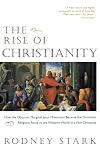
In this interesting and provocative book, sociologist of religion Rodney Stark uses contemporary social science to enrich inquiry into why Christian was successful during its first three hundred years, spreading from one thousand followers a decade after Jesus’ crucifixion to six million by 300 CE.
Stark is probably conservative. His bibliography includes titles like “The Victory of Reason: How Christianity Led to Freedom, Capitalism, and Western Success” and “God’s Battalions: The show more Case For the Crusades”. That said, his work seems honest and erudite, combining his own research, theoretical propositions, and data to back them up. Social science in the 20th century is tinged with Marxism, so books like this which don’t try to fit into such narrow ideological concepts are a breath of fresh air.
This book is only 215 pages but it is dense with ideas and references. In each chapter, Stark proposes at least one theory for why Christianity spread and provides evidence and arguments for his claims. Even with my background readings into this subject, it was sometimes hard to keep up. I imagine someone who hasn’t read anything about the early church might have difficulty reading this, as they’d be constantly encountering for the first time new names, concepts, and historical references.
The popular view of early Christian growth is of starry-eyed street preachers and martyrs initiating mass evangelizations. But this viewpoint is only popular because Christians like it. It implies that their doctrine was so appealing that people quickly converted en masse. Stark believes instead that Christianity spread the same way modern New Religious Movements (NRM) usually do: through interpersonal relationships. Researching the modern Unification Movement, a Korean-American NRM, Stark found that only those with family or friends already in the movement converted. The group tried evangelizing to strangers, but continually failed. Many people were interested in the religion and its ideas, but they failed to join unless they already had peers in the movement.
Stark believes generally that conversion is bringing one’s religious behavior in line with friends and family. We get this idea by applying the “control theory” of deviancy, where social scientists ask not why people deviate, but instead why they conform. Broadly speaking, the theory goes that people conform when they believe they have more to lose being caught in the deviant act than they have to gain in it. So, when a new religion is unpopular with one’s peers, conversion is seen as deviant. But when enough of ones’ attachments are part of it, it becomes an act of conformity.
If this theory is helpful in explaining the growth of new religions, how does it help us understand early Christianity? For one, it points to conversion taking place among social networks rather than mass evangelizations. It also implies a regular pace for growth. If there were one thousand Christians a decade after the crucifixion, and six million when Emperor Constantine converted in the early fourth century, that’s a 40% growth rate per decade. Modern day Mormons claim a similar rate, meaning that 40% is not exceptional and unlikely.
Another popular belief that Stark deflates is that early Christians significantly came from the ranks of the poor. This interpretation, about early Christianity and all New Religious Movements, was dominant in the social sciences and popular understanding from the late 1800’s to the latter decades of the 1900’s. Besides citing numerous biblical quotes and explaining inferences we can make from them, Stark brings contemporary social science to his aid. He divvies up religious movements between the categories church, sect, and cult. Churches tend to be tied with secular society, sects are revitalizations of old faiths and are in tension with secular society, while cults are faiths new to a society that violate religious norms, making them the target of considerable hostility from all quarters.
Data from 1989-1990 on educational background for adherents of various religions shows that cult members were 67% college attendees, mainline denomination adherents included 45-76%, and sects had 10-37%. Stark argues that this happens in part because cults carry a new culture, and privileged people have the education to consider and understand new ideas. In contrast, sects appeal to the poor in part because they just drum up old, familiar religious ideas. While this theory could be arguing that poor people are stupid, it could also be saying that people who have been encouraged to evaluate new ideas may be more drawn to do so, which doesn’t mean they’re smarter, only in a different set of habits.
So, do these insights apply for early Christianity? Stark argues that the original Jesus Movement was something like a sect of Judaism. But, with the included emphasis on resurrection, it became something else. Too much new content was added for it to be a sect anymore. Christians were labelled heretics by Jewish authorities in a way that sects like the Pharisees were not. So to Stark, early Christianity was a cult and not a sect, meaning that it probably appealed to the educated. Here, I think he is persuasive and probably onto something, but I doubt that contemporary categorizations fit a culture two thousand years old. I also wonder what Stark thinks of millenarian religious movements. All that said, Stark makes a good point that, if Christianity really did come from the poor, Roman authorities would have treated it as a more serious political threat than they did.
Marx, Engels, Freud, and other founders of modern social science believed religion to be compensation for thwarted desires. The theory goes, because people can’t have a good life, they seek consolation through religion. But the data shows that church attendance doesn’t break down by class that easily, and that there’s no correlation between social class and belief in life after death. This old “deprivation theory” may explain why some people are drawn to religion, but there are other factors as well, some of which arguably draw in wealthier people. Religious organizations can give positive things in the here-and-now including status, income, self-esteem, relationships, and entertainment. It can also promise otherworldly rewards that don’t exist in this world. Some examples of successful religions that started with educated and prosperous adherents include Islam, Mormonism, and Christian Science.
Regarding the Christian mission to the Jews, Stark believes that, contrary the Book of Acts and scholarly consensus, it was actually successful. He argues that, given his theory of social networks and conversion to new religious movements, Jewish networks would have been well-suited for the growth of Christianity. This chapter came off as odd to me. He’s so sure of his theories that he applies them to override a consensus that, to my knowledge, nobody else was challenging. I guess the best defense is a good offense? Nevertheless, it was an interesting argument.
In the chapter “Epidemics, Networks, and Conversion,” Stark argues that nascent Christian doctrine helped Christians survive at higher rates than Pagans during major epidemics. In 165 and 251 CE, the Roman Empire was hit by epidemics that each wiped out probably a third or more of the population. The rate of death was so severe and impactful that Stark argues that Rome’s decline was probably caused by depopulation instead of Edward Gibbons’ argument of “moral degeneration.”
Alongside many intellectuals from Antiquity, Stark believes that both epidemics actually helped the spread of Christianity. Crises like these that quickly change everything put a strain on religions to console and meet peoples’ needs. It’s during these times that new religious movements emerge and grow. They revitalize cultures to deal with the crisis at hand, mobilizing people to attempt collective action and form new social arrangements.
The Christian Bishop Dionysus writes that many Christians died while nursing the sick, but doing so enabled Christians to survive at a higher rate than Pagans. Stark agrees, arguing that Judeo-Christian thought inherently links “a highly social ethical code with religion.” Not only are Judeo-Christian holy books rife with such admonitions, other ancient Christian writings explicitly state that deacons were charged with supporting the sick, infirm, poor, and disabled. While Pagans practice charity, it lacked any religious imperative. This was partially because Pagan didn’t have the notion that a deity could love humanity. Pagan Gods issued no ethical demands, one only offended them by neglecting their standards for rituals. In contrast, Christianity teaches that God loves those who love him, and that he isn’t pleased until Christians love each other.
Thus, Christian charity led to something like a miniature welfare state, where sick and poor Christians received basic provisioning and care from each other. Though ancient medicine lacked knowledge of germs and hygiene, historian of epidemics William McNeill argues that “when all normal services break down, quite elementary nursing will greatly reduce mortality. Simple provisioning of food and water, for instance, will allow persons who are temporarily too weak to cope for themselves to recover instead of perishing miserably.” Such services would have led to Christians surviving at a higher rate than pagans. This, plus Christians ministering to everybody, would have been viewed favorably by Pagans. It’s possible that the higher Christian survival rate would actually be seen as miraculous at the time.
Urban chaos in general was probably conducive to Christianity’s growth. Stark writes that cities like Antioch were marked by “extraordinary levels of urban disorder, social dislocation, filth, disease, misery, fear, and cultural chaos.” Health was so poor that average life expectancy probably hovered around 30 years. Constant in-migrations would have led to ethnic antagonism and fear. In this context, Christianity was better suited than Paganism because it offered charity, nursing services, hope for life after death, a new sense of family for orphans and widows, and a novel basis for attachments that cut across ethnic lines. Christianity likely “revitalized life” in these cities by introducing norms and relationships that helped residents cope and adjust.
Regarding women’s roles and church growth, Stark argues that women had it better as Christians. Widows were more respected, the double-standard for extramarital affairs was diminished, and statistics show Christian woman marrying older than Pagans, meaning they had more choice in the matter. Christianity would have been enticing to women, which partially explains why women significantly made up the ranks of early Christian converts.
Also related to gender, ancient Rome had a high male-to-female ratio because infanticide was legal and popular, and Pagans usually didn’t want female babies. Christians prohibited the practice alongside abortion and even mutual masturbation, leading to high fertility rates among Christians. That, and a culture that relatively celebrated marriage in contrast to Paganism led to more Christians being born.
Regarding early Christianity’s infamous martyrs, Stark posits that their actions should be viewed as rational choices. Apparently, social scientists in the past believed that religious sacrifice was irrational pandering to supernatural entities. To defend and understand these actions, Stark sets up two related concepts: rewards and compensators. Rewards are desired things while compensators are proposals for achieving them. For example, living a life in-line with religious ethics is a compensator for the reward of going to heaven in the afterlife.
Religious compensators have unique advantages and disadvantages: they promise supernatural rewards like immortality, but they are also uncertain and risky. How do peoples evaluate the risk involved in them? Stark argues that religions get their reputation from social and cultural promotion. In part, we assess a religion’s value based on the confidence we find in other practitioners. Seeing people speak in tongues or give testimonials claiming that religion healed their alcoholism, infidelity issues, and brought personal regeneration can help bolster a religion’s reputation. When we see religious leaders receiving low levels of material reward for their religious services, we also see them as more credible. The poorer they appear, the more credible they seem, since they seemingly lack ulterior motives. This explains the power and value of asceticism to religion.
Stark proposes that “martyrs are the most credible exponents of the value of a religion, and this is especially true if there is a voluntary aspect to their martyrdom.” Though it involves sacrifice, stigmas and sacrifice can be conceived as individual membership costs that lead to larger religious benefits. For example, religious groups sometimes have a “free rider” problem, where people join for the benefits but give very little. But when there are stigmas, like how Christianity forbade sex outside marriage and expected Christian charity, the uncommitted are screened out. This can have a cascading effect, where the group consists of only high participators, leading to more collective benefits. Martyrdom is just one result of such a situation.
Martyrdom came with many benefits, and not just supernatural ones. In the period before their death, martyrs received adulation and celebrity status among Christians. Imprisoned bishops set to be martyred would receive regular visits in jail which included gifts and food. Additionally, martyrs knew they’ve be memorialized after death.
Another theory Stark has for Christianity’s spread is its exclusive, intolerant nature. Pagan client cults were not exclusive, one could and often did worship multiple Gods. This led to weak organizations, where clients lacked ongoing relationships with the cult. One simply consulted them when they needed something and then left. There were no lasting bonds. You did not “convert” to the cult of Orpheus, you “adhered” to its rituals and requirements. This is not the case with Judaism and Christianity.
Because Christianity required exclusivity, it was more capable of getting converts to do things. It has stronger organization that gives adherents a sense of belonging. Christian clergy didn’t sell you religious goods the way Pagan priests did, they guided you in life. This led to Christianity constituting “an intense community” in Stark’s words.
Stark ends the book with a quick discussion of doctrine. While Christian theologians are known for giving too much credence to Christian doctrine in explaining the religion’s spread, Stark believes the social scientists are too critical. All of the facets that Stark discussed in this book are somewhat an echo of Christian doctrine. The Judeo-Christian God “loved the world,” something that cannot be said for Pagan Gods, which led to the idea that Christians must love all of God’s creation. Christianity vaunted pity and mercy, which classical philosophers rejected as unearned and thus irrational. In many ways, Christianity was a revitalization movement to create a single culture out of an empire composed of many clashing ethnicities. Stark ends the book by pointing out that Pagan Romans regularly organized and attended celebratory events to watch gladiators kill each other or wild animals tear apart criminals. That we allegedly find such activity abhorrent and unfathomable now is a reflection of Christian virtue.
This book contains many ideas fresh and new to me, which may be why I’m drawn to it. This could be because Stark is conservative so I’m not used to hearing these ideas. But, many of his arguments don’t seem conservative. I think that the way historical criticism takes place in radical circles is that we identify a Bad Thing, i.e. Christianity, and then we try to root it out of every tendril it has touched historically. Fredy Perlman, in “Against His-Story, Against Leviathan,” offered a helpful corrective to this rampant negativity, arguing that many Bad Things started out as Good Things.
While narratives of Progress are misplaced in how they assume everything is getting better, I think that rejections of Progress lead to equally asinine sentiments that everything is getting worse. Christianity spread in the Roman Empire for probably good reasons: it was more humane and met peoples’ needs in a way that Pagan cults failed. Further, I believe that Christianity, by vaunting all of God’s creation and humanity itself, led the door in our culture to humanism, animal liberation, and biocentrism.
It’s unfashionable in some radical circles to admire humanism. Instead, we prefer to value biocentrism or animal rights. I’m going to posit that our preference for these ideas are not a rejection of Christian humanism, but an evolution from it. The evolution went something like: State pagan cults with no ethical obligations -> Christianity urging worshippers to value all of God’s children (humanity) -> God replaced by humanism -> humanity replaced by all animals and life in general. Sure, other cultures may never have needed to pass through Christianity to view life as sacred, but we are not those cultures. Pretending that we can undo Christianity’s influence is arrogant and ahistorical. We are simply configurations of what came before us. Christianity is a part of us, no matter how atheistic or egoistic we claim to be. show less
Stark is probably conservative. His bibliography includes titles like “The Victory of Reason: How Christianity Led to Freedom, Capitalism, and Western Success” and “God’s Battalions: The show more Case For the Crusades”. That said, his work seems honest and erudite, combining his own research, theoretical propositions, and data to back them up. Social science in the 20th century is tinged with Marxism, so books like this which don’t try to fit into such narrow ideological concepts are a breath of fresh air.
This book is only 215 pages but it is dense with ideas and references. In each chapter, Stark proposes at least one theory for why Christianity spread and provides evidence and arguments for his claims. Even with my background readings into this subject, it was sometimes hard to keep up. I imagine someone who hasn’t read anything about the early church might have difficulty reading this, as they’d be constantly encountering for the first time new names, concepts, and historical references.
The popular view of early Christian growth is of starry-eyed street preachers and martyrs initiating mass evangelizations. But this viewpoint is only popular because Christians like it. It implies that their doctrine was so appealing that people quickly converted en masse. Stark believes instead that Christianity spread the same way modern New Religious Movements (NRM) usually do: through interpersonal relationships. Researching the modern Unification Movement, a Korean-American NRM, Stark found that only those with family or friends already in the movement converted. The group tried evangelizing to strangers, but continually failed. Many people were interested in the religion and its ideas, but they failed to join unless they already had peers in the movement.
Stark believes generally that conversion is bringing one’s religious behavior in line with friends and family. We get this idea by applying the “control theory” of deviancy, where social scientists ask not why people deviate, but instead why they conform. Broadly speaking, the theory goes that people conform when they believe they have more to lose being caught in the deviant act than they have to gain in it. So, when a new religion is unpopular with one’s peers, conversion is seen as deviant. But when enough of ones’ attachments are part of it, it becomes an act of conformity.
If this theory is helpful in explaining the growth of new religions, how does it help us understand early Christianity? For one, it points to conversion taking place among social networks rather than mass evangelizations. It also implies a regular pace for growth. If there were one thousand Christians a decade after the crucifixion, and six million when Emperor Constantine converted in the early fourth century, that’s a 40% growth rate per decade. Modern day Mormons claim a similar rate, meaning that 40% is not exceptional and unlikely.
Another popular belief that Stark deflates is that early Christians significantly came from the ranks of the poor. This interpretation, about early Christianity and all New Religious Movements, was dominant in the social sciences and popular understanding from the late 1800’s to the latter decades of the 1900’s. Besides citing numerous biblical quotes and explaining inferences we can make from them, Stark brings contemporary social science to his aid. He divvies up religious movements between the categories church, sect, and cult. Churches tend to be tied with secular society, sects are revitalizations of old faiths and are in tension with secular society, while cults are faiths new to a society that violate religious norms, making them the target of considerable hostility from all quarters.
Data from 1989-1990 on educational background for adherents of various religions shows that cult members were 67% college attendees, mainline denomination adherents included 45-76%, and sects had 10-37%. Stark argues that this happens in part because cults carry a new culture, and privileged people have the education to consider and understand new ideas. In contrast, sects appeal to the poor in part because they just drum up old, familiar religious ideas. While this theory could be arguing that poor people are stupid, it could also be saying that people who have been encouraged to evaluate new ideas may be more drawn to do so, which doesn’t mean they’re smarter, only in a different set of habits.
So, do these insights apply for early Christianity? Stark argues that the original Jesus Movement was something like a sect of Judaism. But, with the included emphasis on resurrection, it became something else. Too much new content was added for it to be a sect anymore. Christians were labelled heretics by Jewish authorities in a way that sects like the Pharisees were not. So to Stark, early Christianity was a cult and not a sect, meaning that it probably appealed to the educated. Here, I think he is persuasive and probably onto something, but I doubt that contemporary categorizations fit a culture two thousand years old. I also wonder what Stark thinks of millenarian religious movements. All that said, Stark makes a good point that, if Christianity really did come from the poor, Roman authorities would have treated it as a more serious political threat than they did.
Marx, Engels, Freud, and other founders of modern social science believed religion to be compensation for thwarted desires. The theory goes, because people can’t have a good life, they seek consolation through religion. But the data shows that church attendance doesn’t break down by class that easily, and that there’s no correlation between social class and belief in life after death. This old “deprivation theory” may explain why some people are drawn to religion, but there are other factors as well, some of which arguably draw in wealthier people. Religious organizations can give positive things in the here-and-now including status, income, self-esteem, relationships, and entertainment. It can also promise otherworldly rewards that don’t exist in this world. Some examples of successful religions that started with educated and prosperous adherents include Islam, Mormonism, and Christian Science.
Regarding the Christian mission to the Jews, Stark believes that, contrary the Book of Acts and scholarly consensus, it was actually successful. He argues that, given his theory of social networks and conversion to new religious movements, Jewish networks would have been well-suited for the growth of Christianity. This chapter came off as odd to me. He’s so sure of his theories that he applies them to override a consensus that, to my knowledge, nobody else was challenging. I guess the best defense is a good offense? Nevertheless, it was an interesting argument.
In the chapter “Epidemics, Networks, and Conversion,” Stark argues that nascent Christian doctrine helped Christians survive at higher rates than Pagans during major epidemics. In 165 and 251 CE, the Roman Empire was hit by epidemics that each wiped out probably a third or more of the population. The rate of death was so severe and impactful that Stark argues that Rome’s decline was probably caused by depopulation instead of Edward Gibbons’ argument of “moral degeneration.”
Alongside many intellectuals from Antiquity, Stark believes that both epidemics actually helped the spread of Christianity. Crises like these that quickly change everything put a strain on religions to console and meet peoples’ needs. It’s during these times that new religious movements emerge and grow. They revitalize cultures to deal with the crisis at hand, mobilizing people to attempt collective action and form new social arrangements.
The Christian Bishop Dionysus writes that many Christians died while nursing the sick, but doing so enabled Christians to survive at a higher rate than Pagans. Stark agrees, arguing that Judeo-Christian thought inherently links “a highly social ethical code with religion.” Not only are Judeo-Christian holy books rife with such admonitions, other ancient Christian writings explicitly state that deacons were charged with supporting the sick, infirm, poor, and disabled. While Pagans practice charity, it lacked any religious imperative. This was partially because Pagan didn’t have the notion that a deity could love humanity. Pagan Gods issued no ethical demands, one only offended them by neglecting their standards for rituals. In contrast, Christianity teaches that God loves those who love him, and that he isn’t pleased until Christians love each other.
Thus, Christian charity led to something like a miniature welfare state, where sick and poor Christians received basic provisioning and care from each other. Though ancient medicine lacked knowledge of germs and hygiene, historian of epidemics William McNeill argues that “when all normal services break down, quite elementary nursing will greatly reduce mortality. Simple provisioning of food and water, for instance, will allow persons who are temporarily too weak to cope for themselves to recover instead of perishing miserably.” Such services would have led to Christians surviving at a higher rate than pagans. This, plus Christians ministering to everybody, would have been viewed favorably by Pagans. It’s possible that the higher Christian survival rate would actually be seen as miraculous at the time.
Urban chaos in general was probably conducive to Christianity’s growth. Stark writes that cities like Antioch were marked by “extraordinary levels of urban disorder, social dislocation, filth, disease, misery, fear, and cultural chaos.” Health was so poor that average life expectancy probably hovered around 30 years. Constant in-migrations would have led to ethnic antagonism and fear. In this context, Christianity was better suited than Paganism because it offered charity, nursing services, hope for life after death, a new sense of family for orphans and widows, and a novel basis for attachments that cut across ethnic lines. Christianity likely “revitalized life” in these cities by introducing norms and relationships that helped residents cope and adjust.
Regarding women’s roles and church growth, Stark argues that women had it better as Christians. Widows were more respected, the double-standard for extramarital affairs was diminished, and statistics show Christian woman marrying older than Pagans, meaning they had more choice in the matter. Christianity would have been enticing to women, which partially explains why women significantly made up the ranks of early Christian converts.
Also related to gender, ancient Rome had a high male-to-female ratio because infanticide was legal and popular, and Pagans usually didn’t want female babies. Christians prohibited the practice alongside abortion and even mutual masturbation, leading to high fertility rates among Christians. That, and a culture that relatively celebrated marriage in contrast to Paganism led to more Christians being born.
Regarding early Christianity’s infamous martyrs, Stark posits that their actions should be viewed as rational choices. Apparently, social scientists in the past believed that religious sacrifice was irrational pandering to supernatural entities. To defend and understand these actions, Stark sets up two related concepts: rewards and compensators. Rewards are desired things while compensators are proposals for achieving them. For example, living a life in-line with religious ethics is a compensator for the reward of going to heaven in the afterlife.
Religious compensators have unique advantages and disadvantages: they promise supernatural rewards like immortality, but they are also uncertain and risky. How do peoples evaluate the risk involved in them? Stark argues that religions get their reputation from social and cultural promotion. In part, we assess a religion’s value based on the confidence we find in other practitioners. Seeing people speak in tongues or give testimonials claiming that religion healed their alcoholism, infidelity issues, and brought personal regeneration can help bolster a religion’s reputation. When we see religious leaders receiving low levels of material reward for their religious services, we also see them as more credible. The poorer they appear, the more credible they seem, since they seemingly lack ulterior motives. This explains the power and value of asceticism to religion.
Stark proposes that “martyrs are the most credible exponents of the value of a religion, and this is especially true if there is a voluntary aspect to their martyrdom.” Though it involves sacrifice, stigmas and sacrifice can be conceived as individual membership costs that lead to larger religious benefits. For example, religious groups sometimes have a “free rider” problem, where people join for the benefits but give very little. But when there are stigmas, like how Christianity forbade sex outside marriage and expected Christian charity, the uncommitted are screened out. This can have a cascading effect, where the group consists of only high participators, leading to more collective benefits. Martyrdom is just one result of such a situation.
Martyrdom came with many benefits, and not just supernatural ones. In the period before their death, martyrs received adulation and celebrity status among Christians. Imprisoned bishops set to be martyred would receive regular visits in jail which included gifts and food. Additionally, martyrs knew they’ve be memorialized after death.
Another theory Stark has for Christianity’s spread is its exclusive, intolerant nature. Pagan client cults were not exclusive, one could and often did worship multiple Gods. This led to weak organizations, where clients lacked ongoing relationships with the cult. One simply consulted them when they needed something and then left. There were no lasting bonds. You did not “convert” to the cult of Orpheus, you “adhered” to its rituals and requirements. This is not the case with Judaism and Christianity.
Because Christianity required exclusivity, it was more capable of getting converts to do things. It has stronger organization that gives adherents a sense of belonging. Christian clergy didn’t sell you religious goods the way Pagan priests did, they guided you in life. This led to Christianity constituting “an intense community” in Stark’s words.
Stark ends the book with a quick discussion of doctrine. While Christian theologians are known for giving too much credence to Christian doctrine in explaining the religion’s spread, Stark believes the social scientists are too critical. All of the facets that Stark discussed in this book are somewhat an echo of Christian doctrine. The Judeo-Christian God “loved the world,” something that cannot be said for Pagan Gods, which led to the idea that Christians must love all of God’s creation. Christianity vaunted pity and mercy, which classical philosophers rejected as unearned and thus irrational. In many ways, Christianity was a revitalization movement to create a single culture out of an empire composed of many clashing ethnicities. Stark ends the book by pointing out that Pagan Romans regularly organized and attended celebratory events to watch gladiators kill each other or wild animals tear apart criminals. That we allegedly find such activity abhorrent and unfathomable now is a reflection of Christian virtue.
This book contains many ideas fresh and new to me, which may be why I’m drawn to it. This could be because Stark is conservative so I’m not used to hearing these ideas. But, many of his arguments don’t seem conservative. I think that the way historical criticism takes place in radical circles is that we identify a Bad Thing, i.e. Christianity, and then we try to root it out of every tendril it has touched historically. Fredy Perlman, in “Against His-Story, Against Leviathan,” offered a helpful corrective to this rampant negativity, arguing that many Bad Things started out as Good Things.
While narratives of Progress are misplaced in how they assume everything is getting better, I think that rejections of Progress lead to equally asinine sentiments that everything is getting worse. Christianity spread in the Roman Empire for probably good reasons: it was more humane and met peoples’ needs in a way that Pagan cults failed. Further, I believe that Christianity, by vaunting all of God’s creation and humanity itself, led the door in our culture to humanism, animal liberation, and biocentrism.
It’s unfashionable in some radical circles to admire humanism. Instead, we prefer to value biocentrism or animal rights. I’m going to posit that our preference for these ideas are not a rejection of Christian humanism, but an evolution from it. The evolution went something like: State pagan cults with no ethical obligations -> Christianity urging worshippers to value all of God’s children (humanity) -> God replaced by humanism -> humanity replaced by all animals and life in general. Sure, other cultures may never have needed to pass through Christianity to view life as sacred, but we are not those cultures. Pretending that we can undo Christianity’s influence is arrogant and ahistorical. We are simply configurations of what came before us. Christianity is a part of us, no matter how atheistic or egoistic we claim to be. show less
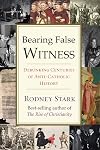
If even a small part of this book is true, it will force you to rethink a lifetime of history you have taken for granted. I can’t tell yet whether I believe all or even most of the claims, but from now on I’ll be reading all history books more skeptically.
Much of the argument is based on the observation that for the past 500 years, Protestant cultures had incentives to portray Catholic history as negatively as possible. You could win fame and fortune, perhaps even employment at a show more prestigious job, if you showed something bad about Catholics and Catholic countries. During much of the 1500s and 1600s, newly-Protestant England was the enemy of Catholic Spain, so for patriotic reasons any voice of disapproval was amplified. Historians quote one another, so even if you were an atheist, you would find a sympathetic audience for anything you wrote negatively about pre-Protestant European history.
Here are a few of the eye-opening claims:
* There never was a “Dark Ages”. The term was coined and popularized by post-Renaissance anti-religious thinkers who wanted to exaggerate their own importance. In fact, Europe was constantly innovating and getting better after the Roman Empire fell.
* Anti-semitism was always condemned by the Catholic Church, which taught that Jews were God’s chosen people. There is little or no recorded violence against Jews for the first thousand years of Church history, and after that it was the Church who protected Jews. Anti-semitism was strongest in areas where the church was weakest.
* Galileo was punished for betrayal of his friendship with the Pope, not for making a scientific claim.
* The Crusades were fought to ensure access to the Holy Land by European Christians, who were regularly persecuted and killed on the pilgrimages they’d been making for a thousand years. Remember, the Holy Land was Christian by choice for 500 years before Muslim invaders forced them to convert.
* The Catholic Church condemned slavery throughout history. Even in the US, the Catholic-majority places (like Louisiana) saw higher manumission than Protestant majority states.
I'm eager to hear more, especially any rebuttals from historians who know more than I do, but I found the arguments compelling and definitely worth a followup. show less
Much of the argument is based on the observation that for the past 500 years, Protestant cultures had incentives to portray Catholic history as negatively as possible. You could win fame and fortune, perhaps even employment at a show more prestigious job, if you showed something bad about Catholics and Catholic countries. During much of the 1500s and 1600s, newly-Protestant England was the enemy of Catholic Spain, so for patriotic reasons any voice of disapproval was amplified. Historians quote one another, so even if you were an atheist, you would find a sympathetic audience for anything you wrote negatively about pre-Protestant European history.
Here are a few of the eye-opening claims:
* There never was a “Dark Ages”. The term was coined and popularized by post-Renaissance anti-religious thinkers who wanted to exaggerate their own importance. In fact, Europe was constantly innovating and getting better after the Roman Empire fell.
* Anti-semitism was always condemned by the Catholic Church, which taught that Jews were God’s chosen people. There is little or no recorded violence against Jews for the first thousand years of Church history, and after that it was the Church who protected Jews. Anti-semitism was strongest in areas where the church was weakest.
* Galileo was punished for betrayal of his friendship with the Pope, not for making a scientific claim.
* The Crusades were fought to ensure access to the Holy Land by European Christians, who were regularly persecuted and killed on the pilgrimages they’d been making for a thousand years. Remember, the Holy Land was Christian by choice for 500 years before Muslim invaders forced them to convert.
* The Catholic Church condemned slavery throughout history. Even in the US, the Catholic-majority places (like Louisiana) saw higher manumission than Protestant majority states.
I'm eager to hear more, especially any rebuttals from historians who know more than I do, but I found the arguments compelling and definitely worth a followup. show less
Lists
Sonlight Books (1)
Awards


You May Also Like


Associated Authors
Statistics
- Works
- 61
- Also by
- 7
- Members
- 5,417
- Popularity
- #4,601
- Rating
- 4.0
- Reviews
- 62
- ISBNs
- 167
- Languages
- 8
- Favorited
- 5