
F. Bruce Gordon
Author of Calvin
About the Author
Works by F. Bruce Gordon
Architect of Reformation: An Introduction to Heinrich Bullinger, 1504-1575 (2004) — Editor — 60 copies
The Place of the Dead: Death and Remembrance in Late Medieval and Early Modern Europe (2000) 27 copies
Shaping the Bible in the Reformation books, scholars, and their readers in the sixteenth century (2012) 10 copies
Protestant History and Identity in Sixteenth-Century Europe (2 Volume Set) (St. Andrews Studies in Reformation History) (1996) 3 copies
Charles Simeon 2 copies
Protestant history and identity in sixteenth-century Europe: Volume 1 - The Medieval Inheritance (1996) 2 copies
Protestant History and Identity in Sixteenth-Century Europe: Volume 2 - The Later Reformation (1996) 1 copy
Heinrich Bullinger 1 copy
Associated Works
Tagged
Common Knowledge
- Canonical name
- Gordon, F. Bruce
- Other names
- Gordon, Bruce
- Birthdate
- 1962
- Gender
- male
- Education
- Dalhousie University (BA|1984|MA|1986)
University of St Andrews (Ph.D|1990) - Occupations
- professor
historian - Organizations
- Yale University
University of St Andrews - Nationality
- Canada (birth)
- Places of residence
- New Haven, Connecticut, USA
Members
Reviews

As the descendent of Swiss Protestants, Zwingli has always loomed large in my national thought, but has been muted in my religious thinking. Gordon does a masterful job presenting Zwingli in all his flawed and frail humanity, his intellectual achievements and his recourse to violence. I finished this book thankful for Gordon’s work in presenting the historical Zwingli and feeling that we are better off having Zwingli muted.
This excellent biography compresses the turbulent life of Swiss reformer Huldrych Zwingli into just a little over 300 pages, including notes, a select bibliography, and an index. Gordon doesn’t shy away from the controversial aspects of Zwingli’s legacy, such as his complicity in the intolerant treatment of the “brothers,” known to history as the Anabaptists, or his incitement to the use of military force to spread the gospel throughout Switzerland. At the same time, Zwingli’s show more positive traits, such as his learning and devotion to the poor, are clearly drawn out. The book is scholarly yet accessible; I imagine Bruce Gordon is a gifted teacher.
Gordon writes of the years covered in the middle third of the book, “Zwingli experienced the period from 1525 until the first war in 1529 not as the linear story that the historian seeks out, but as a series of interlocking and coterminous events and developments that he could neither dictate nor control.” This is reflected in the repetition that creeps in as Gordon strives to keep the narrative clear.
The critical topic of the relation of Zwingli and Luther is well-handled. Gordon argues that Zwingli was not an acolyte of Luther, as his conversion experience in Einsiedeln before Luther had published makes clear. Yet he admired and was influenced by the Saxon reformer. All the more lamentable that their only personal meeting is remembered not for their many points of agreement but for their failure to agree on the Lord’s Supper.
One insight I gleaned that was new to me was that the opposition of the “five states” from inner Switzerland was not only because of their devotion to the “old faith,” as it was called. Zwingli’s adamant opposition to mercenary service threatened a key revenue source and opportunity for advancement for these relatively poorer areas, making its inhabitants unfavorably disposed to Zwingli before they even heard his teachings about the Christian faith.
The book closes not with Zwingli’s death in battle but continues with two valuable chapters. One outlines the various ways Zwingli has been depicted in the intervening centuries; the other reflects the ambivalent way he is viewed today in Zurich, the city he revolutionized in the twelve years he was its leading pastor. show less
Gordon writes of the years covered in the middle third of the book, “Zwingli experienced the period from 1525 until the first war in 1529 not as the linear story that the historian seeks out, but as a series of interlocking and coterminous events and developments that he could neither dictate nor control.” This is reflected in the repetition that creeps in as Gordon strives to keep the narrative clear.
The critical topic of the relation of Zwingli and Luther is well-handled. Gordon argues that Zwingli was not an acolyte of Luther, as his conversion experience in Einsiedeln before Luther had published makes clear. Yet he admired and was influenced by the Saxon reformer. All the more lamentable that their only personal meeting is remembered not for their many points of agreement but for their failure to agree on the Lord’s Supper.
One insight I gleaned that was new to me was that the opposition of the “five states” from inner Switzerland was not only because of their devotion to the “old faith,” as it was called. Zwingli’s adamant opposition to mercenary service threatened a key revenue source and opportunity for advancement for these relatively poorer areas, making its inhabitants unfavorably disposed to Zwingli before they even heard his teachings about the Christian faith.
The book closes not with Zwingli’s death in battle but continues with two valuable chapters. One outlines the various ways Zwingli has been depicted in the intervening centuries; the other reflects the ambivalent way he is viewed today in Zurich, the city he revolutionized in the twelve years he was its leading pastor. show less
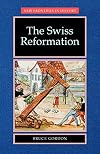
For more than half a century from the 1520s to the 1570s, the rural backwater that was the Swiss Confederation found itself, rather unexpectedly, at the heart of the European Reformation. This was primarily down to the influence of one dominating figure, the Toggenburg preacher Huldrych Zwingli. Zwingli arrived in Zurich in 1519 and proceeded to combine radical sermonising with canny political networking, a combination that would prove decisive. He set the terms of the theological debate for show more the Swiss states and beyond, but he was holding too much together by sheer force of personality: after he was killed on the battlefield in 1531, things slowly but inevitably fell apart. By the mid 1570s, Zwinglianism had been subsumed in a wider Protestant culture that was dominated instead by the ideas of Calvin.
(We don't count Calvinism as Swiss, by the way. Calvin himself was French, and Geneva was essentially an independent republic – though it did become allied with the Confederation during this period.)
The basic narrative of the Swiss Reformation can be found in many other, general books, where it is usually treated (quite rightly) as part of a much broader European movement. What I wanted from this study was to get some idea of how ‘Swiss’ the ideas of Zwingli and Bullinger were – to what extent they arose from and reflected the socio-politico-geographical circumstances of the Swiss Confederation. Gordon has a go at addressing this question, and although his answer involves a lot of shrugging he does at least try to describe the main points of contemporary Swiss society in order that readers can reach their own conclusions. These sections are the most interesting, especially for non-specialists: the first chapter, which outlines the history of the Confederation and discusses some of the main intellectual and religious currents in sixteenth-century society; and the final two chapters, which reflect on ‘the culture of the Swiss Reformation’ in a much wider sense.
Some random observations, mostly for my own benefit:
Though Zurich was at the centre of the Swiss Reformation, it was Basel that was the main cultural and intellectual hotspot – actually, pretty much the only cultural and intellectual hotspot. Basel had the only Swiss university of any importance, and it was also a major printing centre. This is what attracted Erasmus, who lived there on and off from 1514 to 1525 and swore that the Froben printing house had the most beautiful Greek type in the world. Although he did his best to distance himself from the evangelical movement, Erasmus was clearly the godfather of the Swiss Reformation (bad metaphor, they hated godfathers); Zwingli approached theology as an identifiably Erasmian humanist, and his mastery of the ancient Biblical languages, his close reading of the original texts, his cultivation of a sodality of fellow-scholars – all these things Zwingli learned directly from Erasmus.
The Radical Reformation again emerges as the most interesting trend. The early Anabaptists followed Zwingli eagerly, and took him at his word: yes, we must live only by the word of the Bible – Zwingli himself just didn't go nearly far enough for them. Almost immediately there was a separate sensibility which leads directly to the Mennonites of Ontario, the Amish of Pennsylvania. It's one of the striking ironies of the Swiss Reformers that they came to prominence by standing against the bureaucratic structure of the Catholic Church, but almost immediately became incredibly clerical themselves, because of the need to define themselves against the radicals. (There is a novel set in this world that I really want to write – people meeting in secret by moonlight in obscure mountain pastures, dodging Catholics and Reformed authorities alike, heretics burnt on the shores of Lake Zurich, the primacy of newly-printed texts, the importance of the vernacular….)
On the evidence of this book and others like it, the Reformation was a TOTAL SAUSAGE FEST – I don't think a single woman is referred to by name. And yet there are clearly lots of stories to tell – many nuns abandoned their vows when they heard the Reformers' message and went off to get married, while others, their convents forcibly shut down, found themselves with no financial help and no social purpose. Priests' mistresses, who had before been tolerated, could now legally marry their partners and gain some legal protection. There are lots of things like that, where you get only a tantalising glimpse of what must have been going on in individual households and communities.
Gordon's style is pretty dry and academic, it must be said, but he's also synthesised a huge amount of research that is otherwise available only in German and/or in obscure minor journals. I'm grateful for it, and especially grateful for the many suggestions he gives for further reading, both among modern historians and among the contemporary scholars, chroniclers and dramatists of the sixteenth-century Swiss Confederation. show less
(We don't count Calvinism as Swiss, by the way. Calvin himself was French, and Geneva was essentially an independent republic – though it did become allied with the Confederation during this period.)
The basic narrative of the Swiss Reformation can be found in many other, general books, where it is usually treated (quite rightly) as part of a much broader European movement. What I wanted from this study was to get some idea of how ‘Swiss’ the ideas of Zwingli and Bullinger were – to what extent they arose from and reflected the socio-politico-geographical circumstances of the Swiss Confederation. Gordon has a go at addressing this question, and although his answer involves a lot of shrugging he does at least try to describe the main points of contemporary Swiss society in order that readers can reach their own conclusions. These sections are the most interesting, especially for non-specialists: the first chapter, which outlines the history of the Confederation and discusses some of the main intellectual and religious currents in sixteenth-century society; and the final two chapters, which reflect on ‘the culture of the Swiss Reformation’ in a much wider sense.
Some random observations, mostly for my own benefit:
Though Zurich was at the centre of the Swiss Reformation, it was Basel that was the main cultural and intellectual hotspot – actually, pretty much the only cultural and intellectual hotspot. Basel had the only Swiss university of any importance, and it was also a major printing centre. This is what attracted Erasmus, who lived there on and off from 1514 to 1525 and swore that the Froben printing house had the most beautiful Greek type in the world. Although he did his best to distance himself from the evangelical movement, Erasmus was clearly the godfather of the Swiss Reformation (bad metaphor, they hated godfathers); Zwingli approached theology as an identifiably Erasmian humanist, and his mastery of the ancient Biblical languages, his close reading of the original texts, his cultivation of a sodality of fellow-scholars – all these things Zwingli learned directly from Erasmus.
The Radical Reformation again emerges as the most interesting trend. The early Anabaptists followed Zwingli eagerly, and took him at his word: yes, we must live only by the word of the Bible – Zwingli himself just didn't go nearly far enough for them. Almost immediately there was a separate sensibility which leads directly to the Mennonites of Ontario, the Amish of Pennsylvania. It's one of the striking ironies of the Swiss Reformers that they came to prominence by standing against the bureaucratic structure of the Catholic Church, but almost immediately became incredibly clerical themselves, because of the need to define themselves against the radicals. (There is a novel set in this world that I really want to write – people meeting in secret by moonlight in obscure mountain pastures, dodging Catholics and Reformed authorities alike, heretics burnt on the shores of Lake Zurich, the primacy of newly-printed texts, the importance of the vernacular….)
On the evidence of this book and others like it, the Reformation was a TOTAL SAUSAGE FEST – I don't think a single woman is referred to by name. And yet there are clearly lots of stories to tell – many nuns abandoned their vows when they heard the Reformers' message and went off to get married, while others, their convents forcibly shut down, found themselves with no financial help and no social purpose. Priests' mistresses, who had before been tolerated, could now legally marry their partners and gain some legal protection. There are lots of things like that, where you get only a tantalising glimpse of what must have been going on in individual households and communities.
Gordon's style is pretty dry and academic, it must be said, but he's also synthesised a huge amount of research that is otherwise available only in German and/or in obscure minor journals. I'm grateful for it, and especially grateful for the many suggestions he gives for further reading, both among modern historians and among the contemporary scholars, chroniclers and dramatists of the sixteenth-century Swiss Confederation. show less
An extraordinary history of an extraordinary event in European history, the Reformation in Switzerland as it occurred in the mid-16th century, with some consideration of the Swiss Reformation's influence on Reformation events elsewhere in Europe. I found particularly interesting the discussion of Calvin's and Geneva's unpopularity in some other Reformed cantons (especially in Basel, the home of Switzerland's only degree-granting university in that era).
There are a lot – and I mean a lot show more – of characters appearing in this history, but the author (unlike many other historians) has the good sense to include a short biographical glossary at the front of the book. Still, you might want to keep an Internet connection alive to google phrases like "double predestination" or groups like the "Utraquists."
That's the one reason I give this book 4**** and not somewhat higher, that it does require some knowledge of Reformed theology and Reformed as well as paleo-Protestant history that the author skims over or assumes knowledge of. The biographical glossary is a big help, but it's limited to persons – not including sects/groups and theological concepts – which makes the book a bit hard to follow for the casual reader.
Still, given the relative paucity of current-day histories of figures like Zwingli and Bullinger in particular, this is a very welcome addition to Reformed Church history and will stimulate further reading in this area. show less
There are a lot – and I mean a lot show more – of characters appearing in this history, but the author (unlike many other historians) has the good sense to include a short biographical glossary at the front of the book. Still, you might want to keep an Internet connection alive to google phrases like "double predestination" or groups like the "Utraquists."
That's the one reason I give this book 4**** and not somewhat higher, that it does require some knowledge of Reformed theology and Reformed as well as paleo-Protestant history that the author skims over or assumes knowledge of. The biographical glossary is a big help, but it's limited to persons – not including sects/groups and theological concepts – which makes the book a bit hard to follow for the casual reader.
Still, given the relative paucity of current-day histories of figures like Zwingli and Bullinger in particular, this is a very welcome addition to Reformed Church history and will stimulate further reading in this area. show less
Lists
Awards

You May Also Like


Associated Authors
Statistics
- Works
- 16
- Also by
- 1
- Members
- 833
- Popularity
- #30,660
- Rating
- 4.1
- Reviews
- 5
- ISBNs
- 36
- Languages
- 1
- Favorited
- 1