
Frances Parkinson Keyes (1885–1970)
Author of Dinner at Antoine's
About the Author
Image credit: Frances Parkinson Keyes
Series
Works by Frances Parkinson Keyes
The Rose and the Lily: The Lives and Times of Two South American Saints (2015) — Author — 56 copies, 1 review
Two Novels by Frances Parkinson Keyes: The Great Tradition, Senator Marlowe's Daughter (1933) 32 copies
A treasury of favorite poems, from the scrapbooks of Frances Parkinson Keyes (1963) 16 copies, 1 review
Saint Catherine of Siena 1 copy
Another Dante 1 copy
THE MAKING OF A SAINT 1 copy
VIA DELLA GIOIA 1 copy
O Jardim de Salomão 1 copy
Three novels 1 copy
Cuando azota la pasion 1 copy
Associated Works
My Most Inspiring Moment: Encounters with Destiny Relived by Thirty-Eight Best-Selling Authors (1965) 12 copies
Tagged
Common Knowledge
- Canonical name
- Keyes, Frances Parkinson
- Legal name
- Wheeler, Frances Parkinson (birth)
- Birthdate
- 1885-07-21
- Date of death
- 1970-07-03
- Gender
- female
- Education
- Miss Winsor's School
- Occupations
- novelist
magazine editor
journalist
memoirist - Awards and honors
- Royal Order of Isabella the Catholic (1958)
Bates College (Hon. Litt.D|1934) - Relationships
- Keyes, Henry W. (spouse)
- Short biography
- Frances Parkinson Wheeler split her time in childhood between Boston, Massachusetts, and the village of Newbury, Vermont. She was educated privately and traveled widely throughout Europe. In 1904, at the age of 18, she married Henry Wilder Keyes, a politician who eventually became governor and then U.S. Senator from New Hampshire, and the couple lived on his family estate near Haverhill with their three sons.
After her husband's death in 1938, Frances Parkinson Keyes settled in the French Quarter of New Orleans.
Her career as a writer began with the publication of her first novel, Old Gray Homestead, in 1919. During the 1920s, she wrote a series called "Letters from a Senator's Wife," for Good Housekeeping Magazine, where she served as a contributing editor; the columns were later collected and published in book form. Keyes also wrote about her experiences as a political wife in two memoirs, Capital Kaleidoscope: The Story of a Washington Hostess (1937) and All Flags Flying (published posthumously in 1972), as well as a novel, All That Glitters (1941).
Frances converted to Catholicism and this experience fueled much of her writing on religious subjects, both fiction and nonfiction. - Nationality
- USA
- Birthplace
- Charlottesville, Virginia, USA
- Places of residence
- Washington, D.C., USA
New Orleans, Louisiana, USA
Boston, Massachusetts, USA
Newbury, Vermont, USA - Place of death
- New Orleans, Louisiana, USA
- Burial location
- Oxbow Cemetery, Newbury, Vermont, USA
- Associated Place (for map)
- USA
Members
Reviews

The Old Gray Homestead doesn't have the extensive notes on F.P. Keyes's creative process and on-site research that I have come to expect from her books. It's her first book (1919) -- very well written, set in Vermont, drawing upon her life experience of 30-some years, 15 in rural New England. It reminds me of something by Gene Stratton Porter -- a poor farm boy / rich girl romance similar to Laddie, A True Blue Story but thankfully lacking the self-conscious whimsy of the latter; Austin show more calls his lady by her name, Laddie refers to "the Princess" until ... well. Far too often. Perhaps it's more like something by L. M. Montgomery. Keyes's characters would be at home and welcomed in Avonlea. My personal favourite minor character is a gossipy old lady by the name of Mrs Elliott, who sometimes had me laughing out loud. Here she is on the phone: '"Yes, this is Mrs Elliot -- Maybe if some of the folks on the line that's taken their receivers down so's they can know who I'm talkin' to an' what I'm sayin' will hang up, you can hear me a little more plain." (This timely remark resulted in several little clicks.)' show less

There is a wonderful sense of life in the old upper-class New Orleans families of the 1940's . Mardi Gras is very interesting. The mystery works (what there is of it) but the book is mostly a soap opera. The romance in the book did not work for me. Keyes was born in 1885 and she married in 1903. Her husband was 40 years old and a prominent politician who served as a governor and a US senator. Her attitude about love and marriage seems to reflect her own life. All the good women seem to show more strive to be a handmaiden to a good man with important work to do. I like seeing characters play the hand that life has dealt them including the women's social restrictions of the era they lived in. But the women in this book aren't playing their hands, they're just sitting there holding their cards prettily . As incredibly racist as this book is the black woman is actually the best developed female character. The devoted domestic servant is a mainstay in novels. Tossie's devotion actually makes sense. She has found a niche in life that suits her and she is not as humble as she seems. She has found plenty of people to look down on (black-and-white). It is way too long. show less
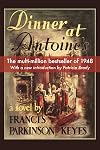
Francis Parkinson Keyes is an author whose books I used to read many years ago. I felt like reading something by her so I picked this up. Dinner at Antoine's takes place in New Orleans and the uniqueness of that city is truly felt in this book. The majority of the book takes place in in 8 days at the beginning of January 1948 and the wrap up chapters extend the time out to October 1948. The characters, all introduced in the beginning at a private dinner at Antoine's, an exclusive restaurant show more are immediately struck with tragedy within 24 hours of the dinner. One of their number is dead. Was it suicide? Murder? The book is extraordinarily long and while I enjoyed it, I do feel it could have benefited from a bit of editing. show less

A reviewer on Amazon complained bitterly about the racism in this book. It's true, the black characters are depicted (through the eyes of the white characters) as Amos-n-Andy types. They just barely stop short of calling them "darkies". But to do them justice, the white characters are pretty stupid and obtuse in their relationships with each other too. The book is like watching a train wreck in slow motion.
Lists
Awards


You May Also Like


Associated Authors
Statistics
- Works
- 75
- Also by
- 4
- Members
- 3,671
- Popularity
- #6,895
- Rating
- 3.4
- Reviews
- 25
- ISBNs
- 130
- Favorited
- 7
