
Russell Baker (1925–2019)
Author of Growing Up
About the Author
Russell Wayne Baker was born in Loudoun County, Virginia on August 14, 1925. He joined the Navy in 1943 and received pilot training. He never went abroad during World War II and left the service in 1945. He received a bachelor's degree in English from Johns Hopkins University in 1947. After show more graduating, he became a night police reporter for The Baltimore Sun. By 1950, he had become a rewrite man, taking phoned notes from reporters at the scene and writing stories on deadline. He eventually became The Sun's London correspondent and then it's White House correspondent. He was hired by The New York Times in 1954 as a Washington correspondent. He covered the State Department, the White House, and the presidential campaigns of 1956 and 1960. In 1962, he became a columnist for The Times and its news service. He wrote the Observer columns until his retirement in 1998. He received the 1979 Pulitzer Prize for distinguished commentary and two George Polk Awards, for commentary in 1978 and career achievement in 1998. His columns were collected in several books including No Cause for Panic, Baker's Dozen, All Things Considered, and Poor Russell's Almanac. After his retirement from The Times, he wrote for The New York Review of Books on politics, history, journalism, and other subjects. A collection of 11 of those essays was published in 2002 under the title Looking Back. His other collections included So This Is Depravity and The Rescue of Miss Yaskell and Other Pipe Dreams. His other books included An American in Washington, the novel Our Next President: The Incredible Story of What Happened in the 1968 Elections, and The Good Times. Growing Up received a Pulitzer Prize for biography in 1983. He was the host of the PBS series Masterpiece Theater from 1993 to 2004. He died from complications of a fall on January 21, 2019 at the age of 93. (Bowker Author Biography) show less
Image credit: photo by SARAH HUNTINGTON -- www.sarahhuntington.com
Works by Russell Baker
Baker's Dozen: A Sampling of Essays By Russell Baker, the "Observer" of The New York Times Editorial Page (1964) 2 copies
A Sinister Metamorphosis 2 copies
Book of American Humor 2 copies
Spaced Out 1 copy
Growing Up (Vol.1),The Good Times(Vol.2) — Author — 1 copy
Associated Works
Reporting Vietnam: American Journalism 1959-1969, Volume 1 (1998) — Contributor — 348 copies, 3 reviews
Devils & Demons: A Treasury of Fiendish Tales Old & New (1991) — Contributor — 289 copies, 2 reviews
Minutes of the Lead Pencil Club: Second Thoughts on the Electronic Revolution (1996) — Contributor — 88 copies, 1 review
Reader's Digest Condensed Books 1983 v03: Mrs. Pollifax on the China Station / The Brea File / Growing Up / Octavia's Hill (1983) — Contributor — 36 copies
Shape Shifters: Fantasy and Science Fiction Tales About Humans Who Can Change Their Shapes (1978) — Contributor — 20 copies, 1 review
The Way West: How the West Was Lost and Won, 1845-1893 [1995 TV series] (1995) — Narrator — 9 copies
Washington: a reader; the National Capital as seen through the eyes of Thomas Jefferson (1967) 3 copies
The Way West, Episode 2: The Approach of Civilization 1865-1869 [1995 TV episode] (1995) — Narrator — 1 copy
The Way West, Episode 4: Ghost Dance 1877-1893 [1995 TV episode] — Narrator — 1 copy
Tagged
Common Knowledge
- Legal name
- Baker, Russell Wayne
- Birthdate
- 1925-08-14
- Date of death
- 2019-01-21
- Gender
- male
- Education
- Johns Hopkins University
- Occupations
- journalist
humorist
essayist
biographer
television host - Organizations
- American Academy of Arts and Letters (Literature ∙ 1984)
The New York Times
PBS - Awards and honors
- Pulitzer Prize (Commentary, 1979)
- Nationality
- USA
- Birthplace
- Morrisonville,Virginia, USA
- Places of residence
- Belleville, New Jersey, USA
Baltimore, Maryland, USA - Place of death
- Leesburg, Virginia, USA
- Associated Place (for map)
- USA
Members
Reviews

It was in the aftermath of the 2000 presidential election that I first, all unwitting, encountered the phenomenon of American political commentary in all its ugly reality. My image of the American political commentator was based largely on The West Wing and on Alistair Cooke, that doyen of reasoned and courteous intelligence. There was no clear presidential winner; so, fed up with the ignorance of the British media on the subject, I started to visit American websites for enlightenment. A show more media industry that had picked Jed Bartlet as their fictional President would be bound to have something profound and insightful to say on the situation… right?
Oh dear.
It was a rude awakening indeed. The strident bigotry… the certainty in the mind of every pundit, of every self-appointed online commentator, that they were right and the other guys were wrong and stupid… the playing to the gallery of extremists.
The great Mr Cooke made the point: ‘In my experience, a weary one that lasted through six days and evenings, there was not one man or woman of whom you could say: "I don't know which party he/she belongs to."’ He did not intend it as a compliment.
For the 2004 presidential election, my expat American wife decided for some reason that I needed to be kept away from the current generation of media mediocrats, and gave me a copy of ‘So This is Depravity’ - Russell Baker’s collection of essays, most of them reprinted from his regular column in The New York Times between 1973 and 1980.
Here was a commentator, an essayist, who could write of serious subjects without taking himself too seriously; who could, amazingly, write with wisdom, empathy and compassion in the midst of that grim period of enforced national self-awareness, when America had, for perhaps the first time in its history, messed up spectacularly and publicly both at home (Watergate) and abroad (Vietnam).
And slipped in between Baker’s wry, witty comment on current affairs and politics, the reverse to its obverse, is his humour. Whether in the catalogue of DIY disaster, “They Don’t Make That Anymore” (p. 94), his foray into culinary immortality, “Francs and Beans” (p. 132), or his account of reading Proust, “Crawling Up Everest” (p. 252 – but oh, for an index or a table of contents anywhere in this book!), Baker has a knack for taking some facet of everyday life and following it to its most absurd and yet logical conclusion – and making us laugh while he does it.
Nowadays Baker’s editor would tell him to be ashamed of his classical education, to hide it away in a filing cabinet, lest it embarrass or confuse some less erudite reader. Fortunately for literary posterity, neither that editor nor that reader had been born when Baker was coaxing “Caesar’s Puerile Wars” (p. 27) out of his Remington.
It is all a far cry from the world of blogs and Facebook, where any fool with an internet connection can spew forth his or her opinion without restraint, moderation or decorum. One longs for the wisdom of a Cooke or the wit of a Baker to make sense of the events of 2011, rather than a sub-culture of pundits and bloggers who rely so heavily on the language of hatred.
I do not 'do' the language of hatred. We each have enough to contend with in life without filling ourselves with hatred - particularly other people's hatred.
Freedom of speech is all very well. The trouble is that it’s too often used as an excuse – an excuse for hatred, for bigotry, for the sheer lazy stupidity of playing to one’s own extremist gallery. The enraged self-righteousness of the strident blogger doesn’t change anyone’s mind; it merely entrenches existing opinions pro or con.
The good news is that these characteristics, the bigotry and the smallness of mind, expose themselves. The other good news is that we can choose not to take part in this dreary, destructive trench warfare.
Russell Baker sets a benchmark for intelligent commentary on the awkward and the unpalatable. Those who wish to express their opinions on the circumstances of 2011 would be well advised to read him, to learn from his wise and good-humoured example, before they commit their views to the ether.
(A fuller version of this review appears at http://wp.me/p1u5Oe-1D) show less
Oh dear.
It was a rude awakening indeed. The strident bigotry… the certainty in the mind of every pundit, of every self-appointed online commentator, that they were right and the other guys were wrong and stupid… the playing to the gallery of extremists.
The great Mr Cooke made the point: ‘In my experience, a weary one that lasted through six days and evenings, there was not one man or woman of whom you could say: "I don't know which party he/she belongs to."’ He did not intend it as a compliment.
For the 2004 presidential election, my expat American wife decided for some reason that I needed to be kept away from the current generation of media mediocrats, and gave me a copy of ‘So This is Depravity’ - Russell Baker’s collection of essays, most of them reprinted from his regular column in The New York Times between 1973 and 1980.
Here was a commentator, an essayist, who could write of serious subjects without taking himself too seriously; who could, amazingly, write with wisdom, empathy and compassion in the midst of that grim period of enforced national self-awareness, when America had, for perhaps the first time in its history, messed up spectacularly and publicly both at home (Watergate) and abroad (Vietnam).
And slipped in between Baker’s wry, witty comment on current affairs and politics, the reverse to its obverse, is his humour. Whether in the catalogue of DIY disaster, “They Don’t Make That Anymore” (p. 94), his foray into culinary immortality, “Francs and Beans” (p. 132), or his account of reading Proust, “Crawling Up Everest” (p. 252 – but oh, for an index or a table of contents anywhere in this book!), Baker has a knack for taking some facet of everyday life and following it to its most absurd and yet logical conclusion – and making us laugh while he does it.
Nowadays Baker’s editor would tell him to be ashamed of his classical education, to hide it away in a filing cabinet, lest it embarrass or confuse some less erudite reader. Fortunately for literary posterity, neither that editor nor that reader had been born when Baker was coaxing “Caesar’s Puerile Wars” (p. 27) out of his Remington.
It is all a far cry from the world of blogs and Facebook, where any fool with an internet connection can spew forth his or her opinion without restraint, moderation or decorum. One longs for the wisdom of a Cooke or the wit of a Baker to make sense of the events of 2011, rather than a sub-culture of pundits and bloggers who rely so heavily on the language of hatred.
I do not 'do' the language of hatred. We each have enough to contend with in life without filling ourselves with hatred - particularly other people's hatred.
Freedom of speech is all very well. The trouble is that it’s too often used as an excuse – an excuse for hatred, for bigotry, for the sheer lazy stupidity of playing to one’s own extremist gallery. The enraged self-righteousness of the strident blogger doesn’t change anyone’s mind; it merely entrenches existing opinions pro or con.
The good news is that these characteristics, the bigotry and the smallness of mind, expose themselves. The other good news is that we can choose not to take part in this dreary, destructive trench warfare.
Russell Baker sets a benchmark for intelligent commentary on the awkward and the unpalatable. Those who wish to express their opinions on the circumstances of 2011 would be well advised to read him, to learn from his wise and good-humoured example, before they commit their views to the ether.
(A fuller version of this review appears at http://wp.me/p1u5Oe-1D) show less
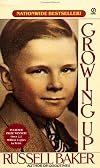
I read Russell Baker's GROWING UP 25 or 30 years ago, when it was still relatively new and had been on bestseller charts for a couple years or more. I picked up an old tattered copy of it at a library sale a few weeks back, knowing I'd already read it, but I remembered how much I loved it, so I couldn't just LEAVE it there in that pile of old books. Then this past weekend I thought I'd just peek into it, maybe skim a few chapters. Nope. Spent a couple days rereading the whole damn thing. And show more it was just as good this time as it was before, because Russell Baker's story is just so fascinating, so 'delicious' to read and read again. Baker's father died when he was only five, and his mother struggled to keep her family together, and managed to raise them in the midst of a large extended family of assorted and colorful uncles, aunts and cousins, as they moved from Virginia to New Jersey to Baltimore. Baker tells of his childhood, adolescence and time in the Navy toward the end of WWII, and then of his early years as a newspaperman with the Baltimore Sun, and his four-year courtship with Mimi, who he would finally marry. Baker went on to enjoy a very distinguished career as a reporter and columnist for the NY TIMES. The stories he tells here are so absorbing, so funny, so moving. He begins and ends with a portrait of his mother in her last years, her mind and memory failing, that will just tear your heart out.
What I found in rereading GROWING UP after nearly thirty years is that it's just as good - maybe even better, given my own graying head and advanced years - the second time around as it was the first time. I thought of a few other favorite memoirs I've revisited: Curtis Stadtfeld's FROM THE LAND AND BACK, Ron Jager's EIGHTY ACRES, and Curtis Harnack's WE HAVE ALL GONE AWAY. This one's right up there with those. I Googled Baker and I think he's still with us, 92 years old and retired in Virginia. Maybe I'll write him a letter. (Remember letters?). I love this book. Thank you, Mr. Baker. My highest recommendation.
- Tim Bazzett, author of the memoir, BOOKLOVER show less
What I found in rereading GROWING UP after nearly thirty years is that it's just as good - maybe even better, given my own graying head and advanced years - the second time around as it was the first time. I thought of a few other favorite memoirs I've revisited: Curtis Stadtfeld's FROM THE LAND AND BACK, Ron Jager's EIGHTY ACRES, and Curtis Harnack's WE HAVE ALL GONE AWAY. This one's right up there with those. I Googled Baker and I think he's still with us, 92 years old and retired in Virginia. Maybe I'll write him a letter. (Remember letters?). I love this book. Thank you, Mr. Baker. My highest recommendation.
- Tim Bazzett, author of the memoir, BOOKLOVER show less

The Good Times is a sequel of sorts to Baker’s classic memoir Growing Up. This part of his life covers mainly his newpaper career at the Baltimore Sun and the New York Times. Baker’s writing is familar, friendly, but shows the craft he perfected over the years working deadlines. His introspection about his own failings encourages the rest of us. “Oh, Russell, make something of yourself” his mother would tell him. Even the two Pulitzer Prizes he won probably wouldn’t have been very show more impressive to her. The end of the book is a discussion of Baker’s nose to the grindstone work ethic and how it contrasts with his own children’s more laid back attitude toward life. At first it bothered him. Then he realized, his was a generational attitude, one that came with the sorrow of the Depression, one that he wouldn’t have wished on his children. This book, like all of Russell Baker’s books, is a gem and a pleasure to read. show less
Russell Baker was born in 1925 to a young poor couple in rural Virginia. His mother was a take-charge woman who unfortunately married a man who proved to be unreliable, and died at age 33 of undiagnosed diabetes combined with alcoholism. His mother left Virginia for Newark, NJ, taking Russell and his sister Doris, and leaving his youngest sister in the care of relatives. Russell was always encouraged by his mother to develop 'gumption,' and began selling newspapers at an early age. The book show more takes us from his childhood to the post-WWII era. Throughout his growing up, Russell is continually living with relatives and many interesting portraits come from these relationships. Eventually, through happenstance, Russell decides to throw caution to the wind, and applies to Johns Hopkins, even though he has no way of financing college. To his surprise, he is granted a 2-semester grant, and attends for one year, until he enrolls in the Navel Air Force. He completes his degree in English upon return, and moves into a career in journalism. This book won the Pulitzer Prize and I can understand why. Its honesty and detail portray an era in a way that is unforgettable. show less
Lists
Awards


You May Also Like


Associated Authors
Statistics
- Works
- 22
- Also by
- 25
- Members
- 2,558
- Popularity
- #10,037
- Rating
- 4.0
- Reviews
- 37
- ISBNs
- 64
- Favorited
- 8