
Frances Moore Lappé
Author of Diet for a Small Planet
About the Author
Image credit: Portrait by Robert Shetterly, AmericansWhoTellTheTruth.org
Works by Frances Moore Lappé
Daring Democracy: Igniting Power, Meaning, and Connection for the America We Want (2017) 99 copies, 12 reviews
Associated Works
The One-Straw Revolution: An Introduction to Natural Farming (1975) — Introduction, some editions — 1,156 copies, 23 reviews
Little House on a Small Planet: Simple Homes, Cozy Retreats, and Energy Efficient Possibilities (2006) — Foreword, some editions — 152 copies, 3 reviews
Tagged
Common Knowledge
- Canonical name
- Lappé, Frances Moore
- Birthdate
- 1944-02-10
- Gender
- female
- Education
- Earlham College
- Occupations
- writer
researcher - Organizations
- Small Planet Institute (co-founder)
- Agent
- "Joan Raines"
- Relationships
- Lappé, Anna (daughter)
- Nationality
- USA
- Birthplace
- Pendleton, Oregon, USA
- Places of residence
- Fort Worth, Texas, USA
California, USA - Associated Place (for map)
- USA
Members
Reviews

Wow, this book was excellent. I found it to be probably the most comprehensive book about food politics that I've read. It encompasses a lot of important points and really takes a thorough look at all of the intricacies of our current food system. For example, the author makes all of the important connections and leaves no stones unturned. She explains how our current food system leads to overproduction, environmental devastation, hunger and questionable food products. She makes the show more connection between today's farming and food production systems and global capitalism. These are all important connections to make that many authors overlook.
What I found most amazing about this book is how accurate it still is 20 years after it was written, and I read the 20th anniversary edition. People knew about all of these things since the 1970s and haven't changed anything! It's depressing if you think about it like that, and really opens my eyes to how entrenched our food policies are. I find it strange that people are reading Michael Pollan as if he's coming up with these brand new ideas, and here they are published already in 1991. (Not to say that Pollan is plagiarizing this book, just that his ideas are hardly novel.)
For the vegan, you will probably lament the lack of animal rights consciousness in this book. The author doesn't eat meat, and explains how meat consumption is inefficient, bad for the environment and helps lead to global poverty, but doesn't take much of an animal rights perspective. (Read John Robbins for that.) She ultimately states that including a small portion of meat in one's diet isn't counter to the ideas in the book. As well, many (if not most) of the recipes do contain animal ingredients. That said, the recipes are probably still a good resource for people looking to eliminate meat from their diets. show less
What I found most amazing about this book is how accurate it still is 20 years after it was written, and I read the 20th anniversary edition. People knew about all of these things since the 1970s and haven't changed anything! It's depressing if you think about it like that, and really opens my eyes to how entrenched our food policies are. I find it strange that people are reading Michael Pollan as if he's coming up with these brand new ideas, and here they are published already in 1991. (Not to say that Pollan is plagiarizing this book, just that his ideas are hardly novel.)
For the vegan, you will probably lament the lack of animal rights consciousness in this book. The author doesn't eat meat, and explains how meat consumption is inefficient, bad for the environment and helps lead to global poverty, but doesn't take much of an animal rights perspective. (Read John Robbins for that.) She ultimately states that including a small portion of meat in one's diet isn't counter to the ideas in the book. As well, many (if not most) of the recipes do contain animal ingredients. That said, the recipes are probably still a good resource for people looking to eliminate meat from their diets. show less
Daring Democracy: Igniting Power, Meaning, and Connection for the America We Want by Frances Moore Lappe
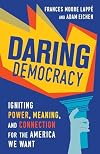
Summary: Responding to the concentration of political power within monied elites, the authors expose their strategy, and advocate a growing Democracy Movement to recover American democratic institutions.
Perhaps one of the most disturbing consequences of politics in the post-Citizens United era is the enlarged role that hidden financial donors in what I would propose are rival plutocracies play in our national politics. That is also a concern of the authors of this work, although they only show more acknowledge the plutocracy of the right. While I think that is a defect of this book, the broader case they make for an active citizen’s democracy movement to challenge the hegemony of wealth in our politics is an important one. These rival plutocracies have created a polarization of the extreme right and left that doesn’t reflect the broader center of the country that has been dis-enfranchised because of the power of money, and the rippling developments that have made it more difficult to elect candidates who do not represent one of these extremes.
Frances Moore Lappe’, who I first encountered in the 1970’s in her Diet for a Small Planet teams up with young Democracy Movement activist Adam Eichen to expose the anti-democratic developments that have brought us to this place, and the need for and promise of a grassroots Democracy Movement to recovering and preserving democracy in America. There are three “powerful ideas” upon which this book is based:
1. Democracy is essential to address public needs and advance public goods.
2. Democracy is possible–a real democracy accountable to people and not narrow, private interests.
3. Each of us has a rewarding and exhilarating role to play in making democracy real.
After describing the powerful ideas that have arisen to respond to what they call “the anti-Democratic movement, the authors trace the development of this monied anti-Democratic movement. They begin with a confidential memo by Justice Lewis Powell commissioned by the U. S. Chamber of Commerce prior to his nomination to the Supreme Court. Powell expresses great concern for “free enterprise” and outlines a strategy to save it by 1) discrediting critics, branding them all as Marxists, 2) avoiding use of the word “capitalism,” substituting the rhetoric of “free” enterprise, 3) promoting a conservative presence in education, from campus speakers to textbooks, 4) gaining control of media outlets. They then describe two sets of strategies that arose from this memo. The first set of four strategies were to control the culture’s mindset:
Strategy 1: Command the Narrative. Think tanks pump out anti-government and pro-market gospel.
Strategy 2: Delegitimize Democracy’s Norms and Institutions.
Strategy 3: Quietly create a parallel political operation pushing the anti-democratic message with hundreds of front groups, community by community.
Strategy 4: Build big donors’ common purpose and coordinate their efforts to achieve the three strategies above.
The second four strategies then rig the rules to favor the monied elites:
Strategy 1: Open doors ever wider to big-money influence in our political system.
Strategy 2: Expand an army of lobbyists and usher anti-democracy forces into government.
Strategy 3: Reduce the voting power of those most likely to be hurt by, and therefore opposed to, the anti-democracy agenda. Curbing voting rights and access and the ruthless gerrymandering of districts.
Strategy 4: Where possible, wipe out local democracy altogether. Eliminate local control, destroy worker protections.
Part three of the book outlines the agenda of the nascent Democracy Movement and gives examples of the kind of impact citizens can have. What must clearly be focused on is finance reform, limits to the power of lobbyists, and redistricting reforms, along with bringing increased transparency about funding sources. The last several chapters are motivational, describing what the authors see as a growing and diverse grassroots movement that came together around a march from Philadelphia to Washington, around resistance to anti-democratic actions in North Carolina, the Women’s March, and other actions. The final chapter is a call for daring engagement in the pursuit of democracy, and outlines additional strategies each of us might pursue. Generally, these strategies combine individual courageous initiative, finding like-minded individuals via events and social media, joining forces with similar movements, and thus amplifying one’s voice.
One thing I think these writers get right is the need for an engaged democracy–that there are a number of us who are not being heard in our highly polarized political discourse. I call us “the adults” who believe a good society has to work for all of us, across race, social class, economic status, religion and gender. We realize it won’t be perfect for anyone, but that good solutions don’t leave anyone out, and the contributions of everyone are considered vital to our society’s health. It has to address concerns of both conservatives and liberals. Most of us are not extremists in any form–Marxist, fascist, anti-facist, you name it. We’re Americans who still think a democratic republic is worth preserving and enhancing, and it won’t be if a monied plutocracy controls it. We are the people we’ve been waiting for, whether young or old, and it is time to make our voices heard and not leave our politics and governance to the extremes.
At the same time, this work left me with two concerns. One is that the authors, (and Lappe’, a veteran activist should know better) do not adequately articulate a long term vision of pursuing democracy. The “anti-democracy” movement they describe was a disciplined, long-term effort by highly committed and focused alliances of individuals, and not simply the influence of a lot of money. Unless there is similar long-term discipline and focus to the democracy movement they envision, their efforts will be little more than attention-deficit disordered emotivist ventilation.
More concerning is that this work at best makes passing references to major funding of progressive causes, which was eclipsed in 2016. But to authentically represent “the adults” in the middle, the authors needed to denounce and expose the monied interests on both extremes in American politics, the elites on both extremes that have controlled our political conversation. Not doing so exposes this movement to the charge of being “stalking horses” for these progressive causes, particularly when they move beyond questions of electoral reform to social issues supported by the left while concerns of thoughtful moderate conservatives are ignored. I would suggest that until the writers do so, this proposal is not democratic enough.
____________________________
Disclosure of Material Connection: I received this book free from the publisher via LibraryThing. I was not required to write a positive review. The opinions I have expressed are my own. show less
Perhaps one of the most disturbing consequences of politics in the post-Citizens United era is the enlarged role that hidden financial donors in what I would propose are rival plutocracies play in our national politics. That is also a concern of the authors of this work, although they only show more acknowledge the plutocracy of the right. While I think that is a defect of this book, the broader case they make for an active citizen’s democracy movement to challenge the hegemony of wealth in our politics is an important one. These rival plutocracies have created a polarization of the extreme right and left that doesn’t reflect the broader center of the country that has been dis-enfranchised because of the power of money, and the rippling developments that have made it more difficult to elect candidates who do not represent one of these extremes.
Frances Moore Lappe’, who I first encountered in the 1970’s in her Diet for a Small Planet teams up with young Democracy Movement activist Adam Eichen to expose the anti-democratic developments that have brought us to this place, and the need for and promise of a grassroots Democracy Movement to recovering and preserving democracy in America. There are three “powerful ideas” upon which this book is based:
1. Democracy is essential to address public needs and advance public goods.
2. Democracy is possible–a real democracy accountable to people and not narrow, private interests.
3. Each of us has a rewarding and exhilarating role to play in making democracy real.
After describing the powerful ideas that have arisen to respond to what they call “the anti-Democratic movement, the authors trace the development of this monied anti-Democratic movement. They begin with a confidential memo by Justice Lewis Powell commissioned by the U. S. Chamber of Commerce prior to his nomination to the Supreme Court. Powell expresses great concern for “free enterprise” and outlines a strategy to save it by 1) discrediting critics, branding them all as Marxists, 2) avoiding use of the word “capitalism,” substituting the rhetoric of “free” enterprise, 3) promoting a conservative presence in education, from campus speakers to textbooks, 4) gaining control of media outlets. They then describe two sets of strategies that arose from this memo. The first set of four strategies were to control the culture’s mindset:
Strategy 1: Command the Narrative. Think tanks pump out anti-government and pro-market gospel.
Strategy 2: Delegitimize Democracy’s Norms and Institutions.
Strategy 3: Quietly create a parallel political operation pushing the anti-democratic message with hundreds of front groups, community by community.
Strategy 4: Build big donors’ common purpose and coordinate their efforts to achieve the three strategies above.
The second four strategies then rig the rules to favor the monied elites:
Strategy 1: Open doors ever wider to big-money influence in our political system.
Strategy 2: Expand an army of lobbyists and usher anti-democracy forces into government.
Strategy 3: Reduce the voting power of those most likely to be hurt by, and therefore opposed to, the anti-democracy agenda. Curbing voting rights and access and the ruthless gerrymandering of districts.
Strategy 4: Where possible, wipe out local democracy altogether. Eliminate local control, destroy worker protections.
Part three of the book outlines the agenda of the nascent Democracy Movement and gives examples of the kind of impact citizens can have. What must clearly be focused on is finance reform, limits to the power of lobbyists, and redistricting reforms, along with bringing increased transparency about funding sources. The last several chapters are motivational, describing what the authors see as a growing and diverse grassroots movement that came together around a march from Philadelphia to Washington, around resistance to anti-democratic actions in North Carolina, the Women’s March, and other actions. The final chapter is a call for daring engagement in the pursuit of democracy, and outlines additional strategies each of us might pursue. Generally, these strategies combine individual courageous initiative, finding like-minded individuals via events and social media, joining forces with similar movements, and thus amplifying one’s voice.
One thing I think these writers get right is the need for an engaged democracy–that there are a number of us who are not being heard in our highly polarized political discourse. I call us “the adults” who believe a good society has to work for all of us, across race, social class, economic status, religion and gender. We realize it won’t be perfect for anyone, but that good solutions don’t leave anyone out, and the contributions of everyone are considered vital to our society’s health. It has to address concerns of both conservatives and liberals. Most of us are not extremists in any form–Marxist, fascist, anti-facist, you name it. We’re Americans who still think a democratic republic is worth preserving and enhancing, and it won’t be if a monied plutocracy controls it. We are the people we’ve been waiting for, whether young or old, and it is time to make our voices heard and not leave our politics and governance to the extremes.
At the same time, this work left me with two concerns. One is that the authors, (and Lappe’, a veteran activist should know better) do not adequately articulate a long term vision of pursuing democracy. The “anti-democracy” movement they describe was a disciplined, long-term effort by highly committed and focused alliances of individuals, and not simply the influence of a lot of money. Unless there is similar long-term discipline and focus to the democracy movement they envision, their efforts will be little more than attention-deficit disordered emotivist ventilation.
More concerning is that this work at best makes passing references to major funding of progressive causes, which was eclipsed in 2016. But to authentically represent “the adults” in the middle, the authors needed to denounce and expose the monied interests on both extremes in American politics, the elites on both extremes that have controlled our political conversation. Not doing so exposes this movement to the charge of being “stalking horses” for these progressive causes, particularly when they move beyond questions of electoral reform to social issues supported by the left while concerns of thoughtful moderate conservatives are ignored. I would suggest that until the writers do so, this proposal is not democratic enough.
____________________________
Disclosure of Material Connection: I received this book free from the publisher via LibraryThing. I was not required to write a positive review. The opinions I have expressed are my own. show less
 This review was written for LibraryThing Early Reviewers.
This book is part political and economic justification for vegetarianism, part "how to" on combining proteins for the most efficient use of resources.
The main argument is that vegetarian foods are a more efficient use of the environment and can produce more protein per acre than meat when the entire cost of production is taken into account. The way toward ending world hunger is to stop mass producing meat.
Unfortunately as a cookbook, this isn't the most inspired book out there. It's low on show more taste, high on "efficiency".
In spite of its weaknesses, it's still one of the foundation works of modern western vegetarianism. The passion it lacks in the recipes is more than made up for by the passion the author has for the topic. show less
The main argument is that vegetarian foods are a more efficient use of the environment and can produce more protein per acre than meat when the entire cost of production is taken into account. The way toward ending world hunger is to stop mass producing meat.
Unfortunately as a cookbook, this isn't the most inspired book out there. It's low on show more taste, high on "efficiency".
In spite of its weaknesses, it's still one of the foundation works of modern western vegetarianism. The passion it lacks in the recipes is more than made up for by the passion the author has for the topic. show less
Daring Democracy: Igniting Power, Meaning, and Connection for the America We Want by Frances Moore Lappé
Daring Democracy is that rare book that should be read by anyone along the political spectrum as long as that reader does indeed desire to live in a democracy. Those who, for whatever reason, prefer some other form of governance will find nothing with which to attack a genuine democracy. The idea of a democracy is not, and should not be perceived as, a partisan issue. In the current atmosphere it is because the right has chosen to be (or been manipulated into being) anti-democracy and any show more attempt for the ideal of one person one vote somehow appears liberal. That is simply how the powers behind the anti-democracy movement have framed the dialogue and does not reflect how democracy can and should work.
This book provides background and history of the anti-democracy movement, what can be done to work toward achieving the democratic government we once thought we had or was working toward perfecting. The information is well documented and almost everything is public record. This is not simply a book with a lot of opinion and little to no substance.
This is a short but dense book, a quick read but one that rewards a second slower read. The resources cited are wonderful and the suggestions for action are workable and within reach, at least for the time being. But action must be taken before the few remaining pillars of our democratic government are destroyed by the anti-democracy and un-American people currently running the country (into the ground).
Highly recommended across political opinions as long as the reader is at least open to the idea of the United States returning to being a democracy.
Reviewed from a copy made available through Goodreads' First Reads. show less
This book provides background and history of the anti-democracy movement, what can be done to work toward achieving the democratic government we once thought we had or was working toward perfecting. The information is well documented and almost everything is public record. This is not simply a book with a lot of opinion and little to no substance.
This is a short but dense book, a quick read but one that rewards a second slower read. The resources cited are wonderful and the suggestions for action are workable and within reach, at least for the time being. But action must be taken before the few remaining pillars of our democratic government are destroyed by the anti-democracy and un-American people currently running the country (into the ground).
Highly recommended across political opinions as long as the reader is at least open to the idea of the United States returning to being a democracy.
Reviewed from a copy made available through Goodreads' First Reads. show less
This review was written for LibraryThing Early Reviewers.Lists
Awards


You May Also Like


Associated Authors
Statistics
- Works
- 33
- Also by
- 3
- Members
- 3,142
- Popularity
- #8,122
- Rating
- 4.0
- Reviews
- 36
- ISBNs
- 103
- Languages
- 6
- Favorited
- 1
