
Jonathan Haidt
Author of The Righteous Mind: Why Good People Are Divided by Politics and Religion
About the Author
Works by Jonathan Haidt
The Righteous Mind: Why Good People Are Divided by Politics and Religion (2012) 4,228 copies, 93 reviews
The Coddling of the American Mind: How Good Intentions and Bad Ideas Are Setting Up a Generation for Failure (2018) 2,089 copies, 43 reviews
The Amazing Generation: Your Guide to Fun and Freedom in a Screen-Filled World (2025) 85 copies, 2 reviews
Can't We All Disagree More Constructively?: from The Righteous Mind (Kindle Single) (A Vintage Short) (2016) 24 copies
Jonathan Haidt Collection 3 Books Set (Happiness Hypothesis, The Righteous Mind, Coddling of the American Mind) (2019) 4 copies
Associated Works
The Believing Primate: Scientific, Philosophical, and Theological Reflections on the Origin of Religion (2009) — Contributor — 44 copies
Tagged
Common Knowledge
- Birthdate
- 1963-10-19
- Gender
- male
- Education
- Yale University (BA) (1985)
University of Pennsylvania (PhD) (1992) - Occupations
- psychologist
professor (ethical leadership) - Organizations
- University of Virginia
Stern School of Business - Short biography
- Jonathan Haidt is the Thomas Cooley Professor of Ethical Leadership at New York University’s Stern School of Business. He received his B. A. from Yale University in 1985 and his Ph.D. from the University of Pennsylvania in 1992. He then did post-doctoral research at the University of Chicago and in Orissa, India. He was a professor at the University of Virginia from 1995 until 2011, when he joined the Stern School of Business. His research focuses on morality – its emotional foundations, cultural variations, and developmental course. He began his career studying the negative moral emotions, such as disgust, shame, and vengeance, but then moved on to the understudied positive moral emotions, such as admiration, awe, and moral elevation. This work got him involved with the field of positive psychology, in which he has been a leading researcher. He is the co-developer of Moral Foundations theory, and of the research site YourMorals.org. He uses his research to help people understand and respect the moral motives of their enemies (see CivilPolitics.org). He won three teaching awards from the University of Virginia, and one from the governor of Virginia. His three TED talks have been viewed more than 3 million times. (Those talks are on political psychology, on religion, and on the causes of America’s political polarization.) He was named a “top 100 global thinker” of 2012 by Foreign Policy magazine, and one of the 65 “World Thinkers of 2013″ by Prospect. He is the author of more than 90 academic articles and two books: The Happiness Hypothesis: Finding Modern Truth in Ancient Wisdom, and the New York Times bestseller The Righteous Mind: Why Good People are Divided by Politics and Religion. For more information see JonathanHaidt.com.
http://righteousmind.com/wp-content/u... - Nationality
- USA
- Birthplace
- Scarsdale, New York, USA
- Places of residence
- Charlottesville, Virginia, USA
Orissa, India - Associated Place (for map)
- USA
Members
Discussions
Jonathan Haidt at TED in Pro and Con (October 2008)
Reviews
The anxious generation : how the great rewiring of childhood is causing an epidemic of mental illness by Jonathan Haidt
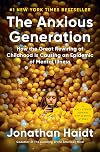
It has taken some time to gather empirical evidence, to perform research, and to compose and publish papers, but the conclusive truth about our new reality is now emerging: technology — smartphones specifically — are, globally, having a profound effect on the mental health, social and neurological development, and cognitive stamina of children and adolescents. In this groundbreaking, compelling book, psychologist Jonathan Haidt describes in great details these causes and effects, and why show more we (humanity) should be concerned. Very concerned.
I selected this title to fulfill the Read Harder 2026 category "a nonfiction book about AI or social media," and while I'm glad I did, as it is topical and enlightening, it also made me feel depressed and concerned about ways I may have already failed my child by being too permissive with screen time and access. This is a book which should be a must-read for parents, educators, teenagers, and anyone seeking to understand how these younger generations are functionally and psychologically different from previous generations. There are endless "Aha!" and "Of course!" and "Oh, no!" moments. The "Spiritual Elevation and Degradation" chapter provides insight into precisely why social media comment sections are overwhelmingly toxic. Here's a librarian pro tip: Right now (June 2026) you can bypass waiting lists and read The Anxious Generation through the Ebooks Minnesota website. An important and necessary, but not at all a feel-good, read. show less
I selected this title to fulfill the Read Harder 2026 category "a nonfiction book about AI or social media," and while I'm glad I did, as it is topical and enlightening, it also made me feel depressed and concerned about ways I may have already failed my child by being too permissive with screen time and access. This is a book which should be a must-read for parents, educators, teenagers, and anyone seeking to understand how these younger generations are functionally and psychologically different from previous generations. There are endless "Aha!" and "Of course!" and "Oh, no!" moments. The "Spiritual Elevation and Degradation" chapter provides insight into precisely why social media comment sections are overwhelmingly toxic. Here's a librarian pro tip: Right now (June 2026) you can bypass waiting lists and read The Anxious Generation through the Ebooks Minnesota website. An important and necessary, but not at all a feel-good, read. show less
The Anxious Generation: How the Great Rewiring of Childhood Is Causing an Epidemic of Mental Illness by Jonathan Haidt

"We are overprotecting our children in the real world while underprotecting them online."
A must-read (or listen) for all parents, caregivers, teachers, and anyone else who cares for children & teens. There is a ton of research in this book, so I found listening to it a lot easier to digest. We all can speculate the dangers of technology and see the effects on the younger generation, but the author, Haidt, takes all the data we now have to create a solid case against the internet & social show more media use for children & teens. There is substantial evidence to prove that heightened internet use is a direct causation (not just correlation) of increases in mental illness in children & teens. Children were made to play outside, develop healthy connections with friends, and explore the world outside of their home. Instead, we are seeing faces glued to a screen in the name of keeping them more physically safe, but it is creating detrimental habits that will damage their young and undeveloped minds.
Haidt does a wonderful job in this book to help parents and guardians set up guidelines for their children. With the combination of his social psychology background and his experiences as a parent, he helps readers set these up for their own families without shaming any previous decisions that have been made. He admits that he would want the below "rules" to be harsher, but that the following are a good middle ground in our current American society:
1. no smartphones before high school
2. no social media before 16 years old
3. make schools phone-free
4. allow more unsupervised play & independence
He argues that by implementing the above steps, mental health in children and teens will significantly improve within two years or less. This, however, cannot happen without parents coming together to voice their concerns & support each other in their decisions. It is more difficult to maintain firm technological boundaries as a parent when there is no one else around you who is on the same page. In the end, tech companies will not be the ones creating these guidelines and boundaries, since the money and data collection they are receiving is too big a motivator. It is now up to the adults placed with the responsibility of these young lives to put their foot down and care way more about their mental safety than what is currently trending. show less
A must-read (or listen) for all parents, caregivers, teachers, and anyone else who cares for children & teens. There is a ton of research in this book, so I found listening to it a lot easier to digest. We all can speculate the dangers of technology and see the effects on the younger generation, but the author, Haidt, takes all the data we now have to create a solid case against the internet & social show more media use for children & teens. There is substantial evidence to prove that heightened internet use is a direct causation (not just correlation) of increases in mental illness in children & teens. Children were made to play outside, develop healthy connections with friends, and explore the world outside of their home. Instead, we are seeing faces glued to a screen in the name of keeping them more physically safe, but it is creating detrimental habits that will damage their young and undeveloped minds.
Haidt does a wonderful job in this book to help parents and guardians set up guidelines for their children. With the combination of his social psychology background and his experiences as a parent, he helps readers set these up for their own families without shaming any previous decisions that have been made. He admits that he would want the below "rules" to be harsher, but that the following are a good middle ground in our current American society:
1. no smartphones before high school
2. no social media before 16 years old
3. make schools phone-free
4. allow more unsupervised play & independence
He argues that by implementing the above steps, mental health in children and teens will significantly improve within two years or less. This, however, cannot happen without parents coming together to voice their concerns & support each other in their decisions. It is more difficult to maintain firm technological boundaries as a parent when there is no one else around you who is on the same page. In the end, tech companies will not be the ones creating these guidelines and boundaries, since the money and data collection they are receiving is too big a motivator. It is now up to the adults placed with the responsibility of these young lives to put their foot down and care way more about their mental safety than what is currently trending. show less
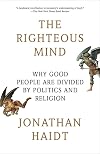
An incredibly interesting and insightful book discussing peoples moral foundations, where they come from, and what it means for society. Rather than following Dawkin's proposal that religion has evolved as a parasitic meme, Haidt proposes that religion evolved as a group selection process. Religion became a corner stone of every society because it enables people to co-exist in groups where we have no family connection. Societies with religion (and morals) were competed out of existance. He show more goes on to talk about the impact of moral foundations on current politics. If nothing else, read the concluding chapter! show less
There's a lot of good food for thought here, and a lot of important insights into how liberals and conservatives view the world differently. Haidt presents his ideas very clearly, backs them up with research, and provides useful summaries at the end of each chapter.
Each chapter could the the subject of an entire book, so sometimes it feels like some of the information is less developed than it could be. I found the first half of the book to be far more enlightening than the second half, show more which seemed to be building towards a big revelation that never quite materialized.
For me, the most interesting part of the book was the discussion of moral foundations. These are the criteria we use to judge morality. For liberals, morality centers around harm and freedom: liberals consider something to be immoral if it causes harm to people or limits their freedom to make their own choices. Conservatives agree, but conservatives also make moral decisions based on authority (whether authority structures are maintained or subverted), group structure (whether the greater good of the group is maintained), fairness (whether people get to keep what they earn), and respect for the sacred. In other words, the two groups use totally different criteria to judge right from wrong, but we don't talk about our underlying assumptions about what is moral, so we feel like we're speaking different languages when we talk to each other.
This was written in the early years of the Obama administration - I wonder how different it would be if written today during the Trump years. show less
Each chapter could the the subject of an entire book, so sometimes it feels like some of the information is less developed than it could be. I found the first half of the book to be far more enlightening than the second half, show more which seemed to be building towards a big revelation that never quite materialized.
For me, the most interesting part of the book was the discussion of moral foundations. These are the criteria we use to judge morality. For liberals, morality centers around harm and freedom: liberals consider something to be immoral if it causes harm to people or limits their freedom to make their own choices. Conservatives agree, but conservatives also make moral decisions based on authority (whether authority structures are maintained or subverted), group structure (whether the greater good of the group is maintained), fairness (whether people get to keep what they earn), and respect for the sacred. In other words, the two groups use totally different criteria to judge right from wrong, but we don't talk about our underlying assumptions about what is moral, so we feel like we're speaking different languages when we talk to each other.
This was written in the early years of the Obama administration - I wonder how different it would be if written today during the Trump years. show less
Lists
Awards


You May Also Like


Associated Authors
Statistics
- Works
- 14
- Also by
- 3
- Members
- 11,296
- Popularity
- #2,080
- Rating
- 4.1
- Reviews
- 235
- ISBNs
- 129
- Languages
- 15
- Favorited
- 5


