
Leonard Michaels (1) (1933–2003)
Author of Sylvia
For other authors named Leonard Michaels, see the disambiguation page.
About the Author
Leonard Michaels (1933-2003) was the author of six collections of stories and essays as well as two novels, Sylvia and The Men's Club. His Collected Stories and novels are available as FSG paperbacks.
Works by Leonard Michaels
City Boy [short story] 1 copy
Associated Works
The Vintage Book of Contemporary American Short Stories (1994) — Contributor — 547 copies, 2 reviews
The Art of the Tale: An International Anthology of Short Stories (1986) — Contributor — 381 copies, 3 reviews
Object Lessons: The Paris Review Presents the Art of the Short Story (2012) — Contributor — 254 copies, 9 reviews
Who's Writing This? Notations on the Authorial I, with Self-Portraits {not Antæus} (1995) — Contributor — 75 copies
Genesis as It Is Written: Contemporary Writers on Our First Stories (1996) — Contributor — 69 copies
Tagged
Common Knowledge
- Canonical name
- Michaels, Leonard
- Birthdate
- 1933-01-02
- Date of death
- 2003-05-10
- Gender
- male
- Education
- University of Michigan (MA|1956|Ph.D|1967)
New York University (BA|1953) - Occupations
- novelist
short story writer
essayist
professor - Organizations
- University of California, Berkeley
University of California, Davis
Paterson State College - Awards and honors
- American Academy of Arts and Letters Academy Award (Literature, 1971)
- Cause of death
- lymphatic cancer
- Nationality
- USA
- Birthplace
- New York, New York, USA
- Places of residence
- New York, New York, USA (birth)
Florence, Italy
Berkeley, California, USA - Place of death
- Berkeley, California, USA
- Burial location
- Oakmont Memorial Park, Lafayette, California, USA
- Associated Place (for map)
- California, USA
Members
Reviews
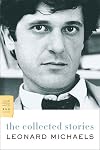
This edition is provides a marvelous vantage point from which the creative trajectory of LM becomes clear. Starting from flashy, acrid stories of the 60s and 70s, in which Babel and the Russian Formalists go fucking around in Manhattan, running across a period of what seems to be intellectually induced disorientation, where the author seems to give a slap to every authoritative philosophizer he meets saying "come again?", bullying the reader into consuming diaries as a form of fiction and show more enjoying ideas like blow-jobs, the volume flows into the gentle, wistful precision of the Nachman stories.
Up until Nachman, I kept laughing aloud so hard I couldn't read, and I kept chewing on every clause, reluctant to swallow, choking on the juice; Nachman seems like a gentle, merciless surgery. Something steely and relentless comes up in that look on the cover towards the end, watches you back and is gone.
There are things I will never be able to understand, things of tremendous and inconceivable power, unreachable for the reason and in immediate contact with my life, Michaels told me somewhere along the way. show less
Up until Nachman, I kept laughing aloud so hard I couldn't read, and I kept chewing on every clause, reluctant to swallow, choking on the juice; Nachman seems like a gentle, merciless surgery. Something steely and relentless comes up in that look on the cover towards the end, watches you back and is gone.
There are things I will never be able to understand, things of tremendous and inconceivable power, unreachable for the reason and in immediate contact with my life, Michaels told me somewhere along the way. show less

There are over sixty essays, extracts and poems in this unwieldy and often self-indulgent guide to the state of the English language in 1990, an update (then) of a similar book that explored the state of English in 1980. I am not surprised the experiment was not repeated in 2000 0r 2010.
The entries are very uneven ranging from obscure poems through literary potboilers and rants to the posturing and preening of pompous academics burnishing their credentials to articles of staggering dullness show more and on to genuinely intelligent and informative articles with honest insights.
There are long periods of boredom and cultural introversion interspersed with a few fascinating gems but the overwhelming impression is of a cultural elite talking to itself somewhat narcissistically without any editorial discipline or preparedness to contextualise.
Looking back on this from the perspective of thirty years of cultural turmoil and wars, the seeds of it all are here if we want to look for them - certainly the activist appropriation of language in the dominant concern with AIDS and the proliferation of -isms and identity concerns.
With 60 or so contributions, it is almost impossible to comment in much detail. There are, of course, the linguistic purists who want a restoration of Latin learning in the schools to underpin grammar (Enoch Powell) and the restorations of right usage but these are relatively few.
There are those at the other extreme (more persuasive) who see language as a fluid and organically developing process where yesterday's solecism can become today's normality if it is consistently used in communication and understood.
In the middle (my preferred breed) are those who just describe without trying to impose value on what they describe although even the describers are not very good at explaining (which is certainly not the same process as judging) what is going on as it is going on.
And there are those, the bane of modern culture, who actively seek to mould language for socio-political purposes, the proof-positive of the great claim that language is essentially not a truth or a virtue but a weapon or a tool in the human struggle for status, power and resources.
George Orwell gets five or six mentions in over 500 pages but we are no longer living in his world of honest use of language. Indeed, since this book's time, Orwell has tended to be used as a weapon himself more often than he is regarded as the standard for a common framework for truth-telling.
While there are many decent academics, dull or not so dull, rising above this tendency to weaponisation, too many do not. The later cultural aggressions surrounding gay rights, BAME discontent and feminism are all played out here as sustained 'ressentiment'.
In fact, the book is to be read as one less about language and more as a psychological source book. Sixty or so different intellectual elite minds talking their book over each other's heads where, in many cases, you can hear behind the verbiage the simple cry - "here, here, look at me!"
From this perspective the tense exchange between linguistic prescriptivists and their opponents and the incursions of identity politics (yes, it really does start around this time and, indeed, comprises the very first section of this book) is unutterably tiresome.
The chaotics are just a reflection of the chaotics of the early stage of globalisation and the rise of a cosmopolitanism that, in cultural terms, should have meant freedom and tolerance within a shared and respected framework but instead would come to mean a nasty struggle for cultural power.
As if to confirm its relationship to power rather than knowledge, the book is strongly orientated towards American culture, use of English and problems and makes the mistake of assuming that English-English and American-English language and culture are more cognate than they are.
This Atlanticist myth is a political construction derived from Churchillian rhetoric but then paradoxically taken up by an academic-intellectual elite towards the end of the last century in obeisance to American progressivism and a racial politics totally alien to the English.
It is a myth that stills drags on us English with its 2020 political context being the recovery of sovereignty but the fighting over its bones by the sinophobic Atlanticist Right and the East Coast-orientated remants of university liberal-leftism still smarting from its recent losses.
In this book you see a culture beginning to oust the old national culture of traditionalism (represented by Enoch Powell and Roger Scruton) and flexing its new elite muscles ready to create the liberal centrism that triumphed before 2008 and collapsed after 2016.
This is not yet at its peak in this book. It is still pushing its way forward. It represents a generation of ambitious intellectuals who know what is right and are angry. One reads some of the articles and feel a deep gloom about what is to come - the Clintons, Blair, political correction, ideology.
Still, we should not disrespect the non-weaponised and non-narcissistic contributions. We are grateful for the relief of tedium. As to tedium, there is a surprising amount of coverage of legal language in American contexts but that is just a reflection of another coming trend - lawfare.
We have Delbridge's review of current Australiian English, Scruton's on the feminist attempt to expropriate the language of dissent and Lesser's informative piece on the history of the language of philanthropy (matched by Keith Thomas' disquisition on the history of letter endings).
There is an extract from a David Lodge novel with its subtle evocation of the fundamentally nasty cultural attitudes that lead to culture wars, Odean's description of the slang of the financial markets with its in-built aggression and Gross' insight into the practice of editing.
There is a descriptive account from Burchfield of how the language of a popular mass market novelist (Archer) and a literary novelist (Brookner) use language, This posits two kinds of English with different purposes and (frankly) of equal value in the context of those purposes.
There is a suggestive piece by Bawtree on why there has been no English high operatic tradition between Purcell and Britten and how this links to language and an excellent piece on the strange linguistic inventions and history of the American entertainment industry magazine 'Variety'.
The book close with Weiner's intelligent account of the attitudinal changes required to create the Second Edition of the Oxford English Dictionary and some examples of linguistic change from Adamson but by then we are exhausted. show less
The entries are very uneven ranging from obscure poems through literary potboilers and rants to the posturing and preening of pompous academics burnishing their credentials to articles of staggering dullness show more and on to genuinely intelligent and informative articles with honest insights.
There are long periods of boredom and cultural introversion interspersed with a few fascinating gems but the overwhelming impression is of a cultural elite talking to itself somewhat narcissistically without any editorial discipline or preparedness to contextualise.
Looking back on this from the perspective of thirty years of cultural turmoil and wars, the seeds of it all are here if we want to look for them - certainly the activist appropriation of language in the dominant concern with AIDS and the proliferation of -isms and identity concerns.
With 60 or so contributions, it is almost impossible to comment in much detail. There are, of course, the linguistic purists who want a restoration of Latin learning in the schools to underpin grammar (Enoch Powell) and the restorations of right usage but these are relatively few.
There are those at the other extreme (more persuasive) who see language as a fluid and organically developing process where yesterday's solecism can become today's normality if it is consistently used in communication and understood.
In the middle (my preferred breed) are those who just describe without trying to impose value on what they describe although even the describers are not very good at explaining (which is certainly not the same process as judging) what is going on as it is going on.
And there are those, the bane of modern culture, who actively seek to mould language for socio-political purposes, the proof-positive of the great claim that language is essentially not a truth or a virtue but a weapon or a tool in the human struggle for status, power and resources.
George Orwell gets five or six mentions in over 500 pages but we are no longer living in his world of honest use of language. Indeed, since this book's time, Orwell has tended to be used as a weapon himself more often than he is regarded as the standard for a common framework for truth-telling.
While there are many decent academics, dull or not so dull, rising above this tendency to weaponisation, too many do not. The later cultural aggressions surrounding gay rights, BAME discontent and feminism are all played out here as sustained 'ressentiment'.
In fact, the book is to be read as one less about language and more as a psychological source book. Sixty or so different intellectual elite minds talking their book over each other's heads where, in many cases, you can hear behind the verbiage the simple cry - "here, here, look at me!"
From this perspective the tense exchange between linguistic prescriptivists and their opponents and the incursions of identity politics (yes, it really does start around this time and, indeed, comprises the very first section of this book) is unutterably tiresome.
The chaotics are just a reflection of the chaotics of the early stage of globalisation and the rise of a cosmopolitanism that, in cultural terms, should have meant freedom and tolerance within a shared and respected framework but instead would come to mean a nasty struggle for cultural power.
As if to confirm its relationship to power rather than knowledge, the book is strongly orientated towards American culture, use of English and problems and makes the mistake of assuming that English-English and American-English language and culture are more cognate than they are.
This Atlanticist myth is a political construction derived from Churchillian rhetoric but then paradoxically taken up by an academic-intellectual elite towards the end of the last century in obeisance to American progressivism and a racial politics totally alien to the English.
It is a myth that stills drags on us English with its 2020 political context being the recovery of sovereignty but the fighting over its bones by the sinophobic Atlanticist Right and the East Coast-orientated remants of university liberal-leftism still smarting from its recent losses.
In this book you see a culture beginning to oust the old national culture of traditionalism (represented by Enoch Powell and Roger Scruton) and flexing its new elite muscles ready to create the liberal centrism that triumphed before 2008 and collapsed after 2016.
This is not yet at its peak in this book. It is still pushing its way forward. It represents a generation of ambitious intellectuals who know what is right and are angry. One reads some of the articles and feel a deep gloom about what is to come - the Clintons, Blair, political correction, ideology.
Still, we should not disrespect the non-weaponised and non-narcissistic contributions. We are grateful for the relief of tedium. As to tedium, there is a surprising amount of coverage of legal language in American contexts but that is just a reflection of another coming trend - lawfare.
We have Delbridge's review of current Australiian English, Scruton's on the feminist attempt to expropriate the language of dissent and Lesser's informative piece on the history of the language of philanthropy (matched by Keith Thomas' disquisition on the history of letter endings).
There is an extract from a David Lodge novel with its subtle evocation of the fundamentally nasty cultural attitudes that lead to culture wars, Odean's description of the slang of the financial markets with its in-built aggression and Gross' insight into the practice of editing.
There is a descriptive account from Burchfield of how the language of a popular mass market novelist (Archer) and a literary novelist (Brookner) use language, This posits two kinds of English with different purposes and (frankly) of equal value in the context of those purposes.
There is a suggestive piece by Bawtree on why there has been no English high operatic tradition between Purcell and Britten and how this links to language and an excellent piece on the strange linguistic inventions and history of the American entertainment industry magazine 'Variety'.
The book close with Weiner's intelligent account of the attitudinal changes required to create the Second Edition of the Oxford English Dictionary and some examples of linguistic change from Adamson but by then we are exhausted. show less

Exquisite series of close observations/meditations on "an essential cat--lonely, wild, secretive sensual... However a cat looks or behaves, it is what it is, a small and intensely serious being, a cat."
"When a cat decides--entirely on its own--to come to you, it is moved entirely from within. A cat does not feel compelled to do anything by convention or custom or guilt, so its decision is freely made, natural, and profound. It offers you truly personal recognition, a pleasure otherwise show more received only from a lover, though never so pure and trustworthy."
"A cat knows what happens to you after you die." show less
"When a cat decides--entirely on its own--to come to you, it is moved entirely from within. A cat does not feel compelled to do anything by convention or custom or guilt, so its decision is freely made, natural, and profound. It offers you truly personal recognition, a pleasure otherwise show more received only from a lover, though never so pure and trustworthy."
"A cat knows what happens to you after you die." show less

When Leonard Michaels passed away, he was writing a series of stories about a mathematician named Nachman. Nachman is a quirky loner, a prominent mathematician and university professor who has almost no friends, no hobbies, no acquaintances, no Math buddies, and no ambitions outside solving math problems. But he isn't sad or pitiable. He's comical and over-the-top, and strangely endearing.
I love Nachman. I love Leonard Michael's prose. These stories are less experimental and more prosaic show more than Michael's earlier fiction, but I love these the most. show less
I love Nachman. I love Leonard Michael's prose. These stories are less experimental and more prosaic show more than Michael's earlier fiction, but I love these the most. show less
Lists
Awards


You May Also Like


Associated Authors
Statistics
- Works
- 23
- Also by
- 24
- Members
- 1,197
- Popularity
- #21,451
- Rating
- 3.7
- Reviews
- 37
- ISBNs
- 78
- Languages
- 9
- Favorited
- 4