
Joseph Heath (1) (1967–)
Author of The Rebel Sell: Why the Culture Can't Be Jammed
For other authors named Joseph Heath, see the disambiguation page.
About the Author
Joseph Heath is a Professor in the Department of Philosophy as well as the Munk School of Global Affairs and Public Policy at the University of Toronto. He is the author of numerous scholarly works, including Communicative Action and Rational Choice (2001) and Following the Rules (2008). He is a show more Fellow of the Royal Society of Canada, as well as the Trudeau Foundation. show less
Works by Joseph Heath
Morality, Competition, and the Firm: The Market Failures Approach to Business Ethics (2014) 10 copies, 1 review
Ethics for Capitalists: A Systematic Approach to Business Ethics, Competition, and Market Failure (2023) 3 copies
What is a validity claim? 1 copy
Associated Works
Tagged
Common Knowledge
- Canonical name
- Heath, Joseph
- Birthdate
- 1967
- Gender
- male
- Education
- McGill University (B.A. ∙ Philosophy )
Northwestern University (Ph.D., philosophy) - Occupations
- Professor of Philosophy, University of Toronto
- Awards and honors
- Pierre Elliott Trudeau Foundation Fellowship
Royal Society of Canada (Fellow)
Donner Prize (2020) - Nationality
- Canada
- Birthplace
- Saskatoon, Saskatchewan, Canada
- Places of residence
- Toronto, Ontario, Canada
- Associated Place (for map)
- Canada
Members
Reviews

I read quite a few philosophy books that are thought-provoking, but “enjoy” is not typically a word I would use to describe the process. Joseph Heath, however, is one philosopher whose works I thoroughly enjoy. He is a very engaging writer who makes economic theories (or, rather, the philosophies guiding them) interesting and understandable without ever dumbing them down. Heath was the co-author of The Rebel Sell: Why the Culture Can’t Be Jammed and it was on the strength of that book show more that I took a chance on this one---otherwise I wouldn’t have looked twice at a book saddled with such an unfortunate title. Even the subtitle, as Heath himself admits, is just a bit of hyperbole: the book itself is not really about Canada nor is it simple boosterism for welfare state capitalism. The fact that Canada has consistently ranked as one of the world’s best countries in which to live is just a handy way for Heath to segue to his central thesis: that we owe this good fortune in large part to the value our nation places on efficiency in public policy development. Efficiency, argues Heath, is not readily apparent but nevertheless has a profound effect on how societies are formed and shaped.
This is not nearly as dry and dreary as it sounds. As in his other books, Heath’s approach is fresh, his writing jargon-free, and his tone witty but never condescending. And his knowledge base is rock-solid. As a former student of Jürgen Habermas, Heath carries on the Frankfurt School tradition of critical social theory in all of his books. Here, it is intermingled with a healthy dose of game theory (prisoner’s dilemmas and collective action problems abound), Hobbesian social contract theory and rational action theory. This is not a book about capitalism per se. (For that, I urge you to read his later work, Filthy Lucre: Economics for People Who Hate Capitalism.) Although he does address the development, functioning and externalities of market economies in The Efficient Society, he continually draws our attention back to the underlying ethics (the more efficient the market, the greater the inequalities), and reframes questions in a way that challenges our assumptions about the costs and benefits of free market systems, the relative merits of public services and private enterprise, the true function of taxation, and the necessity of state regulation to overcome the tendency of capitalism to drive the race to the bottom. Highly recommended. show less
This is not nearly as dry and dreary as it sounds. As in his other books, Heath’s approach is fresh, his writing jargon-free, and his tone witty but never condescending. And his knowledge base is rock-solid. As a former student of Jürgen Habermas, Heath carries on the Frankfurt School tradition of critical social theory in all of his books. Here, it is intermingled with a healthy dose of game theory (prisoner’s dilemmas and collective action problems abound), Hobbesian social contract theory and rational action theory. This is not a book about capitalism per se. (For that, I urge you to read his later work, Filthy Lucre: Economics for People Who Hate Capitalism.) Although he does address the development, functioning and externalities of market economies in The Efficient Society, he continually draws our attention back to the underlying ethics (the more efficient the market, the greater the inequalities), and reframes questions in a way that challenges our assumptions about the costs and benefits of free market systems, the relative merits of public services and private enterprise, the true function of taxation, and the necessity of state regulation to overcome the tendency of capitalism to drive the race to the bottom. Highly recommended. show less
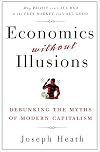
There's a saying in Swiss folklore that if you get lost in the mountains, don't try to find a new trail. Retrace your steps until you find something familiar.
The author tries to do something similar with regard economics, looking at basic assumptions rather than fishing around in current theory.
He sees a big problem in Left / Right polarization but still concludes that at a basic level they are both right. The Left is correct in that a united society has to respect its sick and old, and give show more children from every background the best opportunities. The Right is correct in that America was founded on personal responsibility with the rejection of a bloated and dangerous central government.
In reality Heath shows that the US and most other Western countries have developed a malignant form of both ideologies. The Left has extended costly government "care" to whole sections of the adult population that like it but shouldn't receive it. The Right tries to dispense with government all together and doesn't recognize that government provides a framework for growth. Just because it's corrupt and inefficient doesn't mean that it isn't necessary.
The author is following the theme of his excellent earlier book, "Efficient Society: Why Canada is as Close to Utopia as It Gets" where he argues that societal/economic efficiency is not a Left/Right concept and is basically non-political. Your chosen system either gives you good value health care or it doesn't.
However there are some problems with the book:
Any known trail in economics leads to Comparative Advantage which the author supports, although probably a more valid view is expressed by Harvard professor Stephen Marglin (quoted in Paul Streitz's book "America First"): "First, we don't live in Ricardo's world, where trade is determined by fixed natural resources. In this world technology and capital are immobile: You can't move Portuguese vineyards to England, nor can England's lush sheep pastures survive in Portugal's climate. Today, technology and capital move almost as easily across international borders as within a country."
In a world where new international competitors are quickly able to scale up technology, capital and skilled labour ,Comparative Advantage starts to look like an intellectual refuge for outsourcers. The reality is that the required average skill level for American labour is falling fast with 80% of new employment in very low paying service work.
Another obligatory stop on the trail is Keynesianism, where (in the opinion of this reviewer) he also gets it wrong. He says that Keynes has taught us that recessions/ depressions are just a glitch in the system that can now be corrected by pumping up demand. However, speaking from personal experience of a complete boom/ bust cycle covering decades in a small Spanish town, I can see a whole range of boom time businesses being tested with regards to efficiency (financing, skills, organization, costs, market adaption, technological adaption, suppliers etc.) with many failing but a core of efficient ones remaining profitable. They have raised average efficiency and will presumably do well when the good times return.
In this view, recessions force efficiency onto a free market. If a high level of demand is artificially maintained then maybe inefficiencies continue undisturbed.
Heath also states that, "Technological innovation has no tendency to generate either over production or unemployment." which is doubtful as we see the first example of cashierless checkouts, driverless cars, teacherless online schools etc. (see Martin Ford's interesting book, "The Lights in the Tunnel: Automation, Accelerating Technology and the Economy of the Future").
Nevertheless, I have no hesitation in recommending the book. show less
The author tries to do something similar with regard economics, looking at basic assumptions rather than fishing around in current theory.
He sees a big problem in Left / Right polarization but still concludes that at a basic level they are both right. The Left is correct in that a united society has to respect its sick and old, and give show more children from every background the best opportunities. The Right is correct in that America was founded on personal responsibility with the rejection of a bloated and dangerous central government.
In reality Heath shows that the US and most other Western countries have developed a malignant form of both ideologies. The Left has extended costly government "care" to whole sections of the adult population that like it but shouldn't receive it. The Right tries to dispense with government all together and doesn't recognize that government provides a framework for growth. Just because it's corrupt and inefficient doesn't mean that it isn't necessary.
The author is following the theme of his excellent earlier book, "Efficient Society: Why Canada is as Close to Utopia as It Gets" where he argues that societal/economic efficiency is not a Left/Right concept and is basically non-political. Your chosen system either gives you good value health care or it doesn't.
However there are some problems with the book:
Any known trail in economics leads to Comparative Advantage which the author supports, although probably a more valid view is expressed by Harvard professor Stephen Marglin (quoted in Paul Streitz's book "America First"): "First, we don't live in Ricardo's world, where trade is determined by fixed natural resources. In this world technology and capital are immobile: You can't move Portuguese vineyards to England, nor can England's lush sheep pastures survive in Portugal's climate. Today, technology and capital move almost as easily across international borders as within a country."
In a world where new international competitors are quickly able to scale up technology, capital and skilled labour ,Comparative Advantage starts to look like an intellectual refuge for outsourcers. The reality is that the required average skill level for American labour is falling fast with 80% of new employment in very low paying service work.
Another obligatory stop on the trail is Keynesianism, where (in the opinion of this reviewer) he also gets it wrong. He says that Keynes has taught us that recessions/ depressions are just a glitch in the system that can now be corrected by pumping up demand. However, speaking from personal experience of a complete boom/ bust cycle covering decades in a small Spanish town, I can see a whole range of boom time businesses being tested with regards to efficiency (financing, skills, organization, costs, market adaption, technological adaption, suppliers etc.) with many failing but a core of efficient ones remaining profitable. They have raised average efficiency and will presumably do well when the good times return.
In this view, recessions force efficiency onto a free market. If a high level of demand is artificially maintained then maybe inefficiencies continue undisturbed.
Heath also states that, "Technological innovation has no tendency to generate either over production or unemployment." which is doubtful as we see the first example of cashierless checkouts, driverless cars, teacherless online schools etc. (see Martin Ford's interesting book, "The Lights in the Tunnel: Automation, Accelerating Technology and the Economy of the Future").
Nevertheless, I have no hesitation in recommending the book. show less
Morality, Competition, and the Firm: The Market Failures Approach to Business Ethics by Joseph Heath
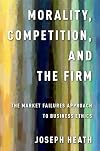
Joseph Heath's new book isn't for beginners and it does need a fairly high level of commitment, but it has to be the best expression that this reviewer has seen of new trends in 21st Century economics.
A principal source for the book comes from efficiency arguments around Canadian healthcare, with a basic observation that the Canadian single payer system delivers more or less the same results as the US system at about half the cost.
The interesting point is that the Canadian system is almost show more always defended for its equality rather than its efficiency, which Heath finds curious since from an efficiency viewpoint, the system directly saves billions of dollars that can be put to more productive use elsewhere (by government or privately). The point here is that the state is intervening in the health insurance market to correct a market failure just as much as it is intervening to ensure distributive justice. In fact the efficiency gains are so great that they benefit everyone without considering distributive justice at all.
Heath defines “market failure” as the failure in a market to reach a Pareto Optimum (someone can gain without someone else losing) with higher levels of organization (e.g. corporations, governments, legal frameworks etc.) needed to capture efficiency gains and reach the Pareto Optimum. Sometimes optimality can be obtained by government action and sometimes through private markets.
The “Market Failures” approach is a truly interesting viewpoint and he develops it showing the basic tension in a competitive free market that generate Pareto optimality (higher efficiency, better quality and lower prices) with the continuous conflict between market players and its winners and losers.
Result that some see free market competition as unfair and unethical (never mind the efficiency gains) and an abandonment of common morality.
The author doesn't accept this. He shows quite convincingly that most societies have a basic morality that exists without the threat of sanction and that this basic morality extends naturally to the economic sphere despite decades of “anti-normative” economics tuition. Normative factors such as loyalty, committment, ethics and fairness are a significant part of economic life.
So what we are left with is something like a government licensed sanction to compete in the interests of Pareto optimality, which he compares to a competitive football league with games played within the rules to get the best performance. Of course players can cheat, but so can corporate employees (eg. at Enron, Hollinger etc.) and these are local market failures (breaking the rules) rather than a basic fault in the game itself.
The papers in the book search around these themes in an exceptionally interesting way but in the opinion of this reviewer, the author could perhaps have extended the analysis into a couple of other areas:
The papers are basically very realistic and evidence based but outsourcing doesn't get a mention. In terms of the sports metaphor, what happens if the winning team in the US league is mostly made up of Chinese players? Isn't the league developing the skills of the Chinese players and crowding out/weakening the skills of American players? or does this matter? In economic terms outsourcing seems to flatten and lower the supply curve shown on page 188 to such an extent that US suppliers can't compete, whatever technology they use, so US consumers perhaps get the doubtful utility gain of flat screen tv's en every room and boxes full of unused toys at the expense of US industries and jobs. Outsourcing would also seem to be very divisive within corporations as managers and shareholders gain at the expense of production workers.
The text also takes “society” for granted. Heath quotes Rawls saying that society is a, “cooperative venture for mutual advantage” which is fine except that countries like the US have nothing like the cohesion that they used to as they segregate along social, racial and religious lines . Continue this long enough and “society” no longer really exists except for fake cooperation taking place just long enough to allow defection with advantage.
All the same, the book is highly recommended, and the reader gets some interesting discussion about the similarity between the 20th century's large scale corporate bureaucracies and centrally planned bureaucracies (scientific management fashion) + Durkheim's view that hunter gatherer groups can split and separate but settled societies can't. They/we have to live together and work it out. show less
A principal source for the book comes from efficiency arguments around Canadian healthcare, with a basic observation that the Canadian single payer system delivers more or less the same results as the US system at about half the cost.
The interesting point is that the Canadian system is almost show more always defended for its equality rather than its efficiency, which Heath finds curious since from an efficiency viewpoint, the system directly saves billions of dollars that can be put to more productive use elsewhere (by government or privately). The point here is that the state is intervening in the health insurance market to correct a market failure just as much as it is intervening to ensure distributive justice. In fact the efficiency gains are so great that they benefit everyone without considering distributive justice at all.
Heath defines “market failure” as the failure in a market to reach a Pareto Optimum (someone can gain without someone else losing) with higher levels of organization (e.g. corporations, governments, legal frameworks etc.) needed to capture efficiency gains and reach the Pareto Optimum. Sometimes optimality can be obtained by government action and sometimes through private markets.
The “Market Failures” approach is a truly interesting viewpoint and he develops it showing the basic tension in a competitive free market that generate Pareto optimality (higher efficiency, better quality and lower prices) with the continuous conflict between market players and its winners and losers.
Result that some see free market competition as unfair and unethical (never mind the efficiency gains) and an abandonment of common morality.
The author doesn't accept this. He shows quite convincingly that most societies have a basic morality that exists without the threat of sanction and that this basic morality extends naturally to the economic sphere despite decades of “anti-normative” economics tuition. Normative factors such as loyalty, committment, ethics and fairness are a significant part of economic life.
So what we are left with is something like a government licensed sanction to compete in the interests of Pareto optimality, which he compares to a competitive football league with games played within the rules to get the best performance. Of course players can cheat, but so can corporate employees (eg. at Enron, Hollinger etc.) and these are local market failures (breaking the rules) rather than a basic fault in the game itself.
The papers in the book search around these themes in an exceptionally interesting way but in the opinion of this reviewer, the author could perhaps have extended the analysis into a couple of other areas:
The papers are basically very realistic and evidence based but outsourcing doesn't get a mention. In terms of the sports metaphor, what happens if the winning team in the US league is mostly made up of Chinese players? Isn't the league developing the skills of the Chinese players and crowding out/weakening the skills of American players? or does this matter? In economic terms outsourcing seems to flatten and lower the supply curve shown on page 188 to such an extent that US suppliers can't compete, whatever technology they use, so US consumers perhaps get the doubtful utility gain of flat screen tv's en every room and boxes full of unused toys at the expense of US industries and jobs. Outsourcing would also seem to be very divisive within corporations as managers and shareholders gain at the expense of production workers.
The text also takes “society” for granted. Heath quotes Rawls saying that society is a, “cooperative venture for mutual advantage” which is fine except that countries like the US have nothing like the cohesion that they used to as they segregate along social, racial and religious lines . Continue this long enough and “society” no longer really exists except for fake cooperation taking place just long enough to allow defection with advantage.
All the same, the book is highly recommended, and the reader gets some interesting discussion about the similarity between the 20th century's large scale corporate bureaucracies and centrally planned bureaucracies (scientific management fashion) + Durkheim's view that hunter gatherer groups can split and separate but settled societies can't. They/we have to live together and work it out. show less

I really liked this book because it tended to describe me in a lot of ways. The difference between type 1, or heuristic thinking and type 2 thinking was pretty eye-opening for me. It made me want to be more aware of when I was engaging type 2 thinking and what triggered it, and if I can trigger it on my own. It also kind of reminded me of how lazy I am...and I guess how lazy we all are, in that we tend to follow the easiest path, the one that requires the least amount of work, which is show more usually the type 1 path. Heath has suggestions at the end of the book about recognizing and using this thinking instead of pretending that we can always overcome it...for example, changing our environment in the first place to avoid temptation instead of thinking that we'll just be able to have the will-power we need in the moment. If we make it easier for us to do the things we want to do without having to engage type 2 thinking, then it'll just be easier to do them! But we have to set ourselves up for success.
Basically - it's hard to be enlightened. Rationality isn't humankind's default, it's kind of just a spandrel that showed up when we learned to communicate with each other and count things...so assuming that we will do rational things in the future, or that other people will act rationally in any given situation, is giving ourselves way too much credit! Let's embrace our irrationality - not by just ceding to it but by planning for it. show less
Basically - it's hard to be enlightened. Rationality isn't humankind's default, it's kind of just a spandrel that showed up when we learned to communicate with each other and count things...so assuming that we will do rational things in the future, or that other people will act rationally in any given situation, is giving ourselves way too much credit! Let's embrace our irrationality - not by just ceding to it but by planning for it. show less
Lists
culture (1)
Awards


You May Also Like


Associated Authors
Statistics
- Works
- 14
- Also by
- 1
- Members
- 1,167
- Popularity
- #22,033
- Rating
- 3.9
- Reviews
- 28
- ISBNs
- 65
- Languages
- 7
- Favorited
- 2