
Robert Hutchinson (1) (1948–)
Author of The Last Days of Henry VIII: Conspiracies, Treason and Heresy at the Court of the Dying Tyrant
For other authors named Robert Hutchinson, see the disambiguation page.
About the Author
Robert Hutchinson is the bestselling author of The Last Days of Henry VIII, Elizabeth's Spymaster, Thomas Cromwell, House of Treason, Young Henry, and The Spanish Armada. He lives in England.
Works by Robert Hutchinson
The Last Days of Henry VIII: Conspiracies, Treason and Heresy at the Court of the Dying Tyrant (2005) 341 copies, 4 reviews
Elizabeth's Spymaster: Francis Walsingham and the Secret War That Saved England (2006) 252 copies, 8 reviews
Thomas Cromwell: The Rise and Fall of Henry VIII's Most Notorious Minister (2007) 222 copies, 3 reviews
The Audacious Crimes of Colonel Blood: The Spy Who Stole the Crown Jewels and Became the King's Secret Agent (2015) 66 copies, 1 review
Weapons of Mass Destruction: The No-Nonsense Guide to Nuclear, Chemical and Biological Weapons Today (2003) 38 copies, 1 review
Tagged
Common Knowledge
- Birthdate
- 1948-10-02
- Gender
- male
- Awards and honors
- Order of the British Empire
- Short biography
- (1) Robert Hutchinson, born in 1948, was defence correspondent for the Press Association from 1976 to 1983 before moving to Jane's Information Group to launch Jane's Defence Weekly. He is a fellow of the Society of Antiquaries of London and a contributing author to The Archaelogy of the Reformation. He is the author of Last Days of Henry VIII, Elizabeth's Spy Master and Thomas Cromwell. He was appointed OBE in the 2008 Honours List. [www.loc.gov & amazon.uk] He is an associate tutor in church archaeology at the University of Sussex's Centre for Continuing Education and is the author of numerous papers. [fromiThomas Cromwell (2007)
Robert Hutchinson (2) is a geologist, possibly in New Hampshire [Amazon]
Robert Hutchinson (3) was born in 1951 [www.loc.gov]
Robert Hutchinson (4) is Robert J. Hutchinson [www.loc.gov]
Robert Hutchinson (5) is Robert C. Hutchinson [www.loc.gov]
Robert Hutchinson (6) lived from 1938-2007 [www.loc.gov]
Robert Hutchinson (7) is Robert A. Hutchinson, born in 1938. In the Library of Congress catalog, he is a distinct entry from Robert Hutchison (6) [www.loc.gov]Robert Hutchinson, author and broadcaster started his working life as a reporter on regional newspapers before joining The Press Association, (the news agency for UK and Irish media) as a night sub-editor. He returned to reporting, later becoming Defence Correspondent. In late 1983 he joined Jane’s Publishing Company as one of the team that successfully launched Jane’s Defence Weekly and became Publishing Director of Jane’s Information Group in 1987, responsible for its magazines, newsletters, books and digital products.
Leaving a decade later, he compiled and edited two editions of Jane’s Warship Recognition Handbook and wrote an acclaimed history of submarines: Jane’s Submarines – War Beneath the Waves (2002), both published by HarperCollins. Weapons of Mass Destruction was published by Weidenfeld & Nicolson in 2004.
He retired as chairman of the media side of the Defence Press Broadcasting Advisory Committee (formerly the ‘D-Notice system’) on November 2007. He was appointed OBE in the 2008 New Year’s Honours List.
Hutchinson was elected a Fellow of the Society of Antiquaries in 1997 and has published numerous papers on aspects of church archaeology for learned journals. He was a contributor to the Archaeology of the Reformation (2004). He is an Associate Tutor in church archaeology for the University of Sussex’s Centre for Community Engagement. He is a regular lecturer and broadcaster and was co-presenter of History Channel’s Inside the Body of Henry VIII in February 2009. He has a doctorate from the University of Sussex.
http://www.andrewlownie.co.uk/authors... - Nationality
- UK
- Birthplace
- Arundel, West Sussex, England
- Map Location
- UK
Members
Reviews
Elizabeth's Spymaster: Francis Walsingham and the Secret War That Saved England by Robert Hutchinson
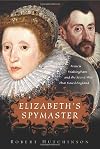
There’s a rule for books dealing with the Elizabethan age; they almost always have to have a picture of Elizabeth I on the cover, even if they’re about somebody else. No exception here; Elizabeth gets pride of place, with Sir Francis Walsingham lurking in the background. As on the cover, so in life – Walsingham is a fascinating figure but not much is known about him, probably a sign that he knew what he was about in running an intelligence service. We don’t know how he got his start, show more how he recruited most of his agents, and how he ran his network. Therefore author Robert Hutchinson has to pad out this book with an account of the execution of Mary Queen of Scots – which Walsingham was mostly responsible for, by forging incriminating letters; and the Defeat of the Spanish Armada. There isn’t too much evidence about what Walsingham did to thwart the Armada, other than getting some information from merchants and planted agents in Spanish ports – but he must have contributed much that is unrecorded, since Sir Francis Drake wrote him to say “…you have fought more with your pen than many in our English navy fought with their enemies…”.
A lot of Walsingham’s work was reprehensible by modern standards; a good part of his efforts were directed against Catholic laymen and priests, who despite their nominal illegality were probably not that much of a threat to Elizabeth or the State. Hutchinson compares Walsingham to Beria and Himmler, but notes that things were different in the 16th century, and that Walsingham never went in for personal aggrandizement, dying in relative poverty after spending most of his private resources on his work.
The secondary characters are often fascinating; I wish there was more about them. Walsingham employed Rackmaster Richard Topcliffe, who was so nasty that his family disowned him and his sons changed their names. When Walsingham was reminded that government torture was technically illegal, Topcliffe solved the problem by noting that torture by private citizens was not and set up a dungeon in his own house (I understand such things are still available in London, but for different reasons). Topcliffe paid for his evil by dying peacefully at a ripe old age, wealthy and honored. Walsingham’s counterpart in Spanish service, Bernardino de Mendoza, managed to thwart or compromise many or Walsingham’s plans and must have had an equal or better network in England than Walsingham had in Spain, but not much is known about it. Playwright Christopher Marlowe was one of Walsingham’s agents and his interesting death might have had something to do with his activities. Walsingham’s daughter, Frances, must have been something, since she successively married Sir Phillip Sidney, one of the most popular nobles of the day and rumored to be the model for Hamlet; then Robert Deveraux, Earl of Essex, who was the queen’s favorite in her old age (until she had him beheaded). Frances’s third husband was less notable but lived longer.
In the 1998 film Elizabeth, Walsingham (played by Geoffrey Rush) is shown as a gay man who poniards his lover through the neck when he suspects an assassination attempt. Although such things were slightly tolerated in Elizabethan times, there’s no evidence that Walsingham was actually gay, and such a thing would have been very foolish as it would have exposed him to blackmail.
Not a bad addition to Elizabethan lore even though a little sparse as a biography. show less
A lot of Walsingham’s work was reprehensible by modern standards; a good part of his efforts were directed against Catholic laymen and priests, who despite their nominal illegality were probably not that much of a threat to Elizabeth or the State. Hutchinson compares Walsingham to Beria and Himmler, but notes that things were different in the 16th century, and that Walsingham never went in for personal aggrandizement, dying in relative poverty after spending most of his private resources on his work.
The secondary characters are often fascinating; I wish there was more about them. Walsingham employed Rackmaster Richard Topcliffe, who was so nasty that his family disowned him and his sons changed their names. When Walsingham was reminded that government torture was technically illegal, Topcliffe solved the problem by noting that torture by private citizens was not and set up a dungeon in his own house (I understand such things are still available in London, but for different reasons). Topcliffe paid for his evil by dying peacefully at a ripe old age, wealthy and honored. Walsingham’s counterpart in Spanish service, Bernardino de Mendoza, managed to thwart or compromise many or Walsingham’s plans and must have had an equal or better network in England than Walsingham had in Spain, but not much is known about it. Playwright Christopher Marlowe was one of Walsingham’s agents and his interesting death might have had something to do with his activities. Walsingham’s daughter, Frances, must have been something, since she successively married Sir Phillip Sidney, one of the most popular nobles of the day and rumored to be the model for Hamlet; then Robert Deveraux, Earl of Essex, who was the queen’s favorite in her old age (until she had him beheaded). Frances’s third husband was less notable but lived longer.
In the 1998 film Elizabeth, Walsingham (played by Geoffrey Rush) is shown as a gay man who poniards his lover through the neck when he suspects an assassination attempt. Although such things were slightly tolerated in Elizabethan times, there’s no evidence that Walsingham was actually gay, and such a thing would have been very foolish as it would have exposed him to blackmail.
Not a bad addition to Elizabethan lore even though a little sparse as a biography. show less
Hutchinson is at his strongest when he describes Cromwell's actions with wit and flair. The author has an opinion and is not shy to make it known, which makes this book an entertaining read. The reader is under no illusion that Hutchinson approves of Cromwell, in fact one gets a sense that he despises the man. This adds humour to a book which might otherwise be accused of being dry, his remarks often had me laughing out loud.
I did however spend much time slogging through chapters with show more endless descriptions of minutae which felt unnecessary if the goal is to paint a general picture of Cromwell's life. Notably, chapter 6. Whilst I appreciate the presentation of evidence and the clear chronology for how Hutchinson formulated his narrative, I found myself muttering 'get on with it' when presented with the exact amount that Cromwell spent buying one of his buddies a nice coat. Perhaps he could have invited the reader to do their own research if they needed the specifics?
That being said, as an introductory whistle stop tour into Cromwell's rise and downfall, I would recommend looking no further. show less
I did however spend much time slogging through chapters with show more endless descriptions of minutae which felt unnecessary if the goal is to paint a general picture of Cromwell's life. Notably, chapter 6. Whilst I appreciate the presentation of evidence and the clear chronology for how Hutchinson formulated his narrative, I found myself muttering 'get on with it' when presented with the exact amount that Cromwell spent buying one of his buddies a nice coat. Perhaps he could have invited the reader to do their own research if they needed the specifics?
That being said, as an introductory whistle stop tour into Cromwell's rise and downfall, I would recommend looking no further. show less
Intriguing, easy to read account of the career of Thomas Cromwell, notorious chief minister to Henry VIII. Robert Hutchinson sets out the main events of Cromwell's life and times without going into much detail. This book is very much a once over lightly account, for instance there is only the bare bones on Cromwell's role in the downfall of Anne Boleyn, an event he played a major part in. Hutchinson does bring to life the Tudor court in all its madness and corruption, illustrating how easy show more it was to fall foul of the king and meet a gruesome end. Hutchinson plainly does not like his subject, nor Henry VIII, very much. He does not have much good to say about either. However, he does write in an engaging style and this book would be a good starting point for anyone interested in Henry VIII's world. show less
The Last Days of Henry VIII: Conspiracies, Treason and Heresy at the Court of the Dying Tyrant by Robert Hutchinson
Oh the Tudors. What a bunch you are --- paranoid, mean-spirited, mean, gluttonous, and in the case of Henry, horny. This book only deals with his last years so a lot of the horny court play had run its course already and what was left was a sick, dying man sadly looking for companionship in his last days.
For a man so concerned with his public image and legacy, specifically an heir, he’s remembered much differently than I’m sure he ever thought possible even in his wildest dreams. In his show more later years, Henry was incredibly obese and most likely spent every minute of his last days in pain. His ulcerated legs constantly oozed. His diet of meat, meat, and more meat caused digestion issues, and he still worried about maintaining appearances. He’s an interesting figure and it’s obvious why so many people want to write books about him and the Tudor court. Honestly though, a book about Henry’s PR machine is something I’d probably read though.
It’s his final wife, Katherine Parr, who brings his family back together though. Welcoming Mary and Elizabeth into the fold and Henry, at this point, adds them to his succession line. His heir, Edward, dies at the young age of 16, Mary turns out to not be the best at ruling, but Elizabeth, well, she turns out to be Henry’s true legacy. Interesting how that works sometimes isn’t it?
This book is broken into chunks meaning each chapter is about a certain aspect of his life --- his sickness, his will, his last queen, and his death. While it’s interesting to see these aspects broken down this way, the timeline gets muddles and I found it slightly hard to follow in terms of what year it was and what was important.
I’ve read a lot about the Tudors, both fact and fiction, and some of this felt too familiar to be as interesting as I wanted it to be. I’m glad I picked it up and I’m sure it’ll add a new perspective to my next Tudor historical fiction read. I realize that while I am sort of tired (sort of bored would be a better way to put it) of the Tudors, I know I’ll probably pick up another book about them and I’m not sure why. Perhaps that will be many days down the road though. show less
For a man so concerned with his public image and legacy, specifically an heir, he’s remembered much differently than I’m sure he ever thought possible even in his wildest dreams. In his show more later years, Henry was incredibly obese and most likely spent every minute of his last days in pain. His ulcerated legs constantly oozed. His diet of meat, meat, and more meat caused digestion issues, and he still worried about maintaining appearances. He’s an interesting figure and it’s obvious why so many people want to write books about him and the Tudor court. Honestly though, a book about Henry’s PR machine is something I’d probably read though.
It’s his final wife, Katherine Parr, who brings his family back together though. Welcoming Mary and Elizabeth into the fold and Henry, at this point, adds them to his succession line. His heir, Edward, dies at the young age of 16, Mary turns out to not be the best at ruling, but Elizabeth, well, she turns out to be Henry’s true legacy. Interesting how that works sometimes isn’t it?
This book is broken into chunks meaning each chapter is about a certain aspect of his life --- his sickness, his will, his last queen, and his death. While it’s interesting to see these aspects broken down this way, the timeline gets muddles and I found it slightly hard to follow in terms of what year it was and what was important.
I’ve read a lot about the Tudors, both fact and fiction, and some of this felt too familiar to be as interesting as I wanted it to be. I’m glad I picked it up and I’m sure it’ll add a new perspective to my next Tudor historical fiction read. I realize that while I am sort of tired (sort of bored would be a better way to put it) of the Tudors, I know I’ll probably pick up another book about them and I’m not sure why. Perhaps that will be many days down the road though. show less
You May Also Like


Statistics
- Works
- 11
- Members
- 1,501
- Popularity
- #17,120
- Rating
- 3.7
- Reviews
- 24
- ISBNs
- 80
- Languages
- 8
- Favorited
- 1
