
Peter Watson (1) (1943–)
Author of Ideas: A History of Thought and Invention, from Fire to Freud
For other authors named Peter Watson, see the disambiguation page.
About the Author
Peter Watson is an intellectual historian, journalist, and author of thirteen books, including The Age of Atheists; Ideas: A History; The German Genius; The Medici Conspiracy; and The Great Divide. He has written for the Sunday Times, the New York Times, the Observer, and the Spectator. He lives in show more London. show less
Series
Works by Peter Watson
The German Genius: Europe's Third Renaissance, the Second Scientific Revolution, and the Twentieth Century (2010) 770 copies, 13 reviews
The Medici Conspiracy: The Illicit Journey of Looted Antiquities--From Italy's Tomb Raiders to the World's Greatest Museums (2006) 336 copies, 3 reviews
A Terrible Beauty: The People and Ideas That Shaped the Modern Mind - A History (2000) 225 copies, 3 reviews
Ideeen / 2 9 copies
Associated Works
Reader's Digest Condensed Books: Toy Soldiers • A Time to Die • The Bears and I • Landscape of Lies 7 copies
Reader's Digest Auswahlbücher 190: Der Schwarze Tod / Auf der Fährte der Silberlöwen / Lügenlandschaft / Frei wie ein Drachen (1993) 5 copies
Tagged
Common Knowledge
- Canonical name
- Watson, Peter
- Legal name
- Watson, Peter Frank Patrick
- Other names
- Ford, Mackenzie (pseudonym)
- Birthdate
- 1943-04-23
- Gender
- male
- Education
- Durham University (BSc|Psychology|1964)
University of London (Ph.D|1967)
Rome University (Dipl. 1965)
Tavistock Clinic - Occupations
- journalist
intellectual historian
art historian
fiction writer - Organizations
- McDonald Institute for Archaeological Research, University of Cambridge
London Times
The Sunday Times
New Society
Reform Club
British Psychological Society (show all 7)
PEN - Awards and honors
- Golden Dagger Award for best thriller (1983)
- Agent
- Robert Ducas
- Nationality
- UK
- Birthplace
- Birmingham, England, UK
- Places of residence
- London, England, UK
- Associated Place (for map)
- England, UK
Members
Discussions
Mystery, pre-1995, clues on the cover, scavenger hunt, upside down cross in Name that Book (February 2020)
Reviews

Watson begins with an interesting question: How to account for the differences between the Old World and the New World at the moment of contact in 1492? His main thesis is that environmental factors operate on humans to produce an ideology, a way of understanding and interpreting the world, and that the ideological trajectories of the Old World and the New World began to diverge around the 10th millennium BC thanks to a whole complex of interlinking changes that occurred together. His claim show more to novelty, and what drew my attention to this book, is his discussion of the influence of intoxicants and hallucinogens on the development of human civilization. Alas, his kitchen-sink approach and his discursive style make this a grueling read.
After a succinct statement of his thesis, Watson lets loose with a catalog of hypotheses and equivocations so that it is hard to tell just which factors explain what. For instance, he believes it is possible to reconstruct distant occurrences in deep time using a ‘new scientific synthesis’ of geography, botany, anthropology, archaeology, meteorology, cosmology, geology, and paleontology to show that environmental catastrophes produced profound effects on the mental life of ancient peoples. Earthquakes, volcanoes and tsunamis are scary and hard to understand, so Myths. And myths are memories.
This is buncombe. Deep time is fun to think about, but it tells us nothing about the distinction between Europe and the Americas in 1492. Piling academic fields of enquiry on top of each other does not bring clarity. And, there is no way to adequately comprehend the mental life of ancient peoples. The consequences of any ‘rupture’ that occurred on the Sunda Shelf between 11,000 and 8,000 years ago have been superseded time and again in the intervening millennia.
Watson seems to acknowledge the wildly speculative nature of the explanations he includes here. On every other page he refashions his caveat; “the significance of this extraordinary difference may have something to do with…” becomes
“The evidence that we have at the moment shows…”
“This may well have been related to…”
“This may not be all there is to…”
“a plausible theory made more so by the fact that…”
“It is not too much to think that…”
“It may be no coincidence that…”
“What follows from this analysis, if correct, is that…”
“On this reckoning, …”
“What we may be seeing here is…”
“One model for this may have been…”
What is introduced as a ‘tantalizing inference’ in one chapter becomes the foundation for further conjecture in the next. Perhaps the accumulation of suppositions and speculation is meant to give the illusion of coherence, but any order to the presentation is confounded by the mangled chronology and the introduction of more and more explanatory factors. When Watson goes back to Ur on page 233, I suddenly felt like taking a nap. By the time we get to Part Three, “Why Human Nature Evolved Differently in the Old World and the New,” (p. 249) the explanation may have something to do with the weather, volcanoes, alluvial plains, deep-sea fishing, barley, oats, shamanism, potatoes, pottery, metallurgy, the domestication of animals, grave goods, cave drawings, chicha, Venus figurines, bulls, bison, jaguars, salmon, beer, ploughs and the traction complex (what?), milk, wool, vegetable fibers, megaliths (menhir/cromlech/dolmen), soma, democracy, tobacco, Christianity, Quetzalcoatl, rubber, psilocybin, mummies, chocolate, or some other I may have missed.
Despite the ill wind blowing through The Great Divide, there are some interesting tidbits to be found here. The best part of the book is the discussion of the cultural effects of hallucinogenic vines, cactus and mushrooms in the Americas, though a reader must excavate the relevant passages from a muddy mess. Other good stuff, to be taken with a grain of salt:
“In the Americas there is a dearth of ‘watery chaos myths’ beyond the Pacific north-west, and New World myths lack almost any references to sea monsters or dragons.”
Fig. 6 is a “List of known catastrophes in ancient times” that includes a bouncing asteroid in Campo Cielo, Argentina (c. 2000 BC), a blitz of fireballs (AD 400-600), meteorites that killed 10,000 people in China (AD 1490), and a tsumani without an earthquake (Japan, AD 1700).
The plant known as Syrian rue (Perganum harmela) from central Asia was used as a truth drug by the Nazis and is the chief ingredient in the preparation of yagé (!?). It is also the source of red dye used in Persian carpets, and thus the geometrical designs characteristic of central Asian carpets may imitate the entopic images produced by harmine, and the tradition of ‘flying carpets’ may be a reflection of the flying sensation induced by the drug.
Some emeritus professor of cognitive archaeology believes that the squiggles of ancient cave art are caused by people actually ‘seeing’ the structures of their brains between the retina and the visual cortex under the influence of drugs.
Someone else thinks that Genesis is a mythical account of the transition from hunter-gathering to farming.
Earthen bowls with a sunburst design suggest the emergence and spread of specific cults involving psychoactive substances.
Tobacco enemas among the first peoples of North America produced hallucinogenic effects and helped overcome fatigue.
Horses―introduced from the steppes into Europe―were expensive, needed careful handling, and were potentially dangerous. Therefore, the use of more intensive psychoactive substances (opium, cannabis) may have become inappropriate, and their use declined. Europeans turned to beer and wine. Riding a horse when you are stoned is harder than riding a horse when you are soused.
The first representation of potatoes on pottery ~1100 BC appeared alongside images of jaguars, baring their teeth and snarling, suggesting they were worshipped as ferocious gods. There were also “depictions of maimed individuals, of people with congenital hairlips, with faces deformed in other ways, such as with split noses, and still other pots depicting figures with amputated legs. The suggestion is that these people were felt to be special or sacred in some way, possibly that they were seen as half-way creatures, half-way between humans and jaguars, perhaps.” Or maybe they had been attacked by jaguars. show less
After a succinct statement of his thesis, Watson lets loose with a catalog of hypotheses and equivocations so that it is hard to tell just which factors explain what. For instance, he believes it is possible to reconstruct distant occurrences in deep time using a ‘new scientific synthesis’ of geography, botany, anthropology, archaeology, meteorology, cosmology, geology, and paleontology to show that environmental catastrophes produced profound effects on the mental life of ancient peoples. Earthquakes, volcanoes and tsunamis are scary and hard to understand, so Myths. And myths are memories.
This is buncombe. Deep time is fun to think about, but it tells us nothing about the distinction between Europe and the Americas in 1492. Piling academic fields of enquiry on top of each other does not bring clarity. And, there is no way to adequately comprehend the mental life of ancient peoples. The consequences of any ‘rupture’ that occurred on the Sunda Shelf between 11,000 and 8,000 years ago have been superseded time and again in the intervening millennia.
Watson seems to acknowledge the wildly speculative nature of the explanations he includes here. On every other page he refashions his caveat; “the significance of this extraordinary difference may have something to do with…” becomes
“The evidence that we have at the moment shows…”
“This may well have been related to…”
“This may not be all there is to…”
“a plausible theory made more so by the fact that…”
“It is not too much to think that…”
“It may be no coincidence that…”
“What follows from this analysis, if correct, is that…”
“On this reckoning, …”
“What we may be seeing here is…”
“One model for this may have been…”
What is introduced as a ‘tantalizing inference’ in one chapter becomes the foundation for further conjecture in the next. Perhaps the accumulation of suppositions and speculation is meant to give the illusion of coherence, but any order to the presentation is confounded by the mangled chronology and the introduction of more and more explanatory factors. When Watson goes back to Ur on page 233, I suddenly felt like taking a nap. By the time we get to Part Three, “Why Human Nature Evolved Differently in the Old World and the New,” (p. 249) the explanation may have something to do with the weather, volcanoes, alluvial plains, deep-sea fishing, barley, oats, shamanism, potatoes, pottery, metallurgy, the domestication of animals, grave goods, cave drawings, chicha, Venus figurines, bulls, bison, jaguars, salmon, beer, ploughs and the traction complex (what?), milk, wool, vegetable fibers, megaliths (menhir/cromlech/dolmen), soma, democracy, tobacco, Christianity, Quetzalcoatl, rubber, psilocybin, mummies, chocolate, or some other I may have missed.
Despite the ill wind blowing through The Great Divide, there are some interesting tidbits to be found here. The best part of the book is the discussion of the cultural effects of hallucinogenic vines, cactus and mushrooms in the Americas, though a reader must excavate the relevant passages from a muddy mess. Other good stuff, to be taken with a grain of salt:
“In the Americas there is a dearth of ‘watery chaos myths’ beyond the Pacific north-west, and New World myths lack almost any references to sea monsters or dragons.”
Fig. 6 is a “List of known catastrophes in ancient times” that includes a bouncing asteroid in Campo Cielo, Argentina (c. 2000 BC), a blitz of fireballs (AD 400-600), meteorites that killed 10,000 people in China (AD 1490), and a tsumani without an earthquake (Japan, AD 1700).
The plant known as Syrian rue (Perganum harmela) from central Asia was used as a truth drug by the Nazis and is the chief ingredient in the preparation of yagé (!?). It is also the source of red dye used in Persian carpets, and thus the geometrical designs characteristic of central Asian carpets may imitate the entopic images produced by harmine, and the tradition of ‘flying carpets’ may be a reflection of the flying sensation induced by the drug.
Some emeritus professor of cognitive archaeology believes that the squiggles of ancient cave art are caused by people actually ‘seeing’ the structures of their brains between the retina and the visual cortex under the influence of drugs.
Someone else thinks that Genesis is a mythical account of the transition from hunter-gathering to farming.
Earthen bowls with a sunburst design suggest the emergence and spread of specific cults involving psychoactive substances.
Tobacco enemas among the first peoples of North America produced hallucinogenic effects and helped overcome fatigue.
Horses―introduced from the steppes into Europe―were expensive, needed careful handling, and were potentially dangerous. Therefore, the use of more intensive psychoactive substances (opium, cannabis) may have become inappropriate, and their use declined. Europeans turned to beer and wine. Riding a horse when you are stoned is harder than riding a horse when you are soused.
The first representation of potatoes on pottery ~1100 BC appeared alongside images of jaguars, baring their teeth and snarling, suggesting they were worshipped as ferocious gods. There were also “depictions of maimed individuals, of people with congenital hairlips, with faces deformed in other ways, such as with split noses, and still other pots depicting figures with amputated legs. The suggestion is that these people were felt to be special or sacred in some way, possibly that they were seen as half-way creatures, half-way between humans and jaguars, perhaps.” Or maybe they had been attacked by jaguars. show less

Where to start? On a positive note, this novel did have a few compelling moments, hence three stars rather than two. That being said, I have so many issues with the story. It opens with Madeleine being stripped naked and humiliated in a "test" meant to prepare her potential torture and execution should she be captured by the Nazis in her role as a British agent in occupied France. But, after a bit of pampering, Madeleine is absolutely fine and up to flirting with the man to orchestrated the show more entire episode: the narrator of this novel, one Matt Hammond. As the novel is narrated from Matt perspective, the book title should really have been Matt's War, not Madeleine's War. In short order, Matt and Madeleine become involved, even as Madeleine leaves for occupied France ahead of the D-Day invasion. Left to his own devices, Matt starts suspect Madeleine could have been a German spy (so much for love, I guess) and then gets himself sent to France to kill a Resistance fighter on Churchill's orders. The last is a bit that could have been left out of the book entirely, and left me with a very negative view of Matt as a person. Overall, I kept wondering what the author wanted the reader to take away from this book: was I supposed to like or have sympathy for the narrator Matt (who I rather despise by the end)? Was there supposed to be some kind of theme about how war compromises everyone's morality? Was I supposed to feel attached to the characters (I didn't mind in the least when several died towards the end)? I'm not sure and I don't know that I could recommend this novel when I've encountered so many WWII-era novels that are just better stories. show less
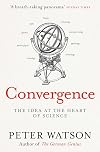
Watson's erudition, his knowledge of the sciences, and his ability to weave a compelling story around them is undeniable and impressive. I haven't read everything in this hefty book (how many people have?), but almost everything I did read was compelling and provocative. Only, after a while you realize that Watson has done quite a bit of cherry picking, has simply selected everything that fits in his convergence-theory and sometimes also relies heavily on less reliable theories and studies. show more For the latter I’m not referring to his extensive report of evolutions in the exact sciences (physics and mathematics first), because I am not sufficiently versed in that. But I did read thoroughly the pieces where he talks about, for instance, Big History, or early human history, because I think I know something about that.
Big History is presented by Watson as proof of his claim that the sciences have been converging since the mid-19th century. I don't know. The publications of a Christian David (to whom Watson strangely does not refer at all) make it clear that Big History can paint an attractive narrative of the evolution of our universe, but you will not find a real integration of physical, biological and social sciences in it. Big History sticks to the surface a little too much for that.
And in the chapter on early human history, Watson relies on highly controversial and often very preliminary recent publications to launch speculative theories. For example, he talks about the prehistoric Venus figurines, citing the highly controversial publications of Maria Gimbutas, and formulating a theory himself that after the domestication of animals, from about 12 to 10,000 years ago, man realized that there was a male input in the onset of pregnancies; it was the beginning of patriarchy, and the sudden disappearance of female fertility statues. The latter is not even true, just to indicate on what loose sand Watson builds his claims.
It is also striking that Watson does not only want to prove that sciences are evolving towards each other, but above all wants to defend the reductionist approach of science. For him, that reductionism is even the core of the success of those sciences. Well, to a certain extent this is justifiable: many breakthroughs, especially in the physical sciences, are the result of focusing on very limited research objects, strictly distinguishing phenomena, etc. But that there are great risks involved, and that this approach does injustice to reality as a whole, is now also clear. None of that with Watson, who continues to ardently defend reductionism, also in the social sciences, and who attacks mainly non-scientists who point to phenomena such as chaos, complexity, emergence, etc. The title of this book would therefore better be: “reductionism. The idea at the heart of science”. show less
Big History is presented by Watson as proof of his claim that the sciences have been converging since the mid-19th century. I don't know. The publications of a Christian David (to whom Watson strangely does not refer at all) make it clear that Big History can paint an attractive narrative of the evolution of our universe, but you will not find a real integration of physical, biological and social sciences in it. Big History sticks to the surface a little too much for that.
And in the chapter on early human history, Watson relies on highly controversial and often very preliminary recent publications to launch speculative theories. For example, he talks about the prehistoric Venus figurines, citing the highly controversial publications of Maria Gimbutas, and formulating a theory himself that after the domestication of animals, from about 12 to 10,000 years ago, man realized that there was a male input in the onset of pregnancies; it was the beginning of patriarchy, and the sudden disappearance of female fertility statues. The latter is not even true, just to indicate on what loose sand Watson builds his claims.
It is also striking that Watson does not only want to prove that sciences are evolving towards each other, but above all wants to defend the reductionist approach of science. For him, that reductionism is even the core of the success of those sciences. Well, to a certain extent this is justifiable: many breakthroughs, especially in the physical sciences, are the result of focusing on very limited research objects, strictly distinguishing phenomena, etc. But that there are great risks involved, and that this approach does injustice to reality as a whole, is now also clear. None of that with Watson, who continues to ardently defend reductionism, also in the social sciences, and who attacks mainly non-scientists who point to phenomena such as chaos, complexity, emergence, etc. The title of this book would therefore better be: “reductionism. The idea at the heart of science”. show less
The German Genius: Europe's Third Renaissance, the Second Scientific Revolution, and the Twentieth Century by Peter Watson
На карантине дочитал-таки кирпич «Немецкий гений: третий Ренессанс Европы, Вторая научная революция и Двадцатый Век». На редкость живая в первых своих двух третях работа о феномене внезапного рывка немецкоговорящих в XIX веке. Особенно это заметно во второй половине XIX show more века – что ни имя, то на слуху или из учебника: Герц, Сименс, Рентген, Ом, Гельмгольц, Больцман, Кох, Эрлих не говоря уж о композиторах, деятелях искусства, литературы и философии, государственных мужах, полководцах и промышленниках. Да и дальнейшие герои тоже на слуху, взять хотя бы Фрица Габера. Меня всегда интриговал этот интеллектуальный взрыв. И вот он обрел своего летописателя, назвавшего это явление его подлинным именем – «Ренессанс». Двадцатый век мне показался менее захватывающим, но это мой собственный недостаток – и политики много, и философии побольше, а научные открытия уже стали сложно понимаемыми – даже в рассказах про Шрёдингера кот не упоминается )
«Еще раз: Кант, Гумбольдт, Маркс, Клаузиус (известен вторым законом термодинамики, созданием концепции энтропии), Мендель, Ницше, Планк, Фрейд, Эйнштейн, Вебер, Гитлер - к добру ли, к худу ли, но может ли какая-либо другая нация похвастаться собранием из одиннадцати (или даже более) индивидуумов, которые сравнятся с этими фигурами по тому непреходящему влиянию, которое они оказали на современный образ мышления? Полагаю, что нет.»
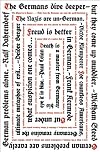
Особо стоит отметить обложку книги: чудесный коллаж из имен, портретов и предметов, ассоциирующихся с выдающимися людьми, для которых немецкий был родным. В конце приводится список из 35 недооцененных немецкоговорящим (в книге к ним относятся и германцы, и австрийцы, и швейцарцы, и евреи, и, как я понял, Кандинский). Список заканчивается этими тремя фамилиями:
"Генрих Дрезер (1860-1924), Артур Эйхенгрюн (1867-1949), Феликс Гофман (1868-1946). В настоящее время производят более 40 000 тонн аспирина ежегодно, более чем через столетие после изобретения препарата. Это, безусловно, один из показателей его влияния. Доказав сперва свою эффективность в при обезболивании, мигрени, ревматоидном артрите, лихорадке и гриппе, а также в борьбе с различными ветеринарными заболеваниями, в последние десятилетия XX века препарат был признан полезным в качестве антикоагулянтного средства и в профилактике стенокардии, инфаркта и инсульта. Этого более чем достаточно, чтобы предположить, что имена Дрезера, Эйхенгрюна и Гофмана достоины быть высеченными в камне. Они, безусловно, помогли человечеству гораздо больше, чем, например, куда более известный Карл Юнг, который, несомненно, возглавил бы любой список самых переоцененных немецкоговорящих.” show less
«Еще раз: Кант, Гумбольдт, Маркс, Клаузиус (известен вторым законом термодинамики, созданием концепции энтропии), Мендель, Ницше, Планк, Фрейд, Эйнштейн, Вебер, Гитлер - к добру ли, к худу ли, но может ли какая-либо другая нация похвастаться собранием из одиннадцати (или даже более) индивидуумов, которые сравнятся с этими фигурами по тому непреходящему влиянию, которое они оказали на современный образ мышления? Полагаю, что нет.»
Особо стоит отметить обложку книги: чудесный коллаж из имен, портретов и предметов, ассоциирующихся с выдающимися людьми, для которых немецкий был родным. В конце приводится список из 35 недооцененных немецкоговорящим (в книге к ним относятся и германцы, и австрийцы, и швейцарцы, и евреи, и, как я понял, Кандинский). Список заканчивается этими тремя фамилиями:
"Генрих Дрезер (1860-1924), Артур Эйхенгрюн (1867-1949), Феликс Гофман (1868-1946). В настоящее время производят более 40 000 тонн аспирина ежегодно, более чем через столетие после изобретения препарата. Это, безусловно, один из показателей его влияния. Доказав сперва свою эффективность в при обезболивании, мигрени, ревматоидном артрите, лихорадке и гриппе, а также в борьбе с различными ветеринарными заболеваниями, в последние десятилетия XX века препарат был признан полезным в качестве антикоагулянтного средства и в профилактике стенокардии, инфаркта и инсульта. Этого более чем достаточно, чтобы предположить, что имена Дрезера, Эйхенгрюна и Гофмана достоины быть высеченными в камне. Они, безусловно, помогли человечеству гораздо больше, чем, например, куда более известный Карл Юнг, который, несомненно, возглавил бы любой список самых переоцененных немецкоговорящих.” show less
Lists
Awards


You May Also Like


Associated Authors
Statistics
- Works
- 34
- Also by
- 4
- Members
- 5,046
- Popularity
- #4,958
- Rating
- 3.9
- Reviews
- 70
- ISBNs
- 223
- Languages
- 10
- Favorited
- 7


