
Guy Gavriel Kay
Author of Tigana
About the Author
Guy Gavriel Kay was born on November 7, 1954 in Weyburn, Saskatchewan, Canada. He became interested in fantasy fiction while working as an assistant to Christopher Tolkien. He assisted him with the editing of J. R. R. Tolkien's The Silmarillion. After receiving a law degree from the University of show more Toronto, he became principal writer and associate producer for the CBC radio series, The Scales of Justice. He also wrote several episodes when the series moved to television. He has written social and political commentary for several publications including the National Post, The Globe and Mail, and The Guardian. His first fantasy novels were The Summer Tree, The Wandering Fire, and The Darkest Road, which make up the Fionavar Tapestry Trilogy. His other works include A Song for Arbonne, The Lions of Al-Rassan, Beyond This Dark House, The Last Light of the Sun, and Under Heaven. He has received numerous awards including and the Aurora Award for Tigana and The Wandering Fire, the 2008 World Fantasy Award for Best Novel for Ysabel, and the International Goliardos Award for his work in the fantasy field. (Bowker Author Biography) show less
Series
Works by Guy Gavriel Kay
Záře dávno pohaslá 1 copy
Xysabel Pb 1 copy
Associated Works
Tagged
Common Knowledge
- Legal name
- Kay, Guy Gavriel
- Birthdate
- 1954-11-07
- Gender
- male
- Education
- University of Manitoba
University of Toronto - Occupations
- editor
Associate Producer (radio)
writer (radio)
fantasy writer - Awards and honors
- Guest of Honour, Eastercon, UK (2000)
Scales of Justice Award (best media treatment of a legal issue, Canadian Law Reform Commission, 1985)
Guest of Honor, Vericon, Cambridge, MA (2007) - Short biography
- Guy Gavriel Kay (born November 7, 1954) is a Canadian author of fantasy fiction. Many of his novels are set in fictional realms that resemble real places during real historical periods, such as Constantinople during the reign of Justinian I or Spain during the time of El Cid. Those works are published and marketed as historical fantasy, though the author himself has expressed a preference to shy away from genre categorization when possible. Kay was born in Weyburn, Saskatchewan, and raised in Winnipeg, Manitoba. When Christopher Tolkien needed an assistant to edit his father J.R.R. Tolkien's unpublished work, he chose Kay, then a student at the University of Manitoba, whose parents were friends of Baillie Tolkien's parents. Kay moved to Oxford in 1974 to assist Tolkien in the editing of The Silmarillion.
He returned to Canada in 1976 to finish a law degree at the University of Toronto, and became interested in fiction writing.
Kay became Principal Writer and Associate Producer for a Canadian Broadcasting Corporation radio series, The Scales of Justice.
In 1984, Kay's first fantasy work, The Summer Tree, the first volume of the trilogy The Fionavar Tapestry, was published. - Nationality
- Canada (birth)
- Birthplace
- Weyburn, Saskatchewan, Canada
- Places of residence
- Weyburn, Saskatchewan, Canada
Winnipeg, Manitoba, Canada
Oxford, Oxfordshire, England, UK
Toronto, Ontario, Canada - Associated Place (for map)
- Canada
Members
Discussions
Guy Kay - where to start and other discussion in The Green Dragon (April 2013)
Tigana Spoiler Thread: Fantasy February Group Read in 75 Books Challenge for 2013 (February 2013)
Tigana by Guy Gavriel Kay: Fantasy February Group Read in 75 Books Challenge for 2013 (February 2013)
For Guy Kay fans in FantasyFans (June 2012)
Group Read (March): Guy Gavriel Kay in The 11 in 11 Category Challenge (April 2011)
The Lions of Al Rassan (in part assumes you've read it...) in The Green Dragon (January 2010)
Book Discussion: A Song for Arbonne ~CAUTION ~ Contains SPOILERS in The Green Dragon (July 2009)
Book Discussion: A Song for Arbonne - SPOILER FREE Thread in The Green Dragon (July 2009)
Tigana discussion! Part Four: The Price of Blood in The Green Dragon (July 2008)
At last, it is time to begin discussing Tigana! Part One Discussion in The Green Dragon (June 2008)
Book Discussion: Arthurian Themed Read *Spoiler Free* in The Green Dragon (March 2008)
Tigana Part Five Discussion: THE MEMORY OF A FLAME in The Green Dragon (February 2007)
Tigana Part Three Discussion: EMBER TO EMBER in The Green Dragon (October 2006)
Tigana Part Two - Dianora - discuss in The Green Dragon (October 2006)
Reviews
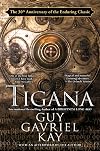
A song of grief, a triumph of memory.
I finished Tigana at 2 AM, closed the cover, and sat in the dark for twenty minutes. Not because I was confused. Because I was grieving for a country that never existed, for names that cannot be spoken, for a melody I will never hear again. That is what Guy Gavriel Kay does to you.
What it is:
A peninsula called the Palm, resembling Renaissance Italy, divided into nine provinces. Two tyrants have conquered it: Brandin of Ygrath in the west, Alberico of show more Barbadior in the east. But this is not a simple war story. Brandin, a sorcerer-king of terrifying power, committed an act of such profound cruelty that it defines the entire novel: when the province of Tigana defied him, he wiped its very name from existence. Anyone born in Tigana forgets their homeland. Anyone from elsewhere cannot hear the name "Tigana." It has been erased from memory, from language, from reality. Only the descendants of Tigana, those born before the spell remember. And they are dying.
The story follows a small band of rebels who dare to remember. Their goal is not to defeat Brandin militarily. Their goal is to make the name "Tigana" heard again to break the spell, to restore the dead to memory, to give their lost province a second life in the hearts of the living.
Why it's a masterpiece (and why it will break you):
1. The prose is among the most beautiful in fantasy. Kay writes like a poet who loves history and a historian who loves music. Every sentence is crafted. Descriptions of food, weather, architecture, and the shifting light of the Palm are rendered with a tenderness that makes the world feel alive. But it is the dialogue, the things left unsaid, the pauses, the weight of grief behind a simple "Goodnight" that haunts me most.
2. The central moral tension is devastating. Brandin, the tyrant who erased a people's identity, is also a loving father, a patron of the arts, a man capable of tenderness. Kay refuses to make him a cartoon villain. When the rebels' plan forces a choice between vengeance and mercy, between restoring Tigana and destroying Brandin's last remaining reason to live, the novel asks: Is the suffering of one innocent worth the freedom of many? There is no easy answer. You will argue with yourself for days.
3. The characters are unforgettable. Devin d'Arro, the young singer who discovers his heritage. Alessan, the prince of Tigana in hiding, carrying the weight of a dead nation. Catriana, a woman torn between vengeance and love. And Dianora, the woman who has infiltrated Brandin's court to assassinate him, only to find herself torn in ways she never anticipated. Her chapters are some of the most agonizingly beautiful passages I have ever read. Kay makes you sympathize with a woman who is planning to kill a man she has come to love, for the sake of a country she has never seen.
4. The theme of memory as resistance. In a world where tyrants can erase history, the act of remembering becomes revolutionary. The rebels do not fight with swords alone; they fight with songs, with stories, with whispered names. "Tigana." Just saying the word is an act of defiance. This book made me think about what I would be willing to die for and what I would be willing to live for.
5. The ending is perfect. Not happy. Not tidy. But earned. I cried. Then I sat in silence for a long time.
Where it might lose some readers (honest critiques):
1. The pacing is slow. Kay luxuriates in description, in interior monologue, in the quiet moments between action. If you need constant plot momentum or battle scenes every fifty pages, this will frustrate you. Tigana is a book to be savored, not devoured.
2. The geography and names can be confusing. A map is provided; use it. The Italianate naming conventions (Sandre, Tregea, Certando, Astibar) blur together if you are not paying attention.
3. Some readers find the Brandin sympathy arc unforgivable. If you believe that a tyrant who commits cultural genocide cannot be humanized, you may struggle with Kay's refusal to condemn him outright. The novel does not excuse Brandin. It asks you to understand him. For some, that is a bridge too far.
Who should read this:
Lovers of literary fantasy (Ursula Le Guin, Patrick Rothfuss, Susanna Clarke).
Readers who want fantasy that engages with politics, ethics, and grief.
Anyone who believes that memory and identity are worth fighting for.
Musicians, poets, and artists; this book is, at its core, about the power of art to resist erasure.
Who should skip it:
If you need fast-paced action and clear good-vs-evil binaries.
If you are uncomfortable with moral ambiguity and sympathetic villains.
If slow, lyrical prose bores you.
Final verdict:
Tigana is not a book. It is an experience. It is a song sung in a minor key, a requiem for a place that never existed but that I will mourn as if it were my own homeland. Kay has written other masterpieces (The Lions of Al-Rassan, A Song for Arbonne), but Tigana is the one that carved itself into my chest. I finished it, closed the cover, and immediately turned back to the first page to find the line: "The summer that Brandin of Ygrath came down from the north, the leaves of the great forest turned gold before their time."
I will never forget that summer. I will never forget Tigana.
Five stars. A thousand stars. Read it with tissues nearby and a quiet evening ahead. show less
I finished Tigana at 2 AM, closed the cover, and sat in the dark for twenty minutes. Not because I was confused. Because I was grieving for a country that never existed, for names that cannot be spoken, for a melody I will never hear again. That is what Guy Gavriel Kay does to you.
What it is:
A peninsula called the Palm, resembling Renaissance Italy, divided into nine provinces. Two tyrants have conquered it: Brandin of Ygrath in the west, Alberico of show more Barbadior in the east. But this is not a simple war story. Brandin, a sorcerer-king of terrifying power, committed an act of such profound cruelty that it defines the entire novel: when the province of Tigana defied him, he wiped its very name from existence. Anyone born in Tigana forgets their homeland. Anyone from elsewhere cannot hear the name "Tigana." It has been erased from memory, from language, from reality. Only the descendants of Tigana, those born before the spell remember. And they are dying.
The story follows a small band of rebels who dare to remember. Their goal is not to defeat Brandin militarily. Their goal is to make the name "Tigana" heard again to break the spell, to restore the dead to memory, to give their lost province a second life in the hearts of the living.
Why it's a masterpiece (and why it will break you):
1. The prose is among the most beautiful in fantasy. Kay writes like a poet who loves history and a historian who loves music. Every sentence is crafted. Descriptions of food, weather, architecture, and the shifting light of the Palm are rendered with a tenderness that makes the world feel alive. But it is the dialogue, the things left unsaid, the pauses, the weight of grief behind a simple "Goodnight" that haunts me most.
2. The central moral tension is devastating. Brandin, the tyrant who erased a people's identity, is also a loving father, a patron of the arts, a man capable of tenderness. Kay refuses to make him a cartoon villain. When the rebels' plan forces a choice between vengeance and mercy, between restoring Tigana and destroying Brandin's last remaining reason to live, the novel asks: Is the suffering of one innocent worth the freedom of many? There is no easy answer. You will argue with yourself for days.
3. The characters are unforgettable. Devin d'Arro, the young singer who discovers his heritage. Alessan, the prince of Tigana in hiding, carrying the weight of a dead nation. Catriana, a woman torn between vengeance and love. And Dianora, the woman who has infiltrated Brandin's court to assassinate him, only to find herself torn in ways she never anticipated. Her chapters are some of the most agonizingly beautiful passages I have ever read. Kay makes you sympathize with a woman who is planning to kill a man she has come to love, for the sake of a country she has never seen.
4. The theme of memory as resistance. In a world where tyrants can erase history, the act of remembering becomes revolutionary. The rebels do not fight with swords alone; they fight with songs, with stories, with whispered names. "Tigana." Just saying the word is an act of defiance. This book made me think about what I would be willing to die for and what I would be willing to live for.
5. The ending is perfect. Not happy. Not tidy. But earned. I cried. Then I sat in silence for a long time.
Where it might lose some readers (honest critiques):
1. The pacing is slow. Kay luxuriates in description, in interior monologue, in the quiet moments between action. If you need constant plot momentum or battle scenes every fifty pages, this will frustrate you. Tigana is a book to be savored, not devoured.
2. The geography and names can be confusing. A map is provided; use it. The Italianate naming conventions (Sandre, Tregea, Certando, Astibar) blur together if you are not paying attention.
3. Some readers find the Brandin sympathy arc unforgivable. If you believe that a tyrant who commits cultural genocide cannot be humanized, you may struggle with Kay's refusal to condemn him outright. The novel does not excuse Brandin. It asks you to understand him. For some, that is a bridge too far.
Who should read this:
Lovers of literary fantasy (Ursula Le Guin, Patrick Rothfuss, Susanna Clarke).
Readers who want fantasy that engages with politics, ethics, and grief.
Anyone who believes that memory and identity are worth fighting for.
Musicians, poets, and artists; this book is, at its core, about the power of art to resist erasure.
Who should skip it:
If you need fast-paced action and clear good-vs-evil binaries.
If you are uncomfortable with moral ambiguity and sympathetic villains.
If slow, lyrical prose bores you.
Final verdict:
Tigana is not a book. It is an experience. It is a song sung in a minor key, a requiem for a place that never existed but that I will mourn as if it were my own homeland. Kay has written other masterpieces (The Lions of Al-Rassan, A Song for Arbonne), but Tigana is the one that carved itself into my chest. I finished it, closed the cover, and immediately turned back to the first page to find the line: "The summer that Brandin of Ygrath came down from the north, the leaves of the great forest turned gold before their time."
I will never forget that summer. I will never forget Tigana.
Five stars. A thousand stars. Read it with tissues nearby and a quiet evening ahead. show less

One could be forgiven for mistaking Kay’s novels for historical fiction: they are meticulously researched, and offer the immersive believability rendered by skilled practitioners of the more traditional craft. The Lions of Al-Rassan delivers a satisfying fictionalization of the Reconquista - the difficulties with that term notwithstanding - during the period of El Cid set in a fictional Iberia of the 11th century. In a convincing portrayal, Kay restores the culture, architecture and show more politics of late al-Andalus, replete with characters who could have been a part. And romance, no, let’s not overlook the romance.
The novel is almost three decades old now. There were moments where I was shaken out of my reading engagement by a discovery. The intervening years have altered the experience of the book at least in a small way. Let me explain.
Why is it that Kay writes historical fantasy rather than historical fiction? The fantasy elements in his works are generally small ones, just enough to inform the reader that while the events may feel like the past of our own world, that is not actually the case. This world has two moons, not one. And a boy with some special knowledge, not particularly crucial to the plot.
Kay loves the description of his work as “history with a quarter-turn to the fantastic”. He has said he does this quarter-turn because he doesn’t like using real lives for his fiction. To The Guardian he said, “I’ve been calling it an epidemic of co-opting real lives, to do whatever we want to do with them. And as an artist, for my own process, I have a problem with this…..I’m happier not pretending I know anything about El Cid in Spain,” he says. “He’s a Spanish national hero. I’d rather invent a character inspired by him but clearly not identical to him. And then I feel liberated creatively. I steep myself in a period and then I twist it just that little bit to give myself the ethical and creative space that seems to work for me.”
Kay does his research and delivers fulfilling worldbuilding, but he is free to make things up, to get things wrong, to play with the history as he wishes. So why was I was periodically jolted from my reading? Memories of Salman Rushdie. Ayatollah Khomeini issued his fatwa in 1989, the year after the publication of The Satanic Verses. Rushdie’s book is often called magical realism; apparently the realism was insufficiently magical. In the decades since the publication of The Lions of Al-Rassan and its narrative of the ending of Muslim rule in Spain, this thread of intolerance has not appreciably diminished. In numerous attentional interludes, I considered the safety of two moons and an alternate universe. What an affront to the imagination that such machinations may offer actual physical safety!
I like Kay’s work very much. This novel has a poignant beauty, as sympathetic characters committed to their loves, their people, their religions, teeter toward the inexorable end of a vanishing world. show less
The novel is almost three decades old now. There were moments where I was shaken out of my reading engagement by a discovery. The intervening years have altered the experience of the book at least in a small way. Let me explain.
Why is it that Kay writes historical fantasy rather than historical fiction? The fantasy elements in his works are generally small ones, just enough to inform the reader that while the events may feel like the past of our own world, that is not actually the case. This world has two moons, not one. And a boy with some special knowledge, not particularly crucial to the plot.
Kay loves the description of his work as “history with a quarter-turn to the fantastic”. He has said he does this quarter-turn because he doesn’t like using real lives for his fiction. To The Guardian he said, “I’ve been calling it an epidemic of co-opting real lives, to do whatever we want to do with them. And as an artist, for my own process, I have a problem with this…..I’m happier not pretending I know anything about El Cid in Spain,” he says. “He’s a Spanish national hero. I’d rather invent a character inspired by him but clearly not identical to him. And then I feel liberated creatively. I steep myself in a period and then I twist it just that little bit to give myself the ethical and creative space that seems to work for me.”
Kay does his research and delivers fulfilling worldbuilding, but he is free to make things up, to get things wrong, to play with the history as he wishes. So why was I was periodically jolted from my reading? Memories of Salman Rushdie. Ayatollah Khomeini issued his fatwa in 1989, the year after the publication of The Satanic Verses. Rushdie’s book is often called magical realism; apparently the realism was insufficiently magical. In the decades since the publication of The Lions of Al-Rassan and its narrative of the ending of Muslim rule in Spain, this thread of intolerance has not appreciably diminished. In numerous attentional interludes, I considered the safety of two moons and an alternate universe. What an affront to the imagination that such machinations may offer actual physical safety!
I like Kay’s work very much. This novel has a poignant beauty, as sympathetic characters committed to their loves, their people, their religions, teeter toward the inexorable end of a vanishing world. show less
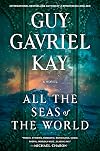
All the Seas of the World - Kay
Audio performance by Simon Vance
4.5 stars
Guy Gavriel Kay is back in his pseudo-Mediterranean Renaissance setting. Geographically it is the same location as in The Lions of Al Rassan, although several centuries later in time. Chronologically the events of this book follow those in A Brightness Long Ago with considerable overlap of characters. Had I known that, I would have reread the first book before starting this one. I have, at this point, reread both show more books. There’s a very significant horse race in the first one that connects both books. (As an additional FYI, although Children of Earth and Sky was published first, it follows this book chronologically.) In a previous review, I commented that Kay brings the reader into the interior lives of even minor characters. Several of those minor characters reappear with important roles in this book. I hardly remembered them, but on rereading, there they were, in the crowd at that important horse race. Their connections to new events are not immediately apparent, because this book begins with at least two completely new personalities.
All of these books are set in a time of extreme political turmoil. Religious intolerance between the Jaddites, Asherites, and Kindath (Kay’s stand-ins for Catholics, Muslims, and Jews) provides justification for border wars, invasions, and persecution. There’s also constant warfare between the petty kings or khalifs within the dominant religions. In all of these turbulent cultures, women have restricted lives and generally subservient roles; usually. Kay’s female characters never seem willing to sit passively on the sidelines. That is especially true in this book. The leading protagonist, Lenia Serrana, an escaped slave, is assertively unwilling to relinquish her personal agency to any man. I’ve said it before. Kay writes female characters who appeal to my feminist heart.
There is a great deal of activity in this book. There’s endless political maneuvering and lots of financial wheeling and dealing. The book begins with an assassination and several attempted assassinations follow. Kay gives the reader the introspective thoughts of characters dealing with challenge and change. In this book there’s a philosophical emphasis on the effects of exile and the idea of home. It seemed completely relevant to current events in the real world.
“The effect of being driven from home, and that home being despoiled … it can go on and on like sea-surf against rocks. On and on within a man or woman, or within a child as it grows up somewhere else, never at home only away” show less
Audio performance by Simon Vance
4.5 stars
Guy Gavriel Kay is back in his pseudo-Mediterranean Renaissance setting. Geographically it is the same location as in The Lions of Al Rassan, although several centuries later in time. Chronologically the events of this book follow those in A Brightness Long Ago with considerable overlap of characters. Had I known that, I would have reread the first book before starting this one. I have, at this point, reread both show more books. There’s a very significant horse race in the first one that connects both books. (As an additional FYI, although Children of Earth and Sky was published first, it follows this book chronologically.) In a previous review, I commented that Kay brings the reader into the interior lives of even minor characters. Several of those minor characters reappear with important roles in this book. I hardly remembered them, but on rereading, there they were, in the crowd at that important horse race. Their connections to new events are not immediately apparent, because this book begins with at least two completely new personalities.
All of these books are set in a time of extreme political turmoil. Religious intolerance between the Jaddites, Asherites, and Kindath (Kay’s stand-ins for Catholics, Muslims, and Jews) provides justification for border wars, invasions, and persecution. There’s also constant warfare between the petty kings or khalifs within the dominant religions. In all of these turbulent cultures, women have restricted lives and generally subservient roles; usually. Kay’s female characters never seem willing to sit passively on the sidelines. That is especially true in this book. The leading protagonist, Lenia Serrana, an escaped slave, is assertively unwilling to relinquish her personal agency to any man. I’ve said it before. Kay writes female characters who appeal to my feminist heart.
There is a great deal of activity in this book. There’s endless political maneuvering and lots of financial wheeling and dealing. The book begins with an assassination and several attempted assassinations follow. Kay gives the reader the introspective thoughts of characters dealing with challenge and change. In this book there’s a philosophical emphasis on the effects of exile and the idea of home. It seemed completely relevant to current events in the real world.
“The effect of being driven from home, and that home being despoiled … it can go on and on like sea-surf against rocks. On and on within a man or woman, or within a child as it grows up somewhere else, never at home only away” show less

One of the finest novels I've read. Kay beautifully explores the power, love and grief of history and memory without it ever slowing down the page-turning thrill of following a small resistance movement on a peninsula ruled by two invading tyrants. Kay has throughout his novels always had an admirable ability to wed heightened sentiment to mundane realism, and that, too, is on splendid display here, the sixth (and so far my favourite) novel I've read by him.
Lists
Best Audiobooks (1)
Antiheroes (1)
Epic Fiction (1)
Ghosts (1)
Which house? (1)
French Books (1)
1980s (3)
Five star books (3)
Favourite Books (3)
Unread books (2)
Epic Fantasy (1)
Nineties (2)
1990s (2)
mom (2)
Awards


You May Also Like


Associated Authors
Statistics
- Works
- 35
- Also by
- 2
- Members
- 38,775
- Popularity
- #467
- Rating
- 4.0
- Reviews
- 1,125
- ISBNs
- 527
- Languages
- 19
- Favorited
- 326

