
James Blish (1921–1975)
Author of A Case of Conscience
About the Author
James Benjamin Blish was born on May 23, 1921 in East Orange, N.J. Blish trained as a biologist at Rutgers and Columbia University, and spent 1942 - 1944 as a medical technician in the United States Army. After the war he became the science editor for the Pfizer pharmaceutical company. His first show more published story appeared in 1940, and his writing career progressed until he gave up his job to become a professional writer. From 1962 to 1968, he worked for the Tobacco Institute. Between 1967 and his death from lung cancer in 1975, Blish wrote authorized short story collections based upon the 1960s TV series Star Trek. He wrote 11 volumes adapting episodes of the series. He died midway through writing Star Trek 12. Perhaps Blish's most famous works were the "Okies" stories, known collectively as Cities in Flight, published in the science-fiction digest magazine Astounding Science Fiction. Some of James Blish's other works include The Vanished Jet, And All the Stars a Stage, The Quincunx of Time, and Flight of Eagles. (Bowker Author Biography) show less
Series
Works by James Blish
A Pair from Space: Giants in the Earth (aka Titan's Daughter) / We, the Marauders (aka Invaders from Earth) (Belmont SF, 92-612) (1965) 61 copies, 1 review
James Blish SF Gateway Omnibus: Black Easter, The Day After Judgement, The Seedling Stars (2013) 28 copies
Obras estelares de la ciencia ficcion: Un caso de conciencia; Semillas estelares (Serie Hugo) (1987) 10 copies
To Pay the Piper 9 copies
Galerij der giganten 5 de beste science-fiction verhalen — Contributor — 7 copies
Watershed 6 copies
Bridge 5 copies
Galaxy 11 - Eine Auswahl der besten Stories aus dem Schience Fiction Magazine GALAXY (1968) — Contributor — 5 copies
Nor Iron Bars 5 copies
Himmelstorm : noveller av James Blish, Robert A. Heinlein og A. E. van Vogt ; presentert av Jon Bing og Tor Åge Bringsværd (1974) — Author — 5 copies
Getting Along — Author — 4 copies
The Oath 4 copies
Triumph o f Time, The 3 copies
Against The Stone Beasts 3 copies
Statistician's Day {short story} 3 copies
Who's In Charge Here? 2 copies
To Love Another (Novelette) 2 copies
More Light {Short story} 2 copies
Bequest Of The Angel 2 copies
The Masks [short story] 2 copies
Um caso de consciência 2 copies
Citadel of Thought 2 copies
Seven and Twelve 1 copy
(Galaxia 15) Grupo galáctico 1 copy
Siglo de pleno verano 1962 1 copy
Um caso de conscin̊cia 1 copy
HLe Imappe del cielo 1 copy
Kalki Vol. III, No. 1 (Whole Number 9) — Editor — 1 copy
Kalki Vol. II, No. 4 (Whole Number 8) — Editor — 1 copy
Kalki Vol. II, No. 1 (Whole Number 5) — Editor — 1 copy
Kalki Vol. II, No. 2 (Whole Number 6) — Editor — 1 copy
Kalki Vol. II, No. 3 (Whole Number 7) — Editor — 1 copy
Bd. 254. Der Psi-Mann T. 2 1 copy
Bd. 253. Der Psi-Mann T. 1 1 copy
Mistake Inside 1 copy
Pasqua nera 1 copy
Duplicated man 1 copy
Lights in Flight 1 copy
As Estrelas Semeadas 1 copy
L'oeil de saturne 1 copy
Knock out 1 copy
The Gulch {short story} — Author — 1 copy
Unterwegs in die Welt von morgen (146):Tausend Milliarden glückliche Menschen - Planet der Träumer (1995) 1 copy
The King in Yellow [A facsimile of the Blasphemous Play transcribed from James Blish's story "More Light" and bound by hand] 1 copy, 1 review
Blackout In Cygni 1 copy
Star Trek 3 1 copy
The Real Thrill 1 copy
The Shipwrecked Hotel 1 copy
A Matter Of Energy 1 copy
Emergancy Refueling 1 copy
Obsession [short fiction] 1 copy
Star Trek 9-12 1 copy
Star Trek 5-8 1 copy
Star Trek 1-4 1 copy
FYI 1 copy
The Bridge 1 copy
Associated Works
The Science Fiction Hall of Fame, Volume One: The Greatest Science Fiction Stories of All Time (1970) — Contributor — 2,099 copies, 34 reviews
The Science Fiction Hall of Fame, Volume Two B: The Greatest Science Fiction Novellas of All Time (1973) — Contributor — 913 copies, 11 reviews
The Big Book of Science Fiction: The Ultimate Collection (2016) — Contributor — 521 copies, 8 reviews
The Norton Book of Science Fiction: North American Science Fiction, 1960-1990 (1993) — Contributor — 344 copies, 6 reviews
The Arbor House Treasury of Great Science Fiction Short Novels (1980) — Contributor — 190 copies, 1 review
American Science Fiction: Nine Classic Novels of the 1950s (2012) — Contributor — 121 copies, 3 reviews
Dogs of War: Ten Classic Stories of Men and Machines in War (2002) — Contributor — 116 copies, 1 review
Science Fiction Showcase: Eleven Extraordinary Stories by Eleven Masters of Science-Fiction and Fantasy (1959) — Contributor — 111 copies, 3 reviews
The Best from Fantasy and Science Fiction: A Special 25th Anniversary Anthology (1974) — Contributor — 84 copies, 2 reviews
The Science Fiction Megapack: 25 Classic Science Fiction Stories by Masters (2011) — Author — 66 copies, 3 reviews
A Century of Science Fiction 1950-1959 : The Greatest Stories of the Decade (1996) — Contributor — 64 copies, 2 reviews
Science Fiction Hall Of Fame Volume Two. The Greatest Science Fiction Stories Of All Time Chosen By The Members Of The Science Fiction Writers Of America (1970) — Contributor, some editions — 41 copies
The Freedom of Fantastic Things: Selected Criticism on Clark Ashton Smith (2006) — Contributor — 26 copies
The Best of Astounding: Classic Short Novels from the Golden Age of Science Fiction (1992) — Contributor — 22 copies
Beyond Human Ken: 21 Startling Stories of Science Fiction and Fantasy (1952) — Contributor — 20 copies
The Magazine of Fantasy and Science Fiction April 1972, Vol. 42, No. 4 (1972) — Contributor — 20 copies
The Magazine of Fantasy and Science Fiction September 1970, Vol. 39, No. 3 (1970) — Contributor — 19 copies
The Magazine of Fantasy and Science Fiction January 1971, Vol. 40, No. 1 (1971) — Contributor — 17 copies
Analog Science Fiction/Science Fact: Vol. LXXXI, No. 3 (May 1968) (1968) — Contributor, some editions — 17 copies
The Magazine of Fantasy and Science Fiction July 1972, Vol. 43, No. 1 (1972) — Book Reviewer — 15 copies
The Magazine of Fantasy and Science Fiction February 1970, Vol. 38, No. 2 (1970) — Contributor — 14 copies
The Magazine of Fantasy and Science Fiction November 1982, Vol. 63, No. 5 (1982) — Contributor — 13 copies
The Magazine of Fantasy and Science Fiction August 1970, Vol. 39, No. 2 (1970) — some editions — 12 copies
The Magazine of Fantasy and Science Fiction January 1957, Vol. 12, No. 1 (1957) — Contributor — 9 copies, 1 review
The Magazine of Fantasy and Science Fiction February 1956, Vol. 10, No. 2 (1956) — Contributor — 8 copies
The Profession of Science Fiction: SF Writers on Their Craft and Ideas (1992) — Contributor — 6 copies
Den elektriske myre og andre science fiction-fortællinger (1984) — Author, some editions — 2 copies, 1 review
Kalki : Studies in James Branch Cabell — Editor, some editions; Contributor, some editions — 1 copy
Tagged
Common Knowledge
- Legal name
- Blish, James Benjamin
- Other names
- Atheling, William, Jr.
- Birthdate
- 1921-05-23
- Date of death
- 1975-07-30
- Gender
- male
- Education
- Rutgers University
Columbia University - Occupations
- science fiction writer
- Organizations
- Futurians
United States Army
Science Fiction and Fantasy Writers of America (co-founder) - Awards and honors
- Guest of honor, Eastercon, UK (1970)
Creation of the James Blish award for Criticism (1977)
Elected to Science Fiction and Fantasy Hall of Fame (2002) - Relationships
- Lawrence, Judith Ann (wife, 1964-1975)
Kidd, Virginia (wife, 1947-1963) - Cause of death
- lung cancer
- Nationality
- USA
- Birthplace
- East Orange, New Jersey, USA
- Places of residence
- Milford, Pennsylvania, USA
Alexandria, Virginia, USA - Place of death
- Henley-on-Thames, Oxfordshire, England, UK
- Burial location
- St Cross Churchyard, Holywell, Oxfordshire, England, UK
- Associated Place (for map)
- USA
Members
Discussions
Mood: Horny, fiery, also blasphemous in Good Show Sir! — bad science fiction and fantasy covers (April 2025)
Black Easter from Centipede Press in Fine Press Forum (February 2022)
Reviews

5/5
A masterful exploration of how religion, specifically Catholicism, would reconcile with novel alien life. It's truly amazing the depth of theme and philosophy exploration that Blish was able to pack into two small novellas. A group of human men, which includes a priest from Peru, are tasked with deciding if a planet populated by sentient lizards is deserving of a place within the galactic federation of humanity. While the other men in the group want to, in various forms, exploit the show more planet for its resources, the priest insists that the planet should be quarantined, as he sees the life and ideas on it to be the work of Satan.
Blish was one of the early hardliners when it came to scientific accuracy in science fiction. It's clear from his work that he practiced what he preached. There is a fair amount of logical scientific explanation, and other arguably dry topics, and yet Blish was able to hold my attention easily throughout. The novel comes off as being extremely well researched, as if it was poured over to hone every sentence as best he could. This effort extends to the world building and aliens themselves. The culture of the Lithians is surprisingly deep and well explored, including their specific scientific advancements, and behavioral customs. The context surrounding human life is similarly interesting, with most life on earth existing in derelict bunkers from a prior age, that are straining the social condition of society at large. Blish is also prescient in his comments on planned obsolescence, and the power that corporations like DuPont and Monsanto will have.
The clear meat of the story revolves around the religious concerns that Father Sanchez works through in his head. Is it possible to be moral and secular, in the specific way that Christians are moral? If God and Satan are real, can Satan directly create physical phenomenon or life in the universe? Is there a difference between divine intervention and physics as we understand it / if a phenomenon is explainable by scientific standards, does it make something less divine or less like the hand of god moving through the world? These questions are explored wonderfully. There's also a satisfying conclusion that perhaps helps to answer them, but is clearly ambiguous enough that the reader is expected to do a lot of thinking on their own.
There is a brief sag towards the beginning of the second novella, when some of the titular characters spend time observing social behaviors at a party, that I struggled to get through. Other than that the novel is well paced and perfectly sized to accomplish it's goals. I compare it a lot to The Canticle for Lebowitiz, another religiously themed novel that I also greatly enjoyed. It's really hard to say which is definitively better, but they both certainly deserve a place in the highest echelons of science fiction literature. show less
A masterful exploration of how religion, specifically Catholicism, would reconcile with novel alien life. It's truly amazing the depth of theme and philosophy exploration that Blish was able to pack into two small novellas. A group of human men, which includes a priest from Peru, are tasked with deciding if a planet populated by sentient lizards is deserving of a place within the galactic federation of humanity. While the other men in the group want to, in various forms, exploit the show more planet for its resources, the priest insists that the planet should be quarantined, as he sees the life and ideas on it to be the work of Satan.
Blish was one of the early hardliners when it came to scientific accuracy in science fiction. It's clear from his work that he practiced what he preached. There is a fair amount of logical scientific explanation, and other arguably dry topics, and yet Blish was able to hold my attention easily throughout. The novel comes off as being extremely well researched, as if it was poured over to hone every sentence as best he could. This effort extends to the world building and aliens themselves. The culture of the Lithians is surprisingly deep and well explored, including their specific scientific advancements, and behavioral customs. The context surrounding human life is similarly interesting, with most life on earth existing in derelict bunkers from a prior age, that are straining the social condition of society at large. Blish is also prescient in his comments on planned obsolescence, and the power that corporations like DuPont and Monsanto will have.
The clear meat of the story revolves around the religious concerns that Father Sanchez works through in his head. Is it possible to be moral and secular, in the specific way that Christians are moral? If God and Satan are real, can Satan directly create physical phenomenon or life in the universe? Is there a difference between divine intervention and physics as we understand it / if a phenomenon is explainable by scientific standards, does it make something less divine or less like the hand of god moving through the world? These questions are explored wonderfully. There's also a satisfying conclusion that perhaps helps to answer them, but is clearly ambiguous enough that the reader is expected to do a lot of thinking on their own.
There is a brief sag towards the beginning of the second novella, when some of the titular characters spend time observing social behaviors at a party, that I struggled to get through. Other than that the novel is well paced and perfectly sized to accomplish it's goals. I compare it a lot to The Canticle for Lebowitiz, another religiously themed novel that I also greatly enjoyed. It's really hard to say which is definitively better, but they both certainly deserve a place in the highest echelons of science fiction literature. show less

A solid and interesting first half is seriously weakened by a disjointed second half whose flow makes little sense, and whose ending leaves much to be desired. This is easier to understand when you learn that "A Case of Conscience" was originally a novella expanded into a novel later on. The first half of the book, the much stronger half, stands on its own as a interesting look at how three vastly different perspectives can interpret evidence that contradicts all existing presuppositions. show more The second half drags into theological debate and the inconsistencies inherent in Catholic dogma set over top a vague background of social unrest about inequality. While several of this book's weak points can be attributed to the age of the book (62 years at the time this review was written), they cannot all be explained away by mere circumstance of time.
The first half of the book sees 4 scientists sent to observe and study an alien world to determine if it is fit for human development and/or colonization. 3 of the scientists all reach different conclusions with vastly different implications, while the fourth listens to be swayed to one side. The debate does drag a bit as it is written very much in the style of a lot of science fiction writing from the 1950s and 1960s: long speeches from "men of intellect" who will break down their every argument into small bits so that even the most inexperienced reader can understand the ultimate conclusions. While that may be helpful for developing the arguments in the book, it does get burdensome to read page after page of philosophical/ethical/theological debate with little break for story or character development through action.
The arguments made are at least interesting to see discussed. While ultimately, Father Ruiz-Sanchez's theological argument becomes the focus of the remainder of the book, Michaelis's argument is the far more interesting one to myself and I suspect most modern readers. His arguments remain relevant today to discussions of de-colonial attitudes and efforts, examinations of the role of force in development and cultural/technological advancement, and the insistence on Western views of "progress" being the only valid measure of civilization.
The geologist Cleaver's ultimate argument reflects many of the attitudes prevalent in the Cold War era in which Blish wrote the novel. The ideas of an arms race remains his most steadfast conviction, even against a people who have no concept of war or weapons. As well, in an era in which many of the European colonies were gaining independence, Cleaver revives old colonial tropes and attitudes, much to the horror of most (I would hope) modern readers. While his arguments remain quite unpersuasive today, they serve as an excellent examination of the danger of colonial attitudes should mankind ever take to the stars for the purposes of expansion.
The second half of the book attempts to do some world building for the far off future of 2050, but it remains vague and unconvincing as a dystopian vision. The idea of social inequity is attempted to be presented as a major brewing crisis, but it never feels like a real danger until the moment is has to erupt to move the plot along. The provocateur of this social unrest comes across as entirely unbelievable at being a charismatic messiah to the masses, instead seeming aloof and entitled/condescending. His being of another world is used to reflect a mirror back onto human society, but it doesn't have the contrast that I think Blish hoped for.
Perhaps it is simply that this book comes from another era with themes and styles that aren't evergreen, but I do find this book to be the weakest of the Hugo Best Novel winners I have read so far. show less
The first half of the book sees 4 scientists sent to observe and study an alien world to determine if it is fit for human development and/or colonization. 3 of the scientists all reach different conclusions with vastly different implications, while the fourth listens to be swayed to one side. The debate does drag a bit as it is written very much in the style of a lot of science fiction writing from the 1950s and 1960s: long speeches from "men of intellect" who will break down their every argument into small bits so that even the most inexperienced reader can understand the ultimate conclusions. While that may be helpful for developing the arguments in the book, it does get burdensome to read page after page of philosophical/ethical/theological debate with little break for story or character development through action.
The arguments made are at least interesting to see discussed. While ultimately, Father Ruiz-Sanchez's theological argument becomes the focus of the remainder of the book, Michaelis's argument is the far more interesting one to myself and I suspect most modern readers. His arguments remain relevant today to discussions of de-colonial attitudes and efforts, examinations of the role of force in development and cultural/technological advancement, and the insistence on Western views of "progress" being the only valid measure of civilization.
The geologist Cleaver's ultimate argument reflects many of the attitudes prevalent in the Cold War era in which Blish wrote the novel. The ideas of an arms race remains his most steadfast conviction, even against a people who have no concept of war or weapons. As well, in an era in which many of the European colonies were gaining independence, Cleaver revives old colonial tropes and attitudes, much to the horror of most (I would hope) modern readers. While his arguments remain quite unpersuasive today, they serve as an excellent examination of the danger of colonial attitudes should mankind ever take to the stars for the purposes of expansion.
The second half of the book attempts to do some world building for the far off future of 2050, but it remains vague and unconvincing as a dystopian vision. The idea of social inequity is attempted to be presented as a major brewing crisis, but it never feels like a real danger until the moment is has to erupt to move the plot along. The provocateur of this social unrest comes across as entirely unbelievable at being a charismatic messiah to the masses, instead seeming aloof and entitled/condescending. His being of another world is used to reflect a mirror back onto human society, but it doesn't have the contrast that I think Blish hoped for.
Perhaps it is simply that this book comes from another era with themes and styles that aren't evergreen, but I do find this book to be the weakest of the Hugo Best Novel winners I have read so far. show less

In this existential treatise on the philosophy of self, James Blish attempts to resolve the infamous "McCoy's Paradox" regarding the continuity of essentia through the medium of a Star Trek: The Original Series novel. As you do.
McCoy's paradox is of course well known to anyone who has even walked past a bookshop that contains philosophy texts, but for completeness I'll recapitulate it here in Blish's terms. The transporters of Star Trek can be (erroneously) thought of as working by show more converting the entirety of the subject's mass into energy, recording the quantum state of every constituent atom along the way, beaming this energy to the destination point (which even Tesla knew how to do (even if we don't…)) and then using the recorded data to reverse the process.
The "paradox" (which like all good paradoxes isn't a paradox) is the following. The person who emerges post-transport is identical in every way to the person who stepped onto the transporter pad, right down to the quantum level. But are they the same person? Having been disassembled, digitised, zapped across the aether, and reassembled (crucially ceasing to exist for a few seconds in the meantime), are you really the same person as at the start of this sentence?
The question, I should point out lest you become agitated to know Blish's answer, is not resolved within this book. Indeed it was still being discussed into the twenty first century. Transfuturist Peter Hamilton in his philosophical note [b:Judas Unchained|9045555|Judas Unchained (Commonwealth Saga, #2)|Peter F. Hamilton|http://photo.goodreads.com/books/1292273190s/9045555.jpg|44507] — in many ways a spiritual sequel to Spock Must Die! — rephrases the problem in terms of attaining immortality through the process of downloading one's memories periodically and, in the event of "body loss", uploading these memories into a cloned body. But is this really immortality or, to paraphrase Hamilton, do I simply die, and then someone else walk away with all of my memories? He counters this issue by analogy with sleep — when one awakes each morning the only connection to the person who went to sleep the previous night is one's memories.
Blish takes a more combative approach to the question, taking an already divided entity — the half human, half Vulcan Spock — and having the transporter malfunction, essentially causing the Spock that would have been disassembled and the Spock that would have been reassembled to both exist concurrently. Do both of these Spocks have equal grounds to claim that they are the original, bona fide person? Well, Blish's précis is summed up in his treatise's title: only one of these Spocks is the real one, and one of these Spocks Must Die. (!)
As far as insightful arguments go, I've heard better. And so as a philosophical discourse the book falls flat on its face — I've known a few philosophers during my time at University and I can count on one hand the number of times they've brought up Spock Must Die! during one of their disquisitions. Fortunately though, and no doubt entirely by chance, the Star Trek trappings that Blish uses as a vehicle for his argument end up forming a quaint story in their own right. It's quirky and oftentimes over the top, and while it's sometimes a little top heavy, the charm of the televised series does sometimes shine through. And on those occasions this book provides its own answer to the paradox; it may go onto the transporter pad as a philosophical tractate yet be disassembled at the atomic level and upon reassembly find itself no longer what it was, but now a fun little science fiction novella. And if we were to have our atoms torn apart and flung pell-mell and everywhither across the Universe I dare say we could all do worse than come back as that. show less
McCoy's paradox is of course well known to anyone who has even walked past a bookshop that contains philosophy texts, but for completeness I'll recapitulate it here in Blish's terms. The transporters of Star Trek can be (erroneously) thought of as working by show more converting the entirety of the subject's mass into energy, recording the quantum state of every constituent atom along the way, beaming this energy to the destination point (which even Tesla knew how to do (even if we don't…)) and then using the recorded data to reverse the process.
The "paradox" (which like all good paradoxes isn't a paradox) is the following. The person who emerges post-transport is identical in every way to the person who stepped onto the transporter pad, right down to the quantum level. But are they the same person? Having been disassembled, digitised, zapped across the aether, and reassembled (crucially ceasing to exist for a few seconds in the meantime), are you really the same person as at the start of this sentence?
The question, I should point out lest you become agitated to know Blish's answer, is not resolved within this book. Indeed it was still being discussed into the twenty first century. Transfuturist Peter Hamilton in his philosophical note [b:Judas Unchained|9045555|Judas Unchained (Commonwealth Saga, #2)|Peter F. Hamilton|http://photo.goodreads.com/books/1292273190s/9045555.jpg|44507] — in many ways a spiritual sequel to Spock Must Die! — rephrases the problem in terms of attaining immortality through the process of downloading one's memories periodically and, in the event of "body loss", uploading these memories into a cloned body. But is this really immortality or, to paraphrase Hamilton, do I simply die, and then someone else walk away with all of my memories? He counters this issue by analogy with sleep — when one awakes each morning the only connection to the person who went to sleep the previous night is one's memories.
Blish takes a more combative approach to the question, taking an already divided entity — the half human, half Vulcan Spock — and having the transporter malfunction, essentially causing the Spock that would have been disassembled and the Spock that would have been reassembled to both exist concurrently. Do both of these Spocks have equal grounds to claim that they are the original, bona fide person? Well, Blish's précis is summed up in his treatise's title: only one of these Spocks is the real one, and one of these Spocks Must Die. (!)
As far as insightful arguments go, I've heard better. And so as a philosophical discourse the book falls flat on its face — I've known a few philosophers during my time at University and I can count on one hand the number of times they've brought up Spock Must Die! during one of their disquisitions. Fortunately though, and no doubt entirely by chance, the Star Trek trappings that Blish uses as a vehicle for his argument end up forming a quaint story in their own right. It's quirky and oftentimes over the top, and while it's sometimes a little top heavy, the charm of the televised series does sometimes shine through. And on those occasions this book provides its own answer to the paradox; it may go onto the transporter pad as a philosophical tractate yet be disassembled at the atomic level and upon reassembly find itself no longer what it was, but now a fun little science fiction novella. And if we were to have our atoms torn apart and flung pell-mell and everywhither across the Universe I dare say we could all do worse than come back as that. show less
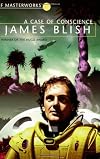
A book literally of two halves, the first and better being originally published as a 1953 novella, and the second added to expand it to novel length in 1959, when it won the prestigious Hugo award. In Part 1, we have a setup rather like that in Black Easter, volume 2 of the After Such Knowledge sequence, of which A Case of Conscience forms the fourth and final part. Four men have been sent to Lithia, a planet 50 light years from Earth, to investigate and deliver a report to the United show more Nations as to how the planet should be exploited or whether it should be closed to humans. As in Black Easter, one of the men is a Catholic priest, a Jesuit, and also a biologist. Up to now, he has been an enthusiastic supporter of the planet and its sentient species, 12 foot tall marsupial reptiles, though puzzled as to how they maintain a society free of crime or conflict. Because of planetary differences, such as a lack of iron, the Lithians lack certain aspects of human technology and scientific knowledge, although they are far in advance with others, such as genetics.
Ruiz-Sanchez's colleagues have differing opinions. One, a chemist, admires the peaceful lifestyle of the Lithians and wants to open the planet for mutual trade and knowledge transfer. The geologist has no firm opinion and vacillates between those of his colleagues. The physicist turns out to want to turn the place into a bomb factory, with the Lithians forced into slave labour.
As book 1 develops and these opinions are expressed, Ruis-Sanchez drops a bombshell.For some reason, the revelation by a Lithian friend of his, that they lay eggs into the sea and that various lifeforms around their forested city are immature Lithians, makes him jump to what I found an irrational conclusion - that Satan must have created the planet as a temptation to humans because it seems to show that sentient beings can live harmoniously from pure reason alone, having no faith or religion. Apart from the chauvinism of a view that another world is only valid for its relationship and effect on humans, Lithians don't really live in a Utopia. They lack all creativity including art, writing, even simple story telling, and presumably also the serendipitous leaps of understanding that have led to so many scientific discoveries on Earth. And my own reaction to this revelation was that it demonstrated a callousness to their own young - these have to fend entirely for themselves, in danger from different predators at each stage of the life cycle, so that only the "fittest" survive, which struck me as eugenist and even Nazi in attitude. . For this reason, Father Ruis-Sanchez votes for quarantine, though aware that his recorded decision will land him in big trouble with the Vatican because it is the heresy of Manichaeism imputing equal creative power to Satan as to God . As the Earthmen prepare to leave at the end of Part 1, the priest's Lithian friend presents him with his own son in egg form to be a kind of ambassador.
Part 2 deals with the raising of the Lithian child or rather his misraising, as the Father goes off to Rome to face the music, leaving him with the chemist and a young woman scientist. Due to basic lack of common sense, they do not give him an environment anything like the one required, not even periods of darkness for sleep, and he grows up mentally as well as physically wrong, with no inbuilt moral compass, unlike the other Lithians. Although the chemist can speak Lithian, he doesn't bother to teach the child and gets him accepted as a citizen because he finds him odd and uncomfortable to be around, and wants to shrug off responsibility for him.
Most of Earth has been turned into huge underground shelters because of the now past threat of nuclear war, and as a result, many people are borderline or actual schizophrenics. The young Lithian grows quickly, ends up as a media celebrity and uses his TV show to incite civil disobedience, which rapidly escalates into major riots. He eventually escapes authority by stowing away on a ship back to Lithia despite stating earlier that he had no interest in the place or his people.
Meanwhile, the priest is not excommunicated but is instructed to exorcise Lithia, which he eventually gets a chance to do over a new superduper telescope which shows the planet in real time. The physicist has been backed by the UN to carry out nuclear experiments - and destroy the Lithians unique communications system, illogically -and it seems he ignores a message sent aboard the same ship used by the returning Lithian to stow away on, to warn him of a serious error in his calculations. At least, when the Father performs an exorcism over the telescope, Lithia blows up and it is left open as to the cause,: whether the physicist's faulty equipment did it or whether the priest is right to believe he has destroyed a whole planet which was truly the devil's snare .
Read as part of the After Such Knowledge omnibus and posted as an individual review as all the other GT reviews are under the individual books. show less
Ruiz-Sanchez's colleagues have differing opinions. One, a chemist, admires the peaceful lifestyle of the Lithians and wants to open the planet for mutual trade and knowledge transfer. The geologist has no firm opinion and vacillates between those of his colleagues. The physicist turns out to want to turn the place into a bomb factory, with the Lithians forced into slave labour.
As book 1 develops and these opinions are expressed, Ruis-Sanchez drops a bombshell.
Part 2 deals with the raising of the Lithian child or rather his misraising, as the Father goes off to Rome to face the music, leaving him with the chemist and a young woman scientist. Due to basic lack of common sense, they do not give him an environment anything like the one required, not even periods of darkness for sleep, and he grows up mentally as well as physically wrong, with no inbuilt moral compass, unlike the other Lithians. Although the chemist can speak Lithian, he doesn't bother to teach the child and gets him accepted as a citizen because he finds him odd and uncomfortable to be around, and wants to shrug off responsibility for him.
Most of Earth has been turned into huge underground shelters because of the now past threat of nuclear war, and as a result, many people are borderline or actual schizophrenics. The young Lithian grows quickly, ends up as a media celebrity and uses his TV show to incite civil disobedience, which rapidly escalates into major riots. He eventually escapes authority by stowing away on a ship back to Lithia despite stating earlier that he had no interest in the place or his people.
Meanwhile, the priest
Read as part of the After Such Knowledge omnibus and posted as an individual review as all the other GT reviews are under the individual books. show less
Lists
Awards


You May Also Like


Associated Authors
Statistics
- Works
- 267
- Also by
- 148
- Members
- 24,428
- Popularity
- #859
- Rating
- 3.6
- Reviews
- 422
- ISBNs
- 481
- Languages
- 14
- Favorited
- 19


