

Quentin James Reynolds (1902–1965)
Author of The Wright Brothers
About the Author
Image credit: Courtesy of the NYPL Digital Gallery (image use requires permission from the New York Public Library)
Works by Quentin James Reynolds
The Fiction Factory : Or From Pulp Row to Quality Street : The Story of 100 Years of Publishing at Street & Smith (1955) 33 copies, 1 review
Adolf Eichmann 5 copies
Parlor Bedlam and Bath — Author — 3 copies
Don't think it hasn't been fun 3 copies
Landmark Books The Wright Brothers 2 copies
The Battle of Britain W-10 1 copy
Macapagal, the Incorruptible 1 copy
Associated Works
Scoundrels & Scalawags: 51 Stories of the Most Fascinating Characters of Hoax and Fraud (1968) — Contributor — 58 copies, 1 review
100 Best True Stories of World War II (WW2) (with 32 illustrations) (2011) — Contributor — 36 copies
My Most Inspiring Moment: Encounters with Destiny Relived by Thirty-Eight Best-Selling Authors (1965) 12 copies
Best In Books: Mandate For Change, A Man Named John, Happy New Year Herbie, Renoir, My Father, The Mirror Crack'd, By Quintin Reynolds, The Dillinger Days, Power Of Attorney,… (1963) — Contributor — 2 copies
Reading-for-Men: The Gracious Lily Affair, Tip on a Dead Jockey, Rally Round the Flag, Boys!, They Fought for the Sky, Rascals in Paradise (1958) — Contributor — 2 copies
Configurations: American Short Stories for the EFL Classroom, Advanced Level (1984) — Contributor — 1 copy
Tagged
Common Knowledge
- Legal name
- Reynolds, Quentin James
- Birthdate
- 1902-04-11
- Date of death
- 1965-03-17
- Gender
- male
- Education
- Brown University
- Occupations
- journalist
war correspondent
screenwriter
professional football player - Organizations
- Collier's Weekly
Brooklyn Lions
Delta Tau Delta International Fraternity - Awards and honors
- Hollywood Walk of Fame
- Cause of death
- cancer
- Nationality
- USA
- Birthplace
- The Bronx, New York, New York, USA
- Place of death
- Travis Air Force Base, Fairfield, California, USA
- Burial location
- Holy Cross Cemetery, Brooklyn, New York, New York, USA
- Associated Place (for map)
- New York, USA
Members
Reviews
One thing I love about reading older books is that often they were intended to be read immediately, to change the way people thought, and were not aimed at posterity. This is that kind of book, and it works as a kind of time machine for that reason.
Quentin Reynolds, a legendary American journalist, found himself in London during the Blitz 80 years ago. This is his day by day account of what happened. A documentary film made at the same time -- he was the narrator -- was called "London Can show more Take It". And that pretty much sums up Reynolds' view.
His descriptions of how Londoners -- and other British people -- coped under the most difficult circumstances are memorable. His portraits of his fellow journalists (who seemed to spend most of their time in bars and restaurants) are unforgettable. The case he makes for America to do more to support Britain is unanswerable.
The one lapse in the book -- and I found this odd -- is his characterisation of U.S. Ambassador Joseph Kennedy, father of the future President John F. Kennedy. Joe was a notorious isolationist, and an opponent of America's entry into the war, but Reynolds writes about him with great sympathy, and says he was very well liked in Britain. show less
Quentin Reynolds, a legendary American journalist, found himself in London during the Blitz 80 years ago. This is his day by day account of what happened. A documentary film made at the same time -- he was the narrator -- was called "London Can show more Take It". And that pretty much sums up Reynolds' view.
His descriptions of how Londoners -- and other British people -- coped under the most difficult circumstances are memorable. His portraits of his fellow journalists (who seemed to spend most of their time in bars and restaurants) are unforgettable. The case he makes for America to do more to support Britain is unanswerable.
The one lapse in the book -- and I found this odd -- is his characterisation of U.S. Ambassador Joseph Kennedy, father of the future President John F. Kennedy. Joe was a notorious isolationist, and an opponent of America's entry into the war, but Reynolds writes about him with great sympathy, and says he was very well liked in Britain. show less

This was the first book I read on World War One. was in 7th grade and checked it out of the school library. It was exciting to read.and every page brought something new, Skip ahead 55 years, I bought a copy from a used book store and reread it. It was missing so much, It had the most famous aces on the Western Front, but nothing about Russia,the Middle East or Italy.The was little about the bomber development or the use of naval aviation,
This was my introduction to Military History and for show more that I will always remember it. However,as history it was about 7th grade level. show less
This was my introduction to Military History and for show more that I will always remember it. However,as history it was about 7th grade level. show less
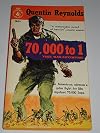
A classic of survival during World War II when an Air Force airman is the sole survivor of a shot down B-17 over New Georgia, an island in the South Pacific which is also the site of Rabaul, the largest Japanese military base in the Southwest Pacific. Crippled in one ankle and with shrapnel in the other, then Master Sergeant Manuel lands in the sea, and gets ashore on a island where 70,000 Japanese soldiers await him. This puts reality survival shows on the Discovery channel to shame...this show more is the real deal. Manual relies on his own wits, his experience is a former guide in the Maine woods, and his owns courage to complete a nine-month term of survival, rescued finally...along with detailed observations and locations of defense installations and Rabaul itself. Not to be missed. show less
In August 1942, nearly two years before D-Day, Allied forces landed in France in large numbers. The Dieppe raid, which consisted mainly of Canadians, was considered a failure at the time. No permanent beachhead was established, nearly 100 RAF aircraft were downed, and something like a third of the Allied troops were killed, wounded or captured.
But Quentin Reynolds, an American journalist who was an eyewitness to the raid on board a British destroyer, wrote a powerful account of the raid, and show more his conclusion was that it was a dress rehearsal for something else. He was of course referring to Operation Overlord, the Allied landings at Normandy in June 1944.
Reynolds was a great journalist and wrote very well. This book is a kind of follow-up to his London Diary, which described the Blitz. One striking feature of the book is the merciless characterisation of the German enemy. Reynolds quoted Lord Lovat, a British Commando officer, saying: “My job is kill Germans … I do not regard men who have already killed about 50,000 civilians in Britain as anything but beasts, so I do not feel I am committing murder when I kill them.” Reynolds himself, describing the shooting down of a German aircraft, described it like this: “It was a lovely site if you hate Germans, and I hate Germans.”
The immediacy fo the writing, aimed at the audience of that day with no thought of posterity, makes books like these into virtual time machines. Writing in London in early 1943, Reynolds transports us back to a very dark and dangerous time, when no one knew for certain how it would all turn out. show less
But Quentin Reynolds, an American journalist who was an eyewitness to the raid on board a British destroyer, wrote a powerful account of the raid, and show more his conclusion was that it was a dress rehearsal for something else. He was of course referring to Operation Overlord, the Allied landings at Normandy in June 1944.
Reynolds was a great journalist and wrote very well. This book is a kind of follow-up to his London Diary, which described the Blitz. One striking feature of the book is the merciless characterisation of the German enemy. Reynolds quoted Lord Lovat, a British Commando officer, saying: “My job is kill Germans … I do not regard men who have already killed about 50,000 civilians in Britain as anything but beasts, so I do not feel I am committing murder when I kill them.” Reynolds himself, describing the shooting down of a German aircraft, described it like this: “It was a lovely site if you hate Germans, and I hate Germans.”
The immediacy fo the writing, aimed at the audience of that day with no thought of posterity, makes books like these into virtual time machines. Writing in London in early 1943, Reynolds transports us back to a very dark and dangerous time, when no one knew for certain how it would all turn out. show less
Lists
Awards

You May Also Like


Associated Authors
Statistics
- Works
- 45
- Also by
- 15
- Members
- 3,700
- Popularity
- #6,848
- Rating
- 3.7
- Reviews
- 26
- ISBNs
- 46
- Languages
- 1