
Lauren Slater
Author of Opening Skinner's Box: Great Psychological Experiments of the Twentieth Century
About the Author
Lauren Slater is a psychologist and the author of nine books, including Welcome to My Country, Prozac Diary, and Opening Skinner's Box, a finalist for the Los Angeles Times Book Prize. She has received numerous awards, including fellowships from the National Endowment for the Arts and the Knight show more Science Journalism program at MIT, and her work has often been reprinted in The Best American Essays. She lives in Fitchburg, Massachusetts. show less
Works by Lauren Slater
Opening Skinner's Box: Great Psychological Experiments of the Twentieth Century (2004) 641 copies, 17 reviews
Associated Works
Touchstone Anthology of Contemporary Creative Nonfiction: Work from 1970 to the Present (2007) — Contributor — 219 copies, 3 reviews
Maybe Baby: 28 Writers Tell the Truth About Skepticism, Infertility, Baby Lust, Childlessness, Ambivalence, and How They Made the Biggest Decision of Their Lives (2006) — Contributor — 132 copies, 4 reviews
The Good Book: Writers Reflect on Favorite Bible Passages (2015) — Contributor — 44 copies, 3 reviews
Tagged
Common Knowledge
- Canonical name
- Slater, Lauren
- Birthdate
- 1963-03-21
- Gender
- female
- Education
- Brandeis University (BA|British and American Literature)
Harvard University (MA|Psychology)
Boston University (PhD|Psychology) - Occupations
- writer
clinical psychologist - Agent
- Kim Witherspoon (InkWell Management)
- Nationality
- USA
- Places of residence
- Boston, Massachusetts, USA
- Associated Place (for map)
- Massachusetts, USA
Members
Reviews
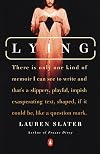
LYING is a stunning feat of postmodern nonfiction, professing itself in every page as being both true and untrue, fully metaphorical and essentially accurate. I don't know how much of it "actually happened," and really, I dot need to. Its composition alone is very impressive -- many memoirs are less than well-organized -- and the conversational writing pulls off the contradictory theme without a hitch. Highly recommended to anyone who doesn't require the truth, the whole truth, and nothing show more but the truth in their readings -- and recommended even more highly to those who do. show less

At the beginning of Prozac Diary, 26-year-old Lauren Slater is severely depressed, suicidal, suffering from OCD, unemployed, and alone. She reveals a lengthy account of her history with mental illness, starting when she was an adolescent. After years and years of struggling to find medication that will alleviate her symptoms, a new doctor puts her on a brand new drug, an SSRI, Prozac. And it works, almost like magic. She is no longer depressed, her OCD is under control, and she is suddenly show more faced with a brand new life that is not dominated by mental illness, but one of productivity, creativity, and new relationships. It is a much welcome outcome, but she struggles with the consequences of a new identity: the sane. She writes about shifting from an “illness-based identity”, to a “health-based identity". Having dealt with mental illness for most of her life, this shift is both a welcome relief as well as well as a challenge - for who is she without the depression that's dominated her life?
There are many, many memoirs about mental illness, specifically depression, but what makes Slater’s memoir stand out is her deft use of language – it is evocative, lyrical, sensual, with some brilliant metaphors thrown in for good measure. Highly engaging, candid, humorous, and poetic. I do love Slater's writing, very much. show less
There are many, many memoirs about mental illness, specifically depression, but what makes Slater’s memoir stand out is her deft use of language – it is evocative, lyrical, sensual, with some brilliant metaphors thrown in for good measure. Highly engaging, candid, humorous, and poetic. I do love Slater's writing, very much. show less
There is no doubt that Lauren Slater is a gifted writer and storyteller. Lying: A Metaphorical Memoir is a frustrating yet beautifully written book. It's also a tricky book, difficult to pigeonhole (memoir? fiction?), and she makes it clear that it can be no other way. It centers mainly around the author's history of epilepsy, which was diagnosed when she was ten. However, this diagnosis, along with the author's very credibility, comes into question as inconsistencies are revealed - show more inconsistencies that Slater does not deny. Some readers will no doubt find the author's literary obfuscation maddening. Indeed, Slater challenges the reader with her wily and evasive style, but taken on its own terms, Lying raises crucial questions about personal truth and speaks to the healing capacity of storytelling. show less
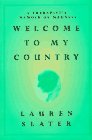
Lauren Slater has written a number of memoirs, each more interesting than the last. This appears to be her first, and it is apparent that she hasn't quite found her footing yet. Not that the book isn't fascinating nonetheless; it is. It mostly relates Slater's experiences working in a residence for male chronic schizophrenics immediately after completing her medical training. Her treatment is not entirely standard, for she is determined to break through to the men in her group, to somehow show more find a way to communicate with them; sometimes she succeeds. But their worlds are almost entirely alien, and she must enter them in order to understand them, and the work is difficult and stressful, and Slater manages to make us understand both this and the rewards. How lucky I am, I came away thinking; how lucky I am to have a brain that functions properly. show less
Lists
Awards


You May Also Like


Associated Authors
Statistics
- Works
- 12
- Also by
- 12
- Members
- 1,978
- Popularity
- #13,002
- Rating
- 3.7
- Reviews
- 47
- ISBNs
- 69
- Languages
- 6
- Favorited
- 4