
Marjane Satrapi (1969–2026)
Author of Persepolis: The Story of a Childhood
About the Author
Series
Works by Marjane Satrapi
Associated Works
My Sister, Guard Your Veil; My Brother, Guard Your Eyes: Uncensored Iranian Voices (2006) — Contributor — 112 copies, 3 reviews
The Penguin Book of Migration Literature: Departures, Arrivals, Generations, Returns (2019) — Contributor — 96 copies
Fumo di china n.114 Dicembre 2003 — Cover artist — 1 copy
Tagged
Common Knowledge
- Canonical name
- Satrapi, Marjane
- Legal name
- مرجان ساتراپی
- Birthdate
- 1969-11-22
- Date of death
- 2026-06-04
- Gender
- female
- Education
- Lycée Français, Tehran, Iran
- Occupations
- graphic novelist
illustrator
film director
children's book author - Awards and honors
- Angoulême Coup de Coeur Award (2001)
Angoulême Prize for Scenario (2002)
Time's Best Books of the Year (2004)
Angoulême Best Comic Book Award (2005)
ALA Best Books for Young Adults (2005)
Cannes Film Festival Jury Prize (2007) (show all 7)
Cinema for Peace Award for "Most Valuable Movie of the Year" (2008) - Relationships
- Ripa, Mattias (husband)
- Nationality
- Iran
France - Birthplace
- Rasht, Iran
- Places of residence
- Rasht, Iran
Tehran, Iran
Vienna, Austria
Strasbourg, France
Paris, Île-de-France, France - Place of death
- Paris, France
- Map Location
- Iran
Members
Discussions
Persepolis 1 & 2 in Made into a Movie (July 2008)
Reviews

The book had been hiding, unread, for years! No longer! It is the story of Marjane's great-uncle, the tar player Nasser Ali, a sad story brilliantly drawn: the musician, trapped by convention and family demands in a marriage with a woman he does not love, who does not understand his creative passion for playing the tar.
Should an artist marry - regardless whether out of love or convention - and submit to the duties of family demands? Or - as Diotima teaches Socrates - aren't the children he show more creates with his music more beautiful and immortal than the physical ones? show less
Should an artist marry - regardless whether out of love or convention - and submit to the duties of family demands? Or - as Diotima teaches Socrates - aren't the children he show more creates with his music more beautiful and immortal than the physical ones? show less

Marjane Satrapi’s Persepolis chronicles her life from the age of 10, when the Islamic Revolution began in Iran, through her early 20s. As a young girl, her parents were revolutionaries who opposed the Shah, but came to lose hope when they saw how right-wing reactionaries used the revolution to install a religious government that further deprived citizens of their rights. She briefly attended school in Vienna, where she found the European youth too decadent, leading her to return to Iran. show more Though she had escaped the Iran-Iraq War, she found that she no longer felt at home under the new restrictions of the Islamic regime. Describing the rules in place to control women and men’s behavior, Satrapi writes, “When we’re afraid, we lose all sense of analysis and reflection. Our fear paralyzes us. Besides, fear has always been the driving force behind all dictators’ repression. Showing your hair or putting on makeup logically became acts of rebellion” (pg. 302). She did find a like-minded group of fellow artists in Iran, but they were forced to live double lives. Satrapi writes, “Our behavior in public and our behavior in private were polar opposites. …This disparity made us schizophrenic” (pg. 305). Through Persepolis, Satrapi offers an accessible coming-of-age story that complicates Westerners’ perception of Iran and its people, while also helping to paint a human face on what the people experience under their government. show less
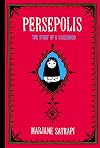
Hardship forces people to change. The author walks us along the path of political turbulence in Iran and shows us how different people react when everything around them turns upside down. Some adapt by throwing away their values and becoming more like the ruling power. Others try to fight it and get imprisoned, tortured, exiled, killed. And then there are the survivors who combine adaptation with resistance: the little girl and her parents are among them.
Through the eyes of a little girl it show more is terrifying to see how kind intelligent loving people have to bend and twist to the destructive whims of the powerful.
For me this was an emotional rollercoaster. Hope, despair, tenderness, rage, love, fear. I kept silently shouting at the characters: "Why are you doing this? Don't you see you are hurting others?" show less
Through the eyes of a little girl it show more is terrifying to see how kind intelligent loving people have to bend and twist to the destructive whims of the powerful.
For me this was an emotional rollercoaster. Hope, despair, tenderness, rage, love, fear. I kept silently shouting at the characters: "Why are you doing this? Don't you see you are hurting others?" show less
Author and illustrator Marjane Satrapi's memoir of growing up in Iran begins in 1980, when she is just ten years old. After the fall of the Shah, her affluent family finds that their privileged, Westernized lifestyle is no longer sustainable. The Ayatollah's standard bearers of Islamic theocracy are in charge, and they are watching everyone for any deviation from acceptable dress, behavior, or attitude. Those who run afoul of the government's dictates risk imprisonment, torture, and even show more execution.
The chief pleasure of this book is in its illustrations. Satrapi's childlike but incisive drawings effectively capture both the innocence of childhood and the harshness of life under a repressive regime. Her affection for her parents and grandmother is particularly evident. In the space of a few pages this book manages to go from funny, to heartbreaking, to tender, and back again, without ever seeming manipulative or forced. I highly recommend this book. show less
The chief pleasure of this book is in its illustrations. Satrapi's childlike but incisive drawings effectively capture both the innocence of childhood and the harshness of life under a repressive regime. Her affection for her parents and grandmother is particularly evident. In the space of a few pages this book manages to go from funny, to heartbreaking, to tender, and back again, without ever seeming manipulative or forced. I highly recommend this book. show less
Lists
KW Wishlist (1)
2000s decade (1)
VBL YA (1)
Allie's Wishlist (1)
Writers at Risk (1)
BitLife (1)
Overdue Podcast (1)
Revolutions (1)
B-B to Get (1)
READ IN 2021 (1)
Women in Islam (2)
Female Author (3)
Favourite Books (1)
Asia (1)
100 New Classics (1)
Lista d2 (1)
Summer 2025 (1)
Awards


You May Also Like


Associated Authors
Statistics
- Works
- 22
- Also by
- 5
- Members
- 29,702
- Popularity
- #677
- Rating
- 4.1
- Reviews
- 982
- ISBNs
- 250
- Languages
- 30
- Favorited
- 62


